Menu

Free Consultation
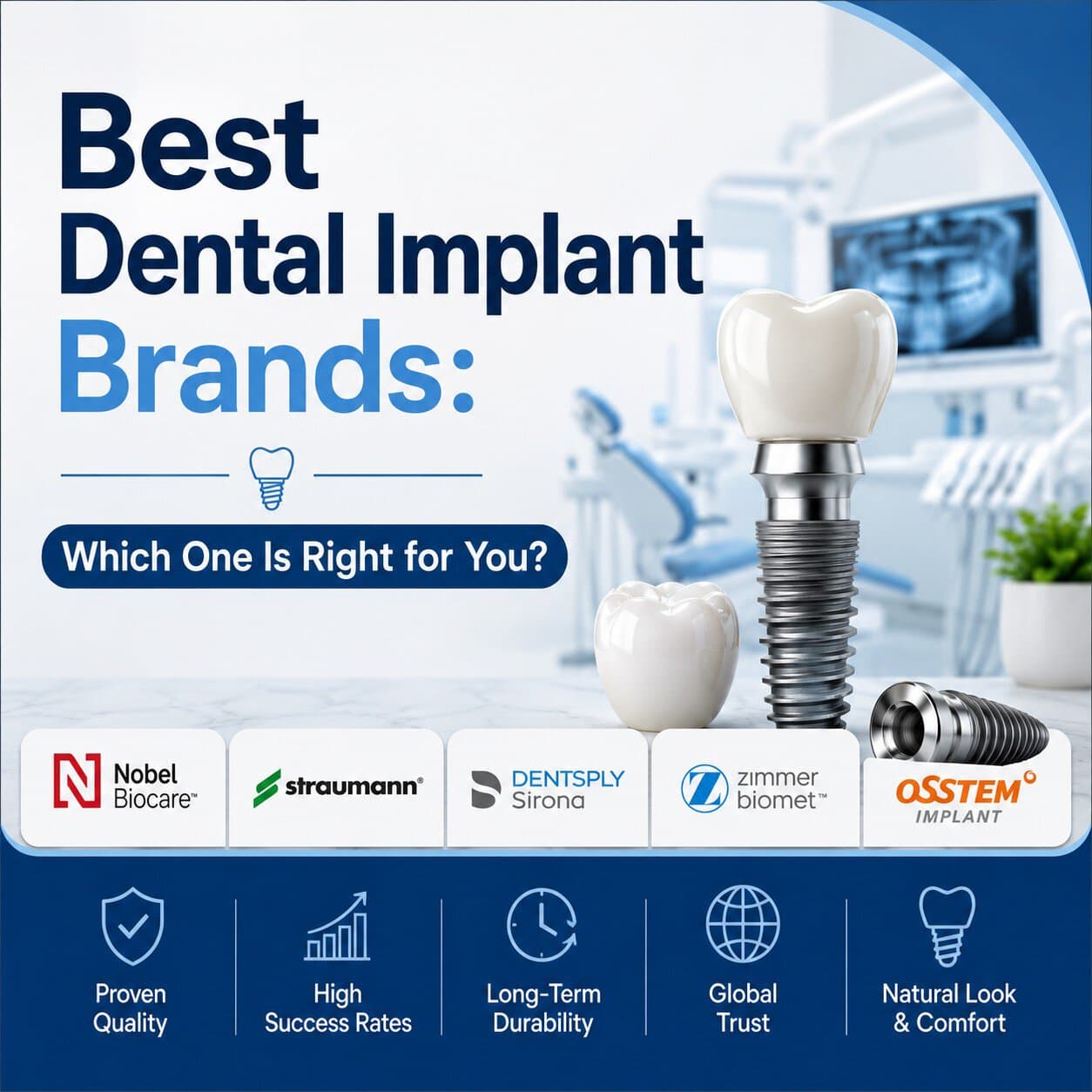
When patients start researching dental implants, one question comes up almost immediately: does the brand of implant matter?
The answer is nuanced and honest dental professionals will tell you it is simultaneously yes and no. The brand matters, but it is rarely the most important variable. Understanding why requires knowing what actually separates a high-quality implant from a lower-quality one, and where brand reputation fits into that picture.
At MosDent Dental Hospital in Istanbul, we work exclusively with globally recognised, clinically validated implant systems. In this article, we walk through the leading implant brands, what makes them different, and most importantly what factors beyond brand name determine the success of your treatment.
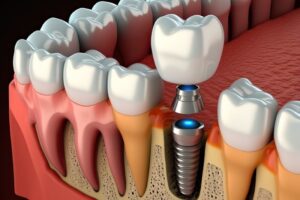
Dental implants are not commodity products. A titanium implant fixture is a precision-engineered medical device with a surface treatment, thread geometry, connection type, and material specification that directly influence how well it integrates with your bone a process called osseointegration and how it performs over decades.
The leading implant brands invest significantly in:
Where brand matters less: once you are comparing two systems from the top tier of manufacturers — all of whom meet these standards the differences are incremental. What then becomes decisive is the skill of the implant surgeon, the quality of the pre-treatment planning, and the health of the surrounding tissue.
Straumann is widely regarded as the global benchmark in dental implantology. Founded in 1954 and headquartered in Basel, Switzerland, Straumann has accumulated one of the largest bodies of independent clinical evidence of any implant manufacturer with peer-reviewed studies spanning over six decades.
Key technologies:
Clinical performance: Studies report Straumann implant survival rates of 96–99% at 5 years and 94–97% at 10 years across diverse patient populations.
Straumann is the implant system most frequently used at MosDent for primary implant cases, chosen for its combination of surface science, clinical evidence depth, and component ecosystem.
Nobel Biocare holds a unique place in implant history: the company's scientific founders, led by Per-Ingvar Brånemark, pioneered the concept of osseointegration in the 1950s and 1960s. The first dental implant placed in a human patient used what would become Nobel Biocare technology.
Key technologies:
Clinical performance: Nobel Biocare implants report 5-year survival rates of 95–98% in published studies, with particularly strong data in full-arch and immediate-loading protocols.
Nobel Biocare systems are a preferred choice at MosDent for All-on-4 and All-on-6 full-arch restorations, given the brand's unmatched clinical heritage in these protocols.
Zimmer Biomet is one of the world's largest medical device companies, with a dental implant division that combines decades of orthopaedic implant engineering experience with dedicated dental implantology research.
Key technologies:
Clinical performance: Long-term survival rates of 94–97% at 5+ years across published independent studies.
Dentsply Sirona combines two heritage dental companies — Dentsply International and Sirona Dental — into one of the world's largest dental equipment and material manufacturers. Their implant division (formerly Ankylos and Friadent) is particularly well regarded for the Ankylos connection system.
Key technologies:
Clinical performance: Astra Tech OsseoSpeed implants report 5-year survival rates of 97–99% in some of the most rigorous independent trial conditions in the literature.
BioHorizons is a US-based manufacturer known for innovation in implant surface technology and has become increasingly prominent in European and international markets.
Key technologies:
Clinical performance: The Laser-Lok technology has independent clinical data showing reduced crestal bone loss compared to machined-surface controls — a relevant advantage for long-term aesthetic outcomes.
Osstem is the largest dental implant manufacturer in Asia and one of the top five globally by unit volume. It has expanded significantly into European and Middle Eastern markets over the past decade and holds ISO and CE certifications.
Key technologies:
Clinical performance: Independent studies report 5-year survival rates of 93–96%, slightly below the upper tier of European brands but within clinically acceptable ranges for standard cases.
Osstem and similar Korean and Israeli-manufactured systems (such as MIS and Alpha Bio) occupy a value segment — appropriate when cost is a significant constraint and the case is standard, but typically not the first choice for complex anatomy, full-arch protocols, or cases requiring maximum long-term reliability.
| Brand | Origin | Surface Technology | Best Known For | 5-Year Survival |
|---|---|---|---|---|
| Straumann | Switzerland | SLActive | Clinical evidence depth, versatility | 96–99% |
| Nobel Biocare | Sweden/Switzerland | TiUnite | All-on-4, zygomatic, immediate loading | 95–98% |
| Zimmer Biomet | USA | MTX | Orthopaedic-grade engineering | 94–97% |
| Dentsply Sirona (Astra) | USA/Germany | OsseoSpeed | Conical connection, tissue health | 97–99% |
| BioHorizons | USA | Laser-Lok | Soft tissue attachment, bone preservation | 95–97% |
| Osstem | South Korea | SA | Cost-accessibility, volume | 93–96% |
Brand selection is one variable in a multi-factor equation. Clinical research consistently identifies the following as equal or greater determinants of long-term implant success:
Implant placement is a surgical skill. The same implant placed by a surgeon with 50 cases of experience versus one with 2,000 cases will produce meaningfully different outcomes — in primary stability, preservation of surrounding bone, management of anatomical structures, and response to complications.
MosDent's oral and maxillofacial surgery team brings extensive implant placement experience across standard, immediate-loading, full-arch, and advanced cases including zygomatic implants.
Precise 3D planning using CBCT imaging to map bone volume, identify anatomical structures, and determine optimal implant position directly influences surgical outcomes. Implants placed without 3D planning have higher rates of anatomical complications and suboptimal positioning.
Every implant case at MosDent begins with CBCT assessment and digital treatment planning before any surgical decision is made.
Active gum disease at the time of implant placement significantly increases the risk of peri-implantitis — the leading cause of late implant failure. Periodontal treatment must precede implant surgery in any patient with active disease.
Similarly, adequate bone volume and quality are prerequisites. Where bone is deficient, bone grafting or advanced implant protocols may be required before standard placement is possible.
Implants do not decay, but they are susceptible to peri-implant disease if oral hygiene is inadequate. Regular professional maintenance typically every six months and a thorough home hygiene routine are the most modifiable factors in long-term implant survival.
Smoking, uncontrolled diabetes, and medications affecting bone metabolism (such as bisphosphonates) all influence osseointegration and long-term implant stability. These factors are assessed during pre-treatment evaluation and managed as part of the overall treatment plan.
At MosDent Dental Hospital, we have made a deliberate decision to work exclusively with premium-tier implant systems Straumann and Nobel Biocare as primary systems, with other tier-one brands selected for specific clinical indications.
The reasoning is straightforward: an implant treatment is a long-term investment in a patient's quality of life. The implant fixture placed today may still be in function in 20 or 25 years. The incremental cost difference between a premium and a budget implant system is small relative to the total cost of treatment but the long-term performance difference, particularly in complex cases, is clinically meaningful.
For patients considering All-on-4, All-on-6, or full-arch implant restoration, the stakes are higher still: these restorations depend on a small number of implant fixtures to support an entire arch. The reliability of each individual fixture matters disproportionately.
Our comprehensive dental implant guide covers every aspect of the implant journey — from candidacy assessment through to long-term maintenance — for patients who want to understand the full picture before making a decision.
The implant fixture is only one component of the final restoration. What the patient sees and feels the crown or prosthetic arch is equally important to the overall outcome.
At MosDent, implant crowns and full-arch prosthetics are routinely fabricated from zirconium a material that combines the aesthetic quality required for natural-looking results with the structural strength that implant-supported restorations demand. For specific anterior aesthetic cases, Emax ceramic options may be considered.
For patients whose treatment involves cosmetic elements beyond the implant itself such as a smile makeover, Hollywood smile design, or teeth whitening of remaining natural teeth these are planned as a coordinated aesthetic whole from the outset, not as afterthoughts.
Does the brand of dental implant really make a difference?
Yes but primarily in comparing premium systems to budget or unvalidated ones. Among the top-tier brands (Straumann, Nobel Biocare, Astra, Zimmer Biomet), the differences are incremental. What matters more is surgeon experience, pre-treatment planning, and post-treatment care.
Which dental implant brand lasts the longest?
Straumann and Nobel Biocare have the deepest bodies of long-term clinical evidence, with published survival data extending 15–20+ years. Both brands report 5-year survival rates consistently above 95% in independent studies.
Are Swiss dental implants worth the extra cost? For most patients especially those undergoing complex, full-arch, or long-term restorations premium-tier systems offer a meaningful advantage in clinical evidence depth, component precision, and long-term reliability. The cost differential is modest relative to the total investment in treatment.
Can I choose which implant brand is used at MosDent?
Yes. We discuss implant system selection with every patient as part of the treatment planning process. Our team will explain their recommendation and the clinical reasoning behind it, and discuss any preferences you have.
What happens if I need a replacement part for my implant years later?
Premium-tier brands maintain component availability for decades after a system is placed an important practical consideration when choosing an implant system. Budget or obscure brands may discontinue components, making future prosthetic work difficult.
The best dental implant brand is the one placed by an experienced surgeon, preceded by thorough 3D planning, in a healthy tissue environment, with a precision-fitted prosthetic restoration on top — and followed by consistent long-term maintenance.
Within the premium tier of manufacturers, Straumann and Nobel Biocare lead on clinical evidence. Dentsply Sirona, BioHorizons, and Zimmer Biomet offer compelling technology in specific clinical indications. Budget-tier brands can work in simple, standard cases — but carry more uncertainty over a 20-year horizon.
If you are considering dental implant treatment in Istanbul, we invite you to contact MosDent for a free consultation. We will explain which implant system we recommend for your specific case and why — so you can make an informed decision, not just a brand preference.
Published by MosDent Dental Hospital | Istanbul, Turkey | mosdenthospital.com