
A first smile, a lifelong habit
A child’s first meeting with the dentist lays the foundation for a lifetime of oral care. At Mosdent that experience is built not on fear, but on play, trust and a room made for children.

Milk teeth are never “just temporary.”
Primary teeth guide chewing, speech and, most of all, hold space for the permanent teeth forming beneath them.
A decayed or prematurely lost milk tooth is not a small matter: it can cause pain and infection, harm the permanent tooth germ underneath, and let neighbouring teeth drift into the gap, crowding the smile that is still to come.
So our work begins earlier than most families expect. The first session is rarely treatment; it is an introduction. Letting a child explore the chair, the light and the doctor’s voice is not wasted time; it is the treatment.
For us the first session is not treatment; it is an introduction.
Mosdent Paediatric Dentistry
Care that grows with your child
Preventive
Fluoride and fissure sealants stop decay before it starts; painless and quick.
Restorative
Fillings for milk-tooth decay; pulp (root) treatment and paediatric crowns for deeper cavities.
Space maintainers
When a milk tooth is lost early, a maintainer holds the space so the adult tooth erupts in line.
Sedation & GA
Conscious sedation for anxious or lengthy care, and general anaesthesia where truly indicated.
The kindest treatment is the one never needed
Fluoride
Professionally applied fluoride strengthens enamel and can arrest early, cavity-free decay before a drill is ever considered.
Fissure sealants
The deep grooves of the back molars are where a brush can’t reach. A thin flowing resin seals them shut; no numbing, no pain.
Diet & brushing
We gently coach families on snack frequency, the risk of falling asleep with a bottle, and brushing twice daily with a fluoride paste.
One smile, step by step
- 1 yrFirst visitA gentle meet-and-greet by the first tooth or first birthday.
- 2–3Habits formBrushing routine, fluoride, first preventive checks.
- 6First molarThe 6-year molar erupts; the moment for sealants.
- 7–12Mixed dentitionOrthodontic watch as baby and adult teeth trade places.
Told, shown, then done
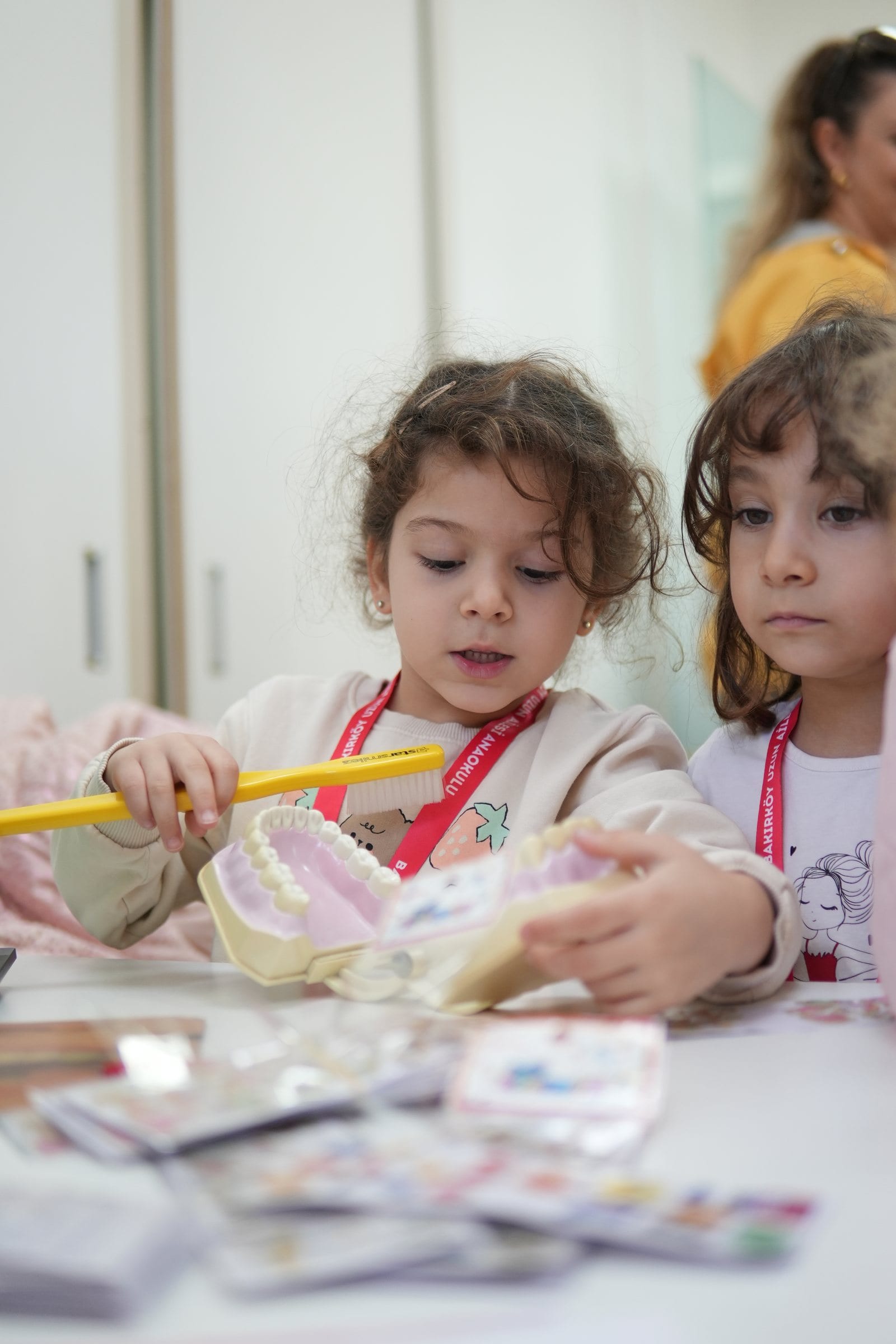
We work by “tell–show–do”: every step is named in a child’s words, shown on a finger or a toy, and only then done. Nothing is a surprise, so nothing is frightening.
The room is designed for the child; the light, the sounds, the furniture and, above all, the doctor’s language. Parents are part of the team, and small wins are always celebrated.
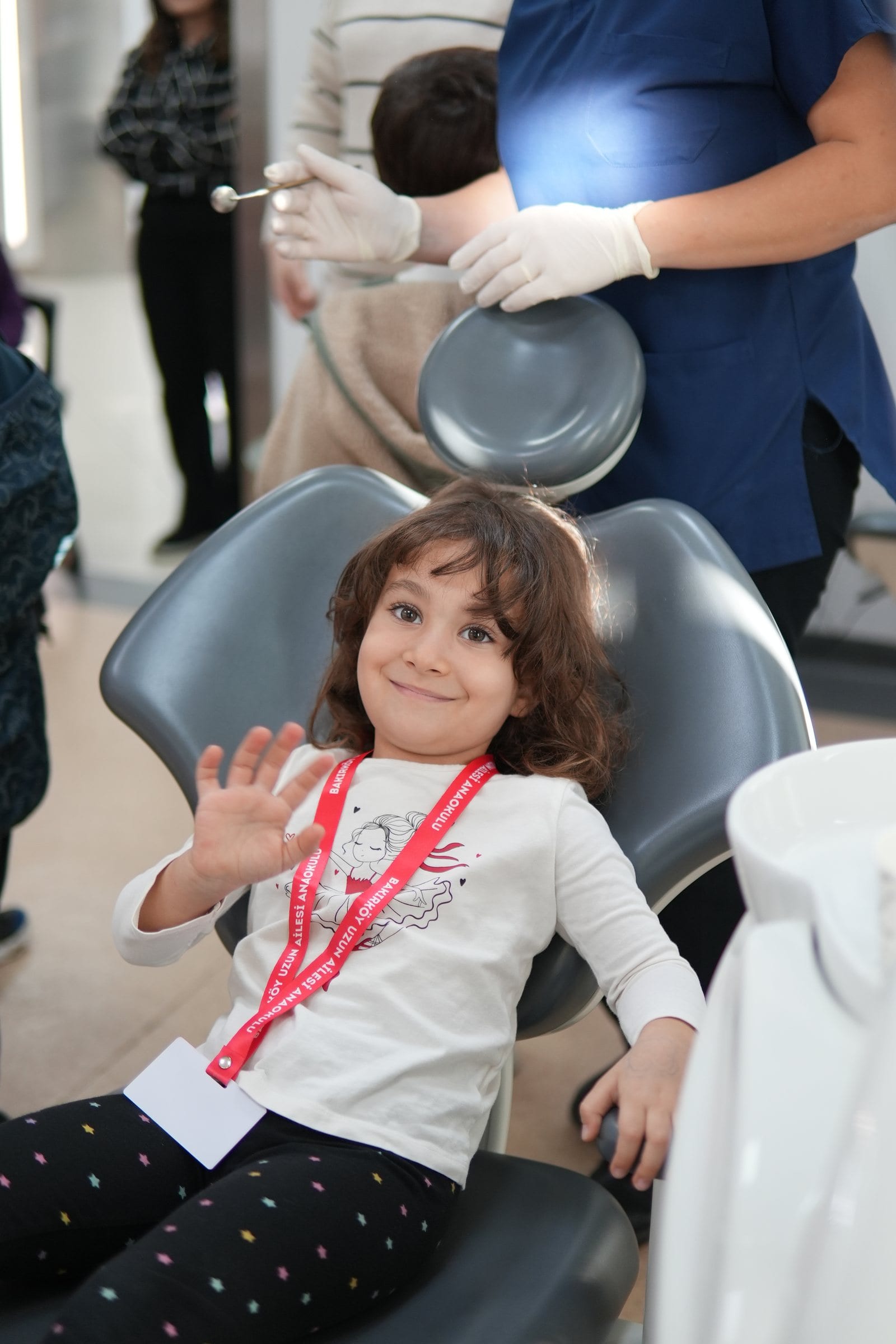

A first meeting that erases fear
We welcome nurseries into our clinic. Children meet the chair, the light and the dentist as a game, in a row and laughing. The first encounter is not treatment but discovery; by the time a real appointment comes, the place is already familiar and the fear is gone.
Questions parents ask
When should my child first see a dentist?
By the time the first tooth appears, or by the first birthday at the latest. An early, friendly visit builds comfort and catches risks before they become problems.
Do decayed milk teeth really need treatment, when they fall out anyway?
Yes. An untreated milk tooth can cause pain and infection, damage the permanent tooth forming beneath it, and, if lost early, lets other teeth drift, crowding the adult smile.
Does a fissure sealant hurt?
No. There is no drilling and no numbing. A flowing resin is painted into the grooves of the tooth and set with a light; it takes minutes.
My child is afraid of the dentist. How do you approach it?
The first session is an introduction, not treatment. We let the child explore the room and build trust first; that comfort is part of the care, not a delay to it.
Paediatric dentistry covers the years from the primary dentition to the permanent one, and most of the work is preventive rather than restorative. In global modelling, untreated decay in deciduous teeth was the tenth most prevalent condition worldwide in 2010, affecting 621 million children, with prevalence peaking at age 6 (PubMed 25740856, drawn from 1,502,260 children aged 1 to 14 in 74 countries). A resin-based sealant on the biting surface of a permanent molar cut the odds of decay against no sealant at 24 months in children aged 5 to 10 (odds ratio 0.12, 95% CI 0.08 to 0.19, seven trials, 1,322 children evaluated, moderate-quality evidence; PubMed 28759120).
- 01What a sealant is worth rises with the child's caries risk. In the same Cochrane review, if 40% of control surfaces decayed over 24 months, the sealed group fell to 6.25% (95% CI 3.84 to 9.63), and if 16% decayed the sealed group fell to 5.2% (95% CI 3.13 to 7.37), across 38 trials and 7,924 children (PubMed 28759120).
- 02Whether a sealant beats a fluoride varnish is not settled. A Cochrane review of 11 trials covering 3,374 children aged five to ten found no reliable difference between the two at 24 to 36 months, while applying a sealant as well as a varnish worked better than varnish alone (odds ratio 0.30, 95% CI 0.17 to 0.55) on very low certainty evidence (PubMed 33142363). A quote listing one of them as clearly superior is going beyond the evidence.
- 03Losing a primary molar early does not leave a tidy gap; the neighbouring teeth drift into it. In a review of 11 studies covering 479 patients, fixed space maintainers such as the band and loop or the lingual arch were preferred over removable ones for long-term stability and lower risk of loss, with removable appliances treated as temporary and dependent on the child's cooperation (PubMed 39851607).
- 04This entry describes the child's own treatment pathway, and the split inside it runs between preventive work and restorative work. How the decay itself is arrested, and at what level of comfort treatment is delivered, is decided at the paediatric dentistry category level, so a first examination is booked before any treatment block is scheduled.
/ What is Pedodontics (Pediatric Dentistry)?
It is a department that aims to protect the milk and permanent teeth of children between the ages of 0-13 in a healthy way and to function, as well as to eliminate the problems caused by caries, physical trauma, hereditary and congenital factors.
Pedodontics is a comprehensive branch of dentistry that includes all treatments in dentistry and performs them in accordance with children and young people.
Pedodontist (Pediatric Dentist is a dentist who continued his education in the Department of Pedodontics after he graduated from the Faculty of Dentistry.
| At a glance | |
|---|---|
| Duration | Case-dependent |
| Warranty | · |
| Materials Used | Child-friendly equipment |

/ What do pedodontists do?
Pedodontists can apply all treatments and preventive applications in dentistry in a special way to the child patient:
- Oral and Dental Care and Nutrition Recommendations
- Child Prosthetics
- Tooth extraction
- Protective and Preventive Practices Against Tooth Decay; Fluorid Gel, Fluorid Varnish, Fissure Sealer
- Treatment of Dental Traumas
- Endodontic Treatments (Root Canal Treatments, Amputations)
- Treatments to Stop Bad Mouth Habits (Finger Sucking, Nail Eating, Lip Biting, etc.)
- Restorative Treatments (Fillings) in Milk and Young Permanent Teeth
- Place Holders
Approaches with the most appropriate examination and treatment techniques for children. In this way, children do not fear a dentist.
Determines the caries risk group and makes protective-preventive applications (such as fissure sealant, local fluoride application).
It monitors jaw development and teething during growth and development, and possible tooth crowding is prevented with protective orthodontic treatments.
In cases where permanent teeth are missing, it improves the aesthetic appearance and chewing by making dentures.
Makes dental treatment of children who need special care.
/ Why should I consult a pedodontist for my child's oral health?
Unlike adulthood, childhood period has features such as rapid metabolism and rapid growth and development. Similarly, the structure of deciduous teeth and newly erupting young permanent teeth is quite different from that of an adult tooth. For this reason, pedodontists are dentists with the most comprehensive knowledge of children's oral health.
/ Treatment Process
- 01Consultation: Initial examination and needs assessment; imaging where required.
- 02Treatment: Treatment per age and need (decay, sealants, prevention).
- 03Follow-up: Outcome review and aftercare guidance.
/ When should my child's first dental examination be done?
It is recommended to have the first dental examination after the eruption of the first tooth (6 months-1 age). With early dental examination, correct oral hygiene training is given, nutrition regulation is made, and information is given about what should be considered to prevent caries. In this way, tooth decays are prevented while still in infancy. With regular dental checks at the interval determined by your pedodontist, the foundations of decay-free and healthy teeth are laid in the long term.
- 1.Kassebaum NJ, Bernabé E, Dahiya M, Bhandari B, Murray CJ, Marcenes W. Global burden of untreated caries: a systematic review and metaregression. J Dent Res 2015;94:650-8. PubMed 25740856
- 2.Ahovuo-Saloranta A, Forss H, Walsh T, Nordblad A, Mäkelä M, Worthington HV. Pit and fissure sealants for preventing dental decay in permanent teeth. Cochrane Database Syst Rev 2017;7:CD001830. PubMed 28759120
- 3.Kashbour W, Gupta P, Worthington HV, Boyers D. Pit and fissure sealants versus fluoride varnishes for preventing dental decay in the permanent teeth of children and adolescents. Cochrane Database Syst Rev 2020;11:CD003067. PubMed 33142363
- 4.Casaña-Ruiz M, Aura-Tormos JI, Marques-Martinez L, Garcia-Miralles E, Perez-Bermejo M. Effectiveness of Space Maintainers in Pediatric Patients: A Systematic Review and Meta-Analysis. Dent J (Basel) 2025;13. PubMed 39851607

Speak with your doctor about this treatment.
Not sure which treatment fits? Tell us what’s wrong →