Menu

Free Consultation
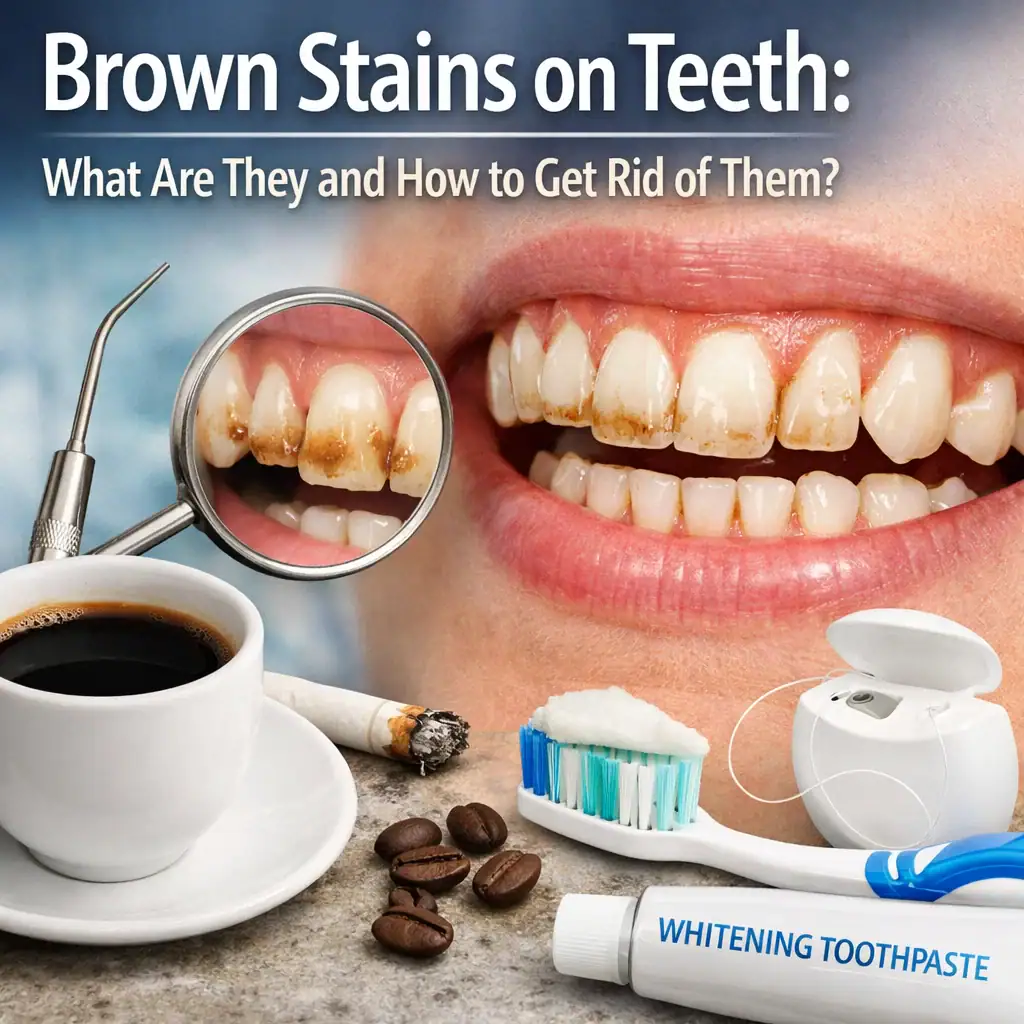
You brush twice a day. You try to take care of your teeth. And yet, at some point, you notice it a brownish tinge along the gum line, a dark spot on the surface, or an overall yellowing that just won't shift no matter how carefully you clean.
Brown stains on teeth are one of the most common dental concerns we see, and they come in many different forms. Some are purely cosmetic. Others are a sign of something that needs clinical attention. Knowing the difference matters because the right treatment depends entirely on what's causing the problem in the first place.
Tooth discolouration broadly falls into two categories: extrinsic (on the surface of the tooth) and intrinsic (within the tooth structure itself). Brown staining can come from either — and sometimes both at once.
Coffee, tea, and red wine are among the most common culprits. These drinks contain chromogens highly pigmented compounds that bond readily to tooth enamel. Over time, even moderate consumption leaves a visible residue that regular brushing alone cannot fully remove.
Tobacco use — whether smoked or chewed produces some of the most stubborn and deeply embedded surface stains. The tars and nicotine in tobacco penetrate enamel and eventually reach the dentin beneath, making discolouration progressively harder to treat with surface-level approaches alone.
Tartar build-up is another frequently overlooked cause. Dental plaque that is not fully removed through brushing and flossing hardens into tartar (calculus) within 24 to 72 hours. Tartar starts off pale yellow but darkens over time, particularly in smokers or heavy coffee drinkers, eventually turning deep brown or black along the gum line. Tartar cannot be removed at home — it requires professional scaling.
Certain foods including soy sauce, balsamic vinegar, berries, and curries — stain teeth in a similar way to coffee and tea. The darker and more acidic the food, the greater its staining potential.
Inadequate oral hygiene amplifies the effect of all of the above. Without consistent and thorough brushing and interdental cleaning, pigmented compounds accumulate faster and penetrate deeper into the enamel surface.
Tooth decay is one of the most important intrinsic causes of brown staining. A cavity does not always present as a black hole — early to mid-stage decay frequently appears as a brown or darkened spot on the surface of the tooth. If you notice a brown mark that seems fixed in one location and doesn't respond to cleaning, this should be evaluated clinically. Early intervention can allow the tooth to be saved with a simple composite filler or aesthetic filling.
Dental fluorosis caused by excessive fluoride exposure during childhood while the teeth are still developing — can produce white, yellow, or brown mottling on the enamel. Mild fluorosis is usually cosmetic, but moderate to severe cases may require restorative treatment.
Old restorations can cause localised discolouration. Older amalgam fillings, in particular, can leach metallic pigment into the surrounding tooth structure, creating a grey or brown shadow that is visible through the enamel. Similarly, composite restorations that have aged or degraded may discolour at their margins.
Trauma to a tooth even an old injury that was never formally treated can cause internal bleeding within the pulp chamber, leading to a gradual brownish or greyish darkening of the entire tooth. This type of discolouration indicates that the pulp may have become non-vital and often warrants further investigation.
Certain medications, most notably tetracycline antibiotics taken during tooth development in childhood, can cause characteristic banding or widespread brown-grey staining that is deeply embedded in the dentin and very difficult to treat without restorative intervention.
Ageing is an inevitable contributor. Over the years, the outer enamel layer naturally thins through wear and acid exposure, allowing more of the yellowish dentin beneath to show through. This is not pathological, but it is one of the reasons teeth tend to look darker and less bright with age.
Not necessarily but it should never be dismissed without assessment.
A brown spot that is smooth, located on a flat surface, and appears equally on multiple teeth is more likely to be staining. A brown spot that is localised, slightly soft or rough in texture, or situated in a pit or fissure on the biting surface is more likely to represent early decay.
The only way to be certain is a clinical examination, which may include dental X-rays to assess whether the discolouration is penetrating below the surface. Early decay that is caught at the enamel stage can often be treated minimally — but left unaddressed, it progresses to the dentin and eventually the pulp, at which point root canal treatment may become necessary.
Treatment depends entirely on the type and cause of the staining.
For extrinsic staining caused by coffee, tea, tobacco, or tartar accumulation, the first step is always a professional clean. Ultrasonic scaling removes hardened tartar that cannot be dislodged at home, and polishing removes surface pigmentation from the enamel. For many patients, this alone produces a significant improvement in tooth colour and appearance.
Once the teeth are clean, teeth whitening is one of the most effective options for addressing residual extrinsic staining and the natural darkening associated with ageing. Professional whitening uses higher-concentration bleaching agents than any over-the-counter product, delivering more consistent and predictable results.
It is worth noting that whitening treatments do not alter the colour of existing restorations — crowns, veneers, and composite fillings will remain their current shade. This is an important consideration if visible restorations are present in the smile zone.
For localised staining a single discoloured tooth, a brown spot at the margin of an old filling, or an area of fluorosis dental bonding can be an effective and minimally invasive solution. A tooth-coloured composite resin is applied directly to the affected surface, masking the discolouration and restoring a natural appearance in a single appointment.
Where staining is widespread, deeply intrinsic (as with tetracycline staining), or where the patient is seeking a comprehensive aesthetic result, porcelain veneers or laminate veneers offer a durable, long-lasting solution. A thin layer of ceramic is bonded to the front surface of the tooth, completely concealing the underlying discolouration. For patients who want minimal preparation, prepless laminate options are also available.
In cases where a tooth is both discoloured and structurally compromised for example, heavily filled or darkened due to previous trauma — a zirconium crown provides full coverage restoration. Zirconium offers excellent aesthetics alongside strength and durability, making it a versatile option for posterior and anterior teeth alike.
Where brown staining is the result of active decay or an infected pulp, the discolouration cannot be resolved cosmetically. The underlying pathology must be addressed first through restorative treatment, root canal treatment, or in cases where the tooth cannot be saved, extraction followed by implant placement. Cosmetic treatment on top of untreated disease will always fail.
To a significant extent, yes. While some causes of discolouration ageing, genetics, medication effects — are beyond a patient's control, a large proportion of tooth staining is directly influenced by daily habits.
Reducing the frequency of staining beverages, using a straw where practical, rinsing the mouth with water after consuming heavily pigmented foods or drinks, and maintaining thorough daily oral hygiene all contribute to keeping teeth brighter for longer. Tobacco cessation is the single most impactful change for patients whose staining is driven primarily by smoking.
Regular professional cleaning recommended every six months for most patients — removes accumulating tartar and surface pigmentation before it has the chance to become deeply embedded, and allows early detection of any decay that might be developing beneath the surface.
Promptly, if:
Any of these presentations suggests a cause that goes beyond surface staining and warrants clinical evaluation. Addressing the problem early almost always means a simpler, less costly solution.
Brown stains on teeth are rarely just a cosmetic inconvenience. They are often the visible signal of something happening at or below the surface whether that is a build-up of tartar, the early stages of decay, or the cumulative effects of years of staining habits.
The good news is that most causes of tooth discolouration are entirely treatable, and in many cases, a combination of professional cleaning and one of the aesthetic options above produces results that patients find genuinely transformative.
If you are concerned about brown staining or discolouration and would like a thorough assessment and personalised treatment plan, get in touch with our team. We will identify exactly what is causing the problem and give you a clear, honest picture of how to address it.