
Menu

Free Consultation
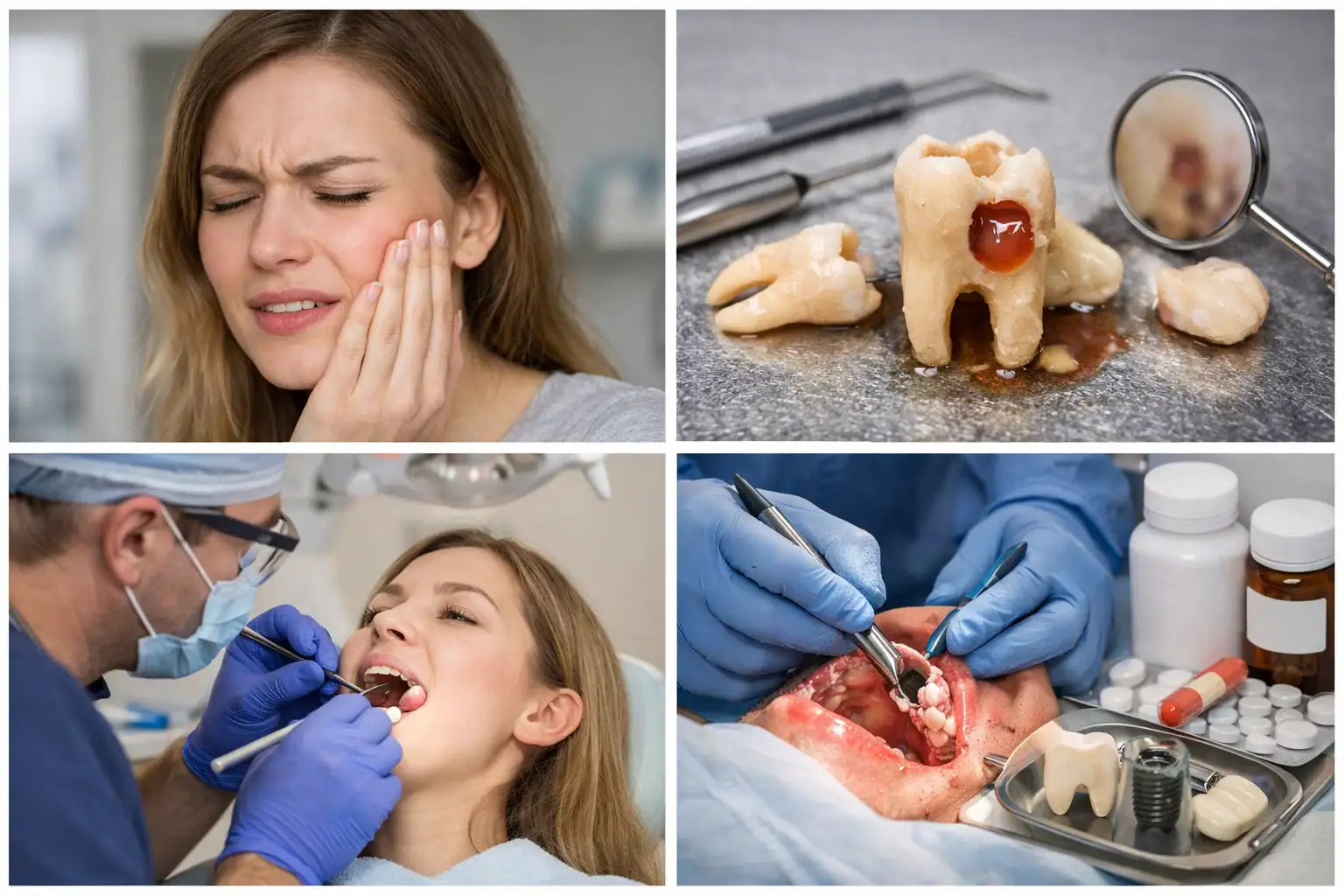
A dental cyst (sometimes called a tooth cyst or jaw cyst) is a sac like lesion often filled with fluid or semi-solid material that can form in the jawbone or around a tooth. Many dental cysts are odontogenic cysts, meaning they originate from tissues involved in tooth development or tooth-supporting structures.
The reason so many people search “what is a dental cyst” is simple: a dental cyst can be silent for a long time. You might not feel anything until the cyst becomes large, infected, or starts affecting nearby teeth, bone, nerves, or sinuses. That’s why many jaw cysts are discovered during routine dental imaging.
This guide covers:
Important: A definitive diagnosis often requires clinical evaluation plus imaging and sometimes biopsy/histopathology.
A dental cyst is a pathologic cavity, typically lined by epithelium (a tissue layer), that develops in the jaw region—often associated with tooth roots, unerupted teeth, or tooth-forming tissues. Many are slow-growing.
Most dental cysts are benign, but they still matter. A jaw cyst can:
So even when a dental cyst is painless, ignoring it is not a good strategy.
People often confuse a dental cyst with an abscess because both can appear near a tooth and can cause swelling.
An abscess can coexist with cystic pathology, which is why dentists use imaging and sometimes tissue testing—to confirm what’s going on.
Dental cysts are often grouped as inflammatory vs developmental odontogenic cysts.
A radicular cyst is the most common inflammatory odontogenic cyst and is typically associated with a tooth that has had long-standing pulp infection/necrosis (a “dead nerve”), often due to deep decay, trauma, or failed endodontic treatment.
Where it forms: usually around the root tip (apex).
Why it matters: it can enlarge, cause bone loss, and sometimes flare up with infection.
A dentigerous cyst forms around the crown of an unerupted or impacted tooth (commonly wisdom teeth or canines). It’s developmental in origin and often discovered on a dental cyst X-ray taken for another reason.
Common association: impacted tooth, delayed eruption.
An odontogenic keratocyst (OKC) is a distinct jaw cyst type known for a higher tendency to recur, depending on treatment approach and lesion characteristics. Because recurrence matters, OKC often requires careful surgical planning and long-term follow-up.
If you’re asking “dental cyst causes”, here are the major categories:
A long-standing infection from deep decay or a dead nerve can trigger inflammatory cyst formation (especially radicular cyst).
When a tooth is trapped in the jaw (an impacted tooth), a cyst can develop around it—most commonly a dentigerous cyst.
Odontogenic cysts can originate from remnants of tooth-forming tissues left behind in the jaw.
OKCs have unique biology and may recur more often, which influences treatment strategy and follow-up frequency.
Many people have no symptoms early on. Common tooth cyst symptoms (or jaw cyst symptoms) may include:
Seek prompt evaluation if you have:
A dentist or oral & maxillofacial surgeon evaluates:
A dental cyst X-ray may include:
For larger or complex lesions, clinicians often use a CBCT scan (3D imaging) to assess:
Imaging suggests a diagnosis, but many services emphasize that tissue diagnosis is important—especially to confirm cyst type and rule out other pathology. This is why removed tissue is commonly sent for analysis.
Dental cyst treatment depends on:
Many jaw cysts are treated surgically; major medical resources note that jaw cyst treatment frequently involves surgery, sometimes combined with other therapies depending on the lesion.
Below are the main treatment paths.
Enucleation means surgically removing the cyst lining and contents ideally in one piece. This is one of the most common cyst removal methods for many dental cyst types. Patient information leaflets describe enucleation and outline alternative options when lesions are large or high-risk.
When enucleation is often used:
Pros:
Considerations:
For a large jaw cyst, surgeons may choose marsupialization (also called decompression) first. This involves creating an opening so fluid drains and pressure decreases, allowing the cyst to gradually shrink. NHS patient information explains marsupialization as an alternative when a cyst is large or removal risks damage to surrounding areas.
When decompression is helpful:
Pros:
Considerations:
If a cyst is connected to a tooth with a dead nerve (common in radicular cyst scenarios), root canal treatment may be recommended to remove infection at the source. Some clinical pathways mention root canal as part of managing infection and helping shrink cystic lesions in certain cases.
Important nuance:
Root canal alone may help in some inflammatory lesions, but many established cysts still require surgical management. Your clinician decides based on imaging, symptoms, and response.
Sometimes the tooth involved is too compromised (severe decay, fracture, poor prognosis), or the cyst is closely associated with an impacted tooth (like a wisdom tooth). In those cases, removing the tooth plus cyst management may be recommended.
With odontogenic keratocyst (OKC), recurrence risk is a major part of treatment planning. Some sources report wide recurrence ranges depending on technique, and professional literature highlights that enucleation/curettage alone can have notable recurrence rates.
Because of that, some protocols use:
Bottom line: If your diagnosis is OKC, ask your surgeon about the recurrence plan and follow-up imaging schedule.
Many jaw cyst procedures are performed under local anesthesia, and larger cases may require sedation or general anesthesia depending on complexity and size.
Tissue is typically sent for histopathology.
Post-op instructions commonly include:
Small, early inflammatory lesions may improve when the infection source is treated (for example, with endodontic therapy) in selected cases, but many true cysts—especially larger or developmental cysts—require surgical management. Major clinical resources on jaw cysts/tumors describe surgical care as a common core of treatment.
Most dental cysts are benign. However, imaging alone can’t always distinguish every jaw lesion type with 100% certainty. That’s a key reason tissue analysis (biopsy/histopathology) is commonly used after removal or biopsy.
A growing jaw cyst can lead to:
Recurrence depends strongly on cyst type and technique:
If you’ve had a dental cyst removed, follow your imaging schedule especially if the pathology is OKC.
You can’t prevent every developmental odontogenic cyst, but you can reduce risk of infection-driven cysts and catch issues early:
A dental cyst is a sac-like lesion (often fluid-filled) that forms in the jaw region, commonly from tooth-related tissues (odontogenic origin).
Common dental cyst causes include chronic tooth infection (radicular cyst), impacted/unerupted teeth (dentigerous cyst), and developmental tissue remnants.
Many have no symptoms at first. Symptoms can include swelling, pressure, dull pain, drainage, tooth movement, and in rare cases numbness if large and near nerves.
Often on dental cyst X-ray (periapical/panoramic). A CBCT scan may be used to assess size and anatomic risks more precisely.
It depends on the type and size. Common options include enucleation (complete cyst removal) or marsupialization/decompression for large cysts, sometimes with root canal treatment or extraction when indicated.
A dental cyst is usually benign but can silently grow and damage bone or teeth. The smartest approach is:
early diagnosis (X-ray/CBCT) + correct classification (often biopsy) + the right dental cyst treatment plan—which may include cyst removal via enucleation or decompression strategies depending on size and type.