Menu

Free Consultation
You brush twice a day. You floss. You think your teeth are fine. Then your dentist points to an X-ray and mentions something you've never heard before: tooth root decay. Suddenly, the problem is bigger than a simple cavity — and the stakes are higher than you expected.
Tooth root decay is one of the most under-discussed threats to long-term dental health. It progresses silently, spreads faster than ordinary decay, and often goes unnoticed until real damage has been done. Understanding what it is, how it develops, and when to seek treatment can be the difference between saving your tooth and losing it entirely.
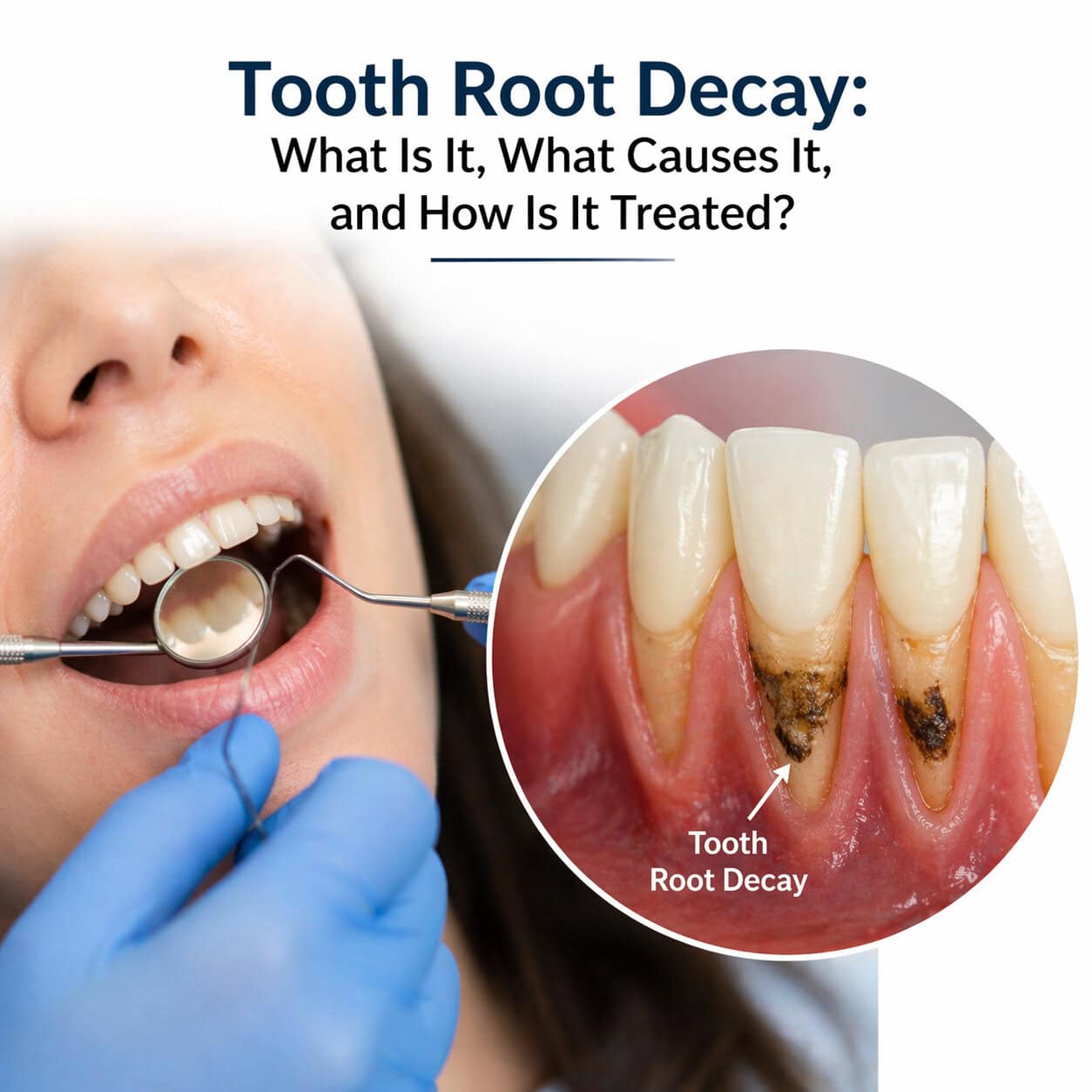
Tooth root decay also referred to as root caries or root cavities — is a form of dental decay that affects the root surface of a tooth rather than its crown. Unlike standard cavities, which form on the enamel-covered upper portion of the tooth, tooth root decay occurs below the gumline, on the cementum that covers the root.
Cementum is significantly softer than enamel. This means that when bacteria and acid reach the root surface, decay progresses roughly twice as fast as it does on the crown. By the time symptoms appear, the damage is often already substantial.
Roots are only exposed when the gums pull back a process known as gum recession. This is why tooth root decay most commonly affects older adults, people with gum disease, and those who have experienced periodontal bone loss. However, it can develop at any age given the right risk factors.
Several factors can trigger tooth root decay, and in most cases, more than one is involved at the same time.
Gum recession is the leading prerequisite. When gum tissue recedes exposing the softer root surface bacteria gain access to an area that was previously protected. This recession can happen due to aggressive brushing, periodontal disease, orthodontic treatment, or simply the natural ageing process. Addressing gum recession early is one of the most effective ways to prevent tooth root decay from developing in the first place. You can learn more about our Periodontology and Gum Disease treatments at MosDent.
Poor oral hygiene is the number-one driver once gum recession is present. Plaque that accumulates at the gumline converts dietary sugars into acids, which then attack the exposed cementum. Without consistent brushing and flossing, this process accelerates rapidly.
Dry mouth (xerostomia) is another significant risk factor. Saliva naturally neutralizes acids and washes away bacteria. Many common medications — including antihistamines, antidepressants, and blood pressure drugs — reduce saliva production, leaving the root surface more vulnerable.
Additional risk factors include:
This is where tooth root decay becomes especially deceptive: many patients experience no symptoms at all in the early stages. By the time pain or sensitivity appears, the decay has usually already reached a more advanced phase.
When symptoms do occur, they typically include:
Tooth sensitivity is often the first noticeable sign. If you feel a sharp or lingering discomfort when consuming hot, cold, or sugary foods and beverages, this may indicate exposed root surfaces actively undergoing decay.
A dull or constant toothache that doesn't resolve on its own is a warning sign that decay is advancing toward the dental pulp.
Visible discoloration particularly a yellowish-brown or black spot near the gumline can signal active tooth root decay, especially on front teeth.
Pain when chewing suggests that the structural integrity of the tooth has been compromised.
Swollen, tender, or receding gum tissue around a single tooth may indicate both gum recession and an associated root lesion.
If you notice any of these symptoms, early diagnosis is critical. Waiting increases the likelihood that a simple dental filling will no longer be sufficient, and more complex treatment including Root Canal Treatment will become necessary.
Diagnosing tooth root decay requires a professional dental examination. A visual inspection alone is not always enough; many root lesions develop in between teeth or beneath the gumline, making X-rays essential.
At MosDent Dental Hospital, we use advanced digital radiography and diagnostic imaging as part of our standard examination protocol. This allows our clinicians to detect early-stage tooth root decay before it progresses dramatically widening your treatment options and improving the outcome.
The right treatment for tooth root decay depends entirely on how far the decay has advanced. Early-stage cases offer the most flexibility; advanced cases may require more complex interventions.
When tooth root decay is caught in its earliest phase — before a lesion has fully formed — topical fluoride treatments can help remineralize the affected root surface and halt further progression. This is the most conservative option and requires close follow-up to monitor the area.
If the decay has formed a lesion but hasn't yet reached the dental pulp, a Composite Filler or similar restoration is typically the recommended treatment. The decayed cementum is removed, and the root surface is sealed with a tooth-coloured filling material.
This is the most common treatment for mild to moderate tooth root decay and, when done promptly, is both effective and long-lasting.
When tooth root decay has advanced into the pulp chamber where the nerves and blood vessels of the tooth reside infection becomes a serious risk. In this scenario, Root Canal Treatment is required to remove the infected tissue, disinfect the canal system, and seal the tooth.
Many patients fear root canal treatment, but with modern techniques and appropriate anaesthesia, the procedure is no more uncomfortable than a routine filling. At MosDent, our endodontics team also offers Micro Endodontics a precision approach that preserves more of the natural tooth structure using high-magnification technology.
Following either a large filling or root canal treatment, the tooth may require a Zirconium Dental Crown to protect what remains of the tooth structure. A crown fully encases the tooth, restoring both its function and appearance while shielding the root area from further bacterial attack.
In severe cases where tooth root decay has caused irreversible structural damage or a widespread infection that cannot be resolved, extraction may be unavoidable. However, this is not the end of the road. A Dental Implant placed at the extraction site provides a permanent, natural-looking replacement that preserves jawbone density and restores full chewing function.
For patients requiring multiple restorations, All-on-4 Implants or All-on-6 Implants may offer a comprehensive full-arch solution.
Prevention is significantly more straightforward and less expensive than treatment. The following habits form the foundation of effective tooth root decay prevention:
Master your brushing technique. Use a soft-bristled toothbrush and gentle circular motions at the gumline. Aggressive horizontal scrubbing is one of the leading causes of gum recession, which directly exposes roots to decay risk.
Floss daily. Flossing removes plaque from the areas between teeth and at the gumline the exact locations where tooth root decay is most likely to begin.
Use fluoride toothpaste and mouthwash. Fluoride strengthens the cementum on exposed root surfaces and makes it more resistant to acid attacks. For patients at elevated risk, your dentist may prescribe a high-concentration fluoride product.
Manage dry mouth. If your medications are causing dry mouth, speak to your doctor about alternatives. Staying hydrated, chewing sugar-free gum, and using saliva substitutes can all help maintain a protective oral environment.
Reduce sugar and acid intake. Limiting sugary snacks, fizzy drinks, and acidic foods reduces the frequency of acid attacks on exposed root surfaces.
Address gum recession early. If your gums are pulling back, visit a periodontist before the underlying root becomes exposed. Our Gum Disease specialists at MosDent can assess your situation and intervene before tooth root decay has a chance to develop.
Attend regular dental check-ups. Twice-yearly examinations with professional cleaning remain the single most effective way to catch tooth root decay in its earliest, most treatable phase.
Is tooth root decay the same as a regular cavity?
Not exactly. While both involve bacterial acid dissolving tooth structure, tooth root decay occurs on the root surface (cementum), which is softer and more vulnerable than enamel. Root decay also progresses faster and sits closer to the nerve, making early detection more critical.
Can tooth root decay heal on its own?
In very early stages, fluoride therapy may halt progression, but once a cavity has formed in the root, it will not reverse without professional treatment. The decay will continue to worsen.
Is root canal treatment always necessary for tooth root decay?
No. Only when decay has reached the pulp or when the tooth shows signs of infection is root canal treatment required. Many cases can be resolved with a filling alone.
Who is most at risk?
Older adults, people with periodontal disease, those with gum recession, patients with dry mouth, and heavy smokers carry the highest risk for developing tooth root decay.
Tooth root decay demands prompt, expert attention. The longer treatment is delayed, the fewer options remain and the higher the cost of care.
At MosDent Dental Hospital, our multidisciplinary team of specialists treats every stage of tooth root decay, from early fluoride intervention to complex root canal treatment, crowns, and implants. As one of Istanbul's leading dental hospitals, with over 30 years of experience and full authorization from Turkey's Ministry of Health for international health tourism, we offer world-class care at a fraction of the cost charged in the UK, USA, or Western Europe.
Whether you are a local patient or travelling from abroad for dental treatment, our team will guide you through every step of your treatment journey.
📅 Book a free consultation: Contact MosDent
🦷 Explore all our treatments: Our Services
📝 Read more dental health articles: MosDent Blog
This article is for informational purposes only and does not constitute medical advice. For a personalised diagnosis and treatment plan, please consult a qualified dental professional.