
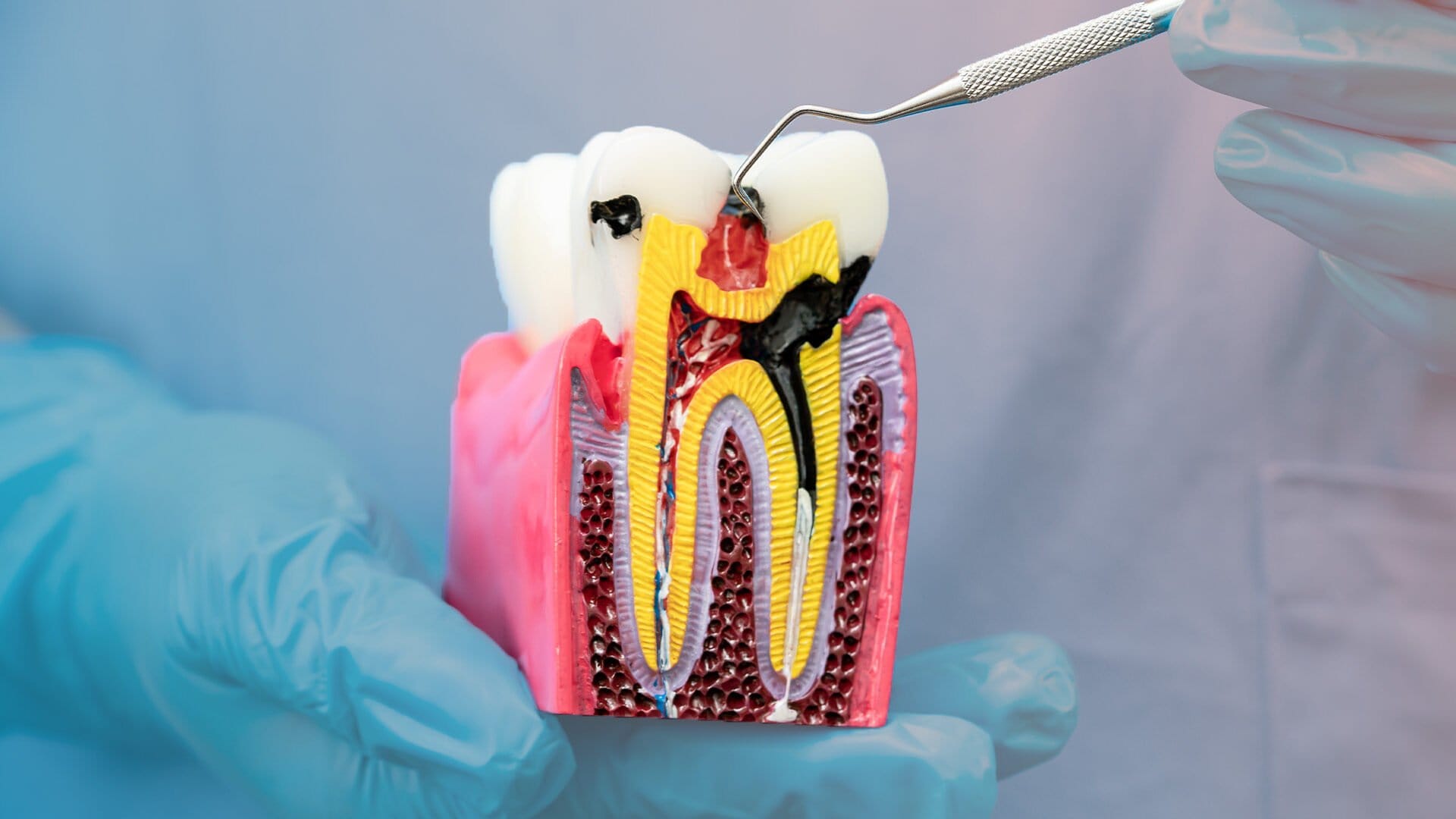
A root canal treatment is called unsuccessful when the tooth does not heal after treatment, the infection continues or the lesion at the root tip does not resolve. How often a root canal is judged to have failed depends heavily on how success is measured: a CBCT meta-analysis of 19 studies put pooled success for treated teeth at 85 per cent under loose radiographic criteria and 45 per cent under strict criteria (PubMed 40122230). The three answers are non-surgical retreatment, apical surgery at the root end, and extraction with a replacement when the tooth cannot be kept.
- 01Failure means the tooth did not heal, and the listed signs are continuing pain, tenderness on biting or chewing, swelling or abscess in the gum, a bad taste or odour, and darkening of the tooth.
- 02The failure figure depends on how success is measured: a CBCT meta-analysis of 19 studies gave 85 per cent pooled success for treated teeth under loose criteria against 45 per cent under strict criteria (PubMed 40122230).
- 03Non-surgical retreatment removes the old filling material, cleans the canal system again and refills it; it is the route when the canal was underfilled or a canal was missed.
- 04Apical resection removes the infected tissue at the root end. A meta-analysis of endodontic microsurgery reported pooled success of 91.3 per cent across 453 teeth in randomised trials and 78.4 per cent across 839 teeth in prospective studies, with follow-up from 2 to 13 years (PubMed 32899437).
- 05Lesion size is not what decides the outcome: a systematic review found periapical lesion size had no significant effect on the success of root canal treatment, non-surgical retreatment or apical surgery (PubMed 36890256).
Root canal treatment is a treatment method that cleans the inflamed or damaged nerve tissue inside the tooth and fills the canal. However, in some cases the root canal treatment can fail and need to be repeated. In this article, the causes, signs and treatment methods of unsuccessful root canal treatment are discussed in detail.
/ Unsuccessful Root Canal Treatment and Its Reasons
Unsuccessful root canal treatment refers to situations where a tooth does not heal after root canal treatment, the infection continues, or the treatment is not sufficient. Root canal treatment is one of the last stages to save the tooth, but sometimes it may not give the desired result due to various factors.
There are many reasons why root canal treatment may fail. Here are the most common reasons:
- Inadequate Cleaning and Continuation of Infection
During root canal treatment, it is necessary to completely clean the bacteria inside the tooth. If the root canals are not completely cleaned, the bacteria will continue to remain inside the tooth and the infection may reoccur.
- Incomplete Filling of the Root Canal
In root canal treatment, the inside of the tooth must be completely filled. If the root canal filling material is incomplete or inadequately applied, bacteria can use these spaces to re-create an infection.
- Complexity of Root Canal Anatomy
Some teeth, especially molars, contain more than one canal and some of these canals can be very thin or complex. This can make it difficult to fully apply the root canal treatment and may cause the treatment to fail.
- Development of New Infection
If a suitable filling or coating is not applied to the tooth after root canal treatment, bacteria can enter the tooth again and cause a new infection. Similarly, failure to pay attention to oral hygiene after root canal treatment can also cause new infections.
- New Fractures or Cracks in the Tooth
A tooth may become weaker and more susceptible to fractures after root canal treatment. If a tooth fractures or cracks, bacteria can enter through these openings and cause a new infection.
- Infection and Abscess Formation in the Gums
As a result of unsuccessful root canal treatment, infection can accumulate at the root tip and an abscess can form. An abscess can cause serious discomfort by causing both pain and swelling.
/ Failed Root Canal Treatment Signs and Management
Some common signs of failed root canal treatment include:
- Continued severe or mild pain in the tooth that has undergone root canal treatment
- Sensitivity when biting or chewing
- Swelling or abscess formation in the gums
- Continuous inflammation and redness around the tooth
- Bad odor or bad taste in the mouth
- Darkening or purplish change in the color of the tooth
If you experience one or more of these symptoms, there is a high probability that the root canal treatment has failed and you should see a dentist immediately.
There are several different treatment options that can be applied in the event of failed root canal treatment :
Retreatment of Root Canal Treatment
If the root canal treatment was not completed completely or there are missing fillings, the dentist may repeat the root canal treatment. During this procedure, the old filling materials are removed, the inside of the tooth is cleaned again, and a better filling is applied.
Apical Resection (Root End Surgery)
If the root canal treatment does not work and the infection continues at the root end, the infected tissue at the root end of the tooth can be surgically removed. This procedure is called apical resection and is usually used to eliminate resistant infections that occur in the root part of the tooth.
Tooth Extraction and Implant Application
If the tooth cannot be saved, the tooth may need to be extracted as a last resort. An aesthetic and functional solution can be provided by applying a dental implant, bridge or denture instead of the extracted tooth.
/ Ways to Prevent Failed Root Canal Treatment and Jawbone Effects
The prevention measures and jawbone effects below relate to unsuccessful root canal treatment and the infection problems described in this article.
Ways to Prevent Failed Root Canal Treatment
The following precautions should be taken to prevent unsuccessful root canal treatment:
- Choose your dentist carefully: Root canal treatment performed by a specialist dentist minimizes the risk of failure.
- Pay attention to post-treatment care: Hygiene rules should be followed after root canal treatment and teeth should be brushed regularly.
- Do not neglect check-ups: Regular check-ups after treatment help to diagnose potential problems early.
- Avoid hard foods: Teeth that have undergone root canal treatment may be more sensitive, so avoid biting very hard foods.
Jawbone Effects After Unsuccessful Root Canal Treatment
An untreated infection after unsuccessful root canal treatment can cause the jawbone to resorb over time. Therefore, it is important to act quickly in cases of unsuccessful root canal treatment.
Unsuccessful root canal treatment is a condition that can be resolved with the correct diagnosis and appropriate treatment methods. If you are experiencing problems with your root canal treatment, it is recommended that you consult a dentist without delay.
/ Frequently Asked Questions
What to do if root canal treatment fails?
If root canal treatment fails, the dentist will evaluate the tooth and recommend an appropriate treatment method such as re-root canal treatment, apical resection or tooth extraction.
How long does the pain last after root canal treatment?
Mild pain and tenderness may last a few days. However, if the pain is severe and lasts for a long time, the root canal treatment may have failed.
Can a tooth that has undergone root canal treatment become infected again?
Yes, if bacteria enter the tooth again or if the root canal is not completely filled, the infection may reoccur.
What is the probability of root canal treatment failing?
Root canal treatment has a high success rate, although persistence of symptoms or infection recurrence can occur in 10% to 15% of cases (PubMed 29276892). How often a treatment is judged to have failed also depends on how success is measured (PubMed 40122230).
Let’s plan the right treatment together.
Free Assessment→- 1.Brochado Martins JF, Georgiou AC, Nunes PD, de Vries R, Afreixo VMA, da Palma PJR, et al. CBCT-Assessed Outcomes and Prognostic Factors of Primary Endodontic Treatment and Retreatment: A Systematic Review and Meta-Analysis. J Endod 2025;51:687-706. PubMed 40122230
- 2.Pinto D, Marques A, Pereira JF, Palma PJ, Santos JM. Long-Term Prognosis of Endodontic Microsurgery-A Systematic Review and Meta-Analysis. Medicina (Kaunas) 2020;56. PubMed 32899437
- 3.Baseri M, Radmand F, Milani AS, Gavgani LF, Salehnia F, Dianat O. The effect of periapical lesion size on the success rate of different endodontic treatments: a systematic review and meta-analysis. Evid Based Dent 2023;24:43. PubMed 36890256
- 4.Olivieri JG, Encinas M, Nathani T, Miró Q, Duran-Sindreu F. Outcome of root canal retreatment filled with gutta-percha techniques: A systematic review and meta-analysis. J Dent 2024;142:104809. PubMed 38145805
- 5.Ho C, Argáez C. Endodontic Therapy Interventions for Root Canal Failure in Permanent Dentition: A Review of Clinical Effectiveness, Cost-Effectiveness, and Guidelines. Ottawa (ON): Canadian Agency for Drugs and Technologies in Health; 2017. PubMed 29276892