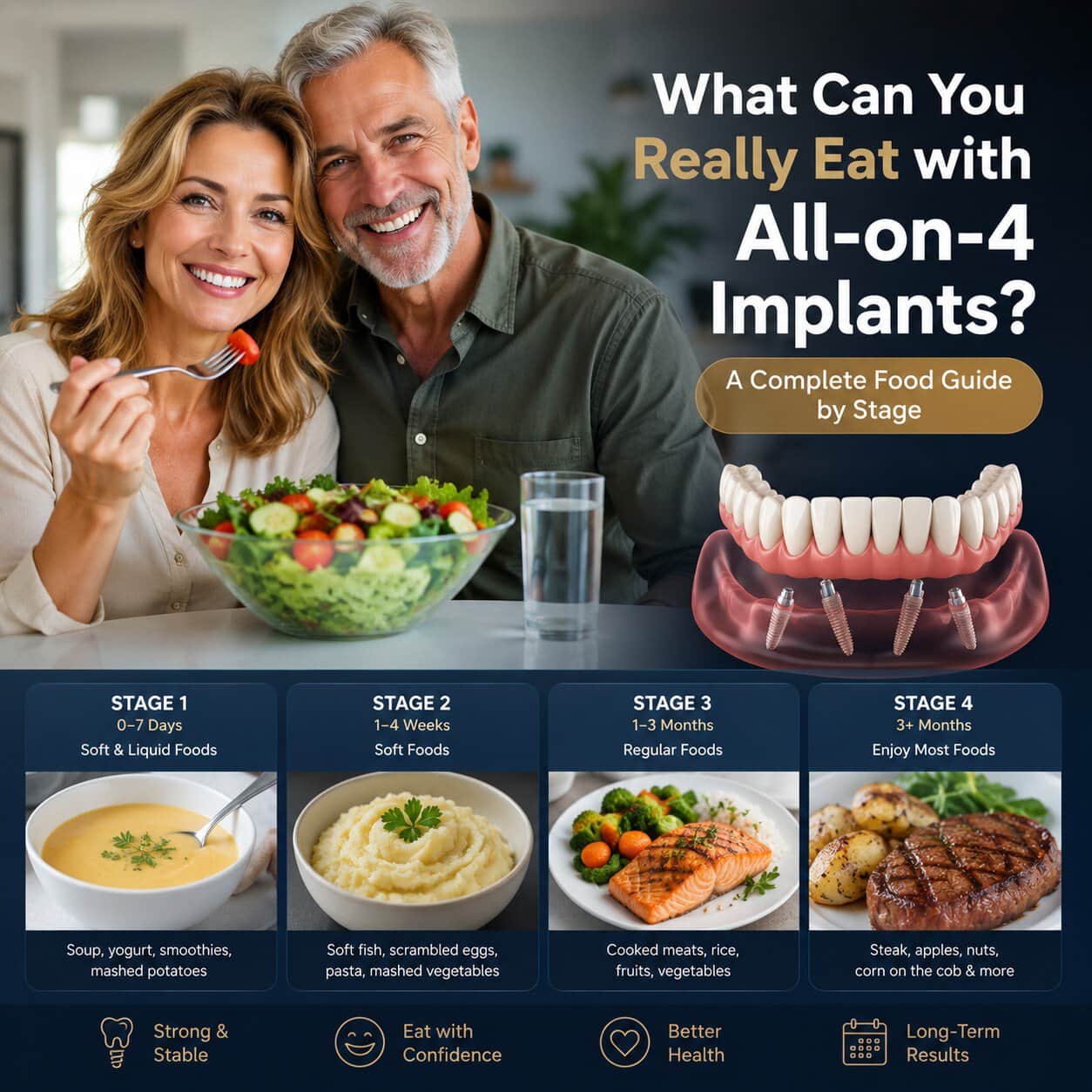
All-on-4 is a full-arch restoration in which four implants, two placed vertically at the front and two angled at the back, carry a fixed set of teeth that is bolted in and stays in place at night. What can be eaten follows the healing timeline rather than the prosthesis: cold liquids only for the first 48 hours, soft food needing no biting force from day three to day fourteen, a graduated soft diet through weeks two to eight, and near-normal eating from months three to six once integration is confirmed. Ice, whole hard nuts and sticky sweets stay limited afterwards.
- 01Fixed on day one does not mean integrated. The prosthesis is bolted in immediately while bone bonding to the implant surface takes months, and the staged diet exists to protect that gap.
- 02The first 48 hours are cold liquids only, and straws are excluded because the suction can dislodge a forming blood clot.
- 03Days 3 to 14 allow soft food that needs no biting force; bread, rice, nuts and crunchy vegetables stay out because small particles lodge in surgical sites.
- 04Near-normal eating starts between months three and six, after integration is confirmed on imaging rather than by how the teeth feel.
- 05A systematic review of 24 studies reported 99.8 percent implant survival beyond 24 months with the All-on-four concept, with peri-implant disease the main biological complication to monitor (PubMed 28298995).
One of the first questions patients ask after committing to All-on-4 implant treatment is also the most practical: "What am I going to be able to eat?"
It's a fair question. Most people coming to All-on-4 have spent months, sometimes years, avoiding certain foods because of broken-down teeth, loose dentures, or significant tooth loss. The promise of eating freely again is a big part of why they choose this procedure in the first place.
The full answer, though, is more nuanced than a simple "you can eat anything." What you can eat depends heavily on where you are in the recovery timeline. This guide walks you through every stage, from the first 24 hours post-surgery to years down the line, so you know exactly what to expect and how to protect your investment.
/ A Quick Refresher: What Is All-on-4?
All-on-4 is a full-arch tooth replacement system that uses just four strategically placed implants to support a complete set of fixed teeth. Unlike removable dentures, All-on-4 restorations are bolted in place, they don't come out at night, they don't shift while chewing, and they function far more like natural teeth.
The four implants are placed at precise angles to maximise contact with available bone, which is why All-on-4 often works even for patients who have experienced some degree of bone loss, sometimes without the need for a bone graft .
But here's the critical detail: even though the prosthetic teeth are fixed from day one, the implants themselves are not yet fully integrated with the jawbone. That process, called osseointegration, takes several months. And that is what determines your dietary restrictions during recovery.
For patients considering both arches, All-on-6 implants follow the same dietary principles with a slightly broader base of support.
/ Stage 1: The First 48 Hours, Liquid Only
The immediate post-surgical period is the most restrictive, and the most important to get right.
For the first 48 hours after your All-on-4 procedure, your diet should consist entirely of cold or room-temperature liquids . Nothing warm, nothing hot, and nothing that requires any chewing whatsoever.
What you can eat:
- Cold water, iced herbal tea (no caffeine)
- Smoothies and blended fruit juices (no seeds or pulp)
- Protein shakes (cold or room temperature)
- Thin yoghurt
- Cold soup broth (not chunky, not hot)
Why cold matters: Heat increases blood flow to surgical sites, which raises the risk of post-surgical bleeding and swelling. Cold helps constrict blood vessels and control inflammation.
What to avoid entirely:
- Hot drinks (coffee, tea, soups)
- Alcohol
- Carbonated drinks
- Anything with seeds, pulp, or small particles that could enter surgical sites
- Straws (the suction creates pressure that can dislodge forming blood clots)
The team at Mosdent Dental Hospital provides every All-on-4 patient with a personalised recovery protocol, including specific nutritional guidance for the post-operative period.
/ Stage 2: Days 3–14, Soft Food Diet
Once the initial surgical inflammation begins to subside (usually by day 3), you can introduce soft foods that don't require real biting or chewing force.
The guiding principle at this stage: if it requires your teeth to apply pressure, it's too soon.
Good choices:
- Mashed potatoes (no skins, no lumps)
- Scrambled eggs or soft-boiled eggs
- Pureed soups (blended, no chunks, served warm, not hot)
- Soft fish such as steamed cod or tilapia
- Yoghurt, ricotta, and cottage cheese
- Ripe banana, avocado, soft melon
- Hummus and other smooth spreads
- Soft-cooked pasta (well done, not al dente)
- Porridge, cream of wheat, congee
Still avoid:
- Bread (even soft bread can ball up and create suction)
- Crunchy vegetables (carrots, celery, bell pepper)
- Nuts and seeds
- Chewy meats
- Rice (small grains can lodge in surgical sites)
- Anything sticky (caramel, toffee, chewing gum)
This phase is also the window where gum health matters most. Any particles that get into the tissue around implants can introduce bacteria, which is why gum health monitoring is built into every follow-up appointment at Mosdent.
/ Stage 3: Weeks 2–8, Graduated Soft Diet
By the second week, most patients have moved through the sharpest phase of discomfort. Swelling is significantly reduced and the provisional prosthesis feels more settled. You can begin introducing a broader range of foods, still soft, but with more texture and variety.
You can start introducing:
- Soft chicken or turkey (shredded, not sliced)
- Lentil soups and well-cooked legumes
- Soft rice dishes (risotto, pilaf well cooked)
- Tofu
- Well-cooked vegetables (zucchini, sweet potato, peas, spinach)
- Soft cheese
- Pancakes, French toast (soft, not crispy)
Still avoid:
- Hard crust bread and rolls
- Steak, pork chops, or any meat that requires tearing
- Apples (even soft-looking ones place significant bite force on anterior implants)
- Nuts and popcorn
- Hard chocolate or candy
- Anything you need to bite into rather than chew softly
This period overlaps with one of the most active stages of osseointegration, the microscopic bonding between implant surface and jawbone. Excessive bite force during this window can interfere with that process.
/ Stage 4: Months 3–6, The Transition to Near-Normal Eating
Most patients begin the transition toward a more normal diet between three and six months post-surgery, once osseointegration is confirmed. Your implant specialist will assess integration progress through imaging before clearing you for this phase.
At this point, you can reintroduce most foods, but with some ongoing awareness.
You can generally enjoy:
- Most cooked meats (cut into smaller pieces rather than bitten into)
- A wider variety of vegetables (most cooked; raw with care)
- Sandwiches and softer bread
- Most dairy
- Pasta in most forms
- Most fruits (except very hard ones like unripe pears)
Still worth limiting:
- Very hard raw vegetables (whole carrots, raw corn on the cob)
- Very chewy bagels or baguettes
- Hard candies and ice chewing
- Extremely sticky foods
/ Long-Term Diet: What Can You Eat for Life?
Once you have passed the six-month mark and your implants are fully integrated, All-on-4 restorations allow for a remarkably broad diet. Most patients at Mosdent report being able to eat foods they haven't enjoyed in years, steak, corn on the cob, apples, even crusty bread.
Long-term foods to approach with care (not necessarily avoid):
- Ice: Chewing ice is a habit that places high point-load force on prosthetic teeth. It can chip or crack restorations and can also damage healthy natural teeth. Avoid habitually.
- Very hard whole nuts: Macadamia nuts, whole almonds, and hard shells can crack porcelain or composite prosthetics. Sliced or chopped nuts are fine.
- Sticky toffees and chewing gum: These create pulling forces on the restoration. Occasional exposure is unlikely to cause damage; daily chewing gum is not recommended.
- Biting into very hard or dense foods with front teeth: The front implants in an All-on-4 configuration aren't designed for direct biting of hard objects. Cutting food before eating protects the restoration long-term.
These guidelines apply equally to All-on-6 implant patients, though the additional implant support does provide somewhat greater overall load distribution.
/ Why Gum Health Is Part of Your Food Strategy
A detail many patients overlook: what you eat affects not just your implants, but the health of the gum tissue around them.
High-sugar diets feed the bacterial populations responsible for peri-implantitis, an inflammatory condition affecting the gum and bone tissue around implants. It is one of the leading causes of late implant failure. Maintaining low-sugar, balanced nutrition, staying well hydrated, and following your oral hygiene routine all contribute to the long-term health of your implants.
If you notice any gum swelling, bleeding, or unusual sensitivity at any point during or after recovery, it warrants prompt assessment. Mosdent's periodontology team monitors peri-implant tissue at every scheduled review and addresses any early-stage changes before they escalate. Our gum disease treatment protocols run parallel to implant care.
/ Comparing All-on-4 to Traditional Dentures: What Changes at the Table?
If you are coming from traditional removable dentures, the difference in eating experience after All-on-4 is significant.
| Factor | Removable Dentures | All-on-4 Implants |
|---|---|---|
| Stability while chewing | Low, movement common | Fixed, no shifting |
| Foods restricted long-term | Many (sticky, hard, chewy) | Very few after healing |
| Bite force compared to natural teeth | ~25% | ~70–80% |
| Bone preservation over time | No (bone resorption continues) | Yes (implants stimulate bone) |
| Diet confidence | Limited | High after recovery |
This is why full-mouth dental implant solutions are increasingly preferred over traditional dentures for patients with complete or near-complete tooth loss. The comprehensive dental implant guide on our website covers all implant options in depth.
/ Nutrition Tips to Support Your Recovery
Getting enough nutrition during the liquid and soft-food phases of recovery is genuinely challenging. Here are practical strategies:
Prioritise protein. Protein is essential for tissue repair and osseointegration. Aim for eggs, Greek yoghurt, protein shakes, soft fish, and well-blended legumes throughout recovery.
Don't skip calories. Many patients eat significantly less during recovery because of the dietary restrictions. Under-eating delays healing. Calorie-dense smoothies with nut butter, avocado, banana, and protein powder help maintain energy intake.
Stay hydrated. Water supports circulation to healing tissues. Aim for at least 2 litres per day throughout recovery.
Supplement if needed. Vitamin C supports collagen formation and wound healing. Vitamin D and calcium support bone health around implants. Discuss supplementation with your care team.
/ Your All-on-4 Journey at Mosdent Istanbul
At Mosdent Dental Hospital, we have been delivering All-on-4 implant treatment to international patients since our founding in 1992. Every patient receives a detailed, stage-by-stage recovery guide tailored to their specific procedure, bone condition, and health profile.
Our implantology team works alongside our periodontology specialists and oral surgery team to ensure every phase of your recovery is monitored and supported. International patients are also assigned a multilingual coordinator who remains available throughout the recovery period.
If you'd like to understand whether All-on-4 is right for your situation, or to discuss what your recovery timeline would look like, contact Mosdent for a free consultation.
/ Frequently Asked Questions
Can I eat normally the day after All-on-4 surgery?
No. The first 48 hours are strictly liquid only. Normal eating is a gradual process over several months, not something that happens overnight. The implants need time to integrate with the bone before full chewing force can be applied safely.
When can I eat steak after All-on-4?
Most patients can eat well-cooked, tender cuts of beef by months three to four. Tougher cuts that require significant chewing force should wait until after the six-month osseointegration confirmation.
Can I drink coffee after All-on-4?
Hot coffee should be avoided in the first 48 hours due to the heat. After that, coffee in moderation is generally acceptable, but excessive coffee consumption can contribute to dry mouth and affect oral hygiene, which indirectly impacts healing.
What happens if I eat the wrong foods too early?
Eating hard or chewy foods before osseointegration is complete can apply micro-stresses to the implant-bone interface. In the worst case, this can interfere with integration and compromise the stability of the implant. Following your recovery protocol protects your entire investment.
Does All-on-4 diet change permanently?
The long-term diet is very close to a normal diet. A few foods, very hard candy, ice chewing, whole hard nuts, are worth moderating permanently, but the vast majority of patients eat freely and comfortably within six months of surgery.
Let’s plan the right treatment together.
Free Assessment→