Menu

Free Consultation
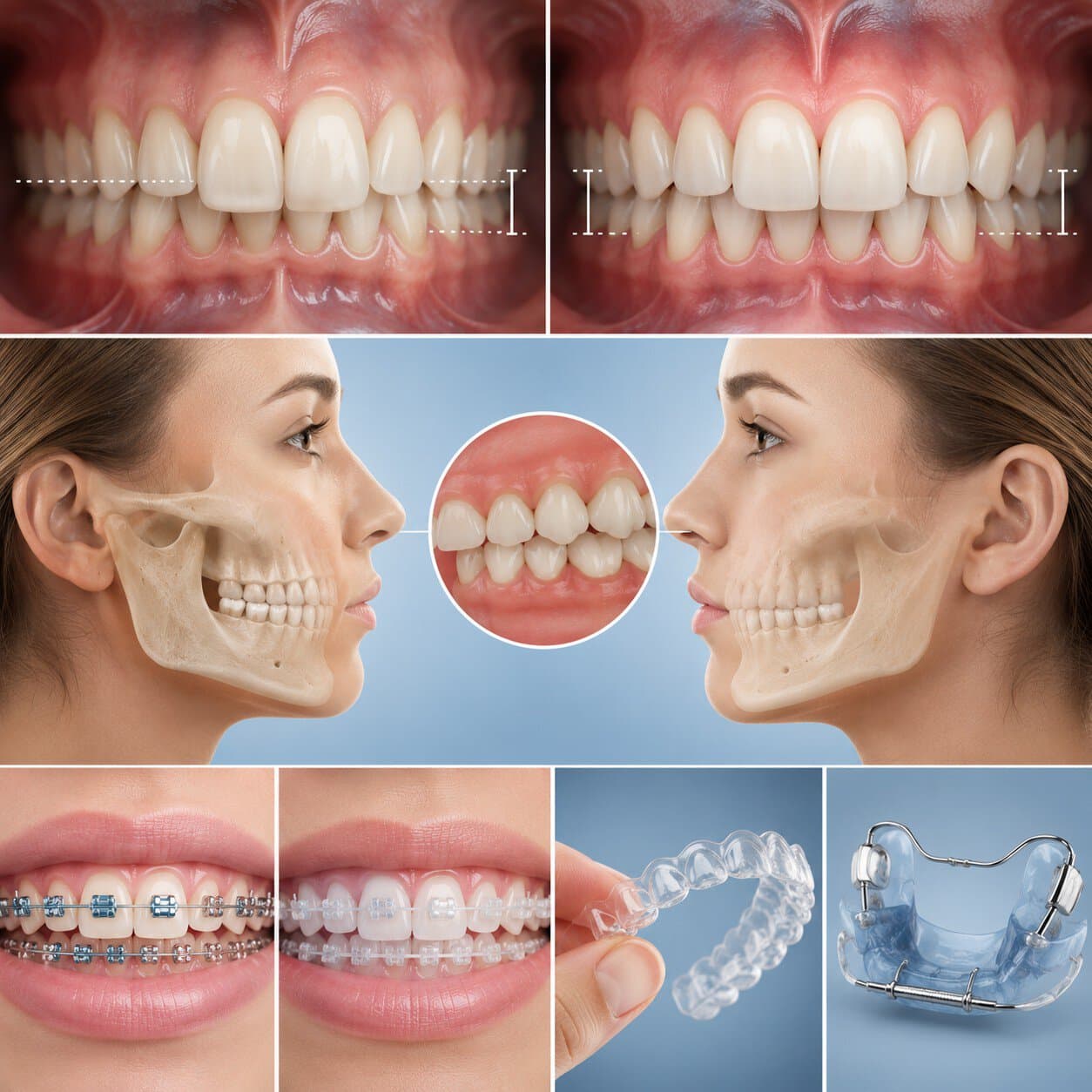
When most people think about orthodontic problems, they picture crowded or crooked teeth. But one of the most common and frequently undertreated malocclusions is the deep bite: a condition where the upper front teeth excessively overlap the lower front teeth in a vertical direction.
A deep bite is not simply an aesthetic concern. Left uncorrected, it creates a chain of consequences: abnormal tooth wear, damage to the gum tissue behind the upper front teeth, jaw joint strain, and in more severe cases compromised facial appearance as the lower jaw appears pushed back or shortened.
At MosDent Dental Hospital in Istanbul, our orthodontics team regularly treats deep bite cases across the full spectrum of severity — from mild functional concerns to complex combined skeletal and dental presentations. This guide explains what a deep bite is, what causes it, how it affects oral health, and what treatment looks like at every stage.
A deep bite also called a deep overbite is a type of malocclusion in which the upper front teeth cover more than approximately one-third of the lower front teeth when the jaws are closed. In a normal bite, the upper front teeth overlap the lower front teeth by about 1–2 mm (roughly 20–30% coverage).
In a deep bite, this vertical overlap is excessive often covering half, two-thirds, or in the most severe cases the entirety of the lower front teeth. In the most extreme deep bites, the lower front teeth may bite directly into the gum tissue behind the upper front teeth, causing direct soft tissue trauma.
Deep bite is classified in two main ways:
Dental deep bite: The excessive overlap is caused by the positioning of the teeth themselves — the upper front teeth are too far erupted downward, or the lower front teeth are similarly over-erupted. The underlying jaw relationship (skeletal relationship) may be relatively normal.
Skeletal deep bite: The cause is the underlying jaw structure the lower jaw (mandible) is vertically smaller or positioned differently relative to the upper jaw. This creates a structural framework that produces the deep bite regardless of tooth position. Skeletal deep bites are generally more complex to treat and may require combined orthodontic and surgical approaches in severe cases.
Deep bites can have single or multiple contributing causes. Understanding the cause is important because it shapes the treatment approach.
Genetics: Jaw size and tooth size are heavily genetically determined. A jaw structure predisposed to vertical discrepancy is the most common underlying cause of skeletal deep bite.
Tooth loss: When posterior teeth (back teeth) are lost and not replaced, the vertical support for the bite collapses. As the back of the bite drops, the front teeth still meeting create an increasingly deep overlap. This is a common way deep bites develop or worsen in adults.
Worn posterior teeth: Chronic grinding (bruxism) that preferentially affects the back teeth reduces their height over time, with the same collapsing effect on the posterior bite dimension.
Habits in childhood: Thumb sucking and prolonged dummy (pacifier) use can create altered jaw growth patterns that contribute to malocclusion including deep bite in some children.
Muscle patterns: Certain facial muscle patterns particularly where the masseter (jaw closing muscle) is dominant favour vertical jaw dimensions that predispose to deep bite development.
Many patients with mild or moderate deep bites are unaware they have the condition, or are aware only of aesthetic concerns. A clinical assessment is the only reliable way to diagnose and classify the severity.
Signs to look for:
These symptoms exist on a spectrum mild deep bites may produce only aesthetic concerns, while severe cases involve active tissue damage, joint strain, and significant functional limitation.
This is the point most commonly underappreciated by patients who view their deep bite as purely cosmetic.
Accelerated tooth wear: In a deep bite, the front teeth bear disproportionate chewing load. The abnormal contact pattern causes accelerated wear on tooth surfaces that should not be primary load-bearing contacts. Over years, this wear can be significant affecting tooth shape, sensitivity, and eventually requiring restorative work.
Gum tissue trauma: In severe deep bites, the lower front teeth bite directly into the soft tissue behind the upper front teeth (the palatal mucosa). This chronic trauma causes tissue damage, recession, and discomfort. Similarly, the upper front teeth can traumatise the lower gum tissue.
Jaw joint involvement: The altered bite relationship affects how load is distributed across the jaw joint (temporomandibular joint). Over time, this can contribute to jaw joint problems including clicking, pain, limited opening, and temporomandibular dysfunction.
Restorative treatment complication: Patients with a deep bite who need crowns, veneers, or other restorations in the front teeth face a complication there may not be adequate space for the restoration without first correcting the bite. Placing a veneer or crown on a tooth that is actively biting abnormally creates a high-failure restoration.
Treatment planning for a deep bite depends on the patient's age, the underlying cause (dental vs skeletal), the severity, and the patient's overall treatment goals. There is no single universal protocol.
For the majority of dental deep bite cases and many mild to moderate skeletal deep bites orthodontic treatment is the primary approach.
The key mechanisms orthodontists use to correct deep bite include:
Intrusion of front teeth: The upper or lower front teeth (or both) are gently moved upward into the jaw (intruded), reducing the vertical overlap. This is one of the most effective orthodontic corrections for dental deep bite.
Extrusion of posterior teeth: The back teeth are encouraged to erupt slightly more, increasing posterior bite height and thereby reducing the vertical overlap at the front.
Levelling the arch: In many deep bite cases, the curve of the lower arch is exaggerated (a steep curve of Spee). Levelling this curve distributes tooth heights more evenly and naturally reduces the overbite.
Braces vs clear aligners for deep bite:
Traditional fixed braces (brackets and archwire) are highly effective for deep bite correction — the continuous wire runs across all teeth and can be shaped to correct the curve of Spee and guide tooth movement in all three dimensions. For complex deep bites, particularly those involving significant intrusion requirements, braces offer precise three-dimensional control.
Clear aligners such as Invisalign have improved significantly in their ability to treat deep bites over recent years. Bite ramps built into the aligner trays help disocclude the posterior teeth and allow intrusion of the front teeth. For mild to moderate dental deep bites, clear aligners can produce excellent results while maintaining the aesthetic advantage of near-invisibility during treatment.
The choice between braces and aligners for deep bite is a clinical decision based on severity, complexity, and the patient's preference not a universal rule. Our orthodontics team discusses both options in detail during the initial consultation.
In adult patients where deep bite has developed partly due to loss of posterior tooth height — from wear, grinding, or missing teeth restoring the posterior bite height through dental restorations can be a key component of treatment.
Dental implants to replace missing posterior teeth restore the vertical dimension that has been lost. Zirconium crowns on worn posterior teeth rebuild their height. These restorations may be used in conjunction with or as an alternative to orthodontic treatment, depending on the case.
Where deep bite has contributed to temporomandibular joint symptoms, an occlusal splint (bite guard) may be used in the early stages of treatment to decompress the joint and reduce symptoms before definitive orthodontic correction. Our jaw joint treatment team works in coordination with orthodontics for cases where joint involvement is significant.
In adults with severe skeletal deep bite where the jaw structure itself is the primary cause and orthodontic correction alone cannot achieve a stable result orthognathic (corrective jaw) surgery may be recommended. This involves surgical repositioning of the jaw(s), typically performed in conjunction with orthodontic treatment. Surgery is reserved for cases where the skeletal discrepancy is beyond the range of orthodontic compensation alone.
Treatment duration depends on severity and the approach used.
Mild dental deep bite with clear aligners: 9–18 months Moderate dental deep bite with braces: 18–24 months Complex cases (significant intrusion or combined dental/skeletal): 24–36 months Combined orthodontic + surgical cases: 24–48 months including surgical recovery
These ranges are indicative. Individual treatment timelines are established during the diagnostic assessment and depend on treatment response as well as initial severity.
Following active orthodontic treatment, retention is essential deep bites have a well-documented tendency to relapse without proper retention. Fixed retainers on the lower front teeth and removable retainers are typically part of the post-treatment plan.
Patients who want both deep bite correction and aesthetic restorations veneers, crowns, or a smile makeover need to understand one important principle: orthodontic correction should generally come before restorative aesthetic work.
Placing porcelain veneers or crowns on teeth that are still in a deep bite position is a setup for restoration failure. The abnormal bite forces will load the new restorations in ways they are not designed to withstand. Correcting the bite first creates the space and occlusal relationship that allows aesthetic restorations to perform and last as intended.
The exception is when restorative work is part of the bite correction strategy for example, rebuilding worn posterior teeth to restore vertical dimension as part of an integrated treatment plan.
MosDent's approach to these combined cases involves coordinated planning between the orthodontics team and the cosmetic dentistry specialists, with a clear sequence that ensures each phase of treatment supports the next.
Patients with chronic deep bites particularly those involving direct gum tissue trauma — often present with localised gum disease or tissue damage in the traumatised areas. Before orthodontic treatment begins, a periodontal assessment ensures any active tissue inflammation is identified and managed.
Additionally, patients with deep bites who have experienced chronic tissue trauma may benefit from gum surgery or soft tissue procedures after bite correction to restore the gum architecture to a healthy and aesthetic form following years of trauma.
Can a deep bite fix itself?
No. Deep bites do not self-correct with age. In most cases, they gradually worsen as tooth wear reduces posterior bite height and increases the vertical overlap over time.
Is a deep bite the same as an overbite?
"Overbite" is the general term for the vertical overlap of the upper over lower front teeth. A "deep bite" or "deep overbite" specifically describes an excessive overbite more than the normal 1–2 mm or 20–30% coverage.
Can Invisalign fix a deep bite?
Yes, in mild to moderate dental deep bite cases. Significant improvements have been made to aligner mechanics for deep bite correction. Severe or skeletal deep bites may require braces or surgical intervention for the best outcome.
How long does deep bite treatment take?
Depending on severity and treatment method, 9 months to 3 years. Complex combined surgical cases may take longer. Individual timelines are established at the diagnostic consultation.
Will deep bite treatment change my facial appearance?
In significant deep bites where the lower jaw appears shortened or the chin recessed correcting the bite can produce a perceptible improvement in facial proportion. The lower face appears less compressed and the chin slightly more defined.
Deep bites do not improve on their own, and the consequences of leaving them untreated accumulate quietly over years. Tooth wear, gum damage, joint strain, and progressive restorative complications are all downstream effects of a bite that is not functioning as it should.
If you suspect you have a deep bite, or if a dentist has mentioned it during an examination, an orthodontic consultation is the appropriate next step. Early intervention typically produces simpler, faster treatment; waiting tends to make the case more complex.
Explore MosDent's orthodontics services or contact our team for a free consultation and comprehensive bite assessment in Istanbul.
Published by MosDent Dental Hospital | Istanbul, Turkey | mosdenthospital.com