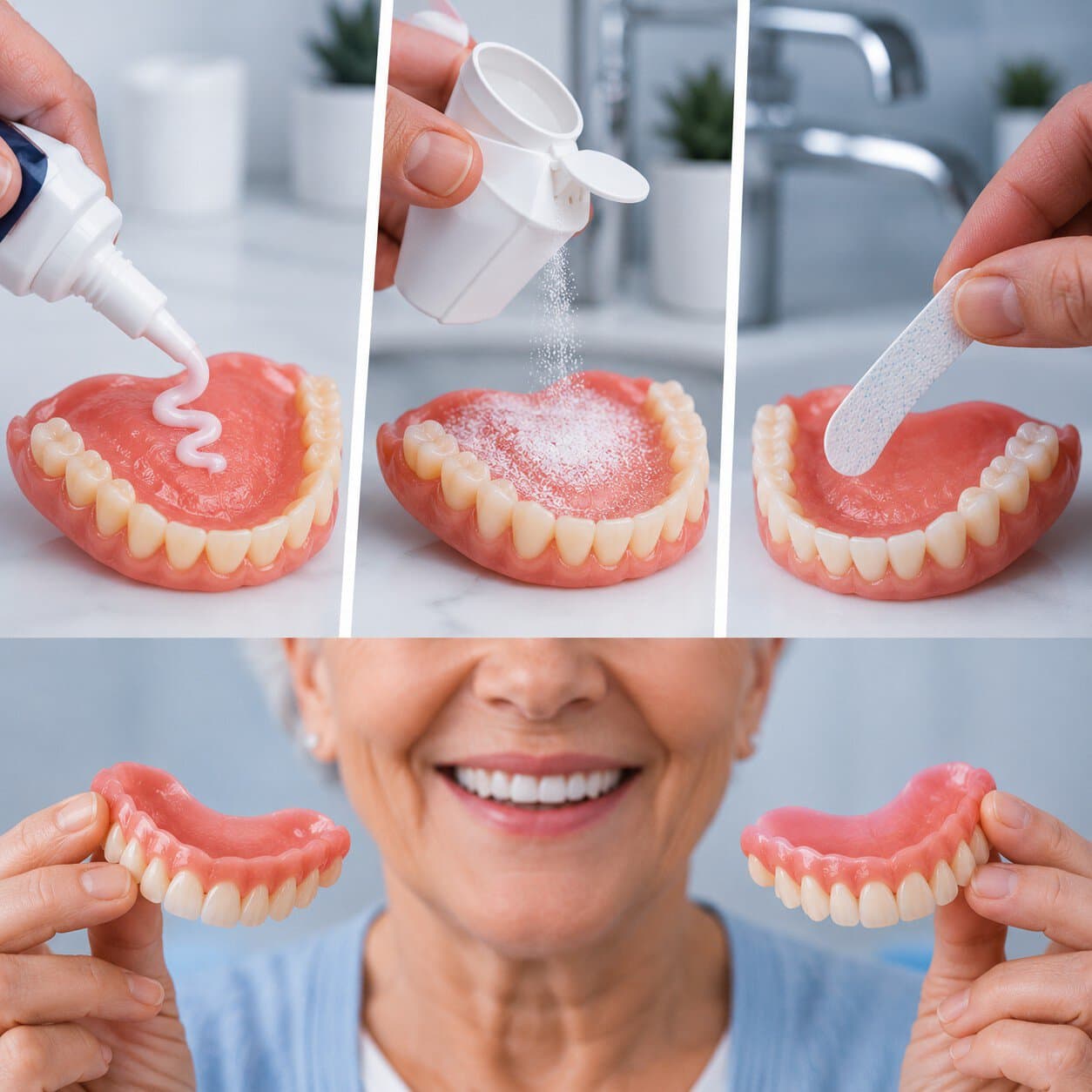
Denture adhesive is a cream, powder or pre-cut strip applied to the fitting surface of a removable denture to supplement the retention that suction, saliva and the shape of the supporting ridge already provide. Cream gives the strongest hold and works in dry mouth, powder is thinner and easier to clean off, strips give the cleanest and most consistent application. A systematic review of 13 randomised trials with 516 participants found adhesives significantly improve retention, stability, patient-reported outcomes and masticatory performance, on low to moderate certainty evidence (PubMed 33551134).
- 01Adhesive supplements retention, it does not create it: a well-fitted denture holds through suction, saliva and ridge contour, and adhesive adds a margin of stability on top of that.
- 02Across 13 randomised trials with 516 participants of mean age 65.5 years, denture adhesives significantly improved retention, stability, patient-reported outcomes and masticatory performance, with certainty rated low to moderate (PubMed 33551134).
- 03The evidence base is thinner than the marketing: a separate review of 10 randomised trials judged 90% of them at high risk of bias and graded overall certainty as very low (PubMed 33438306).
- 04Format decides the trade-off: cream holds strongest and suits dry mouth, powder needs moisture to activate and holds less on lower dentures, strips give consistent thickness but less hold on heavily resorbed ridges.
- 05A denture worn more than 5 to 7 years without adjustment, or one needing significant adhesive just to stay put, is a fit problem, and bone resorption continues for as long as the denture is worn.
If you wear removable dentures, you have almost certainly stood in the dental care aisle staring at a confusing array of products creams, powders, strips, pads each claiming to be the strongest, longest-lasting, or most comfortable option available. With so many choices and so little guidance, most people simply pick what they used before, or what looks most familiar.
But denture adhesives are not all interchangeable. The right type depends on your specific denture fit, your daily routine, the foods you eat, and crucially whether a denture adhesive is even the appropriate solution for what you are actually experiencing.
At Mosdent Dental Hospital in Istanbul, we work with patients who have worn dentures for years and patients who are just beginning to explore tooth replacement options. This guide covers everything you need to know about denture adhesive types and when the conversation should move beyond adhesives entirely.
/ Why Do Dentures Need Adhesive in the First Place?
Before comparing adhesive types, it helps to understand why denture wearers reach for adhesives at all.
A well-fitted, properly maintained denture relies primarily on suction, saliva, and the contour of the supporting ridge to stay in place. When these natural retention mechanisms work well, adhesive is not strictly necessary it simply provides an extra margin of confidence and stability.
However, several factors reduce natural denture retention over time:
Bone resorption: When teeth are lost, the jawbone beneath the gum no longer receives the stimulation it needs to maintain its volume. It gradually shrinks. As the supporting ridge flattens, a denture that once fitted perfectly begins to feel loose and unstable a process that continues as long as the denture is worn.
Salivary changes: Adequate saliva is essential for denture suction. Dry mouth conditions whether from medication, systemic disease, or dehydration reduce this natural adhesion.
Weight changes: Significant changes in body weight can alter facial tissue volume and affect how a denture sits.
Age of the denture: Dentures have a lifespan. As materials age and the supporting tissue changes, even a well-made denture gradually becomes a looser fit.
Understanding this context matters because it shapes how you use adhesives and when you should seek a different solution altogether.
/ Type 1: Denture Adhesive Cream
Cream-based adhesives are the most widely used form and the default choice for most denture wearers. They are typically zinc-containing or zinc-free formulations applied directly to the fitting surface of the denture before insertion.
How to use: Apply small dots or a thin strip to the dry fitting surface of the denture. Do not overapply. Insert the denture and hold briefly with firm pressure.
Advantages:
- Strong initial hold typically the strongest immediate adhesion among the three formats
- Easy to find in pharmacies worldwide
- Available in flavoured and unflavoured versions
- Zinc-free options available for patients concerned about zinc intake
- Works well with both full upper and lower dentures
Disadvantages:
- Can be messy to apply precisely over-application leads to oozing from denture edges
- Removal requires thorough cleaning of both the denture and the gum tissue
- If applied unevenly, can create pressure points that irritate gum tissue
- Some patients find the texture unpleasant, particularly flavoured versions
Best suited for: Patients who need strong, reliable hold throughout the day, particularly for the lower denture where retention is typically weaker. Also appropriate for patients with dry mouth, whose reduced saliva makes natural suction less effective.
A note on zinc content: Most major cream adhesives now offer zinc-free formulations. If you use adhesive cream daily in significant amounts over a long period, choosing a zinc-free option is a sensible precaution, as chronic excess zinc intake can interfere with copper absorption.
/ Type 2: Denture Adhesive Powder
Powder adhesives are sprinkled lightly onto the moistened fitting surface of the denture before insertion. They create a thin, even adhesive layer when activated by saliva.
How to use: Lightly sprinkle powder over the wet fitting surface. Tap away excess. Insert denture and press into place.
Advantages:
- Easier to clean from gum tissue at the end of the day
- Thinner application reduces the bulky feel some patients dislike with cream
- Less messy than cream for most patients
- Lower risk of over-application
- Suitable for patients with sensitive gum tissue
Disadvantages:
- Generally provides less hold than cream, particularly for lower dentures
- Less effective in dry mouth conditions, as moisture is needed to activate the powder
- Can clump if too much is applied or if the fitting surface is unevenly moistened
- Not ideal for very loose dentures the hold may not be sufficient
Best suited for: Patients with upper dentures that have reasonable natural retention and who need only a moderate boost to confidence and comfort. Also suitable for patients who find cream texturally uncomfortable or difficult to clean.
/ Type 3: Denture Adhesive Strips (Pads)
Strips or pads are pre-cut sheets of adhesive material placed directly onto the fitting surface of the denture. They are designed for clean, consistent application without the mess of cream or powder.
How to use: Cut or fold the strip to fit the denture if needed. Place on the dry fitting surface. Wet the gum surface with saliva or water, insert the denture, and press firmly.
Advantages:
- Very clean and precise application no mess
- Consistent adhesive thickness across the fitting surface
- No residue on fingers
- Preferred by patients who travel frequently or value convenience
- Available in pre-cut sizes for upper and lower dentures
Disadvantages:
- Shorter hold duration than cream in some formulations
- Less effective for irregular or heavily resorbed ridges where the strip cannot conform to the surface
- Can feel bulkier than powder for some patients
- Higher per-use cost than powder or cream for equivalent duration
Best suited for: Patients who value cleanliness and convenience over maximum hold. Particularly appropriate for patients who wear their denture part-time or for social occasions rather than throughout the day.
/ Comparison at a Glance
| Feature | Cream | Powder | Strips |
|---|---|---|---|
| Hold strength | High | Moderate | Moderate–High |
| Ease of application | Moderate | Easy | Very easy |
| Ease of cleanup | Moderate | Easy | Easy |
| Suitable for dry mouth | Yes | No | Moderate |
| Suitable for very loose dentures | Partial | No | Partial |
| Travel convenience | Moderate | Good | Excellent |
| Bulky feel | Possible | Low | Low–Moderate |
| Cost per use | Low | Low | Higher |
/ Practical Tips for Using Any Denture Adhesive
Regardless of which format you choose, these principles apply:
Use the minimum amount necessary. More adhesive does not mean better hold it typically means more mess, more cleanup, and a greater likelihood of uneven distribution. Start with a small amount and adjust.
Apply to a clean, dry denture. Adhesive bonds to the denture surface first, not to the gum. Cleaning residue from the previous application before reapplying is essential.
Clean gum tissue thoroughly each evening. Leaving adhesive residue on the gum tissue overnight promotes bacterial growth. Remove your denture nightly, clean it thoroughly, and clean your gum tissue with a soft cloth or toothbrush.
Do not use adhesive to compensate for a broken or damaged denture. A denture that is cracked, warped, or significantly ill-fitting requires professional attention, not more adhesive.
Consider adhesive a supplement, not a solution. If you find yourself relying on increasing amounts of adhesive to achieve basic comfort, this signals that the denture fit itself needs to be addressed professionally.
/ When Adhesive Is Not the Answer
This is the section most adhesive guide articles skip but it may be the most important.
Denture adhesive is appropriate as a supplement to a well-fitted denture, or as a temporary measure while a relining or replacement is arranged. It is not a long-term solution for a fundamentally poorly fitting denture.
If your denture:
- Requires significant adhesive to stay in place at all
- Moves noticeably during eating or speaking despite adhesive
- Causes persistent sore spots or gum irritation
- Has been worn for more than 5–7 years without adjustment
..then the right step is a professional assessment, not a stronger adhesive.
A loose denture is almost always a sign that bone resorption beneath the denture has changed the shape of the supporting ridge. This process continues as long as the denture is worn adhesive does not slow or stop it.
/ Implant-Supported Options: Beyond the Adhesive Dependency
For patients who are frustrated with adhesive dependency and want a long-term solution, implant-supported restorations offer a fundamentally different approach to tooth replacement.
Implant-supported overdentures: Two to four dental implants placed in the jaw provide anchor points for a removable denture. The denture clips onto the implants for secure retention without any adhesive. This dramatically improves chewing confidence and eliminates the daily adhesive routine.
All-on-4 implants : Four implants support a fully fixed prosthetic arch. The restoration is screwed into place and does not come out, no adhesive, no nightly removal, no movement during eating. For patients with full upper or lower tooth loss, All-on-4 represents the most complete functional upgrade from a removable denture.
All-on-6 implants : Six implants provide additional support, particularly beneficial for patients with higher bite forces or more complex anatomy.
Both implant-supported options also address the underlying cause of progressive denture looseness, bone resorption. Because implants transmit chewing forces into the jawbone, they stimulate the bone to maintain its volume rather than continuing to shrink. A patient who has worn a denture for ten years and notices increasing looseness is experiencing the cumulative effect of a decade of bone loss. Implant treatment stabilises this process.
For patients who have experienced significant bone loss already, bone grafting or advanced implant protocols including zygomatic implants can provide implant-based solutions even in cases of severe ridge resorption.
/ Gum Health and Denture Wear
A frequently overlooked aspect of long-term denture wear is its effect on the gum and soft tissue beneath the denture. Prolonged use of ill-fitting dentures and particularly the mechanical pressure they place on soft tissue can contribute to chronic low-grade gum inflammation and tissue changes.
Before any prosthetic adjustment, relining, or implant treatment, a periodontal assessment is valuable to ensure the tissue environment is healthy and stable. Compromised soft tissue affects both the fit of a new denture and the healing following implant surgery.
/ Frequently Asked Questions
Which denture adhesive is the strongest?
Cream adhesives generally provide the strongest hold, particularly in lower dentures where natural suction is weakest. However, "strongest" is only useful if the denture itself fits reasonably well no adhesive can fully compensate for a severely ill-fitting denture.
Can I use denture adhesive every day?
Yes, with appropriate hygiene. Clean residue thoroughly from both the denture and gum tissue each evening. Choose a zinc-free formulation if using cream adhesive daily for extended periods.
Why does my lower denture keep slipping even with adhesive?
Lower dentures rely on far less natural suction than upper dentures the tongue, floor of the mouth, and cheek muscles all create movement. This is one of the main reasons lower denture wearers are strong candidates for implant-supported solutions, even with just two implants providing significantly improved stability.
How do I remove denture adhesive from my gums?
Rinse with warm water and use a soft toothbrush or damp cloth to gently clean the gum tissue. Avoid scrubbing harshly. Adhesive residue left on gum tissue overnight should always be removed.
When should I consider implants instead of adhesive?
When adhesive is no longer achieving comfortable, confident function when you find yourself avoiding certain foods, speaking less freely, or applying increasingly large amounts of adhesive. This is the signal that the underlying fit issue needs to be addressed permanently rather than managed temporarily. Contact Mosdent for a free consultation to discuss implant options suited to your specific situation.
/ The Honest Bottom Line
Cream, powder, and strips each have their place. Cream for maximum hold and dry mouth conditions; powder for a clean, moderate-hold option; strips for convenience and travel. None of them is universally better the right choice is the one that matches your denture fit, daily routine, and comfort preferences.
But the most important thing to understand is that adhesive is a supplement to a well-fitted denture not a substitute for proper prosthetic care. If you are using adhesive to manage a persistently loose or uncomfortable denture, the most effective next step is a professional assessment of the fit itself.
And if you are ready to move beyond adhesive dependency entirely, the implant-supported options available at Mosdent Dental Hospital from implant-supported overdentures through to fully fixed All-on-4 restorations offer a permanent, confident alternative that no adhesive can replicate.
Explore our dental implant solutions or contact our team to understand which option is right for your situation.
Let’s plan the right treatment together.
Free Assessment→- 1.Lemos CAA, da Fonte Porto Carreiro A, Rosa CDDRD, et al. Does the use of an adhesive improve conventional complete dentures? A systematic review of randomized controlled trials. J Prosthet Dent. 2022;128(2):150-157. PMID 33551134
- 2.Elabbasy N, Ahn TJ, Morton P, Han PP, Enciso R, Mulligan R. Efficacy of denture adhesives in complete denture wearers compared to denture wearers not using denture adhesives: a systematic review. Spec Care Dentist. 2021;41(2):251-270. PMID 33438306