Menu

Free Consultation
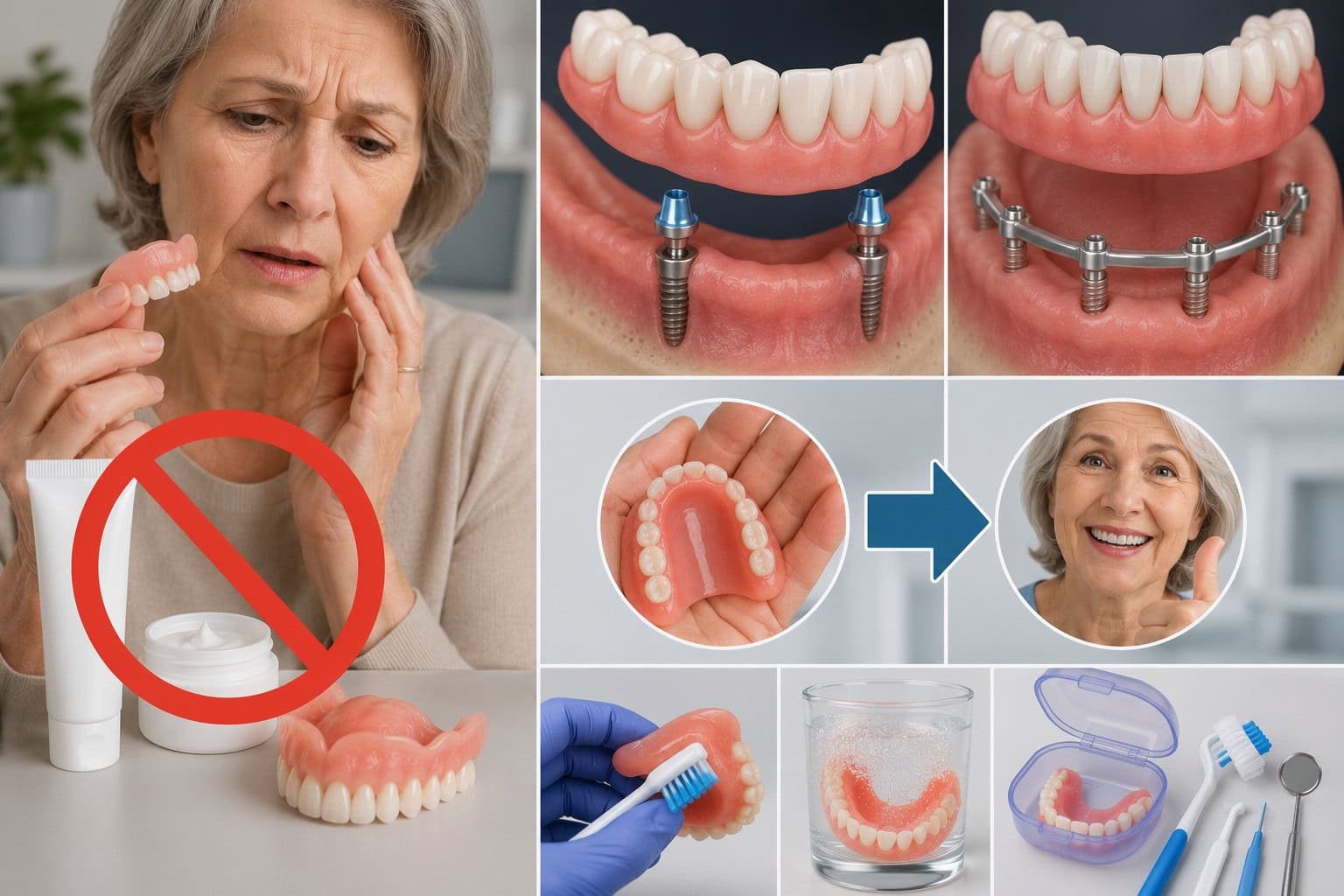
There is a point that most long-term denture wearers eventually reach when the amount of adhesive required to keep their denture in place through a meal has quietly doubled, then tripled, from where it started. When the lower denture shifts during conversation. When certain foods have gradually disappeared from the menu not by choice, but by necessity.
Denture glue is not a solution. It is a workaround and an increasingly inadequate one as time passes.
The good news is that loose dentures are not something you simply have to accept. The looseness has specific, addressable causes. And the fixes range from straightforward clinical procedures to permanent, life-changing restorations that eliminate the need for adhesive entirely.
At MosDent Dental Hospital in Istanbul, we regularly see patients who have been managing worsening denture looseness with increasing amounts of adhesive for years before discovering that alternatives exist. This article explains the real causes of denture looseness and the solutions genuine solutions — available at each stage.
Understanding why your denture has become loose is the essential first step toward knowing how to fix it because the cause determines the appropriate solution.
When teeth are lost, the jawbone that previously held their roots in place no longer receives the mechanical stimulation it needs to maintain its volume. In response, the body begins to reabsorb the bone a process that is gradual, continuous, and largely invisible until its consequences become impossible to ignore.
In the first year after tooth extraction, the jawbone can lose up to 25% of its width. Over five, ten, or twenty years of denture wear, this loss accumulates significantly. The ridge that once supported a well-fitted denture flattens. The contours of the supporting tissue change. The denture which was made to fit a ridge that no longer exists in its original form has not changed, but the jaw beneath it has.
This is the fundamental reason most long-term dentures become progressively looser. It is not a manufacturing defect. It is not because the denture material has changed. It is because the biology of the supporting jaw has changed and no amount of adhesive can reverse that.
Saliva plays a direct role in denture retention through its role in creating suction between the fitting surface and the mucosal tissue. Reduced saliva from medication side effects, ageing, or systemic conditions reduces this natural retention mechanism.
Denture materials undergo slow changes over years of use. The acrylic can develop micro-warping from temperature cycling, cleaning, and mechanical stress. Even a denture that fitted well originally may gradually lose its original fit geometry over time.
Weight loss, changes in facial musculature with ageing, and soft tissue atrophy can all alter how a denture sits, even when bone resorption is not the primary driver.
Denture adhesive creates a thin film between the fitting surface of the denture and the mucosal tissue, improving suction and reducing micro-movement. In appropriate quantities with a reasonably well-fitted denture, it is a legitimate supplement.
What it cannot do:
If adhesive requirements are increasing, the message is unambiguous: the denture-jaw fit itself needs to be addressed.
Relining is the process of replacing the inner fitting surface of an existing denture with new material that conforms to the current shape of the supporting ridge. When bone resorption has changed the ridge enough that the denture no longer fits accurately, relining can restore the fit without requiring a new denture.
Types of relining:
Chairside (direct) reline: Performed in the dental office in a single visit using soft or hard chairside reline material. Provides a rapid improvement in fit. Appropriate for moderate fit discrepancies.
Laboratory reline: The denture is sent to a dental laboratory where new material is added to the fitting surface using the patient's current impressions. More precise than chairside relining and typically longer lasting.
Soft reline: Uses a flexible, cushioning material rather than hard acrylic. Preferred for patients with sensitive or thin mucosal tissue where a hard fitting surface causes discomfort.
When relining works well: When the fit discrepancy is moderate and the denture itself is structurally sound. Relining extends the functional life of an existing denture and significantly reduces adhesive dependency.
When relining is not the answer: When bone resorption has been so extensive that even a relined denture cannot achieve adequate stability. Or when the denture is old, worn, or structurally compromised in which case a new denture is the appropriate starting point, followed by a longer-term plan.
A denture that was made ten or more years ago was fabricated to fit a ridge that has since changed significantly. In these cases, relining an old denture has limited value the entire prosthesis needs to be remade to current anatomy.
A new, well-fitted denture reduces adhesive requirements substantially and improves both comfort and chewing efficiency. It is not a permanent solution to bone resorption the new denture will gradually loosen again over subsequent years for the same underlying reasons but it resets the clock on fit quality and provides a meaningful improvement in daily function.
The realistic lifespan of a well-made conventional denture before significant refit issues arise is approximately 5–7 years, though this varies considerably based on the rate of individual bone resorption.
For patients who want to remain with a removable prosthetic but want dramatically better retention without adhesive, an implant-supported overdenture changes the equation fundamentally.
Two to four dental implants are placed in the jawbone. The denture is fitted with corresponding attachments (snaps, bars, or locator attachments) that connect directly to the implants. The denture can still be removed for cleaning, but during wear it is retained mechanically by the implant connections rather than by suction and adhesive alone.
What changes with an implant-supported overdenture:
This approach is particularly effective for lower dentures, which have the weakest natural retention of any prosthetic and where adhesive dependency is most likely to develop.
For patients whose priority is eliminating adhesive dependency entirely and restoring something as close to natural tooth function as possible, All-on-4 is the most transformative available option.
Four precisely placed implants two anterior, two angled posteriorly support a complete fixed prosthetic arch. The restoration is screwed into place and does not come out. There is no adhesive, no nightly removal, no risk of movement during meals or conversation. Chewing force reaches 70–80% of natural dentition.
Crucially, the All-on-4 approach also addresses the bone resorption problem directly. Implants transmit chewing forces into the jawbone, providing the stimulation the bone needs to maintain its volume. The progressive bone loss that causes increasing denture looseness over decades stops at the implant sites.
Immediate loading: In suitable cases, a fixed provisional prosthesis is fitted on the same day as implant surgery. Patients leave the operating room with fixed teeth no adhesive, no waiting period for a temporary denture.
All-on-6 provides an alternative with additional implant support six anchor points rather than four offering greater load distribution and additional stability, particularly in patients with higher bite forces or more complex anatomy.
Patients who have worn dentures for many years before considering implants often present with substantial bone loss more than would be present if implants had been placed shortly after extraction. This does not necessarily rule out implant treatment, but it may require additional procedures.
Bone grafting: Rebuilds lost bone volume using autologous, bank, or synthetic graft material. After a healing period, the grafted site can support conventional implant placement.
Zygomatic implants: For patients with severe upper jaw bone loss, zygomatic implants anchor into the cheekbone rather than the upper jaw, bypassing the resorbed ridge entirely. Often eliminates the need for bone grafting in the most severe cases.
These advanced options mean that even patients who have been told they have "too little bone" for implants may still be candidates subject to proper 3D assessment. MosDent's oral and maxillofacial surgery team evaluates complex bone loss cases with CBCT imaging and digital treatment planning before any surgical recommendation is made.
Whether you are considering relining, a new denture, or implant treatment, the health of the gum tissue is a prerequisite for a good outcome.
Chronic denture pressure on poorly supported tissue frequently leads to low-grade gum inflammation and tissue changes. Before any prosthetic adjustment or implant placement, a periodontal assessment ensures the tissue environment is stable and healthy.
At MosDent, this assessment is a standard step in all prosthetic and implant planning — not an optional extra.
| Solution | Adhesive Eliminated | Bone Loss Addressed | Invasive | Best For |
|---|---|---|---|---|
| Professional reline | Reduced | No | No | Moderate fit loss, sound denture |
| New denture | Reduced | No | No | Old, worn, or ill-fitting denture |
| Implant overdenture | Yes | Partially | Minimally | Lower denture instability, budget-conscious |
| All-on-4 | Completely | Yes | Yes | Complete, permanent restoration |
| All-on-6 | Completely | Yes | Yes | Higher force, additional stability |
| Bone graft + implant | Completely | Yes | Yes | Severe bone loss cases |
Can I fix a loose denture at home?
Home remedies including DIY reline kits provide at best a very temporary improvement and at worst can damage the denture or irritate the gum tissue. They do not address the underlying cause and are not recommended as a substitute for professional assessment.
How do I know if I need a reline or a new denture?
If your denture is less than 5–7 years old and structurally intact, relining is likely appropriate. If it is older, cracked, worn, or has been relined before with limited effect, a new denture is the better starting point. A professional assessment confirms which applies to your situation.
Is All-on-4 suitable if I've had dentures for a long time?
Often yes, but bone loss must be assessed first. Significant resorption may require bone grafting or zygomatic implants before or alongside All-on-4 placement. CBCT imaging determines the correct approach.
How long do implant-supported solutions last?
Implant fixtures, when properly integrated, can last 20–30 years or more. The prosthetic components (the prosthesis itself) typically require maintenance or replacement on a longer cycle — but the implants themselves are intended as a permanent solution.
Is treatment available for international patients in Istanbul?
Yes. MosDent has been treating international patients since 1992. Most denture relining and assessment procedures can be completed in a single visit. Implant-based treatments are planned with international patient timelines in mind. Contact MosDent to discuss your specific situation and arrange a consultation.
More denture glue is not the solution to a loose denture. It is a response to a problem that will continue to worsen without professional intervention.
The real solutions relining, new dentures, implant overdentures, and fixed All-on-4 restorations — address what adhesive cannot: the changed anatomy beneath the denture, the lost bone that once supported it, and the progressive process that will continue to undermine denture retention regardless of how much glue you apply.
If your denture is becoming harder to manage despite increasing adhesive use, the most important next step is an honest clinical assessment of what is actually happening beneath it — and what can realistically be done.
Contact MosDent Dental Hospital for a free consultation, or explore our dental implant solutions and comprehensive implant guide to understand the full range of options available for your situation.
Published by MosDent Dental Hospital | Istanbul, Turkey | mosdenthospital.com