Menu

Free Consultation
Dental implant treatment offers the most reliable and long lasting solution for replacing missing teeth. However, not every patient has sufficient bone in the upper jaw especially in the posterior (back) region to safely place implants. In such cases, a surgical procedure called sinus lift (also known as sinus augmentation) may be necessary to provide enough bone support for implant placement.
In this definitive guide, we’ll explain:
This article is optimized for both English search engines and AI-powered search results, with structured sections and keyword-rich explanations for natural queries like “sinus lift before dental implants,” “what is sinus lift,” and “sinus augmentation procedure.”
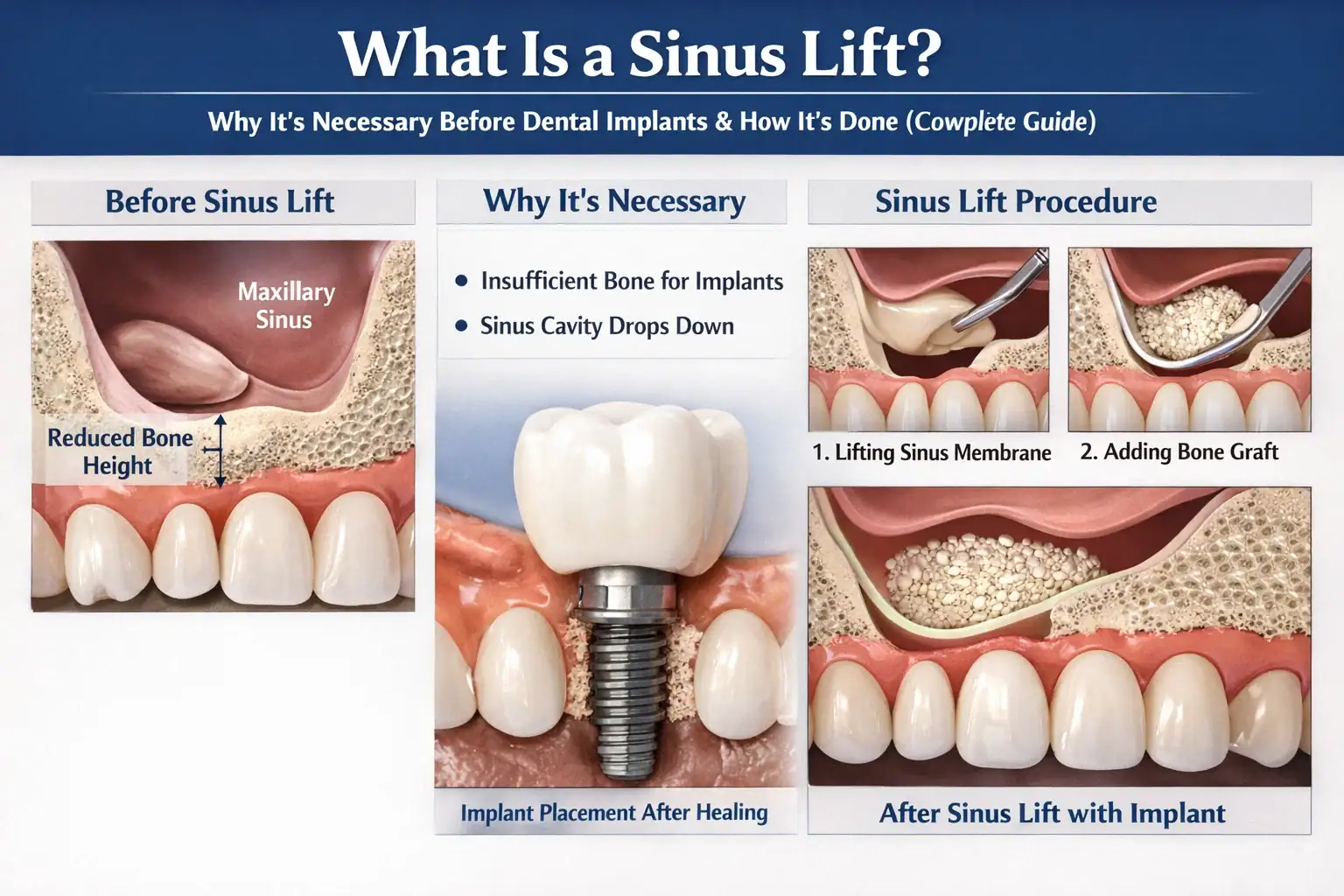
A sinus lift also known as sinus augmentation or maxillary sinus lift is a surgical bone grafting procedure performed on the upper jaw to increase bone height below the maxillary sinus so that dental implants can be placed securely.
The maxillary sinuses are large air-filled spaces located above the back teeth in the upper jaw. When teeth are lost, especially molars and premolars, the bone in this region may shrink over time and the sinus cavity can expand downward. Without sufficient bone height, conventional dental implants cannot be placed safely and securely.
A sinus lift corrects this by gently lifting the sinus membrane and placing bone graft material into the created space, enabling new bone growth and providing a solid foundation for future implants.
The success and long term stability of dental implants heavily depend on the quality and quantity of jawbone at the implant site. Without enough bone:
✔ Implants may fail to integrate with the jaw (avulsion or loosening)
✔ Implant supports may be unstable
✔ Risk of complications increases dramatically
This is especially true in the posterior upper jaw, where bone tends to be thinner and sinuses close to the implant site.
There are two principal approaches to sinus lifting, selected based on existing bone height and surgical needs:
Used when very little bone remains beneath the sinus. A small opening (window) is created on the lateral (side) wall of the sinus. The sinus membrane is lifted and bone graft material is placed underneath it. This creates space and allows new bone growth.
This technique may be performed in a two-stage process: sinus lift first, then implant placement after healing.
Used when some bone already exists but more height is needed. The sinus floor is gently pushed up through the implant preparation site, and graft material is placed simultaneously with implant insertion (if bone amount is nearly sufficient).
Both approaches aim to increase bone volume for safe, stable implant support.
Bone graft materials may include:
✔ Patient’s own bone
✔ Donor bone from tissue banks
✔ Bovine (animal-derived) bone
✔ Synthetic biomaterials
The graft serves as a scaffold that allows the patient’s own bone to regenerate and integrate, ensuring long-term implant support.
A sinus lift increases bone height, enabling the secure placement of implants that otherwise couldn’t be placed.
Adequate bone ensures stronger osseointegration (fusion of implant with jawbone), increasing the implant’s longevity.
With a solid foundation, dental implants can deliver natural chewing and speaking function.
Sinus augmentation contributes to long-lasting implant performance and reduces the risk of implant failure.
Sinus lifts are recommended when:
Before undergoing a sinus lift:
✔ Comprehensive clinical evaluation
✔ CBCT imaging for accurate bone measurement
✔ Medical history review
✔ Discussion of anesthesia and sedation options
A detailed treatment plan ensures the safest outcome and maximizes implant success.
Most patients experience:
✔ Mild swelling
✔ Temporary discomfort
✔ Minor bruising
These symptoms usually peak within the first 48 hours and improve over 7–10 days.
In many cases, 4-9 months of healing time is recommended before implant placement to ensure adequate bone integration.
In some instances, implants can be placed at the same time as the sinus lift (internal approach) if enough bone is present.
Like all surgical procedures, sinus lifting carries potential risks, though they are relatively low when performed by experienced professionals:
✔ Membrane perforation
✔ Infection
✔ Swelling
✔ Minor bleeding
✔ Delayed healing
Your surgeon will discuss risks and aftercare in detail during planning.
At MosDent Hospital, our sinus lifting procedures are personalized using:
Q: What is the main purpose of a sinus lift?
A: To increase bone height in the upper jaw so dental implants can be placed securely.
Q: How long does recovery take?
A: Most healing is complete in 7–10 days; bone integration may take several months.
Q: Is sinus lifting painful?
A: Local anesthesia and sedation minimize pain; most discomfort occurs post-op and is manageable.
Q: Can implants be placed immediately after sinus lift?
A: In some cases yes, depending on bone height and surgical assessment.
When upper jaw bone height is insufficient, a sinus lift is often the most effective way to enable safe, stable, long-lasting dental implant placement. Although it adds time to the treatment process, its benefits — including improved implant stability and long-term success — make it a worthwhile and common procedure in modern implant dentistry.
At MosDent Hospital, sinus lifting is performed with precision, care, and advanced technology to ensure optimal outcomes for patients seeking implant solutions.