Menu

Free Consultation
Most patients exploring dental implant options will never encounter the terms "transnasal" or "subperiosteal." These are not first-line treatments, second-line treatments, or even typical third-line treatments. They occupy a precise clinical niche: the small but significant population of patients for whom every other implant pathway has been exhausted or ruled out.
If you have been told that standard implants are impossible, that zygomatic or pterygoid implants are not suitable for your anatomy, or that your bone loss is simply "too severe" for conventional approaches — this article is written for you.
At MosDent Dental Hospital in Istanbul, we work with patients who arrive having been turned away elsewhere. Understanding the full spectrum of implant solutions including those at the furthest edge of the clinical envelope — is part of how we find a path forward for patients who thought one no longer existed.
To understand when transnasal and subperiosteal implants are needed, it helps to understand the full hierarchy of implant options and where these two systems sit within it.
Level 1 — Standard endosseous implants Placed directly into jawbone. Require 8–10 mm of bone height and adequate width. Suitable for the majority of implant patients. Often combined with bone grafting when bone volume is borderline insufficient.
Level 2 — Angulated or short implants Tilted implant placement (as in All-on-4 and All-on-6 protocols) maximises contact with available bone. Short implants use reduced fixture length in areas of limited height. A sinus lift may augment bone volume for posterior upper jaw placement.
Level 3 — Zygomatic and pterygoid implants Anchor into the cheekbone or pterygoid plate respectively, bypassing severely resorbed upper jaw bone entirely. Eliminate or minimise the need for bone grafting. Covered in detail in our dedicated guides to zygomatic and pterygoid implant options.
Level 4 — Transnasal and subperiosteal implants Reserved for cases where none of the above is anatomically viable. These systems do not rely on traditional osseointegration into the jawbone in the conventional sense. Instead, they work with the bone surface, the nasal cavity walls, or the residual skeletal structure wherever viable anchorage remains.
This hierarchy is not about preference. It is about matching the solution to the anatomy. For the vast majority of patients, levels 1–3 provide excellent outcomes. But for a subset of patients with extreme bone loss, complex anatomy, or specific systemic conditions, level 4 options may represent the only viable pathway to fixed teeth.
A subperiosteal implant is one of the oldest implant concepts in modern dentistry — yet it has experienced renewed clinical interest as a solution for patients with extreme bone loss who cannot receive endosseous implants of any kind.
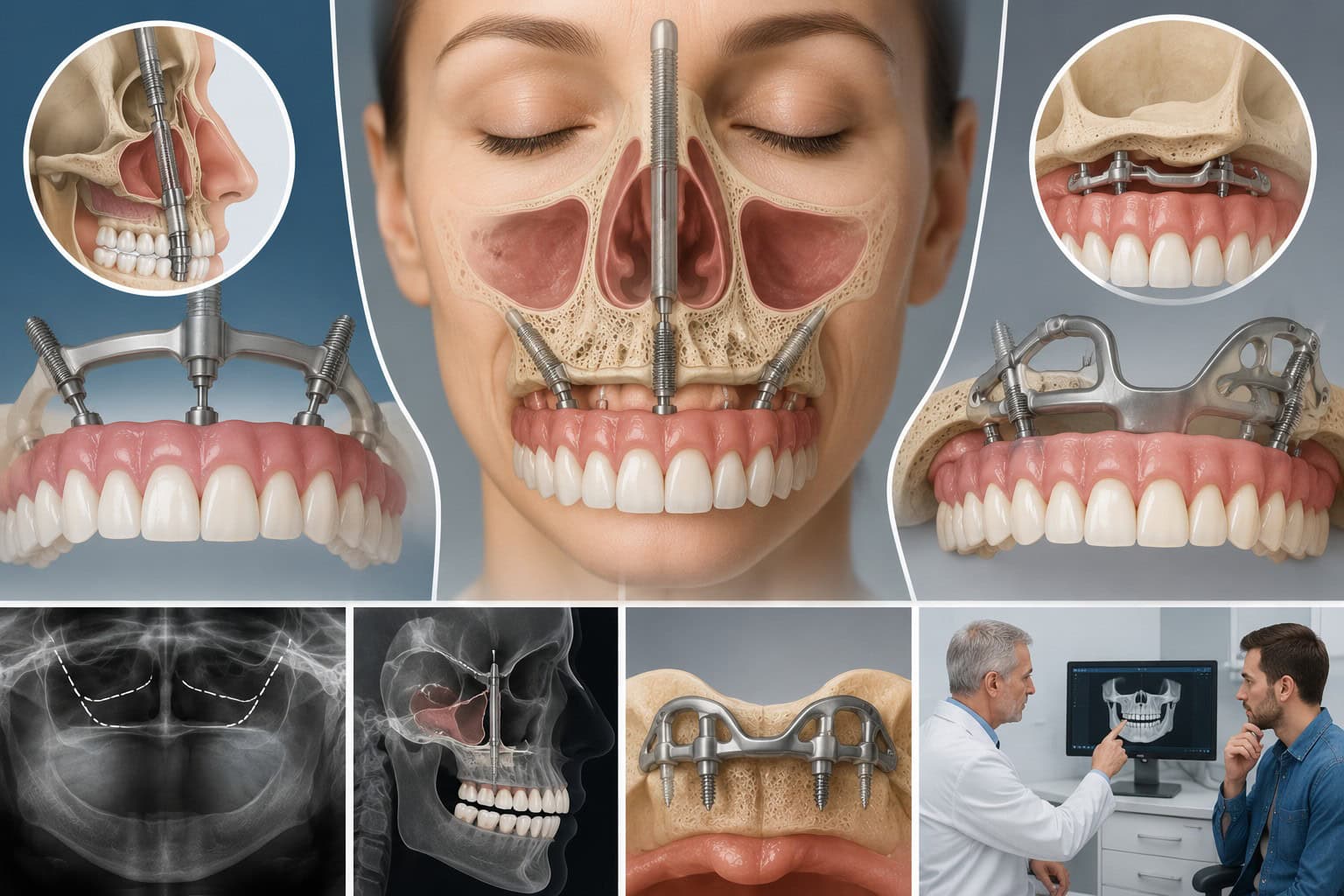
Unlike all conventional implants, a subperiosteal implant does not penetrate into the bone. Instead, a custom-fabricated metal framework historically cast from impressions, now designed using 3D scanning and CAD/CAM technology is placed beneath the periosteum (the dense connective tissue layer covering the bone surface) and on top of the jawbone. Posts project through the gum tissue, and the prosthetic restoration attaches to these posts.
How it works: The periosteum, when elevated and replaced over the framework, grows back around and integrates with it over time. The implant is held in place not by osseointegration in the traditional sense, but by the periosteal attachment and mechanical fit of the framework against the bone surface.
Why it matters today: Early subperiosteal implants common in the 1950s–1980s before endosseous implants were developed had variable long-term outcomes due to limited manufacturing precision. The modern reintroduction of subperiosteal concepts, enabled by CBCT 3D scanning and precision-milled titanium frameworks, has dramatically improved their accuracy, fit, and outcomes.
When is a subperiosteal implant indicated?
The critical requirement for subperiosteal implant success is a thorough 3D assessment of the remaining bone surface geometry. Modern CBCT imaging combined with digital framework design allows the subperiosteal structure to be mapped and fabricated to the patient's exact anatomy before surgery — significantly improving outcomes compared to historical techniques.
The transnasal implant is a less widely known but clinically significant option for specific cases of severe upper jaw bone loss involving the anterior maxilla (the front portion of the upper jaw near the nasal cavity).
As the name suggests, a transnasal implant takes a path through or adjacent to — the nasal cavity wall to achieve anchorage in bone that remains intact in or around the nasal floor and anterior nasal spine, even when the conventional alveolar ridge above the front teeth has completely resorbed.
The anatomical rationale: The bone forming the floor of the nasal cavity — the nasal process of the maxilla and the anterior nasal spine — tends to retain greater density and volume than the alveolar ridge even in patients with advanced bone loss. This bone is structurally accessible via a carefully planned transnasal pathway, giving the implant an anchorage point that standard anterior jaw placement cannot reach.
When is a transnasal implant indicated?
Important clinical nuance: Transnasal implants require precise 3D surgical planning due to proximity to the nasal cavity mucosa and nearby anatomical structures. They are not appropriate for every patient with anterior bone loss careful anatomical evaluation is essential. Our oral and maxillofacial surgery team conducts detailed imaging analysis to assess whether this pathway is viable and safe for each individual.
| Implant Type | Anchorage Site | Bone Graft Needed | Primary Indication |
|---|---|---|---|
| Standard endosseous | Jawbone | Sometimes | Adequate bone present |
| All-on-4 / All-on-6 | Jawbone (tilted) | Rarely | Moderate–severe jaw bone loss |
| Zygomatic | Cheekbone (zygoma) | Rarely | Severe upper jaw resorption |
| Pterygoid | Pterygoid plate | No | Posterior upper jaw bone loss |
| Subperiosteal | Bone surface (on top of) | No | Extreme resorption, no endosseous options |
| Transnasal | Nasal floor / anterior nasal spine | No | Severe anterior upper jaw loss |
This table illustrates why the clinical evaluation particularly 3D imaging is not optional in complex cases. The difference between "zygomatic implant viable" and "subperiosteal required" is determined by precise anatomical measurement, not by clinical impression alone.
For standard implant cases, a panoramic radiograph and clinical examination may be sufficient. For the advanced cases described in this article, cone beam computed tomography (CBCT) — the 3D imaging standard in modern implantology is non-negotiable.
CBCT imaging allows the surgical team to:
At MosDent, every complex implant assessment begins with CBCT imaging and digital treatment planning. Our oral and maxillofacial surgery team reviews the 3D data before any surgical recommendation is made.
Patients who require subperiosteal or transnasal implants have typically experienced significant bone loss and in many cases, that bone loss was driven or accelerated by periodontal disease. Before any advanced implant procedure, the soft tissue environment must be assessed and, where necessary, treated.
Active gum disease creates a bacterial environment that significantly increases the risk of peri-implant complications even for implants that do not rely on conventional osseointegration. A subperiosteal framework resting on inflamed, disease-affected tissue is at high risk of failure regardless of its engineering quality.
MosDent's periodontology team assesses every complex implant candidate before surgery. Where active disease is present, periodontal treatment, gum surgery, or periodontal flap surgery is completed first — creating the stable soft tissue foundation that any successful implant outcome depends upon.
For some patients, the choice between implant options is influenced not just by anatomy but by systemic health factors.
Severe osteoporosis: In patients with advanced osteoporosis, bone density may be insufficient for reliable osseointegration even where bone volume appears adequate. Subperiosteal implants, which do not rely on osseointegration in the traditional sense, may be preferable in these cases. Patients taking bisphosphonates require specific evaluation due to the risk of medication-related osteonecrosis of the jaw.
Previous radiotherapy to the jaw: Irradiated bone heals poorly and has a higher failure rate with conventional implants. Advanced implant options in non-irradiated bone — including zygomatic anchorage in the cheekbone, which is typically outside the radiation field may offer better outcomes.
Failed multiple bone grafts: Patients who have undergone two or more failed bone grafting procedures may be poor candidates for further grafting. Implant systems that circumvent the need for grafting entirely offer a more predictable path.
Uncontrolled systemic disease: Implant surgery of this complexity requires that any relevant systemic conditions be well managed before proceeding.
These factors are always reviewed during the comprehensive assessment process. For patients with complex medical histories, our team coordinates with relevant medical specialists before finalising any treatment plan.
Both subperiosteal and transnasal implant procedures are performed under general anaesthesia or deep sedation, managed by MosDent's anaesthesia team. Given the complexity of the surgery, post-operative recovery is more involved than standard implant procedures but the principles are similar.
First 48–72 hours: Swelling, bruising, and discomfort are expected. Cold compresses, prescribed pain relief, and antibiotics manage this phase. Head elevation during rest reduces swelling.
First two weeks: Soft diet, restricted physical activity, careful oral hygiene around the implant emergence points. No forceful nose blowing.
Weeks 3–8: Gradual return to normal activity. Soft tissue healing progresses; the framework or implant begins integrating with surrounding tissue.
Months 3–6: Final prosthetic restoration placed once integration is confirmed. In some suitable cases, a provisional fixed prosthesis may be fitted at the time of surgery.
Recovery guidance is provided in detail as part of the pre-treatment process. International patients receive specific protocols for managing recovery during and after their return home.
Once subperiosteal or transnasal implant treatment is complete and the definitive prosthesis is in place, patients often pursue aesthetic treatments they have been unable to access for years. Common complementary options include:
Are subperiosteal implants still used today?
Yes and their use is increasing, driven by improved 3D imaging and precision CAD/CAM manufacturing. Modern subperiosteal implants are far more accurate than historical versions and are showing promising long-term outcomes in patients who have no other implant options.
Is a transnasal implant the same as a zygomatic implant?
No. Zygomatic implants anchor into the cheekbone. Transnasal implants anchor into the nasal floor or anterior nasal spine a different anatomical structure, accessed via a different surgical pathway. They address different regions of bone loss.
How long do subperiosteal implants last?
Contemporary subperiosteal implants are too recent in their modern form for long-term outcome data comparable to conventional implants. Historical data from older designs showed variable results; modern precision-milled frameworks are expected to perform significantly better. As with all implants, longevity depends on case selection, surgical execution, and ongoing maintenance.
Can I get fixed teeth on the same day with these implants?
In some cases, yes. Immediate loading of subperiosteal and transnasal implants is case-dependent and at the surgeon's discretion based on stability achieved at the time of surgery.
How do I know if I need these advanced options?
The only way to know is through comprehensive 3D imaging and expert evaluation. If you have been told standard implants are not possible, that is the starting point — not the end point. Contact MosDent to arrange an assessment.
The phrase "you don't have enough bone for implants" is not a definitive verdict. It is a description of the anatomy at one level of the treatment hierarchy and that hierarchy extends further than most patients are told.
Subperiosteal and transnasal implants sit at the frontier of what implant dentistry can achieve for patients with extreme bone loss. They are complex, demanding procedures that require specialist expertise — but for the right patient, they open a door that appeared permanently closed.
If you have been through multiple consultations without a clear path forward, MosDent Dental Hospital invites you to bring your imaging and history to our team. Our comprehensive dental implant approach and specialist oral and maxillofacial surgery team will give you an honest assessment of every option available including the ones you may not yet have heard of.
Contact us to begin.
Published by MosDent Dental Hospital | Istanbul, Turkey | mosdenthospital.com