Menu

Free Consultation
When a patient is told they have "too little bone" for conventional dental implants, it can feel like a dead end. Years of bone loss following tooth extraction, failed dentures, or previously rejected implants leave some patients believing that a fixed, permanent set of teeth is simply out of reach.
Zygomatic implants exist precisely for this scenario — and the question patients ask most often, once they discover this option, is: "But how long will they actually last?"
It is the right question to ask. Any surgical procedure of this complexity demands not just a solution, but a durable one. In this article, we walk through everything the clinical evidence tells us about zygomatic implant longevity, the factors that influence their lifespan, and what patients at MosDent Dental Hospital in Istanbul can realistically expect from this treatment over the long term.
Before addressing longevity, it helps to be precise about what zygomatic implants are because they are fundamentally different from standard dental implants in both design and anchorage.
A conventional dental implant is placed into the jawbone (maxilla or mandible). It typically requires a minimum bone height of 8–10 mm to achieve stable osseointegration. When the upper jawbone has resorbed significantly due to tooth loss, periodontal disease, failed previous implants, or long-term denture wear this bone volume is simply not available, and standard implants cannot be placed without bone grafting procedures that may add six months or more to treatment.
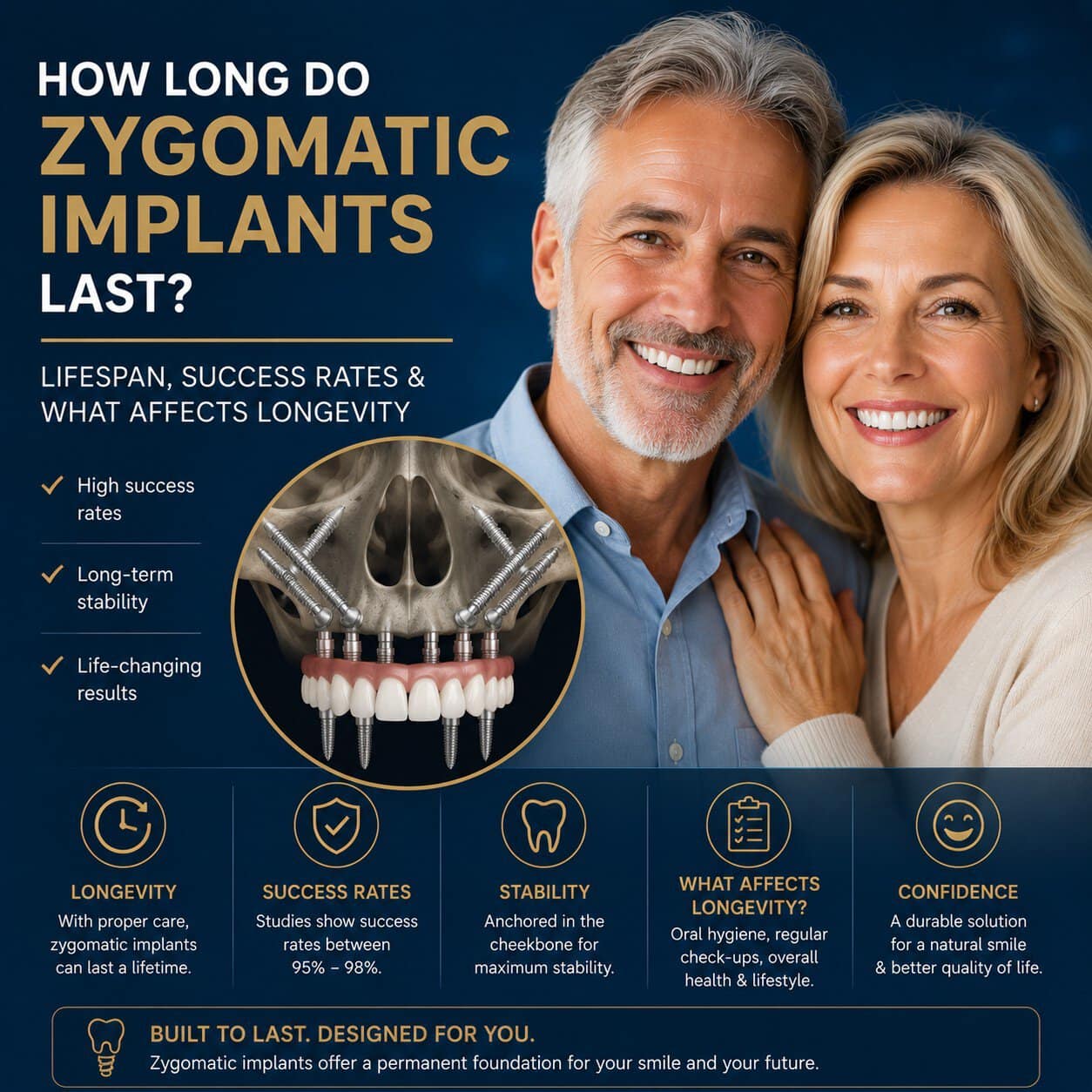
Zygomatic implants bypass this limitation entirely. Rather than anchoring into the upper jaw, they pass through it and anchor into the zygomatic bone the dense, resilient cheekbone that retains its volume and density even when the upper jaw has severely resorbed. Zygomatic implants are longer (typically 30–55 mm) and angled to follow the path from the prosthetic arch through the remaining maxillary bone and into the zygoma.
Because the zygomatic bone is not subject to the same resorption process as the alveolar ridge, it provides an exceptionally stable foundation which is one reason zygomatic implants perform so well over the long term.
The honest answer: zygomatic implants are among the most durable implant solutions in modern dentistry, with published studies supporting survival rates and longevity comparable to — and in some populations, exceeding conventional implants in compromised bone.
Key findings from clinical literature:
To put these numbers in perspective: these are outcomes in patients who were considered unsuitable for conventional implants — often the most challenging cases in implant dentistry. The fact that zygomatic implants achieve survival rates in this range, in patients with severely compromised bone, is a testament to the stability of the zygomatic bone as an anchor.
Expected lifespan in practical terms:
For most patients, zygomatic implants — once successfully integrated — can be expected to function for 15 to 20 years or more. Some patients retain functioning zygomatic implants for 20+ years with no significant complications. As with all implant solutions, the prosthetic components (the prosthetic arch, crowns, or bridge) may require maintenance, adjustment, or replacement over this period, but the implant fixtures themselves are designed for long-term permanence.
A common question is whether zygomatic implants last as long as conventional implants. The comparison requires context.
| Factor | Standard Dental Implants | Zygomatic Implants |
|---|---|---|
| Anchorage site | Jawbone (alveolar ridge) | Cheekbone (zygoma) |
| Suitable bone required | 8–10 mm minimum | Minimal or no upper jaw bone needed |
| Average reported survival (5+ yrs) | 95–98% (healthy bone) | 90–96% (severely resorbed bone) |
| Expected functional lifespan | 15–25+ years | 15–20+ years |
| Bone grafting required | Often (in deficient cases) | Rarely or never |
| Immediate loading possible | Sometimes | Frequently yes |
The key takeaway: in patients with healthy, adequate bone, standard implants achieve slightly higher survival rates — but they are being placed in ideal conditions. Zygomatic implants are placed in the most challenging anatomical circumstances, and they still achieve comparable longevity. For patients who cannot have standard implants without extensive bone grafting, zygomatic implants offer a faster, highly durable alternative.
At MosDent, patients who may be candidates for either approach are assessed with 3D cone beam CT imaging to determine which solution offers the best long-term prognosis for their specific anatomy.
Longevity statistics describe populations, not individuals. What actually determines how long your zygomatic implants last comes down to a combination of surgical factors, biological factors, and lifestyle habits.
Zygomatic implant placement is a demanding procedure. The surgical pathway passes close to critical anatomical structures — the orbital floor, the infraorbital nerve, and the sinus walls. An experienced oral and maxillofacial surgeon with specific training in zygomatic implantology is not optional; it is fundamental to long-term success.
MosDent's oral and maxillofacial surgery team performs zygomatic implant procedures with 3D digital planning, ensuring the implant path is mapped precisely before the first incision.
Peri-implantitis — the inflammatory condition that affects gum and bone tissue around implants — is a primary cause of late implant complications. Patients with active gum disease who proceed to implant surgery without treatment are at significantly elevated risk.
Before any zygomatic implant procedure at MosDent, our periodontology team conducts a full assessment. Active gum disease is treated and in some cases, gum surgery or periodontal flap surgery is performed before implant placement proceeds.
Tobacco use is one of the most significant modifiable risk factors for implant failure. Smoking impairs blood circulation to healing tissues, slows osseointegration, and increases the risk of peri-implantitis. Studies consistently show that smokers have higher rates of implant complications and reduced long-term survival compared to non-smokers.
For patients who smoke, cessation before and after zygomatic implant surgery is strongly recommended and is actively discussed during the treatment planning process at MosDent.
Conditions that affect bone metabolism or immune response particularly uncontrolled diabetes, osteoporosis, and autoimmune diseases can affect osseointegration and long-term implant stability. Patients with well-controlled diabetes can and do achieve excellent implant outcomes, but the emphasis is on controlled. Poorly managed systemic conditions increase complication risk.
Unlike natural teeth, implants cannot develop cavities but they are highly susceptible to peri-implantitis if hygiene is neglected. The soft tissue around the implant emergence point must be kept clean and free of bacterial biofilm. Patients with zygomatic implant-supported fixed arches need a consistent oral hygiene routine: soft-headed electric toothbrush, interdental brushes, and in some cases, a water flosser or specific interdental cleaning tools designed for fixed prosthetics.
The implant fixture anchors in the cheekbone. The prosthetic arch it supports whether an All-on-4 style bridge, an All-on-6 configuration, or a custom full-arch restoration is subject to daily mechanical loads. High-quality materials, precise occlusal design, and regular professional maintenance all extend prosthetic lifespan and protect the implants themselves from excessive mechanical stress.
Zygomatic implants require periodic professional monitoring radiographic checks, soft tissue assessment, prosthetic inspection, and occlusal review. Early detection of any peri-implant changes allows for intervention before complications escalate. Patients who attend regular follow-up appointments consistently outperform those who do not in long-term outcome studies.
One of the most clinically significant advantages of zygomatic implants relevant to both the patient experience and long-term outcomes is their frequent suitability for immediate loading: the placement of a fixed provisional prosthesis on the same day as surgery.
Because zygomatic implants anchor into the dense, stable cheekbone, they can often achieve primary stability sufficient for an immediate provisional arch without waiting for full osseointegration. For patients who have endured years of dentures or tooth loss, walking out of the operating room with a fixed set of teeth the same day represents a profound change in quality of life.
Immediate loading does not compromise long-term outcomes in appropriately selected cases. The provisional arch is designed to function within controlled load parameters while osseointegration proceeds; it is typically replaced with the definitive prosthesis after integration is confirmed.
This approach is frequently combined with All-on-4 and All-on-6 protocols, where zygomatic implants are used to anchor the posterior portion of a full-arch restoration when upper jaw bone is insufficient for posterior standard implants.
Zygomatic implants are not the first-line solution for every patient — but for patients with specific presentations, they are often the optimal path:
Patients who have only moderate upper jaw bone loss may still be good candidates for standard implants — potentially in combination with a sinus lift procedure to augment bone volume. A thorough 3D assessment determines which approach best balances complexity, risk, and expected outcome for each individual.
Once zygomatic implants are integrated and the definitive prosthesis is in place, many patients choose to address remaining aesthetic considerations. Common complementary treatments include:
Can zygomatic implants fail?
Like all implants, zygomatic implants can fail but published data shows failure rates are low when placed by experienced surgeons in appropriate candidates. The most common causes of failure are peri-implantitis, smoking, and uncontrolled systemic disease. These risks can be minimised with pre-treatment assessment and post-treatment care.
Are zygomatic implants painful?
The procedure is performed under general anaesthesia or deep sedation in most centres. Post-operative discomfort is typically managed with prescribed pain relief and resolves within one to two weeks. The recovery is more involved than standard implants due to the surgical scope, but most patients describe it as manageable.
How many zygomatic implants are needed?
Typically two to four zygomatic implants are used one or two per side. They are usually combined with two to four standard implants in the anterior jaw to form a complete full-arch support system.
Do zygomatic implants require bone grafting?
Generally no and eliminating the need for bone grafting is one of their primary advantages. In some cases, a small amount of bone augmentation in the anterior jaw may still be necessary, but the extensive bone grafting associated with standard implant placement in severely resorbed jaws is typically avoided.
Are zygomatic implants available in Istanbul?
Yes. MosDent Dental Hospital offers zygomatic implant treatment as part of its full-arch implant solutions, performed by our oral and maxillofacial surgery team with 3D digital planning. International patients receive full support from first consultation through recovery. Contact MosDent to arrange a free assessment.
Zygomatic implants are not a compromise solution for patients who "can't have real implants." They are a precision-engineered, clinically validated treatment that offers:
For the right patient, zygomatic implants represent not just a last resort but frequently the most direct path to a fixed, permanent smile.
If you have been told you don't have enough bone for conventional implants, explore your options with MosDent Dental Hospital. Our dental implant team and comprehensive implant guide can help you understand whether zygomatic implants are the right solution for your anatomy — and what a lasting result looks like for you.
Published by MosDent Dental Hospital | Istanbul, Turkey | mosdenthospital.com