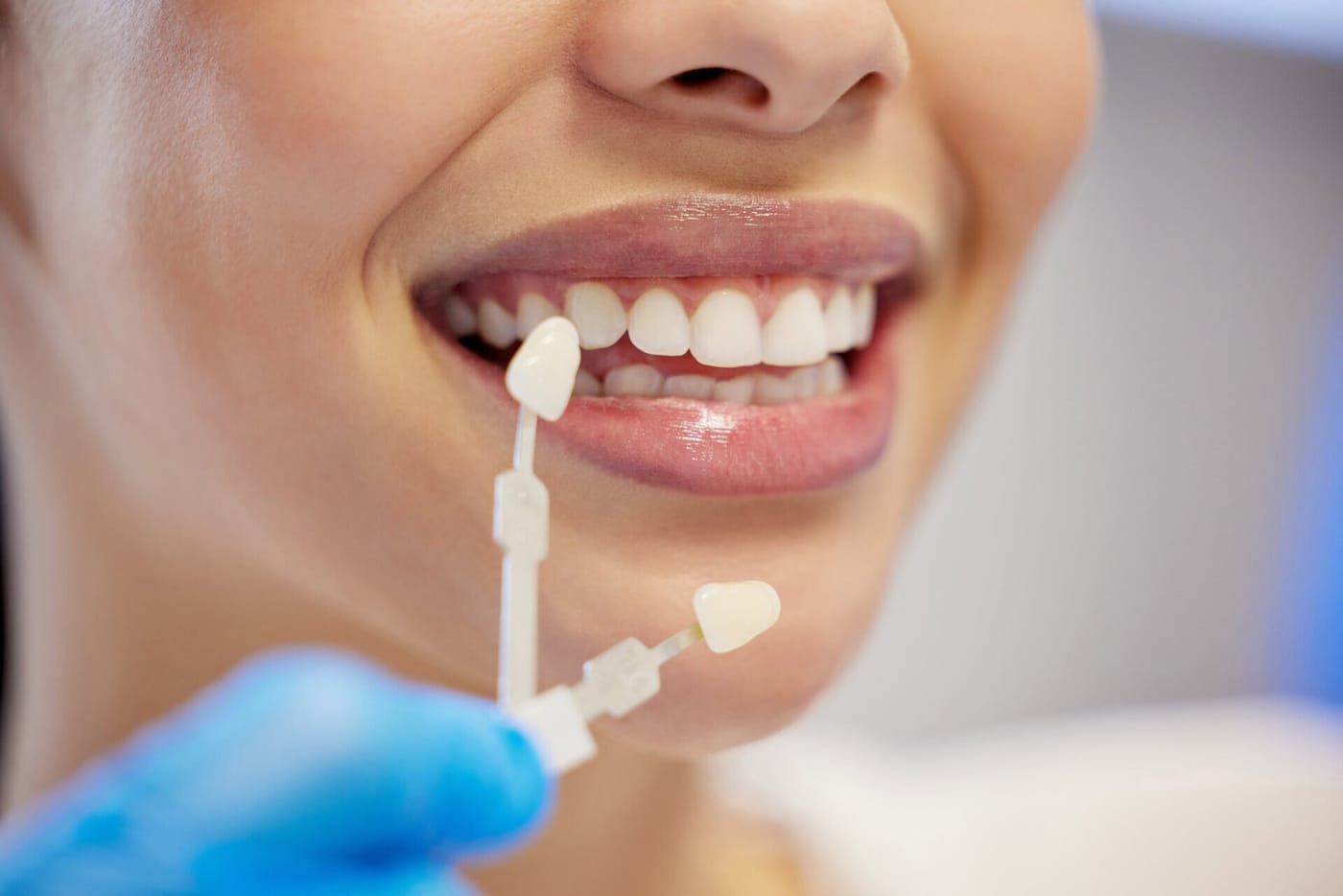
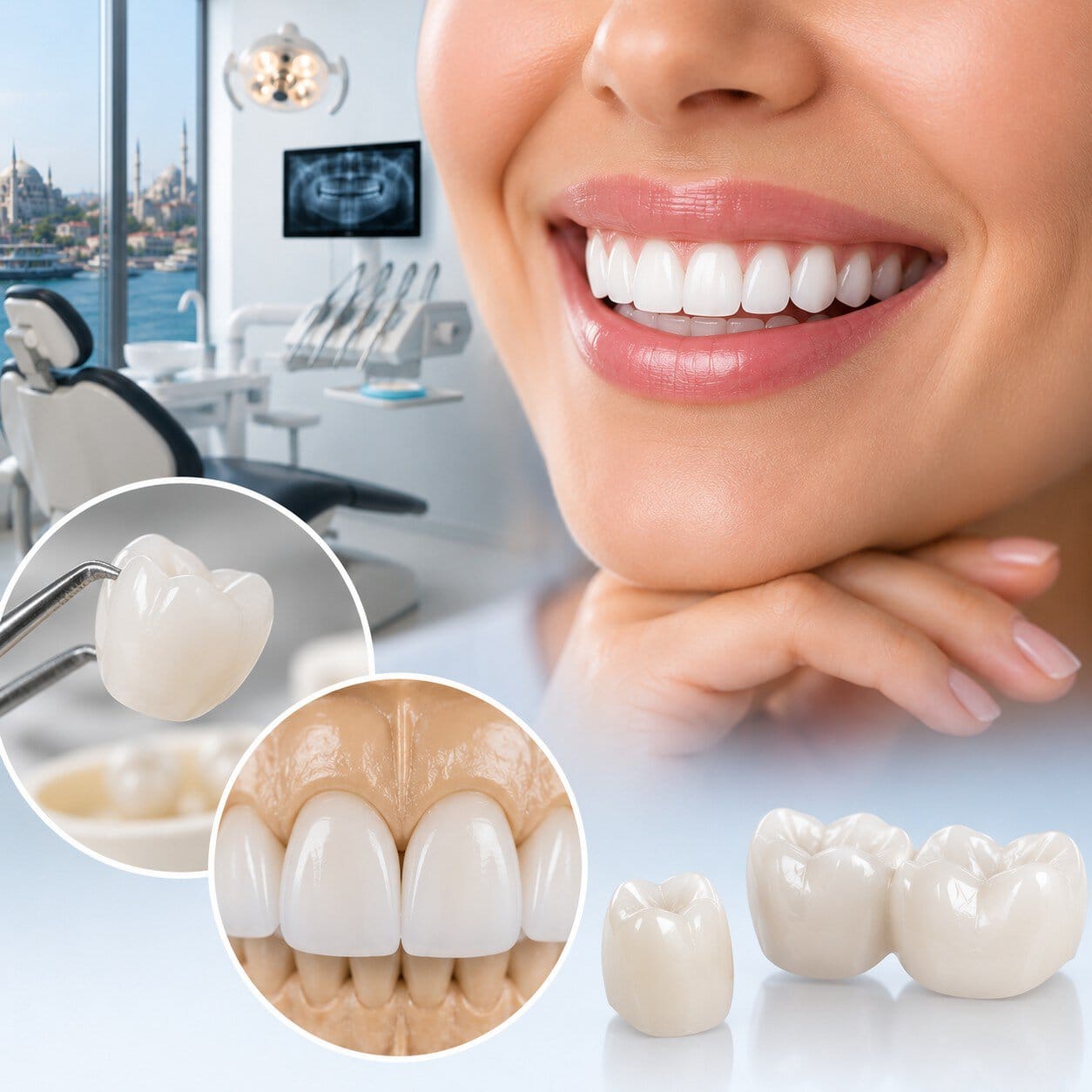
A zirconium front tooth crown is a full-coverage restoration milled from zirconia (zirconium dioxide) ceramic with no metal substructure, which is why its margin cannot expose a grey line as gum tissue recedes. In a meta-analysis of 64 studies covering 3,509 metal-ceramic and 8,051 all-ceramic tooth-supported single crowns, five-year survival was 96.8% for monolithic densely-sintered zirconia, 97.3% for veneered zirconia and 97.1% for metal-ceramic; apart from feldspathic and metal-ceramic crowns, material types performed similarly in anterior and posterior positions (PubMed 41489982). Shade and translucency matching decide how natural the finished crown reads.
- 01Zirconia is the material and the crown is the restoration type: high-translucency formulations raise yttria content to transmit more light, trading a measure of fracture resistance for optical depth in the smile zone.
- 02Five-year survival is close across the main crown materials: 96.8% for monolithic zirconia, 97.3% for veneered zirconia, 97.1% for metal-ceramic and 98.5% for monolithic lithium disilicate in a 64-study meta-analysis (PubMed 41489982).
- 03Position is not the deciding factor for zirconia. Except for feldspathic and metal-ceramic crowns, material and design types performed similarly in anterior and posterior regions in the same analysis (PubMed 41489982).
- 04Monolithic design is what reduces chipping: monolithic lithium disilicate and monolithic zirconia crowns showed significantly fewer ceramic fractures and chips than veneered alternatives (PubMed 41489982).
- 05Long-term monolithic data remain short: a review of 9 studies with 594 patients and 1,657 single-tooth restorations reported survival between 91% and 100%, but with a mean exposure time of only 1.07 years (PubMed 34615842).
A crown on a back tooth is largely a functional decision. A crown on a front tooth is something else entirely it will be visible in every photo, in every conversation, in every mirror. The material you choose for an anterior crown directly shapes how natural your smile looks, how the restoration ages over time, and whether you'll be proud of the result years from now.
So why do so many patients and clinicians now choose zirconium for front teeth, when the material was originally celebrated primarily for its strength in posterior positions?
The answer lies in how dramatically high-translucency zirconium has evolved and in how many advantages it now holds over the alternatives when appearance, longevity, and biocompatibility are all required at once.
At Mosdent Dental Hospital in Istanbul, we place anterior zirconium restorations routinely as part of Hollywood smile treatments, smile makeovers, and individual tooth restoration. This article explains precisely why zirconium has become our primary recommendation for front tooth crowns and the specific situations where an alternative material may be worth discussing.
/ The Unique Demands of a Front Tooth Crown
Before discussing materials, it helps to understand what a front tooth crown must achieve that a molar crown does not.
Aesthetic precision: Front teeth are in the smile zone. Any discrepancy in shade, shape, or surface texture between a crown and the surrounding natural teeth is immediately visible. The margin where the crown meets the gum must be virtually imperceptible.
Light behaviour: Natural anterior teeth are not uniformly opaque. Light passes through them, scatters within the enamel, and creates a depth of appearance that makes them look alive rather than artificial. A good front tooth crown must replicate this optical behaviour not just the colour.
Gumline aesthetics: Over time, gum tissue changes. A crown material that is beautiful today but reveals a dark line at the gumline in ten years is not truly a long-term solution.
Durability without excessive bulk: Front teeth need to be strong enough to withstand biting forces, but the restoration must also be thin enough to look proportionate and natural particularly if minimal tooth preparation was performed.
Zirconium, in its modern high-translucency formulations, addresses all four of these requirements more comprehensively than any competing material at comparable cost and longevity.
/ Reason 1: High-Translucency Zirconia Replicates Natural Enamel Appearance
The earliest zirconia crowns produced in the mid-2000s had a reputation for looking slightly opaque and artificial in the anterior region. That reputation, which still lingers in some patient circles, no longer reflects current material science.
Modern high-translucency zirconia (HT-zirconia and ultra-high-translucency variants like 5Y-TZP) transmits light in a manner that closely approximates natural dental enamel. When fabricated by an experienced ceramist using shade gradients, surface texture characterisation, and appropriate glazing, a contemporary zirconium crown on a front tooth is effectively indistinguishable from a natural tooth to the casual observer, and often to the trained eye as well.
This optical quality is the result of changes to the crystal structure of the zirconia material itself: increasing the yttria content reduces optical opacity while maintaining adequate strength for anterior positions. The tradeoff slightly reduced fracture resistance compared to standard zirconia is clinically insignificant for front teeth, where biting forces are lower than in the molar region.
At Mosdent, our laboratory team selects the specific zirconia formulation based on the patient's shade requirements, the translucency of adjacent natural teeth, and the clinical position of the crown ensuring the material choice is optimised for each individual case.
/ Reason 2: No Dark Line at the Gumline, Ever
This is one of the most practical and enduring reasons to choose zirconium over porcelain-fused-to-metal (PFM) for front teeth.
PFM crowns contain a metal alloy substructure beneath the porcelain layer. As gum tissue naturally recedes with age a process that occurs in virtually every adult to some degree the metal margin of a PFM crown can become visible as a dark or grey line at the gumline. On a front tooth, this is highly visible and difficult to conceal.
Zirconium contains no metal. The material is uniformly white throughout. Even as gum tissue changes over decades, there is no metal to emerge at the margin the crown remains aesthetically consistent regardless of gum level changes.
For patients having front tooth crowns placed in their 30s or 40s, this matters enormously. A zirconium crown placed today should look as clean and natural at the margin in twenty years as it does on the day of fitting. This longevity of aesthetics is something no PFM crown can match.
/ Reason 3: Full Biocompatibility, Ideal for Visible Gum Margins
The front teeth are where gum health and crown aesthetics intersect most visibly. Healthy, pink, well-contoured gum tissue around an anterior crown is as important to the final appearance as the crown material itself.
Metal-containing substructures in PFM crowns can cause localised tissue reactions in sensitive patients contributing to mild inflammation, gum recession, or discolouration of the gum tissue adjacent to the metal margin. These effects are subtle but can accumulate over years.
Zirconium dioxide is fully biocompatible no metal ions, no galvanic reactions, no tissue irritation. Long-term gum health around well-fitted zirconium crowns is consistently better than around equivalent PFM restorations in clinical follow-up studies.
This biocompatibility benefit is amplified in patients undergoing comprehensive smile makeover treatment, where multiple anterior crowns are placed side by side. Consistent gum health across all restoration margins is essential for a unified, natural-looking result and zirconium delivers this most reliably.
Before any crown placement, Mosdent's periodontology team assesses gum health to ensure the tissue environment supports an optimal long-term outcome. Active gum disease is treated first, and pink dental aesthetics procedures are incorporated where gum contouring is needed to frame the restoration correctly.
/ Reason 4: Exceptional Strength Despite Its Thin Profile
A common concern about ceramic materials on front teeth is fragility, particularly under edge-to-edge biting forces or in patients who grind their teeth. This concern is legitimate for older or weaker all-ceramic systems, but not for modern zirconium.
Even high-translucency zirconia maintains fracture toughness significantly above that of traditional feldspathic porcelain or earlier glass-ceramic systems. For anterior positions, where bite forces are substantially lower than in the molar region this strength provides a comfortable margin of safety against chipping and fracture during normal function.
For patients with bruxism (teeth grinding), a custom night guard is still recommended alongside zirconium crowns to protect restorations from nocturnal loading. But the material itself is robust enough for virtually all anterior clinical situations without this representing a structural concern.
/ Reason 5: CAD/CAM Precision, A Perfect Marginal Fit
Every zirconium crown at Mosdent is designed digitally and milled from a precision zirconia block using CAD/CAM technology. This manufacturing approach produces marginal fits the seal between crown and tooth preparation measured in microns.
For front teeth, where the crown margin is often placed at or slightly beneath the gumline for aesthetic reasons, this precision matters enormously. A tight marginal fit means no micro-gap for bacterial accumulation, better long-term gum health at the margin, and reduced risk of secondary decay forming beneath the restoration.
Traditional hand-layered porcelain crowns, while often beautiful, cannot consistently achieve the marginal accuracy of CAD/CAM-milled zirconia. This precision advantage compounds over time a crown placed with a tight fit in 2024 will still have that tight fit in 2034.
/ Reason 6: Long-Term Colour Stability, No Staining
Zirconium is highly resistant to staining from coffee, tea, red wine, and other chromogenic foods and beverages. The glazed surface of a well-finished zirconium crown does not absorb pigment in the way that composite resin restorations do.
For anterior teeth, which are most visible during smiling, eating, and drinking this colour stability is a meaningful long-term advantage. The crown you have placed today should maintain its original shade for decades with normal care.
This stability also makes zirconium an excellent choice when shade matching to natural teeth that have been whitened: the crown shade can be selected to match the whitened teeth with confidence that the crown shade will not shift over time.
/ When Might Emax Be Considered Instead?
A clinically honest discussion of anterior crown materials must include Emax (lithium disilicate glass-ceramic), the primary alternative to zirconium in the anterior aesthetic zone.
Emax offers outstanding optical properties some ceramists and patients feel that the very finest Emax work achieves a marginal visual superiority in cases where maximum light-scattering translucency is the primary goal. In the hands of a highly skilled ceramist, Emax can produce exceptionally lifelike anterior restorations.
However, Emax carries some considerations that make zirconium the more broadly suitable choice for most anterior crown cases:
- Emax has lower fracture resistance than zirconium, making it less suitable for patients with parafunctional habits or edge-to-edge bite relationships
- Emax is not suitable for posterior teeth or bridges without risk of fracture
- In combination treatments where some teeth receive crowns and others receive veneers, zirconium more reliably achieves consistent shade matching across multiple units
At Mosdent, the choice between zirconium and Emax for an anterior crown is made case by case, based on the patient's bite, adjacent tooth characteristics, and aesthetic goals. In some high-aesthetic cases, Emax veneers may be recommended on healthy teeth alongside zirconium crowns on structurally compromised teeth within the same smile design.
/ Zirconium Front Tooth Crowns as Part of a Smile Design
In most comprehensive smile design cases at Mosdent, the final aesthetic result involves a combination of restorations rather than a single crown. Zirconium crowns are placed on teeth that require full structural coverage, root canal treated teeth, severely damaged teeth, or teeth with large existing restorations, while porcelain veneers or laminate veneers are used on healthy teeth requiring only surface correction.
The key to a natural-looking result in these combination cases is precise shade coordination between the zirconium crowns and the adjacent veneers or natural teeth. Our laboratory produces shade gradients and surface characterisation on each zirconium unit to ensure the crown integrates invisibly within the overall smile composition.
For patients considering a complete Hollywood smile transformation, the treatment plan details which teeth receive crowns, which receive veneers, and whether any additional procedures, such as teeth whitening of remaining natural teeth, gum contouring, or implant restoration, are incorporated into the plan.
/ The Process: Getting a Zirconium Front Tooth Crown at Mosdent
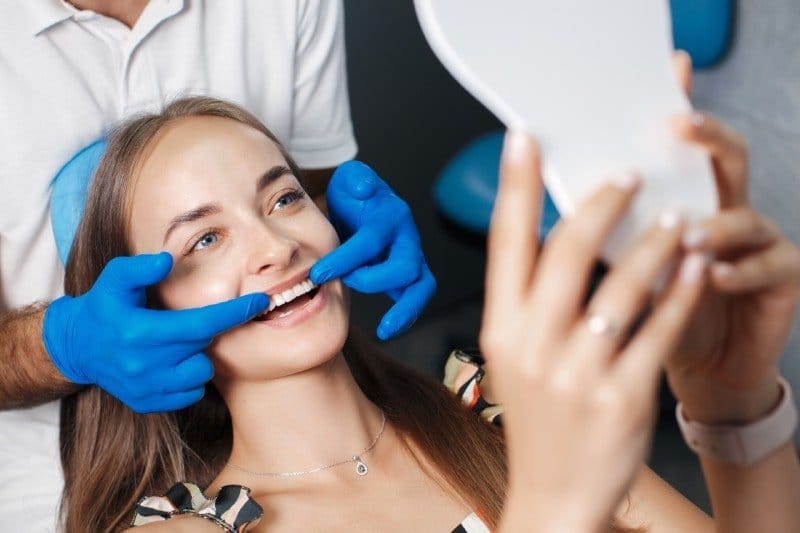
Consultation and digital planning: Photographs, shade assessment, and digital smile design tools create a visual preview of the expected result before any treatment begins.
Tooth preparation: Under local anaesthesia, the tooth is conservatively shaped to accommodate the crown. A temporary crown protects the prepared tooth.
Digital scan and design: A precise digital scan replaces traditional impressions. The crown is designed in three dimensions, with shade gradients and surface texture specified for the ceramist.
CAD/CAM milling and finishing: The crown is milled from a high-translucency zirconia block, then finished and characterised by our ceramist to match the surrounding dentition precisely.
Fitting and cementation: The crown is tried in, adjusted if needed, and permanently bonded. The final result is checked in natural lighting and from multiple angles.
Most single anterior crown cases can be completed within a 5–7 day visit to Istanbul, making the treatment well suited to international patients combining dental care with travel.
/ Frequently Asked Questions
Can zirconium crowns look completely natural on front teeth? Yes. With modern high-translucency zirconium and skilled ceramist finishing, an anterior zirconium crown is effectively indistinguishable from a natural tooth. The quality of the final result depends on both material selection and the experience of the ceramist producing the restoration.
How long do zirconium crowns last on front teeth? Clinical studies report survival rates of 95–97% at five years and above 90% at ten years for anterior zirconium crowns. With proper care, a realistic functional lifespan is 15–25 years or more.
Will a zirconium front tooth crown look different from my natural teeth? Shade-matching and translucency-matching are performed to ensure the crown integrates naturally with adjacent teeth. In well-executed cases, the crown is undetectable without close inspection.
Is a zirconium crown better than Emax for front teeth? Both are excellent anterior materials. Zirconium offers greater strength and is more versatile across different clinical scenarios. Emax may offer a marginal aesthetic advantage in the very highest-demand cases. The choice should be made based on your specific bite, tooth condition, and aesthetic goals.
Can I get a zirconium front tooth crown in Istanbul in one visit? Yes. Most single or multi-unit anterior crown cases can be completed within a 5–7 day visit to Istanbul. Contact Mosdent to discuss your specific treatment timeline.
/ The Right Crown for the Most Visible Teeth You Have
Front teeth are what the world sees when you smile, speak, and laugh. The crown placed on a front tooth will be looked at every day, by you, by everyone around you. The material choice matters more here than anywhere else in the mouth.
Modern high-translucency zirconium provides strength that won't crack under normal use, aesthetics that closely replicate natural enamel, biocompatibility that supports long-term gum health, and colour stability that keeps the result looking fresh for decades. Combined with CAD/CAM precision manufacturing and expert ceramist finishing, it is the most comprehensively capable material available for anterior crown restoration today.
If you are considering a zirconium dental crown for a front tooth in Istanbul, explore Mosdent's full range of aesthetic dentistry services or contact our team for a free consultation and personalised treatment plan.
Let’s plan the right treatment together.
Free Assessment→- 1.Pjetursson BE, Pitta J, Balet A, Bjarnadottir GR, Sailer I, Romandini P. A Systematic Review and Meta-analysis Evaluating the Survival, Failure, and Complication Rates of Metal-Ceramic, Veneered, and Monolithic All-Ceramic Tooth-Supported Single Crowns-Part 1. Int J Prosthodont 2026;39:308-324. PubMed 41489982
- 2.Leitão CIMB, Fernandes GVO, Azevedo LPP, Araújo FM, Donato H, Correia ARM. Clinical performance of monolithic CAD/CAM tooth-supported zirconia restorations: systematic review and meta-analysis. J Prosthodont Res 2022;66:374-384. PubMed 34615842