Menu

Free Consultation
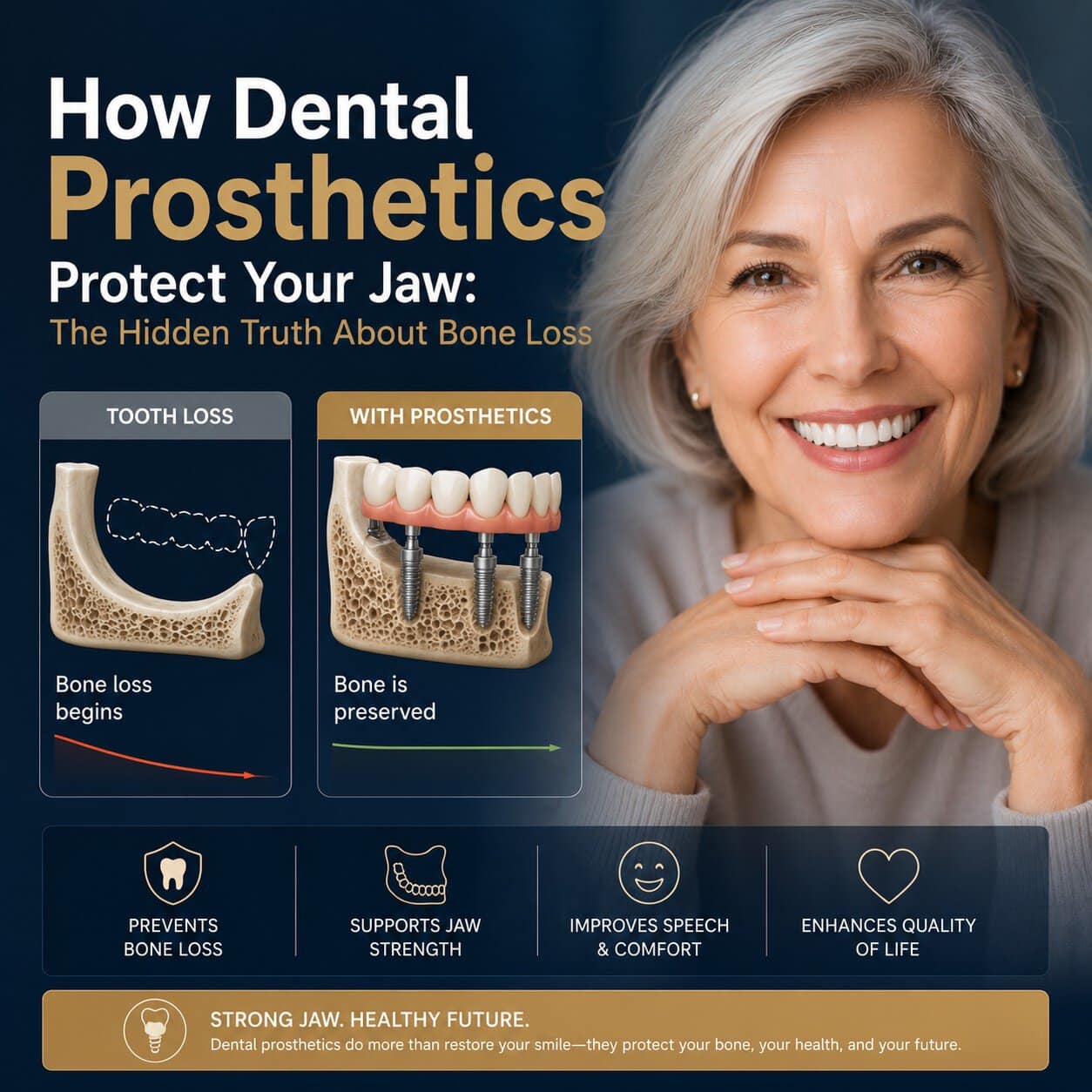
Most people associate tooth loss with one visible consequence: a gap in their smile. What they don't see — and what no mirror can show them — is what happens beneath the gumline in the months and years that follow.
When a tooth is lost, the jawbone beneath it begins to shrink. Quietly. Progressively. And in many cases, irreversibly — unless the right prosthetic solution is put in place.
This is the hidden story behind dental prosthetics. They are not simply replacements for missing teeth. The right prosthetic can preserve the structural integrity of your jawbone, maintain your facial profile, and protect decades of future oral health. The wrong choice — or no choice at all — can accelerate a process that changes not just your mouth, but your face.
At MosDent Dental Hospital in Istanbul, we have been guiding patients through these decisions since 1992. In this article, we explain exactly what happens to your jaw after tooth loss, how different prosthetic options respond to that challenge, and what the science says about long-term bone protection.
To understand why prosthetics matter for jaw health, you first need to understand what keeps a jawbone healthy in the first place.
Every time you bite or chew, the root of your tooth transmits mechanical force into the surrounding bone. That force is the signal the jawbone needs to maintain its density and volume. Without it, the bone receives no reason to sustain itself — and begins a process called resorption: the gradual breakdown and shrinkage of bone tissue.
The timeline is sobering. Research consistently shows that the jawbone can lose up to 25% of its width in the first year following a tooth extraction. Over five to ten years without intervention, the bone loss can be so severe that it alters the shape of the lower face — causing the cheeks to appear sunken, the lips to thin, and the chin to rotate forward. This is the characteristic appearance often associated with long-term denture wearers.
It is worth emphasising: this is not an inevitable consequence of ageing. It is the direct result of unaddressed bone resorption following tooth loss. And it is largely preventable with the right prosthetic solution.
Removable dentures have been the standard solution for complete or near-complete tooth loss for over a century, and they remain a valuable option for many patients. However, their relationship with jawbone health is one that requires honest discussion.
How removable dentures interact with the jawbone:
Traditional full dentures rest on the gum tissue and are held in place by suction, adhesive, or both. They do not transmit chewing forces into the jawbone the way natural tooth roots do. Instead, the force of chewing is distributed across the soft tissue of the gums — and in some cases, directly compresses the ridge of the jawbone.
The practical result is that resorption continues uninterrupted beneath a full denture. The jawbone has no mechanical reason to maintain its volume, and so it continues to shrink. Over time, this shrinkage itself becomes a problem for the denture: as the bone ridge flattens, the denture loses its fit, shifting during eating and speaking, and requiring relining or replacement.
This is not a minor inconvenience. Many long-term denture wearers find that by the time they seek implant treatment, the bone volume available for implant placement has been significantly reduced by years of denture-related resorption — making treatment more complex and sometimes requiring bone grafting before implants can be placed.
Removable dentures are a legitimate, accessible option — particularly for patients who are not candidates for implant surgery. But patients who choose them should do so with a clear understanding of the long-term implications for jaw structure.
Fixed bridges — where two healthy adjacent teeth are prepared as abutments and a prosthetic tooth (or teeth) is suspended between them — offer a stable, non-removable solution that performs better than removable dentures in terms of chewing efficiency and comfort.
However, from a jawbone preservation standpoint, bridges share an important limitation with removable dentures: the missing tooth's root is not replaced. Chewing forces travel through the abutment teeth on either side, but the bone beneath the pontic (the suspended artificial tooth) receives no direct stimulation. Resorption continues in that specific area, even as the surrounding bone remains intact.
There is an additional consideration. Preparing healthy adjacent teeth as bridge supports requires the permanent removal of healthy tooth structure — a trade-off that is irreversible. For patients with otherwise sound neighbouring teeth, this represents a cost worth carefully weighing.
For cases where fixed bridges are appropriate, zirconium dental crowns and Emax ceramic restorations offer excellent aesthetic and functional outcomes. These materials can be shade-matched with exceptional precision and provide durable, natural-looking results. However, the underlying bone limitation remains regardless of the restoration material.
This is the fundamental distinction that separates dental implants from every other prosthetic option: implants replace not just the crown of the tooth, but its root.
A titanium implant post is placed directly into the jawbone. Over the following weeks and months, the bone tissue grows around and bonds to the implant surface — a process called osseointegration. Once complete, the implant functions biomechanically like a natural tooth root: every time you bite or chew, the implant transmits force into the surrounding bone, providing exactly the stimulation the bone needs to maintain its density and volume.
The clinical evidence for implant-based bone preservation is well established. Studies show that patients with implants maintain significantly more bone volume at implant sites than patients with unrestored tooth loss or traditional dentures. The bone does not simply stop shrinking — it receives the same type of physiological signal that natural teeth provide.
This is why dental implant treatment is increasingly considered the gold standard for tooth replacement — not just for its aesthetic and functional benefits, but for its role in preserving the structural foundation of the face.
For a comprehensive overview of all implant options and candidacy criteria, MosDent's complete dental implant guide covers every stage of the treatment process.
For patients with complete or near-complete tooth loss, single-implant replacement of every missing tooth is not always practical. Full-arch implant systems — All-on-4 and All-on-6 — address this by supporting an entire fixed arch of prosthetic teeth on just four or six strategically placed implants.
All-on-4: Four implants — two placed vertically at the front, two angled at the rear — support a full arch of fixed teeth. The angled placement of the posterior implants maximises contact with available bone, which is why All-on-4 frequently eliminates the need for bone grafting even in patients with moderate bone loss. The result is a fully fixed, non-removable set of teeth that stimulates the jawbone across the entire arch.
All-on-6: Six implants provide a broader base of support, improving load distribution and long-term stability. All-on-6 is particularly well suited to patients with higher bite forces or those where additional anchorage points are beneficial for the prosthetic design.
Both solutions represent a transformative improvement over traditional full dentures in terms of jawbone preservation, facial structure maintenance, and quality of life. Patients who have worn full dentures for years often describe the difference as profound — not just in what they can eat, but in how their face looks and feels.
For patients who are not yet ready for or eligible for implant surgery, implant-supported overdentures represent an intermediate option: removable prosthetics that clip onto implants, providing better stability than adhesive dentures and some degree of bone stimulation at the implant sites.
A common concern for patients who have lived with tooth loss or worn dentures for years is whether too much bone has been lost for implants to be possible. In many cases, this concern can be addressed.
Bone grafting is a surgical procedure that rebuilds jawbone volume in areas where resorption has occurred. Graft material — sourced from the patient's own body, from a bone bank, or from synthetic sources — is placed in the deficient area and, over several months, integrates with the existing bone to create a stable foundation for implant placement.
For cases where upper jaw bone loss is particularly severe, zygomatic implants — which anchor into the cheekbone (zygoma) rather than the upper jaw — may eliminate the need for bone grafting entirely.
The availability of these advanced solutions means that bone loss, while it complicates treatment, rarely makes implant treatment impossible. A 3D cone beam CT scan, which MosDent performs as part of every implant assessment, gives the clinical team precise measurements of available bone volume — and allows for a treatment plan tailored specifically to your anatomy.
Our oral and maxillofacial surgery team handles complex bone regeneration cases as a routine part of implant preparation, often working alongside our periodontology specialists to ensure both the bone and soft tissue foundation are optimised before any prosthetic work begins.
Jawbone preservation does not happen in isolation. The health of the gum tissue surrounding implants and remaining teeth plays a critical role in long-term outcomes.
Peri-implantitis — inflammation of the gum and bone tissue around an implant — is one of the leading causes of late implant failure. Like periodontal disease around natural teeth, it is driven by bacterial accumulation and, if untreated, can result in progressive bone loss around the implant itself.
This is why MosDent's approach to implant treatment includes a mandatory periodontal assessment before any surgical work begins. Patients with active gum disease receive periodontology treatment first — and in some cases, gum surgery or periodontal flap surgery — to establish a stable soft tissue environment before implants are placed.
For patients who also have aesthetic concerns about gum appearance, pink dental aesthetics procedures can reshape and recontour gum tissue to create a harmonious frame for the new restoration.
| Prosthetic Type | Root Replacement | Bone Stimulation | Bone Loss Prevention | Removable |
|---|---|---|---|---|
| Full removable denture | No | None | No — loss continues | Yes |
| Traditional dental bridge | No | Partial (abutments only) | Limited | No |
| Single dental implant | Yes | Full (natural root equivalent) | Yes | No |
| All-on-4 implants | Yes (4 points) | Full across arch | Yes | No |
| All-on-6 implants | Yes (6 points) | Full across arch | Yes | No |
| Implant-supported overdenture | Yes (2–4 points) | Partial | Partial | Yes |
Many patients, once their jawbone health and tooth function are restored through implant treatment, choose to address remaining aesthetic concerns. Common complementary treatments include:
Can dentures cause jaw bone loss?
Traditional removable dentures do not prevent bone loss — and the pressure they place on the gum ridge can actually accelerate resorption in some cases. Implant-based solutions are the only prosthetics that actively stimulate the jawbone and slow or prevent further bone loss.
How quickly does jaw bone loss happen after tooth extraction?
Research shows the jawbone can lose up to 25% of its width in the first 12 months following an extraction. This is why early intervention — ideally within the first few months after tooth loss — gives the best outcomes for bone preservation.
Is it too late to get implants if I've worn dentures for years?
Not necessarily. Bone grafting can rebuild volume in many cases. A 3D scan is the only way to assess your specific situation accurately. Contact MosDent for a full evaluation.
Do All-on-4 implants prevent bone loss across the whole jaw?
All-on-4 implants stimulate the jawbone at four anchor points and distribute chewing forces across the entire arch. Clinical evidence shows significantly better bone preservation compared to traditional full dentures.
Does gum disease affect implant success?
Yes. Active gum disease must be treated before implants are placed. Untreated periodontal disease significantly increases the risk of peri-implantitis and implant failure. MosDent's treatment protocol always includes a periodontal assessment before implant surgery.
The decision about which prosthetic is right for you involves more than aesthetics — it involves the long-term structural health of your face. Whether you are exploring options following a recent extraction or have been living with tooth loss for years, the earlier you act, the more bone you preserve.
Explore MosDent's full range of dental implant solutions or contact our team for a free consultation. We will assess your bone health, discuss every option available to you, and help you make a decision that protects not just your smile — but the foundation beneath it.
Published by MosDent Dental Hospital | Istanbul, Turkey | mosdenthospital.com