Menu

Free Consultation
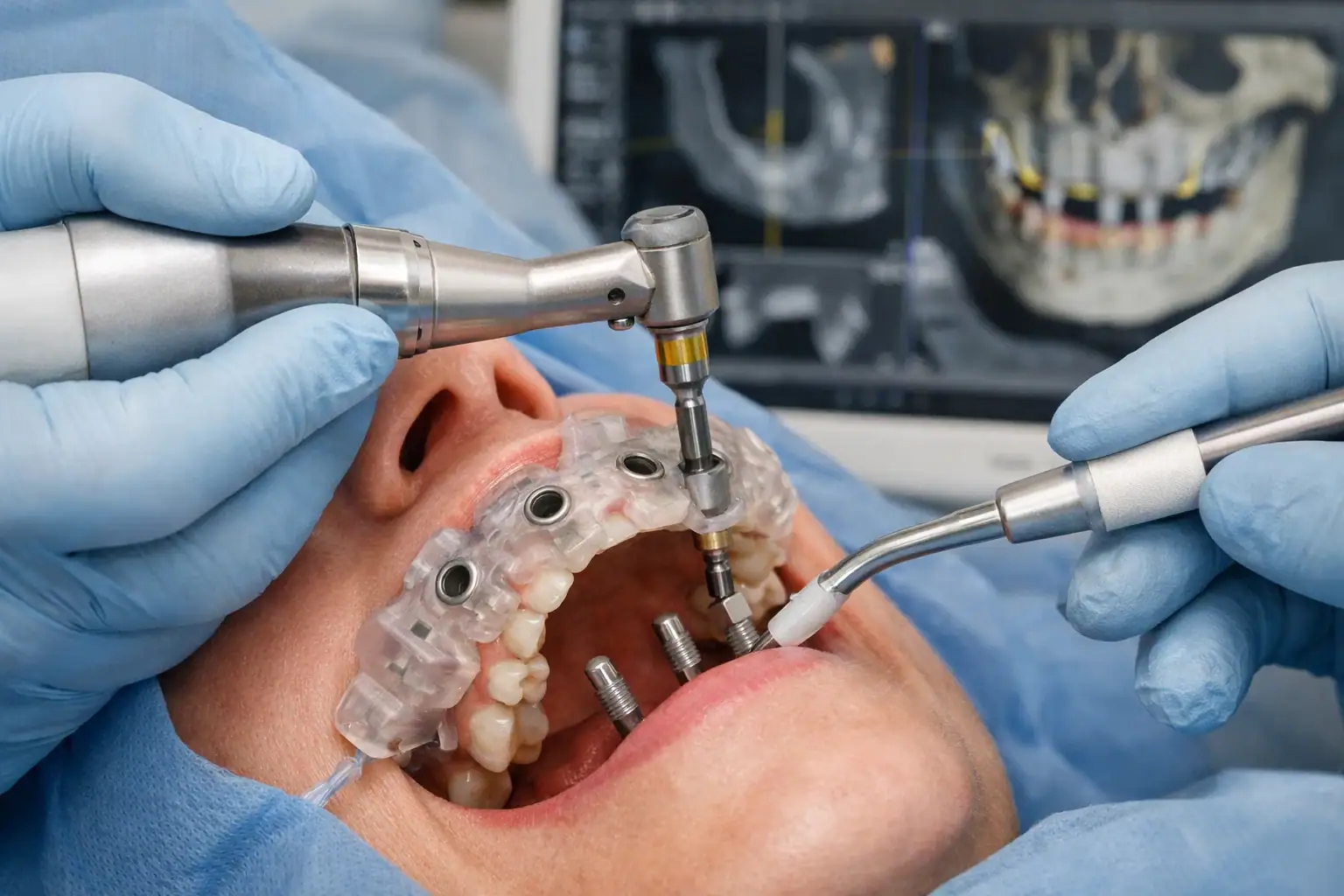
Dental implantology has evolved significantly over the last decade. One of the most advanced and precise techniques available today is guided implant surgery, also known as computer-guided implant surgery. This modern approach allows dental implants to be placed with exceptional accuracy, safety, and predictability.
In this in-depth guide, you will learn:
Guided implant surgery is a digital dental implant technique where implants are placed using a custom-made surgical guide, designed with advanced 3D imaging and planning software.
Instead of placing implants freehand, the dentist follows a pre-planned digital roadmap, ensuring the implant is positioned at the exact:
This technique dramatically improves precision and reduces surgical risks.
Guided implant surgery is also referred to as:
All describe the same technology-driven approach.
Guided implant surgery combines digital dentistry, 3D imaging, and custom surgical guides.
A surgical guide is a transparent, custom-made template that fits over the patient’s teeth or gums. It contains small openings that guide surgical instruments during implant placement.
Types of surgical guides:
Guided implant surgery ensures:
This minimizes human error and improves long-term success.
Critical anatomical structures such as:
are clearly visualized and avoided.
In many cases:
This leads to faster healing.
Patients often experience:
Implants are placed according to the final crown position, not just available bone.
This results in:
| Feature | Guided Implant Surgery | Freehand Implant Surgery |
|---|---|---|
| Planning | Fully digital | Visual & manual |
| Accuracy | Extremely high | Operator-dependent |
| Surgical time | Shorter | Longer |
| Risk level | Lower | Higher |
| Invasiveness | Minimal | More invasive |
| Learning curve | Technology-based | Experience-based |
Guided implant surgery is ideal for:
✔ Patients seeking maximum precision
✔ Complex implant cases
✔ Full-arch implant treatments
✔ Immediate implant placement
✔ Patients with limited bone volume
✔ Patients wanting minimally invasive surgery
Although highly versatile, guided implant surgery may not be recommended for:
This technique is especially valuable in:
Guided planning allows multiple implants to be placed simultaneously with high precision.
No. Guided implant surgery is typically:
Because it is minimally invasive, patients often report less discomfort compared to traditional implant surgery.
In some cases, same-day implants and temporary teeth are possible.
Typical recovery timeline:
Healing is often faster due to reduced trauma.
Clinical studies show success rates of:
Accuracy and digital planning significantly improve outcomes.
While highly effective, guided implant surgery has some limitations:
❌ Higher initial planning cost
❌ Requires advanced technology
❌ Dependent on accurate data acquisition
However, these are outweighed by the benefits in most cases.
Costs vary depending on:
Although initial cost may be higher, long-term value is excellent due to fewer complications.
In some cases:
This improves predictability even in challenging cases.
Guided implant surgery offers:
Myth: It’s only for complex cases
Truth: It benefits simple cases too
Myth: It replaces dentist skill
Truth: It enhances expertise, not replaces it
Yes, due to digital planning and precision.
In many cases, yes (flapless surgery).
No medical procedure is 100% guaranteed, but success rates are very high.
For most patients, absolutely yes.
Guided implant surgery represents the future of implant dentistry by combining:
✔ Digital precision
✔ Patient comfort
✔ Predictable results
✔ Advanced technology
For patients seeking safe, accurate, and minimally invasive implant treatment, computer-guided implant surgery is one of the best options available today.
Guided implant surgery allows dentists to place implants with unmatched accuracy and confidence, leading to: