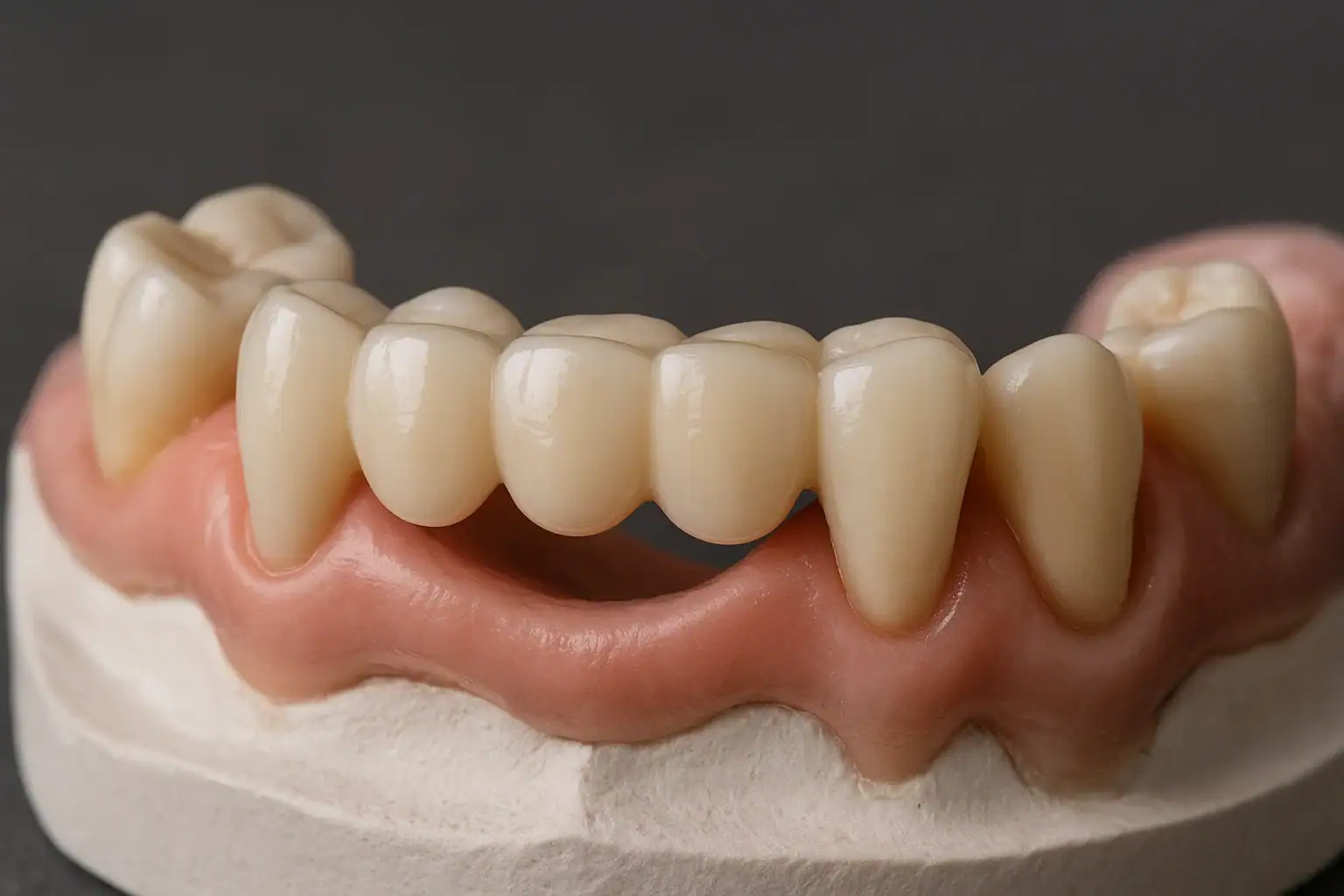
A 5-tooth bridge, also called a 5-unit bridge, is a single fixed restoration spanning five crown positions, most often three artificial teeth called pontics carried by two prepared abutment teeth, or the same span carried by 2 to 4 implants. It is cemented or screw-retained, so it is not removed at home. In a 2026 systematic review of 41 studies covering 600 metal-ceramic and 1,532 all-ceramic bridges, 5-year survival was 91.3 percent for metal-ceramic and 92.9 percent for veneered zirconia, and 71.0 percent of restorations stayed free of any complication over 5 years (PubMed 41650383).
- 01The standard design is 3 pontics plus 2 abutments; an implant-supported version uses 2 to 4 implants with a healing period of 8 to 16 weeks before the framework is fitted, and a cantilever variant with 4 pontics on 1 abutment is used only rarely.
- 02Material choice moves the odds measurably. Across 41 studies covering 600 metal-ceramic and 1,532 all-ceramic bridges, 5-year survival was 92.9 percent for veneered zirconia, 91.3 percent for metal-ceramic, 88.4 percent for glass-infiltrated alumina, 87.9 percent for monolithic zirconia and 82.5 percent for lithium disilicate, the only material significantly below metal-ceramic (PubMed 41650383).
- 03Framework fracture exceeded 10 percent over 5 years for lithium disilicate and glass-infiltrated alumina bridges, which is why weaker ceramics are not used for long spans (PubMed 41650383).
- 04Retention loss and marginal caries are recurring complications: all-ceramic bridges showed higher rates of marginal caries and loss of retention than metal-ceramic ones (PubMed 41650383), and the earlier 40-study review reported the same pattern for zirconia (PubMed 25935732).
- 05Halitosis has a clinical definition, chronic bad breath beyond normal morning odour, and three categories: genuine halitosis, objectively detectable; pseudo-halitosis, believed but not detectable; and halitophobia, persistent fear of odour after treatment.
/ Introduction
Missing several adjacent teeth affects more than just your smile. It impacts how you chew, speak, and even how your face is supported. A 5-tooth bridge (also called a 5-unit dental bridge ) is a reliable way to replace multiple missing teeth with a single, fixed restoration.
In this guide, we’ll explore:
- What a 5-tooth bridge is
- The different types (including implant-supported )
- The procedure step by step
- The cost of a 5-tooth bridge in various contexts
- Longevity and maintenance
- The connection between bridges and halitosis (bad breath), including halitosis meaning, halitosis causes, and how to remove, eliminate, prevent, or stop halitosis
/ What Is a 5-Tooth Bridge?
A dental bridge spans gaps left by missing teeth by anchoring artificial teeth ( pontics ) to natural teeth or implants ( abutments ).
A 5-tooth bridge typically includes:
- 3 pontics + 2 abutments (traditional design)
- Implant-supported designs using 2–4 implants
- Rarely, 4 pontics + 1 abutment (cantilever), if anatomy allows
When Is It Recommended?
- Multiple missing teeth in a row
- Patients seeking a fixed alternative to removable dentures
- Adequate strength of abutment teeth or sufficient bone for implants
/ Historical Background
- Ancient times: Etruscans (700 BC) used gold bands and animal teeth.
- 20th century: Porcelain-fused-to-metal (PFM) became dominant.
- 21st century: Zirconia, e.max ceramics, and CAD/CAM workflows created stronger, more aesthetic bridges.
/ Types of 5-Tooth Bridges
1. Traditional Tooth-Supported Bridge
- Abutments are reshaped for crowns; pontics span the gap.
- Pros: Reliable, no surgery required.
- Cons: Sacrifices healthy tooth structure; long spans stress abutments.
2. Implant-Supported 5-Unit Bridge
- 2–4 implants support the span.
- Pros: Preserves natural teeth, prevents bone loss, excellent durability.
- Cons: Requires surgery, healing time, and higher upfront cost.
3. Cantilever or Maryland Variants
Rarely used for long spans. Typically suited for smaller gaps.
/ Materials
- Zirconia: unmatched strength, especially for molars.
- Lithium disilicate (e.max): highly aesthetic ; best for visible areas.
- PFM: strong but less aesthetic; risk of gray gum line.
- ZLS (Zirconia-Reinforced Lithium Silicate): blends translucency with resilience.
Most five-unit spans we make in Istanbul are milled from zirconia for exactly that reason. The material grades, the shade process and the fitting visits are set out on our zirconium dental crown page, and the wider fixed and removable range sits under prosthodontics.
/ Planning Process
- Comprehensive exam: X-rays/CBCT, bite analysis, gum health.
- Treatment planning: choose between tooth-supported or implant-supported.
- Smile design: digital previews for aesthetics.
- Address pre-treatments: periodontal therapy, extractions, grafting.
/ Step-by-Step Procedure
Tooth-Supported Bridge
- Preparation of abutment teeth
- Impressions or digital scans
- Temporary bridge
- Lab fabrication and try-in
- Permanent cementation
Implant-Supported Bridge
- Implant placement (2–4 implants)
- Healing (8–16 weeks)
- Abutment placement and impressions
- Framework try-in
- Final delivery (cemented or screw-retained)
/ Cost of a 5-Tooth Bridge
Key Cost Factors
- Material (zirconia vs. PFM vs. e.max)
- Number and condition of abutments/implants
- Diagnostic imaging and temporary bridge
- Dentist and lab expertise
- Geographic location
Tooth-Supported Cost
Often lower initial cost but may require future work on abutments.
Implant-Supported Cost
Higher initial investment, but preserves teeth and may last longer.
Global Comparison
- U.S.: Highest range
- Europe: Moderate, zirconia common
- Turkey/Hungary/Eastern Europe: Popular dental tourism destinations
- Asia: Affordable options with modern technology
Insurance & Financing
- Coverage depends on whether it’s medically necessary .
- Cosmetic-only cases often not covered.
- Financing and staged treatment can spread costs.
FAQ Answer: How much does a 5-tooth bridge cost?, It varies widely. Always request a written, itemized estimate.
/ Longevity: How Long Does It Last?
- Average lifespan: 10–15 years
- With proper care: 15–20+ years
- Implant-supported bridges can last decades
Factors influencing longevity:
- Oral hygiene at margins and under pontics
- Bite forces (grinding shortens lifespan)
- Use of nightguards
- Gum health and diet
/ Cleaning and Maintenance
Daily care is crucial to prevent decay, gum issues, and halitosis breath .
- Brush twice daily with fluoride toothpaste
- Floss or use superfloss/threaders under pontics
- Water flossers for flushing debris
- Alcohol-free antibacterial rinses
- Professional cleanings every 6 months
/ Halitosis and 5-Tooth Bridges
Halitosis Meaning
The clinical term for chronic bad breath, beyond normal morning odor.
Halitosis Causes
- Tongue coating with bacteria
- Gum disease
- Food debris under bridges
- Dry mouth
- Systemic conditions: sinus issues, reflux, diabetes
Connection with Bridges
- Poor cleaning under pontics leads to odor
- Overhanging or poorly contoured designs trap plaque
- Inflamed gums around abutments worsen odor
Types of Halitosis
- Genuine halitosis : objectively detectable
- Pseudo-halitosis : patient believes they have odor, but none is detected
- Halitophobia : persistent fear of bad breath
How to Remove Halitosis
- Immediate: brush, floss under bridge, tongue scrape, rinse, hydrate
- Long-term: fix rough margins, treat gum disease, perfect hygiene
- Prevention: nightly cleaning under pontics, water flossers, routine checkups
- Stop permanently: address systemic causes with medical evaluation
/ Warning Signs
A 5-tooth bridge may need attention if you notice:
- Persistent halitosis breath
- Gum bleeding or swelling
- Food consistently trapped under pontics
- Chips, cracks, or loose feeling in the bridge
- Pain or sensitivity around abutments or implants
/ Psychological and Social Benefits
- Restores facial structure and aesthetics
- Improves speech clarity
- Boosts confidence in social and professional life
- Reduces anxiety linked to missing teeth or bad breath
/ Future of 5-Tooth Bridges
- CAD/CAM workflows for faster, more precise results
- 3D printing for temporary and permanent bridges
- AI-driven smile design for real-time previews
- Bioceramics and nanomaterials under development for longer-lasting results
/ FAQs
How much does a 5-tooth bridge cost?
Varies by material, lab, implants, and location, get a detailed quote.
How much is a 5-tooth bridge with insurance?
Insurance may cover a percentage if medically necessary, up to your annual maximum.
How long does a 5-tooth bridge last?
Typically 10–15 years, often 20+ with good care.
Can they install a 5-tooth bridge?
Yes, if support is sufficient from abutment teeth or implants.
What is halitosis?
Halitosis means chronic bad breath, usually caused by bacteria.
How to remove, eliminate, prevent, and stop halitosis?
Daily cleaning (including under pontics), tongue scraping, rinses, hydration, professional cleanings, and treatment of systemic causes.
/ Conclusion
A 5-tooth bridge is more than just a prosthesis, it’s a life-changing restoration that restores chewing, aesthetics, and confidence. Understanding the true cost of a 5-tooth dental bridge, choosing the right material and design, and maintaining excellent hygiene ensures long-lasting success.
Equally important is recognizing the link between halitosis causes and bridges. While bridges don’t inherently cause odor, plaque, poor design, or gum disease can lead to halitosis breath. With proper cleaning and professional care, both your bridge and your breath will stay fresh.
Let’s plan the right treatment together.
Free Assessment→- 1.Romandini P, Pjetursson BE, Pitta J, Balet A, Ikumi R, Sailer I. A Systematic Review and Meta-analysis Evaluating the Survival, Failure, and Complication Rates of Metal-Ceramic, Veneered, and Monolithic All-Ceramic Tooth-Supported Multiple-Unit Fixed Dental Prostheses (FDPs)-Part 2. Int J Prosthodont 2026;39:444-462. PubMed 41650383
- 2.Pjetursson BE, Sailer I, Makarov NA, Zwahlen M, Thoma DS. All-ceramic or metal-ceramic tooth-supported fixed dental prostheses (FDPs)? A systematic review of the survival and complication rates. Part II: Multiple-unit FDPs. Dent Mater 2015;31:624-39. PubMed 25935732