
Invisalign Treatment
Invisalign is an orthodontic system that aligns teeth with a custom series of clear trays, worn 20-22 hours a day and taken out to eat and brush.
- Clear aligners, no visible brackets or wires
- Removable for eating and brushing
- Certified Invisalign provider in Istanbul
- Preferred method for adult orthodontics
First consultation free · same-day reply · no price pressure
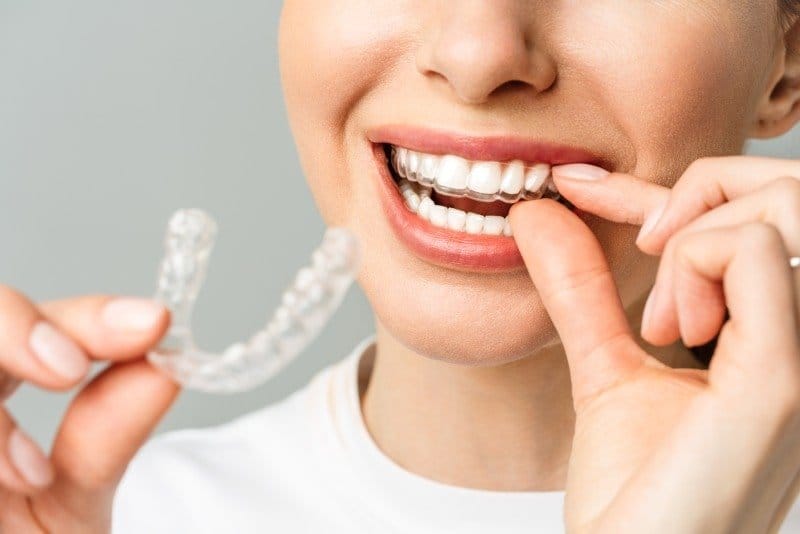
Invisalign is a clear aligner system made by Align Technology that moves teeth through a custom-made sequence of removable trays, worn 20-22 hours a day and changed roughly every two weeks. A systematic review of eleven studies found that aligners align and level the arches and intrude anterior teeth predictably, but control extrusion poorly, at around 30% accuracy, and rotate round-crowned teeth poorly (PubMed 25412265). Across 401 anterior teeth in 37 patients, the mean accuracy of planned movement with Invisalign was 41%, which is why refinement trays are built into most treatment plans (PubMed 19121497).
- 01Bodily movement of about 1.5 mm in upper molars was achieved with 88% predictability, while accuracy for extrusion stayed near 30% (PubMed 25412265).
- 02In a review of eight comparative studies, the three pooled showed clear aligner treatment 6.31 months shorter on average than fixed braces (95% CI 4.24-8.37), and the review reported that aligners may be less effective at producing occlusal contacts, controlling torque and expanding the arch transversely (PubMed 30674307).
- 03A systematic review of 22 studies limits the evidence-based use of Invisalign to non-extraction correction of mild to moderate malocclusion in non-growing patients; efficacy was limited for closing extraction spaces and for bodily arch expansion (PubMed 30264270).
- 04In a meta-analysis of nine studies, aligner patients showed a plaque index 0.53 points lower and a gingival index 0.27 points lower than fixed appliance patients; the authors downgraded the certainty of that evidence for bias and inconsistency (PubMed 29921415).
- 05A 2020 systematic review rated certainty about aligner tooth movement efficiency as low to moderate and concluded that most movements may not be predictable enough to be completed with a single set of trays (PubMed 31651082).
/ How Invisalign Treatment is Defined and Planned
Invisalign treatment is an orthodontic treatment that stands out as a radical alternative to metal braces and has been frequently preferred in recent years. Invisalign treatment, which is planned individually for the patient, is applied using transparent aligners known as aligners, which encourage the teeth to return to the correct alignment.
Invisalign treatment is also called "wire-free orthodontic treatment" or "clear aligner treatment". Thanks to invisalign treatment, which has become increasingly widespread in recent years, the teeth are brought to the position they should be. Thus, extremely beneficial results are achieved both in terms of health and aesthetics.
- For the application of Invisalign treatment, the patient is first examined and if the patient is found suitable for the treatment, the treatment process is planned specifically for the patient.
- The patient's upper and lower jaw measurements are taken. Teeth are photographed and an intraoral x-ray is taken if deemed necessary.
- The impressions taken from the patient are sent to the clear aligner manufacturer. After transfer to digital media, the patient's and doctor's wishes are evaluated. Teeth are finalized in the digital environment, provided that the patient can make sense of them.
- With the completion of the digital clear aligner analysis, the appearance that the teeth will gain at the end of the treatment is presented to the patient. If the patient approves, the transparent aligner production process begins. This process is completed in approximately 1 to 2 weeks.
| At a glance | |
|---|---|
| Duration | 6-18 months |
| Sessions | 8 |
| Warranty | · |
| Materials Used | Invisalign (Align Technology) |

Treatment Process
- 01Digital Scan: Intraoral 3D scan and treatment simulation.
- 02Aligner Production: All aligners for the full course produced upfront.
- 03Treatment: Each aligner worn two weeks; monthly checks.
- 04Retention: A retainer aligner preserves the result.
/ Invisalign Treatment Placement and Aligner Use
Invisalign treatment placement continues with tooth colored buttons and aligner instructions.
- Tooth colored buttons are placed on some teeth using a key transparent aligner prepared for the upper and lower jaw at the same time. The buttons, which are barely visible in the mouth, mimic the brackets used in classical orthodontic treatment.
- If the patient's teeth are highly crowded, minimal abrasions called "stripping" or "ipr" can be performed on the right and left sides of the teeth. These abrasions can vary between 0.05 mm and 0.30 mm. However, they do not cause tooth sensitivity or tooth decay as they do not penetrate the tooth enamel.
- After these procedures are completed, the first aligner is placed by the dentist. In the same way, the patient is asked to remove and reinsert the transparent aligner.
- Each clear aligner provides movement between 0.5 mm and 1 cm. After 15 days of use, the next aligner can be used.
When the transparent aligners are first inserted, you may experience pain or a feeling of tightness in the teeth. This is perfectly natural. When the aligners are inserted, they are gently pushed towards the front teeth. By applying equal amounts of force with the fingers, the clear aligner is pressed and placed towards the right and left molars. When removing the clear aligner, start from the right or left molar and remove the clear aligner from the teeth with the fingertip towards the other molar. In order to prevent any damage to the transparent aligner, it should not be removed using sharp objects.
/ Invisalign Treatment Completion, Features and Aesthetic Context
After the Invisalign treatment is completed, it may be necessary to use a retainer for 1 or 2 months depending on the patient-specific treatment. The structure of the retainers is harder than the aligners used during the treatment process. It may be beneficial to use a retainer to ensure that the teeth get used to their new position. In addition, invisible wires called "retainers" may be attached behind the teeth to eliminate the risk of returning after treatment.
- Invisalign treatment uses transparent and invisible aligners. While the crowding of the teeth is corrected, it is not visible from the outside that the patient is undergoing orthodontic treatment.
- Since the transparent aligners are easily removable, they provide a comfortable wearing experience during daily activities such as eating, drinking and brushing teeth. Patients do not face restrictions during invisalign treatment as they do with traditional orthodontic treatment. That is, as long as the clear aligners are removed, everything is free to eat and drink.
- Again, since the metal brackets on the teeth in traditional orthodontic treatment are not used in Invisalign treatment, there are no problems with teeth and gums. Since Invisalign is made of soft and smooth plastic, it does not cause discomfort like the sharp edges and hard materials of wires and brackets.
People who have an unaesthetic appearance due to crowding and irregularities in their teeth may be dissatisfied with this situation and may even experience self-confidence problems. As a result, they may avoid smiling and feel obliged to close their mouth while laughing or talking.
Invisalign treatment is an effective and comfortable solution for people who are uncomfortable with crowding and irregularities in their teeth. Thanks to the Invisalign treatment planned and applied individually, the person can have teeth that look much better aesthetically. Thus, it may be possible for the person to regain his/her self-confidence and have a positive impact on his/her work and social life.
/ Advantages of Invisalign Treatment
- Thanks to Invisalign treatment, having the correct tooth and jaw structure helps to speak and eat effectively and comfortably. Therefore, it can be stated that removing crowding is not only aesthetically beneficial, but also plays a critical role in oral health and function.
- The presence of crowded and crooked teeth in the mouth, as well as a misaligned bite, can wear down teeth and even lead to oral health risks. If such problems are not treated, undesirable conditions such as gum diseases , tooth decay, tooth loss, jaw problems, chewing and speech disorders may occur.
- Thanks to the removable structure of the transparent aligners, the patient can interrupt the treatment at any time during the day.
- Invisalign treatment is less painful and more comfortable than traditional orthodontic treatment . The transparent aligners have a smooth surface. In this way, they do not cause stinging or wound formation on the cheeks.
- Changing the clear aligners at weekly or fifteen-day intervals is one of the factors that increase the comfort of the treatment process.
- The fact that transparent aligners can be removed and reinserted is an important advantage in terms of oral hygiene. In addition, being able to remove the aligners during meals or important events can increase the patient's comfort and improve their appearance.
- The transparent and colorless appearance of the aligners prevents them from being noticed from the outside. Patients can have an aesthetically good appearance during invisalign treatment.
/ Invisalign Treatment Duration and Suitable Candidates
The duration of Invisalign treatment may vary depending on the patient's tooth structure. In mild cases, results can usually be obtained in periods ranging from 9 to 15 months. To achieve this, patients need to wear their clear aligners for an average of 20 to 22 hours every day. For the rest of the time, the aligners should only be removed when eating or brushing teeth .
Invisalign treatment is a process that requires the cooperation of dentist and patient. Therefore, the success of the treatment is directly related to the patient's regular use of the clear aligners. If the patient does not use the clear aligners regularly for the period specified by the dentist, the time needed for the correct alignment of the teeth will be prolonged. This is because failure to comply with the dentist's planned treatment can prevent the treatment from progressing as planned.
Clear aligner treatment is a method that can be applied to children, adolescents and adults. However, like all treatments, the decision on the suitability of clear aligner treatment is made on a patient-specific basis after evaluations.
Clear aligner treatment is an ideal solution for people who want to remove crowding and irregularities in their teeth and thus have smoother looking teeth, but do not prefer traditional orthodontic treatments. However, the crowding of the patient's teeth must be able to be corrected with invisalign treatment.
/ Applicable and Non-applicable Cases for Invisalign Treatment
Some situations where Invisalign treatment can be applied are listed below:
- There is a narrow distance between the teeth, that is, there is a shortage of space for the teeth to settle in the mouth
- The appearance of the teeth leaning on each other or interlocking
- Asymmetry in the alignment of the teeth
- Teeth are not lined up properly on the jawbone
- The mouth, teeth and jaw structure is suitable for invisalign treatment
- No abnormality in the jaw structure
- No impacted teeth in the upper and lower jaw bones
- If the teeth have severe decay, invisalign treatment is not applicable. Decay weakens the tooth structure, preventing the transparent aligners from aligning effectively.
- Patients with missing teeth do not undergo invisalign treatment. Lack of teeth can prevent the clear aligners from fitting and aligning correctly. In such cases, implant or denture treatments may be preferred.
- People who suffer from teeth clenching during sleep should have this problem treated before invisalign treatment is applied.
- Patients with excessive tooth loss cannot be treated with invisalign. In such cases, prosthetic or implant treatments may be recommended to compensate for the missing teeth.
- Patients with jaw structure problems that prevent the correct fitting of clear aligners are not suitable candidates for Invisalign treatment.
- 1.Rossini G, Parrini S, Castroflorio T, Deregibus A, Debernardi CL. Efficacy of clear aligners in controlling orthodontic tooth movement: a systematic review. Angle Orthod 2015;85:881-9. PubMed 25412265
- 2.Kravitz ND, Kusnoto B, BeGole E, Obrez A, Agran B. How well does Invisalign work? A prospective clinical study evaluating the efficacy of tooth movement with Invisalign. Am J Orthod Dentofacial Orthop 2009;135:27-35. PubMed 19121497
- 3.Papadimitriou A, Mousoulea S, Gkantidis N, Kloukos D. Clinical effectiveness of Invisalign® orthodontic treatment: a systematic review. Prog Orthod 2018;19:37. PubMed 30264270
- 4.Ke Y, Zhu Y, Zhu M. A comparison of treatment effectiveness between clear aligner and fixed appliance therapies. BMC Oral Health 2019;19:24. PubMed 30674307
- 5.Jiang Q, Li J, Mei L, Du J, Levrini L, Abbate GM, et al. Periodontal health during orthodontic treatment with clear aligners and fixed appliances: A meta-analysis. J Am Dent Assoc 2018;149:712-720.e12. PubMed 29921415
- 6.Robertson L, Kaur H, Fagundes NCF, Romanyk D, Major P, Flores Mir C. Effectiveness of clear aligner therapy for orthodontic treatment: A systematic review. Orthod Craniofac Res 2020;23:133-142. PubMed 31651082

Who is this treatment for?
- Limited space between the teeth
- Teeth overlapping or interlocking with each other
- Asymmetry in the alignment of the teeth
- Teeth not being properly aligned on the jawbone
- Discomfort with crowded or irregular teeth
- Desire to have better-aligned-looking teeth
- Not preferring traditional orthodontic treatments
Doctors specialising in this treatment

Frequently asked
01What is the difference between Invisalign and clear aligners?+
Invisalign is a brand of clear aligner; clear aligner is the generic name for the treatment. Both describe a custom-made sequence of removable transparent trays that move teeth in planned steps, worn 20-22 hours a day and changed roughly every two weeks. What differs between systems is the planning software and the tray material, not the principle.
02Are clear aligners as effective as braces?+
It depends on the movements the case needs. In a review of eight comparative studies, the three pooled showed clear aligner treatment 6.31 months shorter on average than fixed braces (95% CI 4.24-8.37), and the review reported that aligners may be less effective at producing occlusal contacts, controlling torque and expanding the arch transversely (PubMed 30674307). A review of 22 studies limits their evidence-based use to non-extraction mild to moderate malocclusion in non-growing patients (PubMed 30264270).
03How long does Invisalign treatment take in Istanbul?+
Typical treatment runs 6-18 months depending on case difficulty. The full aligner series is produced upfront, so international guests attend for the digital scan and fitting and then follow monthly remote or in-person checks. Mean accuracy of planned movement was 41% across 401 anterior teeth in 37 patients, which is why refinement trays are planned into most cases and can extend the schedule (PubMed 19121497).
04How many hours a day must I wear aligners?+
Twenty to twenty-two hours a day. Aligners are removed only for eating and brushing; below that daily wear the planned movement does not happen, treatment lengthens and extra refinement trays may be needed. Each tray is worn for about two weeks and checks are monthly. Drinking anything other than water while the trays are in stains and distorts them, so they come out first.
Orthodontics
Bracket Treatment
Bracket treatment, or fixed braces, moves teeth in three planes using metal or ceramic brackets bonded to the teeth and an archwire running through them.
Explore→02Crooked Teeth Treatment
Crooked teeth treatment moves overlapping teeth into the space they lack using braces or clear aligners, with space creation or extraction where indicated.
Explore→Speak with your doctor about this treatment.
Not sure which treatment fits? Tell us what’s wrong →