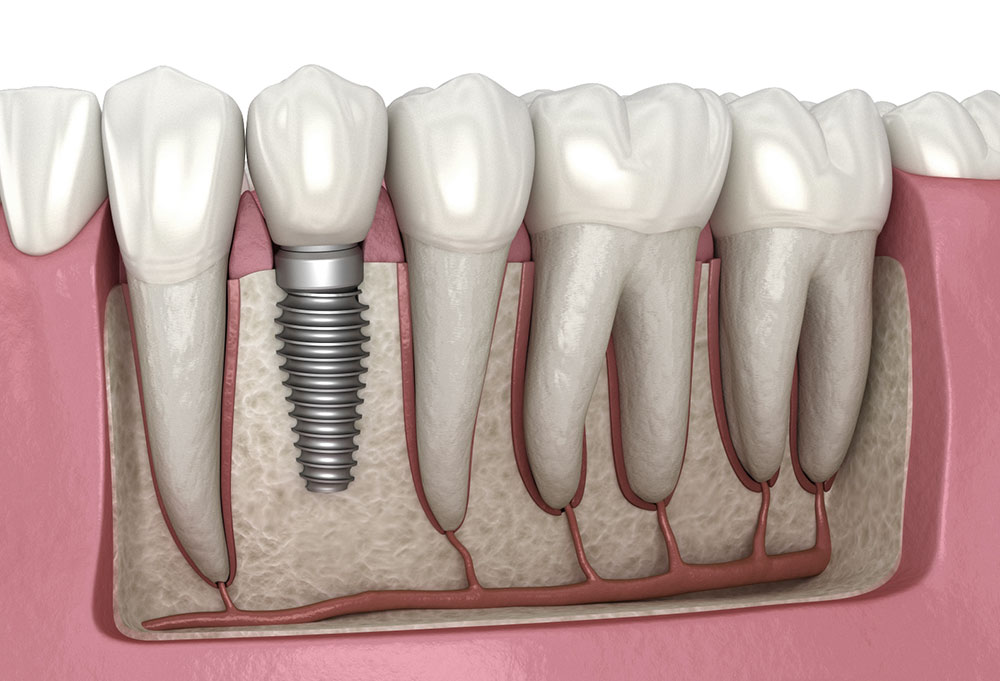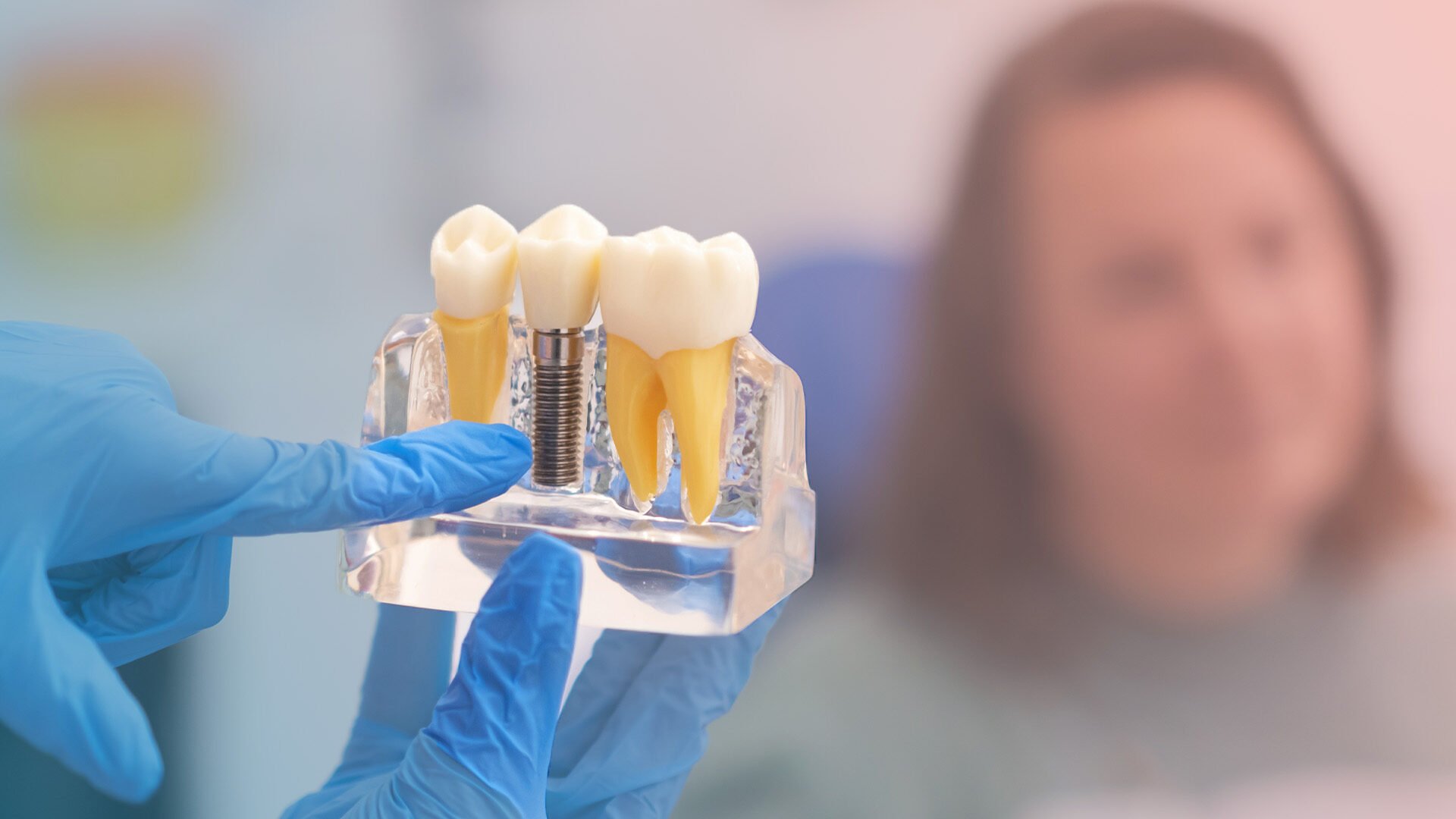
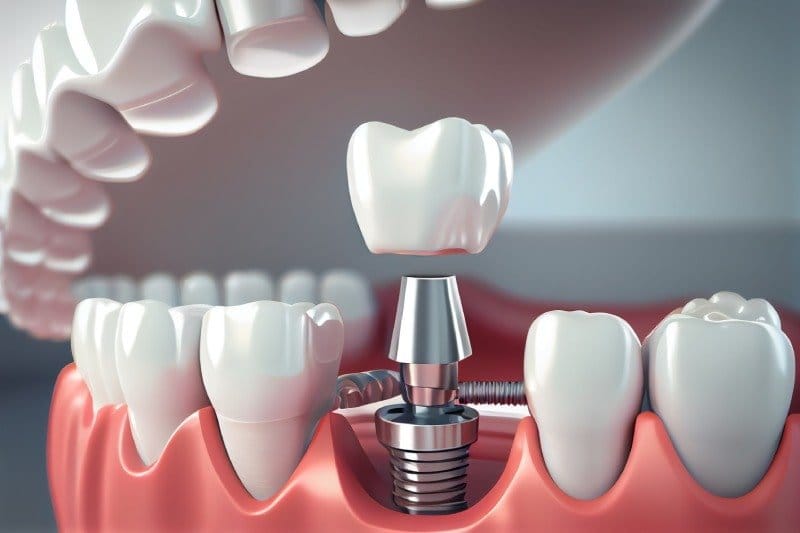
Neither All-on-4 nor All-on-6 is automatically better. If the back of the jaw has limited bone, four strategically placed implants may avoid grafting. If six implants can be safely placed, they may distribute mechanical forces across more points. A five-year randomised comparison found similar implant survival, with fewer technical complications in the six-implant group (PubMed 39581887).
What All-on-4 and All-on-6 have in common
All-on-4 and All-on-6 are two ways of replacing all teeth in one jaw with a fixed, screw-retained prosthesis. Unlike a conventional removable denture, the replacement teeth are supported by implants. In suitable cases, the implants are placed during one surgical appointment and a fixed temporary bridge can be fitted on the same day. The permanent bridge is made after the implants have integrated with the bone.
We explain the wider treatment journey in our full-mouth implant treatment guide. You can also read our separate article on All-on-4.
The names describe a treatment design, not competing products. Both can use the same surgical team, implant system and prosthetic technology. For this reason, there is no universal answer to "Which is better?" The more useful question is, "Which design suits my jaw?"
The main difference is the number and positioning of the supporting implants. All-on-4 normally uses two implants at the front and two implants angled towards the back. Angling the posterior implants can help the dentists at Mosdent use stronger areas of existing bone when the back of the jaw has resorbed. All-on-6 uses six implants distributed along the arch, but it requires enough bone in the posterior areas to support the additional implants.
What does the evidence say about four versus six implants?
A multicentre randomised study directly compared four and six implants in the upper jaw over five years. It included 47 patients and 233 implants. At five years, implant survival was 100% in the four-implant group and 99.3% in the six-implant group. There was no significant difference in bone-level changes, and no peri-implantitis was recorded in either group (PubMed 39581887).
The difference appeared mainly in technical complications and patient preferences. Screw loosening and similar technical problems occurred in 16.6% of the four-implant group and were not reported in the six-implant group. The cost analysis favoured four implants. Patients rated the four-implant prosthesis more positively for appearance, while the six-implant prosthesis received higher ratings for function and speech (PubMed 39581887).
This is an important distinction. Six implants are not automatically proven to survive longer. Their possible advantage is mechanical, because the prosthetic load can be shared across more support points. Four implants may mean less surgery and fewer components when the anatomy allows it.
Bone is the first factor
A three-dimensional scan usually places a patient into one of several broad situations. If there is adequate bone across the jaw, both designs may be technically possible. The decision can then consider bite force, prosthetic design, cost and the patient's preferences.
If the back of the jaw has resorbed but the front still has suitable bone, All-on-4 may be a practical option. The angled posterior implants are planned to use available bone while avoiding important structures such as the sinus or nerve canal. Angled implants are not automatically weaker than upright implants. A meta-analysis of 44 studies found no significant overall difference in implant loss between angled and straight implants. However, when only upper-jaw studies were assessed, a limited but significant difference favoured straight implants. No such difference was found in the lower jaw, and there was no difference in bone loss between the groups (PubMed 25239770). This means upper-jaw planning requires particular care.
In advanced bone loss, the question may no longer be four or six implants. If there is not enough bone to support either design safely, the treatment plan may involve bone grafting, a sinus lift, or, in selected cases, zygomatic implants. These options can only be assessed after reviewing the scan.
Bite, opposing teeth and prosthetic design
The same patient may need a different design in the upper and lower jaws. The lower jaw generally has denser bone. The upper jaw is often less dense, and the back of the upper jaw is limited by the sinus.
The opposing teeth also matter. Natural teeth or a fixed bridge in the opposite jaw can create greater chewing forces than a removable denture. Strong biting, tooth grinding and a long prosthetic span may support using more implants to spread the load. The technical complication findings in the randomised study are consistent with this mechanical reasoning, although they do not mean that every patient needs six implants (PubMed 39581887).
The permanent prosthesis must be considered at the same time. Its material, whether it is made as one piece or in sections, and how far back the teeth extend can all affect the design. Implant count should not be sold as a package separately from the bone, bite and prosthesis. The choice of implant system is a separate issue, discussed in our implant brand guide.
Health risks, smoking and treatment timeline
Two people with similar bone anatomy may still receive different recommendations because their medical and lifestyle risks differ. Smoking is one of the clearest measured factors. In a long-term upper-jaw All-on-4 series, smoking increased the risk of implant loss by 1.94 times (PubMed 30924250). Broader implant evidence has also found a higher risk of implant loss among smokers (PubMed 35056347).
Smoking does not automatically rule out treatment. It does mean that the surgical risks should be discussed honestly, with a plan to stop or reduce smoking around surgery where possible and with closer follow-up. Uncontrolled diabetes, a history of gum disease and some medicines may also affect the timing, maintenance plan and choice of a more cautious design.
The general timeline is similar with four or six implants. During the first visit, the dentists at Mosdent review the scan, complete the surgery and assess initial implant stability. If the implants have enough primary stability, a fixed temporary bridge may be fitted on the same day.
For patients travelling from abroad, the first stage is often planned within a single visit of around seven to ten days. This allows time for suture review and bite adjustments. The temporary bridge remains in place while the implants integrate. After approximately three months, integration is checked radiographically. Impressions, try-in appointments and delivery of the permanent prosthesis then take place during a shorter second visit. Six implants may make the surgery slightly longer, but the healing principles are the same.
Long-term results and maintenance
All-on-4 has substantial published long-term data. In one upper-jaw series involving 1,072 patients, implant cumulative survival was 94.7% after five to 13 years. In a lower-jaw series involving 471 patients followed for 10 to 18 years, implant survival was 93% (PubMed 30924250; PubMed 30924309). These studies came from the clinic that developed the treatment approach, so results may not be identical in independent centres.
The most common long-term issues in these reports were often prosthetic repairs rather than implant loss. In the upper-jaw series, mechanical complications affected 58.8% of temporary prostheses and 7.3% of permanent prostheses (PubMed 30924250). A loose screw or small fracture in a temporary bridge does not necessarily mean that the treatment has failed, but it does show why maintenance and adjustments matter.
There is not an equivalent published, more-than-ten-year All-on-6 series at this scale. The strongest direct comparison currently described here is the five-year randomised study, which found similar implant survival for both designs (PubMed 39581887). Long-term results depend heavily on cleaning, professional reviews, smoking status and management of gum inflammation. Our implant maintenance guide explains the daily care involved.
Cost factors and decision-making at Mosdent
The price of full-arch implant treatment is shaped by more than the number of implants. Important factors include the need for extractions, the condition and volume of the bone, whether grafting or a sinus lift is required, the implant system, the material and design of the temporary and permanent prostheses, sedation, laboratory work and the number of appointments.
For international patients, the overall plan may also be affected by the length of the first visit, follow-up arrangements, travel timing and whether additional treatment is needed in the opposing jaw. A quote should clearly state what is included, which prosthesis is temporary, what material will be used for the final bridge and how future adjustments are handled. You can review our transparent price list, but the final treatment plan should follow the scan and clinical examination.
At Mosdent in Istanbul, the dentists begin with a three-dimensional scan and map the available bone. They then plan implant number, position and any need for additional procedures. The prosthetic design and treatment schedule are agreed after these points have been assessed.
If both All-on-4 and All-on-6 are suitable, the discussion is usually about two legitimate trade-offs: less surgery and fewer components, or more implant support and broader load distribution. Ask how many implants are recommended, where they will be placed and why, whether grafting is needed, which materials will be used, which implant system is planned and how follow-up will work.
You can see the clinical scope of full-arch treatment on our full mouth dental implants page and of single implants on our implant treatment page, request an appointment through our contact page, or meet the surgical team on our dentists page.
Let's plan the right treatment together.
Free Assessment→- 1.Toia M, Moreira CS, Dias DR, Corrà E, Ravidà A, Cecchinato D. Fixed Full-Arch Maxillary Prostheses Supported by Four Versus Six Implants: 5-Year Results of a Multicenter Randomized Clinical Trial. Clin Oral Implants Res. 2025;36(3):298-313. PubMed 39581887
- 2.Maló P, de Araújo Nobre M, Lopes A, Ferro A, Nunes M. The All-on-4 concept for full-arch rehabilitation of the edentulous maxillae: A longitudinal study with 5-13 years of follow-up. Clin Implant Dent Relat Res. 2019;21(4):538-549. PubMed 30924250
- 3.Maló P, de Araújo Nobre M, Lopes A, Ferro A, Botto J. The All-on-4 treatment concept for the rehabilitation of the completely edentulous mandible: A longitudinal study with 10 to 18 years of follow-up. Clin Implant Dent Relat Res. 2019;21(4):565-577. PubMed 30924309
- 4.Chrcanovic BR, Albrektsson T, Wennerberg A. Tilted versus axially placed dental implants: a meta-analysis. J Dent. 2015;43(2):149-170. PubMed 25239770
- 5.Mustapha AD, Salame Z, Chrcanovic BR. Smoking and Dental Implants: A Systematic Review and Meta-Analysis. Medicina (Kaunas). 2021;58(1):39. PubMed 35056347