Dental implant treatment usually follows six stages: examination and CBCT imaging, treatment planning, implant placement, healing and osseointegration, impressions and crown fabrication, then fitting and maintenance. The surgery itself may take about 40 minutes for one implant, while the overall timetable is mainly determined by healing. Bone grafting or sinus lifting can add further stages.
Dental implant treatment stages and first assessment
Most patients considering an implant want to know three things: how many appointments they will need, why there is a waiting period, and what they will have in the gap while treatment is progressing. The standard pathway has six main stages:
- 01Examination and imaging
- 02Treatment planning
- 03Implant placement
- 04Healing and osseointegration
- 05Impressions and crown fabrication
- 06Crown fitting and ongoing reviews
For a single missing tooth, the time spent in the dental chair may add up to only a few hours. The months on the calendar are mainly spent waiting for the implant to integrate with the bone. This is not simply a sign that treatment is slow. It is an important biological stage.
For an explanation of what an implant is and how it differs from a bridge, see our dental implant guide.
Treatment begins with an examination, not just an X-ray. Our dentists assess the missing tooth area, neighbouring teeth, gums and bite. Three-dimensional imaging is then used to assess the bone in detail. A panoramic X-ray shows the general appearance of the jaws, but a cone beam CT scan, also called CBCT, provides information about bone height, width and density. It also helps measure the position of important structures, such as the nerve canal in the lower jaw and the sinus in the upper jaw.
The medical history is also relevant. The dentists at Mosdent will ask about medicines, diabetes and other chronic conditions, smoking and any previous gum disease. These factors do not always prevent implant treatment, but they may change the plan or add preparation first.
Bring a list of medicines and any previous dental scans to the consultation. Patients taking blood-thinning medication should mention this at the first appointment. Any change to prescribed medication must be planned between the treating dentist and the doctor who prescribed it. You can read more about suitability in our guide to dental implant treatment conditions.
Treatment planning and implant placement
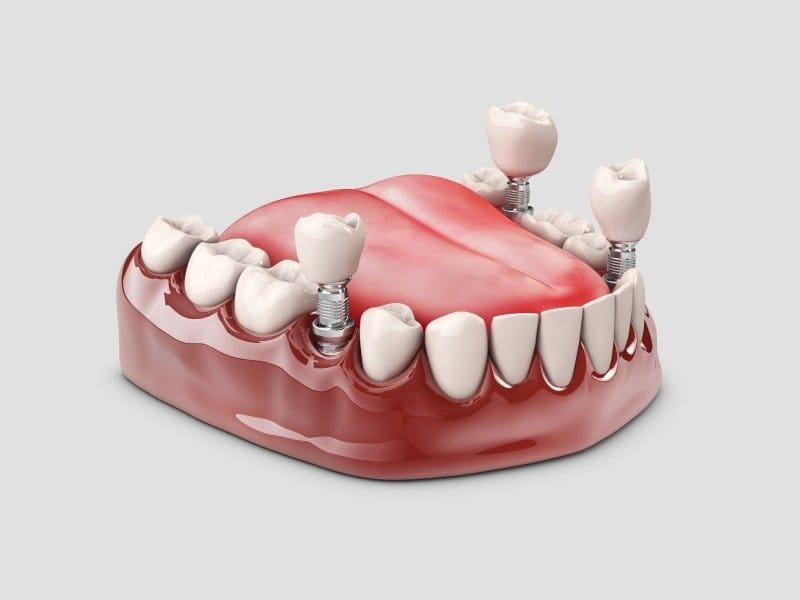
An implant plan should be based on the examination and CBCT findings. Once the assessment is complete, the plan should clarify the number and position of implants, their planned angulation, and whether bone grafting or a sinus lift is needed. It should also specify whether the final restoration will be a single crown or a bridge, and which implant system is being considered.
The implant system is selected as part of the plan, rather than before the clinical assessment. Our articles on choosing an implant brand and Straumann implants explain what information to look for. If a bridge is being considered instead of an implant for one missing tooth, compare the options in our implant or bridge guide.
If the bone volume is insufficient, bone grafting or sinus lifting may be added. These procedures can extend the overall timetable.
Implant placement is often the part patients worry about most, but it is usually one of the shorter appointments. For one implant, the procedure often takes around 40 minutes and is carried out under local anaesthetic. The area is fully numb, so pain is not expected during the procedure, although pressure and vibration may be felt. Sedation may be discussed for patients with significant anxiety or for more extensive treatment. See our guide to sedation for dental treatment.
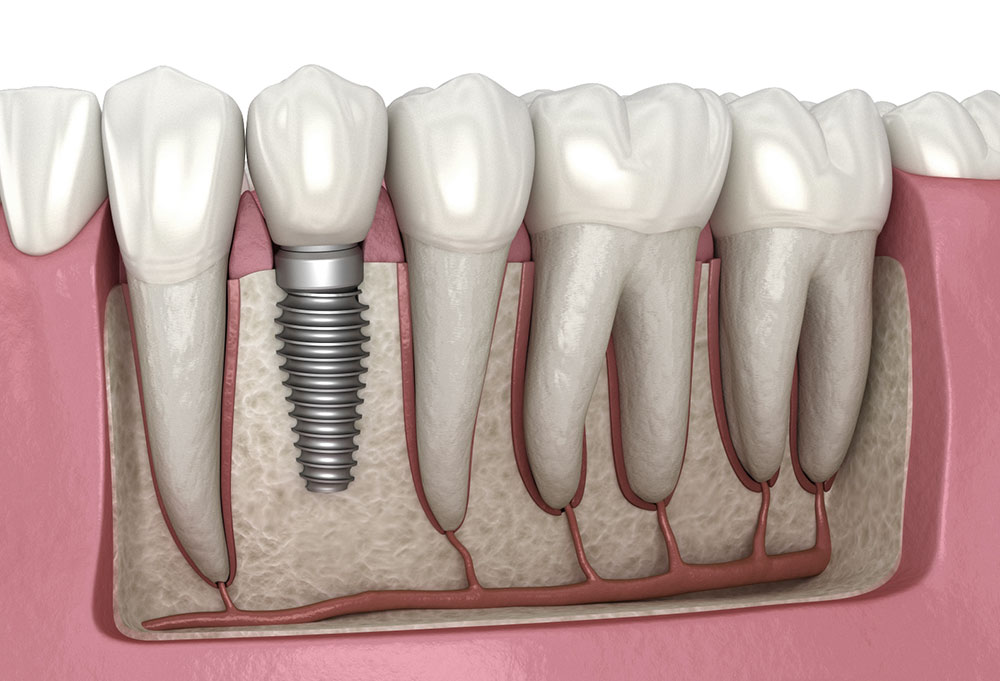
The gum is opened, a carefully prepared channel is made in the bone, and the implant is placed with a planned level of torque. The gum may then be stitched over the implant, or a small healing abutment may be placed above it. This decision depends on the implant's initial stability and the conditions found during surgery.
A temporary tooth can be planned in advance if the missing area is visible, particularly at the front of the mouth. Mild soreness, swelling or a small bruise can occur during the following days.
Healing, osseointegration and temporary teeth
The healing and osseointegration stage usually determines the overall calendar. The implant is mechanically held in the bone when it is first placed. Permanent stability develops as bone cells attach directly to the implant surface. This biological process is called osseointegration.
A Cochrane review describes the conventional loading protocol as leaving the implant unloaded for more than two months. In clinical practice, the waiting period is often around three months in the lower jaw and may be longer in the upper jaw, where bone density can be lower (PubMed 23543525).
Patients may not need frequent appointments during this period, but healing is still monitored. The soft tissue closes during the first weeks, stitches are removed when appropriate, and reviews check progress. The implant is not restored simply because a certain number of weeks has passed. Our dentists confirm healing with radiographs and an assessment of implant stability before the crown is planned. More detail is available in our guide to implant healing time.
Many patients are concerned about spending several months without a tooth. This is not necessary in every case. A missing back tooth may not be visible, so some patients use no temporary replacement. For a front tooth, options may include a temporary tooth bonded to neighbouring teeth, a small removable appliance, or, in a suitable case, an immediate temporary crown kept away from chewing contact.
The choice depends on the position, bite and initial stability of the implant. A temporary tooth is mainly intended to support appearance and speech, not to withstand normal chewing forces. Hard and sticky foods may therefore need to be avoided. A loose or displaced temporary tooth is usually a reason to contact the clinic, rather than an emergency. Normal work, travel and daily activities are generally possible between planned reviews.
Crown fabrication, fitting and maintenance
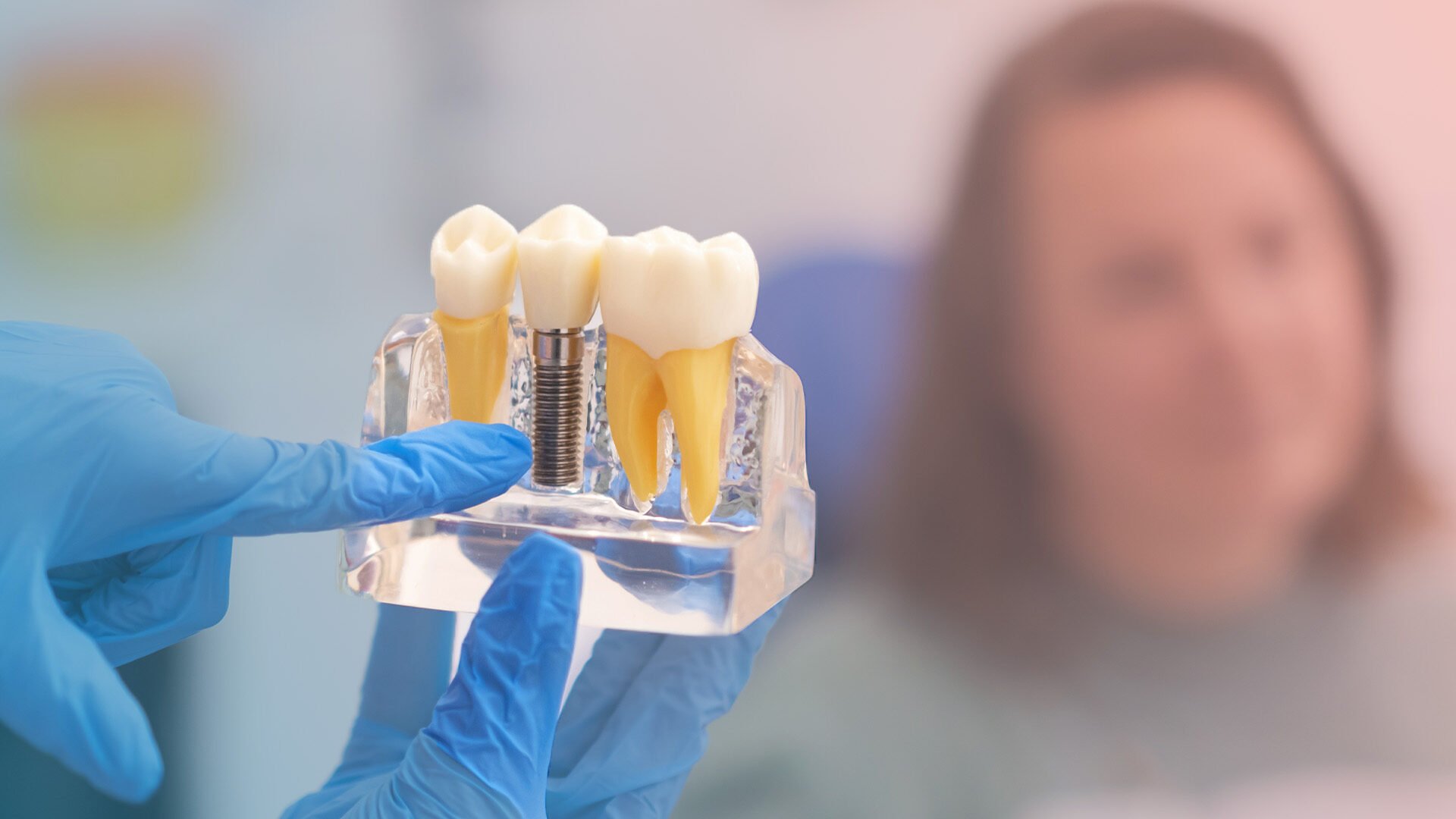
Once implant integration has been confirmed, an abutment, which is the connecting component between the implant and crown, is placed if required. Impressions are then taken. In many cases, an intraoral scanner is used to create a digital record for the laboratory. The shade is selected to match the neighbouring teeth.
When the crown is ready, it is tried in and checked for bite, contact with adjacent teeth and the fit around the gum. Minor adjustments or another try-in may sometimes be needed. Long-term maintenance matters because technical problems can affect the crown as well as the implant. In a systematic review of single implant crowns, implant survival was 97.2% at five years and 95.2% at ten years. Crown survival was 96.3% and 89.4% at the same time points, with screw loosening the most common technical problem at five years (PubMed 23062124).
After the crown is fitted, treatment moves into a maintenance phase. An implant cannot decay, but the gum and bone around it can become inflamed. This condition is called peri-implantitis. A meta-analysis of 57 studies found peri-implantitis in 19.53% of patients and around 12.53% of implants (PubMed 36261829).
Daily cleaning around an implant is slightly different from cleaning natural teeth. Interdental brushes and the correct technique are explained in our implant care guide. Regular clinical reviews and professional cleaning help identify inflammation while it is still easier to manage. Review intervals are set according to individual risk, and may be shorter for patients who smoke or have a history of gum disease.
Same-day implant treatment and cost factors
Immediate loading means placing a temporary crown or prosthesis within the first week after implant surgery. It is not suitable for every patient. The decision depends on the implant's stability at placement, the available bone and the bite.
A Cochrane review of 26 randomised studies involving 2,120 implants found no convincing difference in implant or prosthesis loss between immediate and conventional loading. However, the review also noted that many studies had a risk of bias, so the findings should not be interpreted as a promise that same-day treatment is appropriate for everyone (PubMed 23543525).
Full-arch same-day protocols are a different treatment design. Information about these options is available in our All-on-4 guide and our All-on-6 guide.
The cost of implant treatment depends on the clinical plan, not only on the implant itself. Factors may include the number of implants, the implant system, the type and number of crowns, the need for bone grafting or sinus lifting, temporary teeth, sedation, laboratory work and the number of appointments required.
For international patients, travel planning may also depend on whether treatment can be completed in one visit or needs a healing interval before the final crown. The assessment is needed before an accurate plan can be given. You can review the items included in our transparent price list.
Risk factors that may need a different implant plan
Smoking is one of the clearest factors associated with increased risk. A meta-analysis found that smokers had 2.4 times the risk of implant loss compared with non-smokers, with an average additional bone loss of 0.58 mm around implants (PubMed 35056347). This does not automatically rule out treatment, but smoking should be discussed openly and a reduction or stopping plan may be advised around surgery.
Uncontrolled diabetes, untreated gum disease, some medicines and insufficient bone can also change the sequence. Treatment may be delayed while these issues are managed, or an additional surgical stage may be added.
Long-term outcomes depend on every stage being handled carefully. In one ten-year study of 1,692 implants in 881 patients, cumulative survival was 98.23% at implant level and 95.70% at patient level. Early losses were mainly related to failure of integration, while later care depends more on maintenance and monitoring (PubMed 30110515). You can learn about the dentists at Mosdent on our team page, request an appointment through our contact page, or review the clinical scope of our implant treatment service.
Let's plan the right treatment together.
Free Assessment→- 1.Kim S, Jung UW, Cho KS, Lee JS. Retrospective radiographic observational study of 1692 Straumann tissue-level dental implants over 10 years: I. Implant survival and loss pattern. Clin Implant Dent Relat Res. 2018;20(5):860-866. PubMed 30110515
- 2.Esposito M, Grusovin MG, Maghaireh H, Worthington HV. Interventions for replacing missing teeth: different times for loading dental implants. Cochrane Database Syst Rev. 2013;2013(3):CD003878. PubMed 23543525
- 3.Jung RE, Zembic A, Pjetursson BE, Zwahlen M, Thoma DS. Systematic review of the survival rate and the incidence of biological, technical, and aesthetic complications of single crowns on implants reported in longitudinal studies with a mean follow-up of 5 years. Clin Oral Implants Res. 2012;23(Suppl 6):2-21. PubMed 23062124
- 4.Mustapha AD, Salame Z, Chrcanovic BR. Smoking and Dental Implants: A Systematic Review and Meta-Analysis. Medicina (Kaunas). 2021;58(1):39. PubMed 35056347
- 5.Diaz P, Gonzalo E, Villagra LJG, Miegimolle B, Suarez MJ. What is the prevalence of peri-implantitis? A systematic review and meta-analysis. BMC Oral Health. 2022;22(1):449. PubMed 36261829