A sinus lift, also called sinus augmentation, is a bone grafting operation in the upper jaw that raises the Schneiderian membrane lining the maxillary sinus and packs graft material into the space beneath it, so that the posterior maxilla gains the bone height a dental implant needs. It is indicated when residual bone below the sinus floor is too shallow for standard implant placement. In prospective studies with at least five years of follow-up and residual bone height of 6 mm or less, weighted annual implant loss after the lateral window technique was 0.43 percent (PubMed 30624789). Membrane perforation is the common intraoperative event, weighted incidence 23.5 percent across 1,652 surgeries (PubMed 26974034).
- 01A sinus lift raises the sinus membrane and places graft material below it; the lateral window approach is used when very little bone remains, the transcrestal osteotome approach when some bone height already exists and the implant can go in at the same visit.
- 02Weighted annual implant loss after lateral window sinus floor augmentation was 0.43 percent (95 percent CI 0.37 to 0.49) across 11 prospective studies with five years or more of follow-up (PubMed 30624789).
- 03Where residual bone height averaged 5.7 mm, implants placed simultaneously with graft-free sinus elevation showed a mean survival of 97.9 percent and a weighted vertical bone gain of 3.8 mm across 864 implants (PubMed 28168901).
- 04Schneiderian membrane perforation occurred in 23.5 percent of 1,652 sinus lift surgeries, range 3.6 to 41.8 percent; implant survival on perforated and non-perforated sides did not differ significantly when the perforation was handled properly (PubMed 26974034).
- 05Graft consolidation is measured in months, not weeks: 4 to 12 months for the graft to integrate with existing bone, and 4 to 9 months before implant placement when the sinus lift is staged.
Dental implant treatment offers the most reliable and long lasting solution for replacing missing teeth. However, not every patient has sufficient bone in the upper jaw especially in the posterior (back) region to safely place implants. In such cases, a surgical procedure called sinus lift (also known as sinus augmentation) may be necessary to provide enough bone support for implant placement.
/ Sinus Lift and Its Role Before Dental Implants
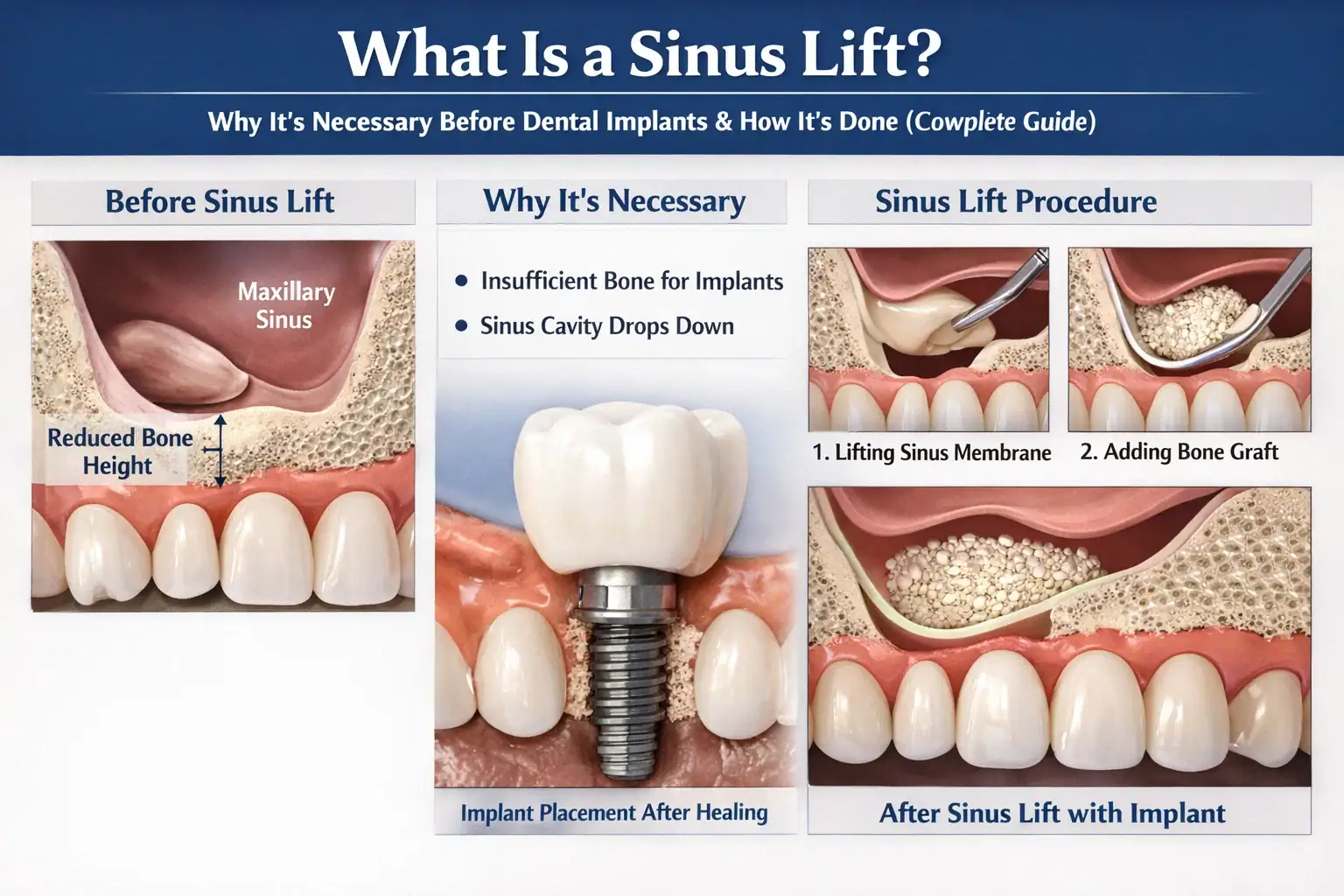
A sinus lift also known as sinus augmentation or maxillary sinus lift is a surgical bone grafting procedure performed on the upper jaw to increase bone height below the maxillary sinus so that dental implants can be placed securely.
The maxillary sinuses are large air-filled spaces located above the back teeth in the upper jaw. When teeth are lost, especially molars and premolars, the bone in this region may shrink over time and the sinus cavity can expand downward. Without sufficient bone height, conventional dental implants cannot be placed safely and securely.
A sinus lift corrects this by gently lifting the sinus membrane and placing bone graft material into the created space, enabling new bone growth and providing a solid foundation for future implants.
Why Sinus Lifting Is Necessary Before Dental Implants
The success and long term stability of dental implants heavily depend on the quality and quantity of jawbone at the implant site. Without enough bone:
✔ Implants may fail to integrate with the jaw (failure to osseointegrate or loosening)
✔ Implant supports may be unstable
✔ Risk of complications increases dramatically
This is especially true in the posterior upper jaw, where bone tends to be thinner and sinuses close to the implant site.
Common situations where sinus lifting is necessary
- Missing multiple upper molars
- Significant bone loss due to periodontal disease
- Bone resorption after prolonged tooth loss
- Anatomically large sinus cavity
- Trauma or previous extraction without bone preservation
When bone height is insufficient for implant placement, a sinus lift becomes essential before implant surgery.
/ Types and Steps of Sinus Lift Procedures
There are two principal approaches to sinus lifting, selected based on existing bone height and surgical needs:
1. Lateral Window (External) Technique
Used when very little bone remains beneath the sinus. A small opening (window) is created on the lateral (side) wall of the sinus. The sinus membrane is lifted and bone graft material is placed underneath it. This creates space and allows new bone growth.
This technique may be performed in a two-stage process: sinus lift first, then implant placement after healing.
2. Internal (Osteotome) Sinus Lift
Used when some bone already exists but more height is needed. The sinus floor is gently pushed up through the implant preparation site, and graft material is placed simultaneously with implant insertion (if bone amount is nearly sufficient).
Both approaches aim to increase bone volume for safe, stable implant support.
How Sinus Lift Works (Step-by-Step)
- Consultation & Imaging:
Advanced imaging (such as CBCT scans) is used to assess bone height and sinus anatomy.
- Local Anesthesia:
Sinus lifts are typically done under local anesthesia to minimize discomfort.
- Access & Membrane Elevation:
A small incision is made to expose the bone. The sinus membrane is gently lifted upward.
- Bone Graft Placement:
Bone graft material (which can be autogenous, allogeneic, xenograft, or synthetic) is placed in the created space to support new bone growth.
- Closure & Healing:
The area is sutured closed. Over several months (typically 4-12), the graft integrates with existing bone.
/ Sinus Lift Materials for Implant Support
Sinus lift treatment uses graft materials to increase bone volume and help suitable patients receive implants. Grafting remains an option in osteoporosis as well: in a CBCT study of 55 postmenopausal women with compromised bone health, the particulate graft did not remodel into native bone but still served as a scaffold for implants in patients whose osteoporosis was controlled. Grafting remains an option in osteoporosis as well: in a CBCT study of 55 postmenopausal women with compromised bone health, the particulate graft did not remodel into native bone but still served as a scaffold for implants in patients whose osteoporosis was controlled.
Materials Used in Sinus Lifting
Bone graft materials may include:
✔ Patient’s own bone
✔ Donor bone from tissue banks
✔ Bovine (animal-derived) bone
✔ Synthetic biomaterials
The graft serves as a scaffold that allows the patient’s own bone to regenerate and integrate, ensuring long-term implant support.
Benefits of Sinus Lifting
✅ Increased Bone Volume
A sinus lift increases bone height, enabling the secure placement of implants that otherwise couldn’t be placed.
✅ Improved Implant Stability
Adequate bone ensures stronger osseointegration (fusion of implant with jawbone), increasing the implant’s longevity.
✅ Better Functional Results
With a solid foundation, dental implants can deliver natural chewing and speaking function.
✅ Long-Term Success
Sinus augmentation contributes to long-lasting implant performance and reduces the risk of implant failure.
Who Needs a Sinus Lift?
Sinus lifts are recommended when:
- Bone height is too low to support standard implants
- Sinus cavities have expanded downward due to tooth loss
- Periodontal disease has caused bone resorption
- Patients want implants in the upper back jaw but lack sufficient bone support
/ Sinus Lift Planning and Recovery at Mosdent
Pre-Procedure Considerations
Before undergoing a sinus lift:
✔ Comprehensive clinical evaluation
✔ CBCT imaging for accurate bone measurement
✔ Medical history review
✔ Discussion of anesthesia and sedation options
A detailed treatment plan ensures the safest outcome and maximizes implant success.
Recovery After Sinus Lifting
Most patients experience:
✔ Mild swelling
✔ Temporary discomfort
✔ Minor bruising
These symptoms usually peak within the first 48 hours and improve over 7–10 days.
When Can Implants Be Placed After Sinus Lifting?
In many cases, 4-9 months of healing time is recommended before implant placement to ensure adequate bone integration.
In some instances, implants can be placed at the same time as the sinus lift (internal approach) if enough bone is present.
Risks & Complications
Like all surgical procedures, sinus lifting carries potential risks, though they are relatively low when performed by experienced professionals:
✔ Membrane perforation
✔ Infection
✔ Swelling
✔ Minor bleeding
✔ Delayed healing
Your surgeon will discuss risks and aftercare in detail during planning.
Mosdent’s Approach to Sinus Lifting Surgery
At Mosdent Hospital, our sinus lifting procedures are personalized using:
- Advanced CBCT imaging for precise planning
- Digital 3D evaluation of bone and sinus anatomy
- Skilled surgical specialists experienced in sinus augmentation
- Careful post-op monitoring and support
/ Sinus Lift FAQs
Q: What is the main purpose of a sinus lift?
A: To increase bone height in the upper jaw so dental implants can be placed securely.
Q: How long does recovery take?
A: Most healing is complete in 7–10 days; bone integration may take several months.
Q: Is sinus lifting painful?
A: Local anesthesia and sedation minimize pain; most discomfort occurs post-op and is manageable.
Q: Can implants be placed immediately after sinus lift?
A: In some cases yes, depending on bone height and surgical assessment.
Conclusion: Is Sinus Lifting Worth It?
When upper jaw bone height is insufficient, a sinus lift is often the most effective way to enable safe, stable, long-lasting dental implant placement. Although it adds time to the treatment process, its benefits, including improved implant stability and long-term success, make it a worthwhile and common procedure in modern implant dentistry.
At Mosdent Hospital, sinus lifting is performed with precision, care, and advanced technology to ensure optimal outcomes for patients seeking implant solutions.
Let’s plan the right treatment together.
Free Assessment→- 1.Raghoebar GM, Onclin P, Boven GC, Vissink A, Meijer HJA. Long-term effectiveness of maxillary sinus floor augmentation: A systematic review and meta-analysis. J Clin Periodontol 2019;46 Suppl 21:307-318. PubMed 30624789
- 2.Duan DH, Fu JH, Qi W, Du Y, Pan J, Wang HL. Graft-Free Maxillary Sinus Floor Elevation: A Systematic Review and Meta-Analysis. J Periodontol 2017;88:550-564. PubMed 28168901
- 3.Al-Dajani M. Incidence, Risk Factors, and Complications of Schneiderian Membrane Perforation in Sinus Lift Surgery: A Meta-Analysis. Implant Dent 2016;25:409-15. PubMed 26974034
- 4.Muttanahally KS, Yadav S, Freilich MA, Tadinada A. Does the Outcome of Graft Materials at Dental Implant Sites Differ Between Patients With Normal and Compromised Bone Health?. J Oral Implantol. 2024;50(3):238-244.