A dental implant is an artificial tooth root, usually medical-grade titanium or zirconia, placed surgically into the jawbone to carry a crown, bridge or full-arch prosthesis; the system has three parts, the fixture in the bone, the abutment connector and the visible restoration. Suitability is decided by bone volume, gum health, general health and skeletal maturity; age sets only a lower limit. Long-term data are honest about the limits: a 20-year meta-analysis reported survival of 88% across five retrospective studies covering 1,440 implants, and 92% in three prospective studies of 237 implants (PubMed 39305362).
- 01An implant system is three components, not one: the fixture placed in bone, the abutment that connects, and the crown, bridge or prosthesis on top. Maintenance and failure can arise at any of the three.
- 02Twenty-year survival is high but not absolute: 88% (95% CI 78-94%) across five retrospective studies of 1,440 implants, and 92% (95% CI 82-97%) across three prospective studies of 237 implants, falling to 78% (95% CI 74-82%) after imputation on 422 implants (PubMed 39305362).
- 03Bone loss no longer disqualifies a patient by itself: bone grafting, sinus lift, guided bone regeneration, short implants and, in advanced cases, zygomatic implants extend the indication.
- 04Systemic conditions and risk factors change the planning rather than closing the door: well-controlled diabetes, osteoporosis, cardiovascular disease, a history of periodontitis and smoking all require additional assessment, and smoking specifically raises failure risk.
- 05Survival and success are different measures. Success rates run lower than survival because they also account for marginal bone level and soft-tissue health, so an implant still in the mouth is not automatically an implant in good condition.
What a Dental Implant Replaces
A dental implant replaces the root of a missing tooth, and the tooth on top is carried by that new root. Losing a tooth affects more than appearance. Chewing becomes less efficient, some sounds are harder to form, and over time the bone that used to hold the root can shrink while neighbouring teeth drift into the gap. Dental implants address the problem at the level of the root, which is why they are usually discussed first when a fixed replacement is being planned.
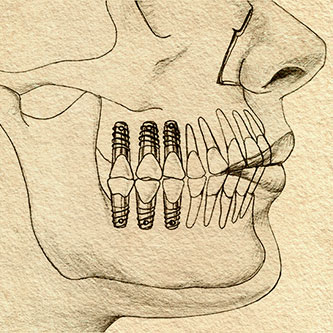
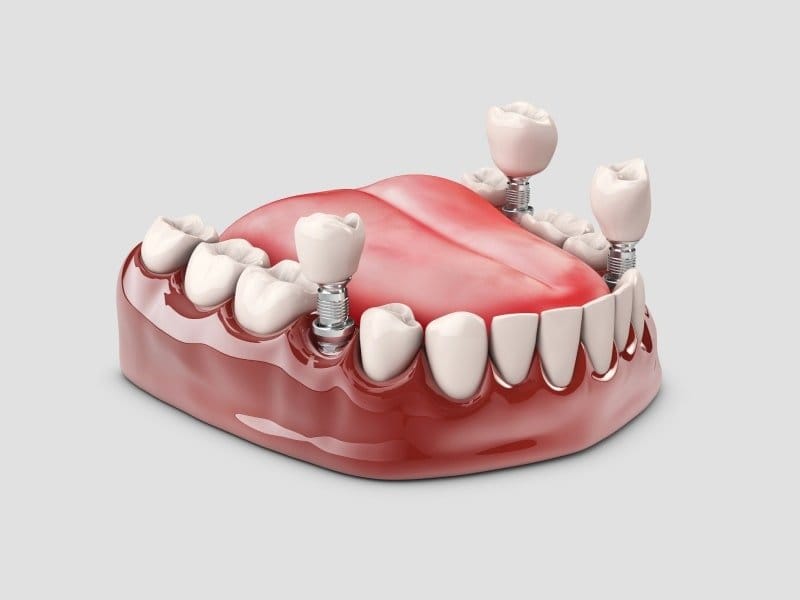
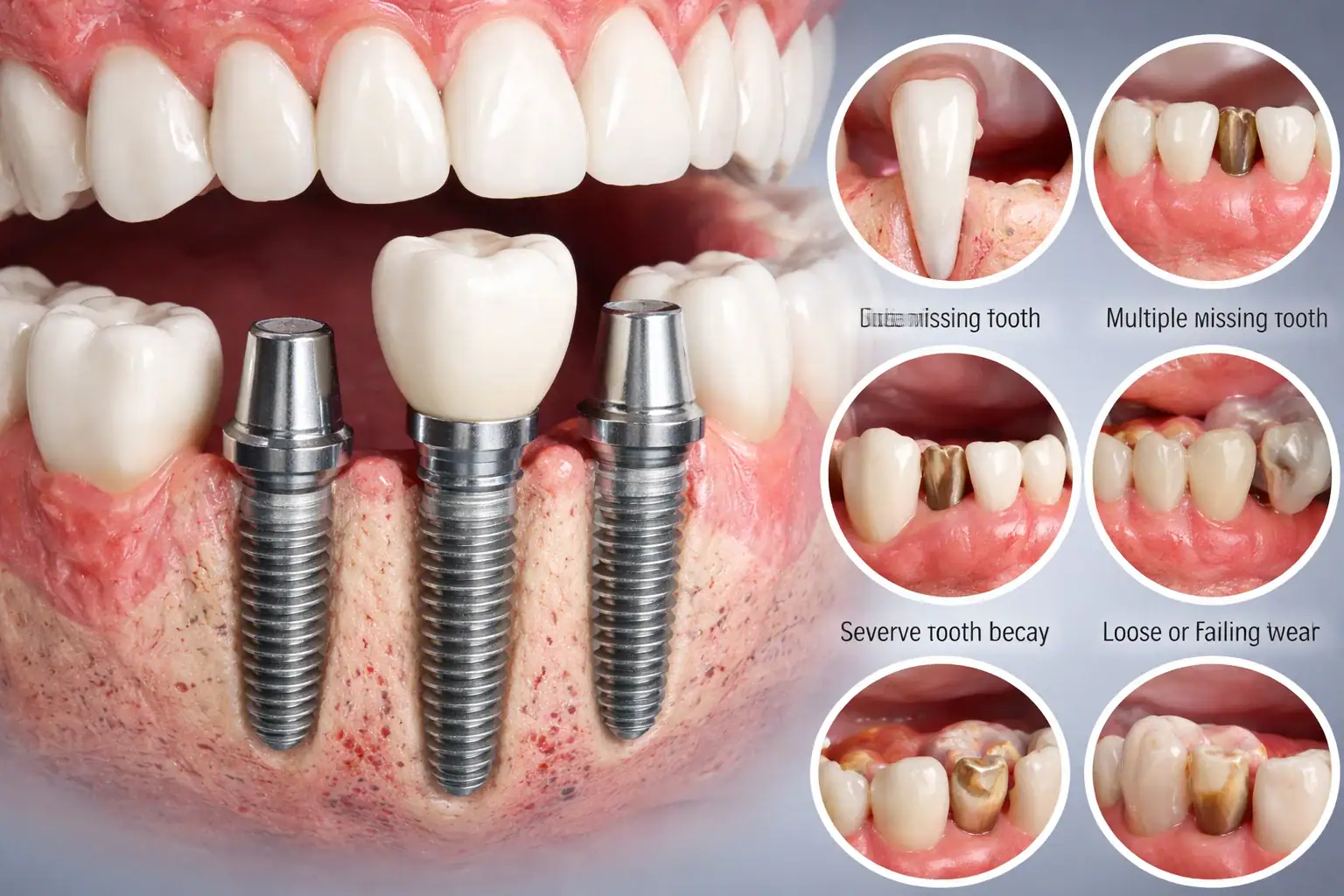
An implant is an artificial tooth root, usually made from medical-grade titanium or zirconia, placed surgically into the jawbone to carry a crown, a bridge or a full-arch prosthesis. The system has three parts. The fixture is the screw-shaped component that sits in the bone and takes the place of the root. The abutment is the connector that joins the fixture to the visible tooth. The restoration is the crown, bridge or prosthesis that you see and chew with.
Seeing the implant as three components helps later on, because maintenance applies to all three and a problem can start at any of them: in the bone and gum around the fixture, in the connection, or in the porcelain of the crown. Compared with a removable denture or a conventional bridge, an implant does not lean on the neighbouring teeth for support, and it transmits chewing load into the bone at the site of the missing tooth.
The Conditions That Make a Patient Suitable
Suitability is decided by bone volume, gum health, general health and skeletal maturity; age on its own is not the deciding factor. The core requirements are one or more missing teeth, enough jawbone volume or eligibility for bone augmentation, healthy gums or gum disease that can be treated first, reasonably good general health, and completed skeletal growth, typically over 18.
The lower age limit exists for a mechanical reason: a jaw that is still growing continues to develop around a fixture that does not move with it. At the other end there is no upper age limit as long as general health and healing capacity allow surgery. Older age does appear in the data as a factor to discuss: in a sensitivity analysis of 18 prospective studies, age of 65 or more was a significant predictor, with ten-year survival of 91.5% in that group (PubMed 30904559). That is a reason for careful planning and follow-up in older patients, and it does not close the door.
None of these conditions can be judged from a description of symptoms. The assessment needs a clinical examination and three-dimensional imaging with cone beam computed tomography (CBCT), because bone height, bone width and the position of the nerve canal and the sinus determine what can be placed and where. Gum inflammation is treated before surgery.
Treatment Routes When Bone Has Been Lost
Bone loss used to rule many patients out of implant treatment; today it usually changes the route instead. When a tooth has been missing for a long time, or has been lost to infection or gum disease, the ridge that held it can become too low or too narrow for a standard fixture. Several techniques are used to deal with this.
Bone grafting adds bone or bone substitute to the deficient area, often covered by a membrane, so that the ridge regains the width or height needed. A sinus lift raises the floor of the maxillary sinus in the upper back jaw and places graft material beneath it. Guided bone regeneration uses a barrier membrane to let new bone fill a defect without soft tissue growing into it. Short implants use a shorter fixture within the existing bone. In advanced cases in the upper jaw, zygomatic implants anchor in the cheekbone.
Which of these is appropriate is read from the CBCT scan; the same verbal description of "little bone" can correspond to very different volumes on imaging. The trade-off with augmentation is mainly time, because grafted bone needs to heal before or while the implant integrates. After placement, the implant fuses with the bone over 3 to 6 months before the final restoration is fitted, and a graft can add to that period.
Clinical Situations Implants Are Used For
Implants are used for several patterns of tooth loss, and the number of fixtures follows the pattern. Where a single tooth is missing, one implant carries one crown and the neighbouring teeth are left untouched; a conventional bridge would require the teeth on either side to be prepared.
Where several teeth are missing in a row, implant-supported bridges can replace them using fewer fixtures than the number of missing teeth. The exact number depends on the length of the gap, the bone available and the chewing load in that part of the mouth.
Where all teeth in a jaw are missing or cannot be kept, full-arch concepts restore a fixed row of teeth on a limited number of implants. All-on-4 uses four implants per jaw, with the back implants angled to make use of the available bone, and All-on-6 spreads the load over six. The choice between them is made on bone volume, bite forces and the planned prosthesis.
For people who already wear a complete denture, implants can stabilise it. Implant-supported dentures clip onto the fixtures and stay removable for cleaning, while resisting the slipping that makes a conventional lower denture difficult to wear. Each situation follows the same suitability assessment; what changes is the number and position of the implants and the restoration on top.
Medical Conditions That Change the Plan
Most systemic conditions call for additional assessment and do not in themselves exclude implant treatment. The ones that come up most often are diabetes, osteoporosis, cardiovascular disease, a history of periodontal disease and smoking. Well-controlled diabetes is usually compatible with treatment; poorly controlled diabetes slows healing and is addressed with the patient's physician first.
For osteoporosis, the question is usually the medication. A 2025 meta-analysis found that medication-related osteonecrosis of the jaw after implant placement occurred in 0.5% of patients taking antiresorptive therapy, pooled from 21 cohorts, and a single risk-adjusted report found that bisphosphonates added 3 cases per 1000 patients (PubMed 40505730). In the same review, implant failure among patients taking antiresorptives showed no clear increase, with a relative risk of 0.82 across 9 studies and 655 patients, although the certainty of that evidence was very low (PubMed 40505730). The medication, its duration and the prescribing physician are therefore part of the planning conversation.
Smoking is the risk factor with the clearest numbers. A meta-analysis of 292 publications compared 35,511 implants placed in smokers with 114,597 implants in non-smokers and found a higher failure risk in smokers, with an odds ratio of 2.402 (PubMed 35056347). Stopping before surgery and through the healing period is strongly recommended; a smoker who continues is not refused treatment, but should know that the risk profile is different.
Survival Figures Over Ten to Twenty Years
Implants have long-term data behind them, and those data are high without being absolute. A meta-analysis of 18 prospective studies of contemporary implant systems put ten-year survival at the implant level at 96.4% (PubMed 30904559). A single-practice cohort of 10,871 implants in 4247 patients reported cumulative survival of 94.0% at 15 years (PubMed 33768695). At 20 years, five retrospective studies covering 1440 implants showed 88% survival, three prospective studies of 237 implants showed 92%, and the prospective estimate fell to 78% after imputation for missing data on 422 implants (PubMed 39305362). The authors summarised this as about 4 out of 5 implants still in function at twenty years (PubMed 39305362).
Survival and success are different measures. Survival asks whether the implant is still in the mouth; success also looks at the bone level around the fixture and the health of the soft tissue, so success rates run lower. An implant that is still present is not automatically in good condition, which is why follow-up continues past the ten-year mark.
Implants are also compared with bridges on longevity. In a systematic review of tooth-supported and implant-supported restorations, ten-year survival was 89.4% for implant-supported single crowns and 89.2% for conventional bridges (PubMed 17594374). The case for an implant over a bridge therefore rests on leaving the neighbouring teeth unprepared and keeping load on the bone at the gap.
From Consultation to the Final Restoration
Treatment runs from a few months to about a year, and the stage that sets the pace is osseointegration. It begins with a consultation and diagnostics: a clinical examination, X-rays, a CBCT scan and digital planning in which the implant position is decided on the scan before surgery. A treatment plan follows, setting out the number of implants, any grafting, and the type of restoration.
Implant placement is a single appointment under local anaesthesia or sedation, and discomfort afterwards is usually mild. The implant then fuses with the bone over 3 to 6 months, during which a temporary tooth may be worn. When integration is confirmed, the final crown, bridge or prosthesis is made and fitted. Digital smile design, zirconia crowns and planning of the gum contour are used to match the new teeth to the surrounding teeth and the face.
For patients deciding between implants and a removable denture, the differences are practical. An implant restoration is fixed, while a denture is removed for cleaning and at night. Implants keep load on the bone at the site, while the bone under a denture continues to resorb. Chewing with implants comes closer to natural teeth. A denture needs no surgery, which matters for some patients.
Daily Care and the Questions for Your Consultation
Implants need the same daily care as natural teeth, with particular attention where the gum meets the implant. Brushing twice a day, cleaning between the teeth with floss or interdental brushes, avoiding smoking, attending regular check-ups and dealing with gum inflammation early keep the tissue around the fixture healthy. Early inflammation around an implant is painless, so it is usually found at check-ups. When implants fail, the cause is most often infection, smoking or poor bone quality.
A consultation is useful when it answers specific questions about your own mouth. Is there enough bone at the site on the CBCT scan, and if not, which augmentation route is proposed and how much time does it add? Are the gums healthy now, or is there inflammation to treat first? Do any medical conditions or medications, such as diabetes or antiresorptive drugs for osteoporosis, need input from your physician? If you smoke, what does the plan assume about stopping? How many implants are planned, what will they carry, and what does follow-up look like after the final restoration? With those answers, whether implant treatment suits you can be discussed in concrete terms, and cost is set out once the plan is known.
Let's plan the right treatment together.
Free Assessment→- 1.Kupka JR, Koenig J, Al-Nawas B, Sagheb K, Schiegnitz E. How far can we go? A 20-year meta-analysis of dental implant survival rates. Clin Oral Investig. 2024;28(10):541. doi:10.1007/s00784-024-05929-3. PubMed 39305362
- 2.Mirza R, El Rabbany M, Ali DS, Tetradis S, Morrison A, Ruggiero S, et al. Dental Implant Failure and Medication-Related Osteonecrosis of the Jaw Related to Dental Implants in Patients Taking Antiresorptive Therapy for Osteoporosis: A Systematic Review and Meta-Analysis. Endocr Pract. 2025;31(9):1189-1196. PubMed 40505730
- 3.Howe MS, Keys W, Richards D. Long-term (10-year) dental implant survival: A systematic review and sensitivity meta-analysis. J Dent 2019;84:9-21. PubMed 30904559
- 4.French D, Ofec R, Levin L. Long term clinical performance of 10 871 dental implants with up to 22 years of follow-up: A cohort study in 4247 patients. Clin Implant Dent Relat Res 2021;23:289-297. PubMed 33768695
- 5.Pjetursson BE, Brägger U, Lang NP, Zwahlen M. Comparison of survival and complication rates of tooth-supported fixed dental prostheses (FDPs) and implant-supported FDPs and single crowns (SCs). Clin Oral Implants Res 2007;18 Suppl 3:97-113. PubMed 17594374
- 6.Mustapha AD, Salame Z, Chrcanovic BR. Smoking and Dental Implants: A Systematic Review and Meta-Analysis. Medicina (Kaunas) 2021;58. PubMed 35056347
- 7.Shao WH, Chen R, Wang S, Duan SY, Zhang XD, Tang YL. All-on-4 and All-on-6 implant-supported fixed prostheses for the edentulous jaw: a systematic review and meta-analysis. Int J Oral Maxillofac Surg 2026;55:1098-1112. PubMed 42031576
- 8.Kwon T, Bain PA, Levin L. Systematic review of short- (5-10 years) and long-term (10 years or more) survival and success of full-arch fixed dental hybrid prostheses and supporting implants. J Dent 2014;42:1228-41. PubMed 24975989
- 9.Khouly I, Braun RS, Ordway M, Alrajhi M, Fatima S, Kiran B, et al. Post-operative pain management in dental implant surgery: a systematic review and meta-analysis of randomized clinical trials. Clin Oral Investig 2021;25:2511-2536. PubMed 33839939
- 10.Melini M, Forni A, Cavallin F, Parotto M, Zanette G. Analgesics for Dental Implants: A Systematic Review. Front Pharmacol 2021;11:634963. PubMed 33584316