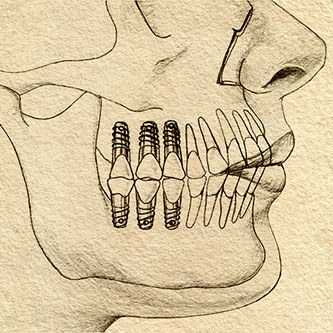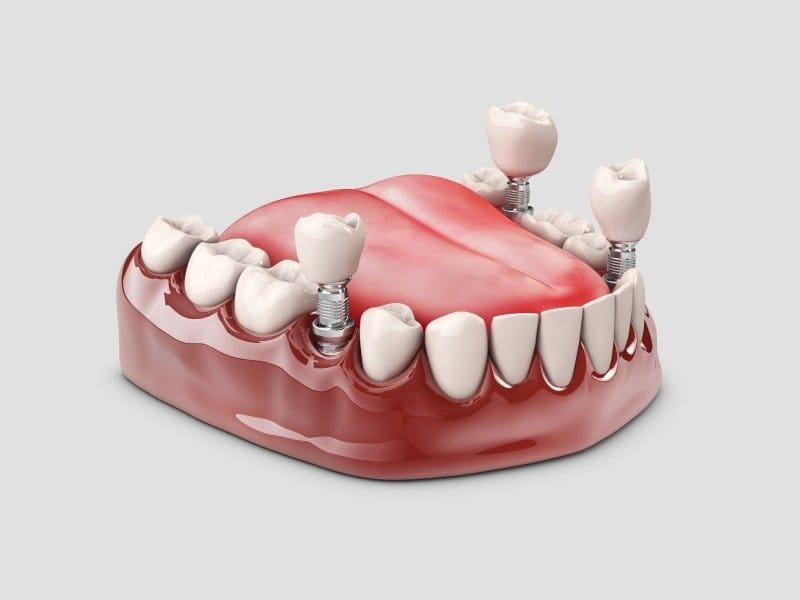
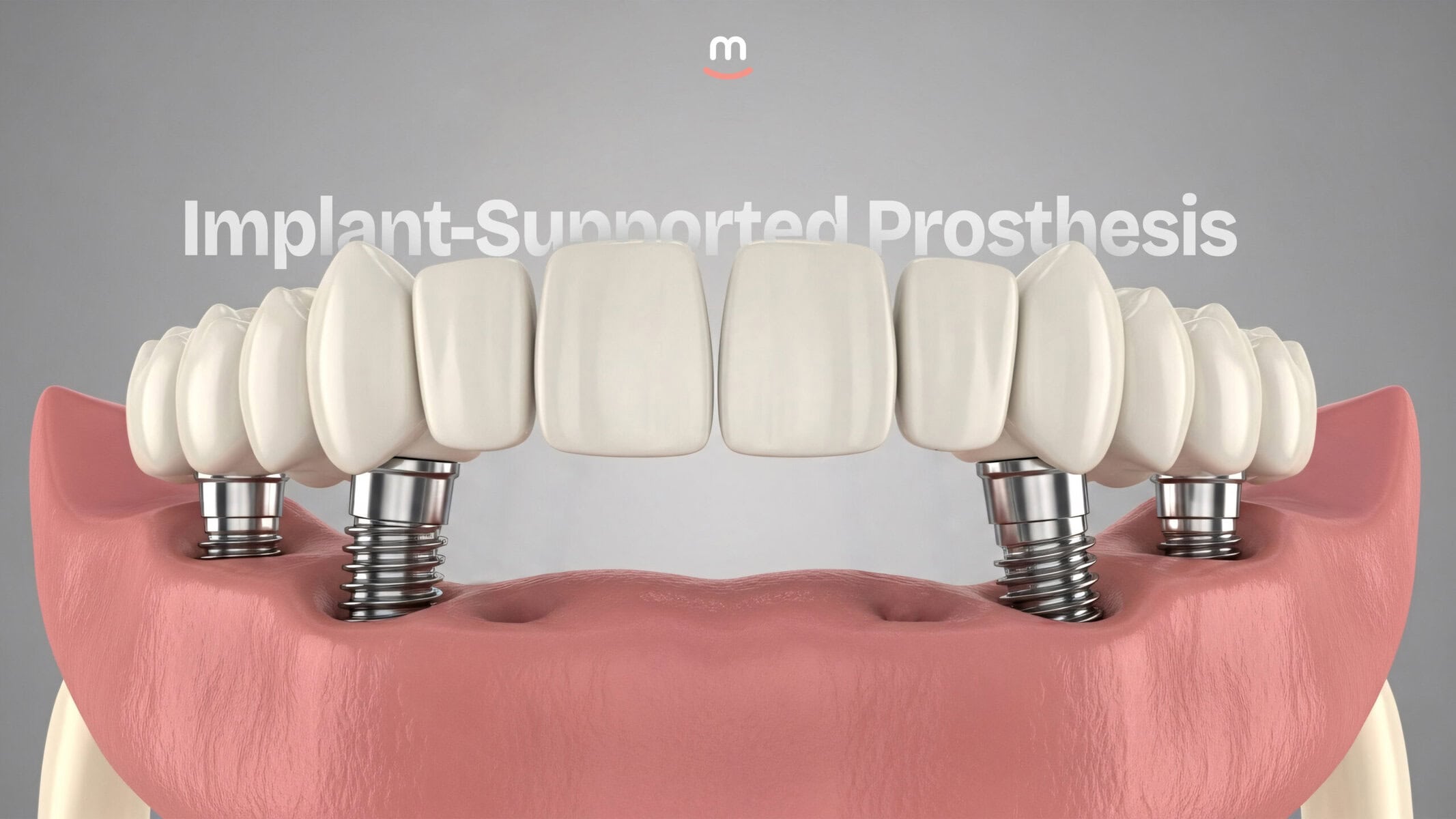
An implant-supported prosthesis is a crown, bridge or full-arch restoration anchored to titanium or zirconia implants placed in the jawbone rather than resting on the gums, so biting force passes through the implants into bone instead of pressing on soft tissue. Survival is well documented: a systematic review of 32 studies put the survival of implants supporting fixed dental prostheses at 95.6 percent after 5 years and 93.1 percent after 10, with metal-ceramic implant-supported prostheses at 96.4 and 93.9 percent (PubMed 23062125). The same analysis is candid about upkeep, since only 66.4 percent of patients were free of any complication at 5 years.
- 01Two families exist: fixed prostheses that only a dentist can remove, including All-on-4 and All-on-6 full arches, single crowns and implant bridges; and removable overdentures that clip onto two to four implants through bars, balls, buttons or locators.
- 02Long-term data are strong: across 32 studies, implants supporting fixed prostheses survived at 95.6 percent over 5 years and 93.1 percent over 10, and metal-ceramic implant-supported prostheses at 96.4 and 93.9 percent (PubMed 23062125).
- 03Complications are frequent even when survival is high. In the same analysis 33.6 percent of patients had a complication within 5 years, most often fracture of the veneering material (13.5 percent), peri-implantitis and soft tissue problems (8.5 percent) and screw or abutment loosening (5.3 percent) (PubMed 23062125).
- 04The bone argument is measurable: after an extraction left untreated, 20 studies recorded horizontal bone loss of 29 to 63 percent and vertical loss of 11 to 22 percent at 6 months, with the fastest reduction in the first 3 to 6 months (PubMed 22211303).
- 05Timeline is set by biology, not by scheduling: osseointegration takes 3 to 6 months between implant placement and the final prosthesis, and maintenance visits every 6 months are part of the treatment rather than an optional extra.
Tooth loss can have a significant impact on both oral function and confidence. Although conventional dentures and bridges have been used for many years to restore missing teeth, implant-supported prostheses offer a modern, durable, and natural alternative. These prosthetic alternatives anchor directly to dental implants placed in the jawbone, providing stability, function, and aesthetics that mimic natural teeth.
/ Implant-Supported Prostheses and Fixed Options
An implant-supported prosthesis is a dental restoration that uses titanium or zirconia implants surgically placed in the jawbone to support a fixed or removable dental prosthesis. The implants act as artificial roots, creating a stable foundation for crowns, bridges, or full-arch restorations.
Unlike conventional dentures that typically rest on the gums, implant-supported prostheses distribute biting forces through the implants to your bone, creating a stable and durable connection. As a result, this approach helps preserve jawbone density and prevents the facial collapse often associated with tooth loss.
Implant-supported prostheses are ideal for patients missing multiple teeth or an entire arch, offering enhanced comfort, stability, and chewing efficiency.
Types of Implant-Supported Prostheses
Implant-supported prostheses can be broadly categorized into fixed and removable options. The choice depends on the number of missing teeth and your bone density, needs, preferences, and budget. Here are some of the most common alternatives:
1. Fixed Implant-Supported Prosthesis
As their name suggests, this type of prosthetic treatment is permanently attached to implants and can only be removed by a dentist in a professional environment. They’re also called implant-supported fixed bridges or hybrid prostheses. Among these you can find:
● All-on-4 and All-on-6 systems : These are the most common examples for patients with complete tooth loss. This fixed prosthesis uses four or six implants per arch to support a full set of new teeth.
● Fixed dental crowns : They’re unitary dental restorations that replace one missing tooth without affecting or touching neighboring healthy teeth. They can be used on front or back teeth, offering many options.
● Fixed dental bridges : This alternative uses two or more dental implants to restore multiple missing teeth. The implants serve as the base for a bridge that restores aesthetics and function.
/ Removable Implant-Supported Dentures and Key Differences
In this case, a removable prosthesis attaches to dental implants through specialized connectors, such as bars, balls, buttons, or locators. In contrast to fixed solutions, patients can remove these types of prosthesis for daily cleaning or sleeping.
These prosthetic treatments are typically supported by two to four implants per arch, providing greater retention than traditional dentures, while all-on-4 and all-on-6 systems use four or six implants respectively to carry a full fixed arch. They’re ideal for patients without teeth seeking a balance between stability and affordability.
Key Differences Between Implant-Supported Prostheses
While fixed and removable implant-supported alternatives offer similar advantages, they have crucial differences that may affect your decision.
Key Advantages
Fixed implant supported prostheses offer excellent stability, eliminating possible movements during speech or eating while offering a natural appearance. Removable implant-supported dentures, on the other hand, allow for easier hygiene maintenance, improving chewing efficiency while reducing gum irritations.
Disadvantages
Fixed alternatives typically come at a higher cost and the need for professional intervention in case of repairs or cleanings. Removable options are slightly less stable than fixed options and may require periodic adjustments of attachments.
/ Implant-Supported Prosthesis Procedure Planning and Surgery
The process of getting an implant-supported prosthesis involves several stages and typically spans several months, allowing for proper healing and integration. While these steps may vary from one type of prosthesis to other, these are some common stages:
1. Initial Consultation and Planning
Just as other dental restorations, getting an implant-supported prosthesis requires a complete evaluation that typically includes assessing your oral health, bone density , and overall condition. This first step usually requires using X-rays, CT scans, and oral scans to provide a comprehensive assessment of your entire mouth while creating a digital reconstruction of the structures to determine implant positions and the type of prosthesis best suited to your needs.
Once the evaluation is complete, your dentist can create a tailored treatment plan, adapted to your needs and preferences.
2. Implant Placement Surgery
Once the site is numbed under local anesthesia or sedation , the specialist places the dental implants into the jawbone using a surgical guide previously made during the digital planning. The number of implants varies depending on the case and the type of restorations, whether it’s an all-on-4 or a fixed bridge for 3 teeth.
During this step, the specialist uses specialized drill bits and other tools to insert the dental implants in the jawbone carefully. Some cases require a previous dental extraction or other surgical procedures that may extend the healing period further.
/ Healing Before Prosthesis Placement
Implant-supported prosthesis treatment continues with healing after surgery.
3. Osseointegration or Healing Phase
Over the next 3–6 months, the implants fuse with the bone through a biological process called osseointegration, creating a solid foundation for the prosthesis. This is the most essential phase of the treatment, requiring careful and consistent maintenance to prevent dental plaque or other factors that may affect healing.
4. Abutment and Prosthesis Placement
Once the healing is complete, abutments work as small connectors that attach your implants to the prosthesis. With the abutment in place, your dentist can fit, adjust, and secure your custom-made dental prosthesis for optimal comfort and function. This process is crucial whether your prosthesis is fixed or removable.
5. Follow-Up and Maintenance
With your implants and prosthesis in place, all that’s left are regular follow-up visits to monitor healing, check bite alignment, keep abutments in excellent shape, and ensure long-term stability. Your dentist will also provide customized dental advice to extend the life and performance of your restorations.
Differences Between Implant-Supported Prostheses and Other Dental Prosthetics
Implant-supported prostheses differ from conventional dentures and bridges in multiple ways:
● Stability and Comfort : Unlike removable dentures, they don’t slip, move, or cause gum soreness. While most removable dentures are adapted and made to prevent issues, most of them eventually show these issues, requiring repairs and adjustments.
● Bone Preservation : Implants stimulate the jawbone, preventing bone resorption and eliminating the side-effects associated with tooth loss.
● Longevity : Implants supporting fixed prostheses showed 93.1% survival at 10 years (PubMed 23062125), while complete dentures were commonly replaced after 6 years of service (PubMed 34645719).
● Aesthetics : Implant-supported restorations blend with the neighbouring teeth and look natural.
● Function : Implants restore nearly full chewing strength, allowing patients to eat a varied diet confidently without fearing of breaking, dislodging, or moving.
While the upfront cost and investment is typically higher than other prostheses, the long term benefits in function and oral health make implant-supported prostheses a cost effective investment over time.
/ Care and Maintenance of Implant-Supported Prostheses
Proper care is crucial to extend the life of your implants and prosthesis. Consider the following:
Daily Cleaning
● Fixed Prostheses : Brush your teeth twice daily using a soft-bristle toothbrush and non-abrasive toothpaste. Also, incorporate floss threaders, interdental brushes, or water flossers to clean around the implants or under the bridge.
● Removable Prostheses : Remove daily for thorough cleaning with a denture brush and mild soap or denture cleaner. Avoid hot water, lemon, vinegar, or other abrasive substances that can distort and damage acrylic.
Regular Dental Visits
Schedule professional cleanings and examinations every 6 months, or more often if your dentist recommends it. Your specialist will check for plaque buildup, wear, or loosening of components to address them in time and prevent further complications.
Avoid Damaging Habits
Avoid biting hard objects, like ice or pens, grinding your teeth, and reduce or quit smoking, as all of them can shorten your prosthesis’s lifespan and compromise implant health over time.
Maintain Excellent Periodontal Hygiene
One of the most frequent complications in implant-supported prostheses are issues related to inflammation and infection of implants. These conditions are called mucositis, when the tissues are just inflamed, and peri-implantitis when it starts affecting the bone beneath the implants. As a result, keeping your gums and implant clean and plaque-free is essential to prevent complications and keep your restorations in great shape for many years.
/ Candidacy for Implant-Supported Prosthesis
Implant-supported prosthesis outcomes also depend on candidacy, systemic control, and maintenance after treatment.
Control Systemic Issues
Some systemic conditions and diseases have a direct effect on your implant’s health. Diabetes, some medications, and other metabolic disorders can make healing more challenging, requiring strict medical control to prevent multiple complications.
Who Is a Good Candidate for an Implant-Supported Prosthesis?
While implant solutions are an excellent alternative, they’re not for everyone. You may be a good candidate if you:
● Are missing multiple teeth or a full arch
● Have sufficient bone density or eligible for bone grafting
● Don’t smoke or are willing to quit during treatment
● Maintain good oral and general health
Unfortunately, patients with chronic conditions, such as osteoporosis or uncontrolled diabetes, should consult their specialist before undergoing implant therapy.
Conclusion
Implant-supported prostheses combine dental implants with fixed or removable restorations. Compared with conventional dentures they are more stable during chewing, and the choice between the designs depends on bone volume, the number of missing teeth and the prosthetic plan.
Let’s plan the right treatment together.
Free Assessment→- 1.Pjetursson BE, Thoma D, Jung R, Zwahlen M, Zembic A. A systematic review of the survival and complication rates of implant-supported fixed dental prostheses (FDPs) after a mean observation period of at least 5 years. Clin Oral Implants Res. 2012;23 Suppl 6:22-38. doi:10.1111/j.1600-0501.2012.02546.x
- 2.Tan WL, Wong TL, Wong MC, Lang NP. A systematic review of post-extractional alveolar hard and soft tissue dimensional changes in humans. Clin Oral Implants Res. 2012;23 Suppl 5:1-21. doi:10.1111/j.1600-0501.2011.02375.x
- 3.Taylor M, Masood M, Mnatzaganian G. Complete denture replacement: a 20-year retrospective study of adults receiving publicly funded dental care. J Prosthodont Res 2022;66:452-458. PubMed 34645719