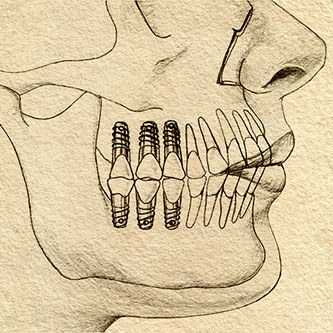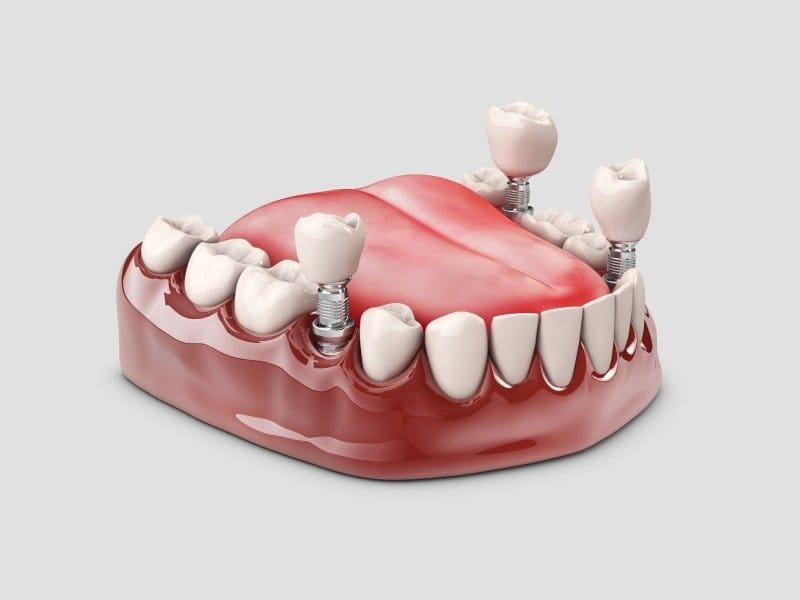
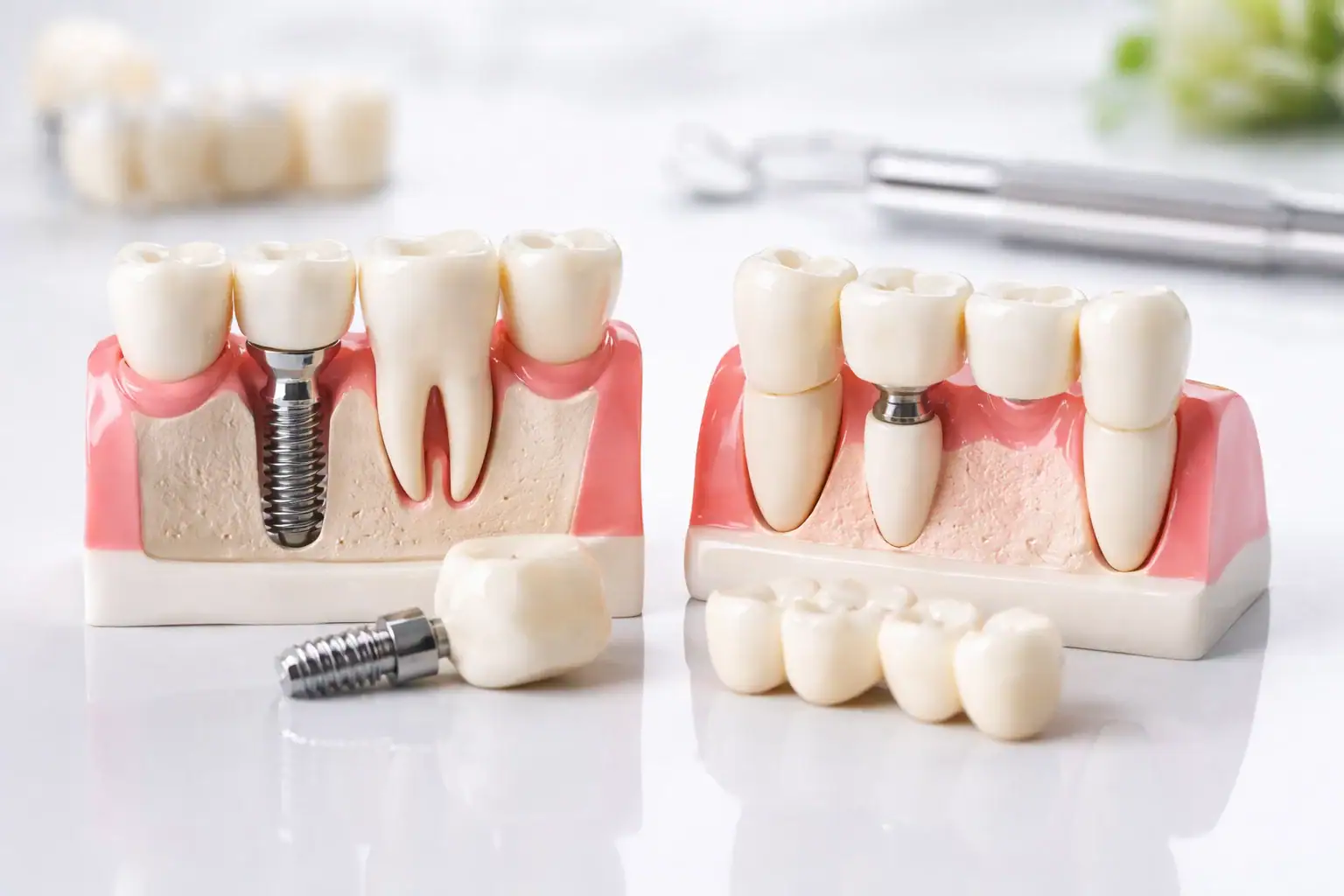
A dental implant is a titanium post placed into the jawbone to replace the tooth root, while a dental bridge is a false tooth carried by crowns cemented onto the two neighbouring teeth, which have to be trimmed down first. The difference is structural rather than cosmetic: the implant stands on its own, the bridge borrows support from healthy teeth. A meta-analysis of cohort studies estimated 10-year survival at 89.4% for implant-supported single crowns and 89.2% for conventional tooth-supported bridges, so late survival is close; what separates them is the cost in tooth structure, surgery and available bone (PubMed 17594374).
- 01A bridge is retained by crowns on the adjacent teeth, so those two teeth must be reduced; an implant is anchored in bone and leaves the neighbours untouched.
- 02Estimated 5-year survival was 94.5% for implant-supported single crowns and 93.8% for conventional tooth-supported bridges; at 10 years the figures were 89.4% and 89.2%, while cantilever bridges fell to 80.3% (PubMed 17594374).
- 03Complications are more frequent on the implant side: 38.7% of patients with implant-supported fixed prostheses had some complication within 5 years, against 15.7% for conventional tooth-supported bridges (PubMed 17594374).
- 04The complication types differ by design: caries and loss of pulp vitality dominate on tooth-supported bridges, while veneer chipping, abutment or screw loosening and loss of retention dominate on implants.
- 05Screw loosening is the single most common technical problem on implant single crowns, with a cumulative 5-year incidence of 8.8% (95% CI 5.1 to 15.0) in a meta-analysis of 46 studies (PubMed 23062124).
/ Dental Implant vs Dental Bridge
Which Tooth Replacement Option Is Right for You?
Missing teeth can affect your confidence, speech, chewing ability, and overall oral health. Two of the most common solutions for replacing missing teeth are dental implants and dental bridges. But which one is better? What are the real differences between implants and bridges?
What Is a Dental Implant?
A dental implant is a titanium post surgically placed into the jawbone to act as an artificial tooth root. Once healed, a crown is attached on top, creating a natural-looking replacement tooth.
Parts of a Dental Implant:
- Titanium implant (root)
- Abutment (connector)
- Crown (visible tooth)
Benefits of Dental Implants:
✔ Looks and feels like a natural tooth
✔ Prevents bone loss
✔ Does not affect nearby teeth
✔ Long-lasting solution
✔ Strong chewing power
✔ High success rate
What Is a Dental Bridge?
A dental bridge is a prosthetic tooth (or teeth) held in place by crowns on adjacent natural teeth. These supporting teeth are reshaped to anchor the bridge.
Types of Dental Bridges:
- Traditional bridge
- Cantilever bridge
- Maryland bridge
- Implant-supported bridge
Benefits of Dental Bridges:
✔ Faster treatment
✔ No surgery required
✔ Lower upfront cost
✔ Proven technique
Disadvantages:
❌ Healthy teeth must be shaved
❌ Does not prevent bone loss
❌ Depends on the abutment teeth, where caries and loss of pulp vitality are the leading biological complications
Dental Implant vs Dental Bridge: Key Differences
| Feature | Dental Implant | Dental Bridge |
|---|---|---|
| Adjacent teeth | Not affected | Must be trimmed |
| Bone preservation | Yes | No |
| 10-year survival | 89.4% (single crown) | 89.2% (conventional) (PubMed 17594374) |
| Surgery | Required | Not required |
| Aesthetics | Excellent | Good |
| Comfort | Very high | Moderate |
| Cleaning | Easy | More difficult |
/ Dental Implant vs Dental Bridge Decision Factors
Dental implant vs dental bridge decisions include durability, candidacy, care, health impact, and technology.
Longevity: Which Lasts Longer?
Dental Implants
- 89.4% of implant-supported single crowns survived 10 years (PubMed 17594374)
- Very high success rate
Dental Bridges
- 89.2% of conventional bridges survived 10 years (PubMed 17594374)
- Dependent on supporting teeth health
Ten-year survival is similar.
Who Is a Good Candidate for Dental Implants?
Ideal candidates:
✔ Good overall health
✔ Enough jawbone
✔ Non-smokers or light smokers
✔ Good oral hygiene
Not ideal:
- Uncontrolled diabetes
- Severe bone loss
- Heavy smokers
Who Is a Good Candidate for Dental Bridges?
✔ Patients who want quick results
✔ Patients with existing crowns
✔ Patients who cannot undergo surgery
✔ Budget-conscious patients
Treatment Process Comparison
Dental Implant Procedure:
- Consultation & 3D scan
- Implant placement
- Healing (2–4 months)
- Abutment placement
- Crown attachment
Dental Bridge Procedure:
- Tooth preparation
- Impression
- Temporary bridge
- Final bridge placement
Pain and Comfort Comparison
Implants
- Minor surgical discomfort
- Pain subsides in 2–3 days
Bridges
- Minimal pain
- Temporary sensitivity
Aesthetic Results
Dental Implants
✔ Natural gum contour
✔ Perfect color match
✔ No dark metal edges
Dental Bridges
✔ Good cosmetic outcome
❌ Gum recession over time
❌ Possible metal shadows
Chewing Strength
- Implants: Similar to natural teeth
- Bridges: Moderate biting force
Cleaning and Maintenance
Implants
- Brush normally
- Floss daily
Bridges
- Requires special floss
- Harder to clean underneath
Cost Comparison
Prices depend on:
- Clinic location
- Dentist experience
- Materials used
Average Cost:
$1,500 – $4,000 per tooth
Dental Bridge:
$800 – $2,500
⚠ Although implants cost more initially, they last longer.
Health Impact
Dental implants:
✔ Prevent jawbone loss
✔ Protect neighboring teeth
✔ Maintain facial structure
Dental bridges:
❌ Bone loss continues
❌ Stress on support teeth
Which Is More Natural?
Dental implants mimic real teeth:
✔ Root replacement
✔ Natural chewing
✔ Independent structure
Dental bridges:
❌ Depend on other teeth
Risks and Complications
Implants
- Infection (rare)
- Implant failure (rare)
Bridges
- Tooth decay
- Gum disease
- Bridge loosening
Modern Technology in Implant Dentistry
- Digital scanning
- 3D guided surgery
- CAD/CAM crowns
These technologies increase:
✔ Precision
✔ Comfort
✔ Success rate
/ FAQs
Which is better: implant or bridge?
Neither wins outright. Ten-year survival is close, 89.4% for implant-supported single crowns against 89.2% for conventional bridges, while complications within five years were more frequent on the implant side, 38.7% against 15.7% (PubMed 17594374). Implants preserve bone and leave the neighbouring teeth untouched, which is where their advantage sits.
Can a bridge fall out?
Yes, if cement weakens.
Are implants permanent?
They are fixed rather than permanent. Estimated survival was 94.5% at five years and 89.4% at ten years for implant-supported single crowns (PubMed 17594374), and screw loosening is the most common technical problem, with a cumulative five-year incidence of 8.8% (PubMed 23062124).
Does insurance cover implants?
Depends on provider.
Aesthetic Dentistry Perspective and Final Decision
Aesthetic Dentistry Perspective
Most cosmetic dentists prefer:
Dental implants
because they:
✔ Preserve natural teeth
✔ Look more realistic
✔ Prevent bone loss
Final Decision: Implant or Bridge?
Choose dental implants if you want:
✔ Long-term solution
✔ Natural look
✔ Bone preservation
✔ Strong bite
Choose dental bridges if you want:
✔ Quick treatment
✔ Lower cost
✔ No surgery
Summary
- Ten-year survival is similar, 89.4% against 89.2% (PubMed 17594374)
- Bridges are quicker
- Implants protect bone
- Bridges affect neighboring teeth
- Long-term value favors implants
Conclusion
Both dental implants and dental bridges are effective tooth replacement options. The best choice depends on:
- Your oral health
- Bone structure
- Budget
- Treatment goals
Always consult a qualified dentist for a personalized treatment plan.
Let’s plan the right treatment together.
Free Assessment→- 1.Pjetursson BE, Brägger U, Lang NP, Zwahlen M. Comparison of survival and complication rates of tooth-supported fixed dental prostheses (FDPs) and implant-supported FDPs and single crowns (SCs). Clin Oral Implants Res 2007;18 Suppl 3:97-113. PubMed 17594374
- 2.Jung RE, Zembic A, Pjetursson BE, Zwahlen M, Thoma DS. Systematic review of the survival rate and the incidence of biological, technical, and aesthetic complications of single crowns on implants reported in longitudinal studies with a mean follow-up of 5 years. Clin Oral Implants Res 2012;23 Suppl 6:2-21. PubMed 23062124