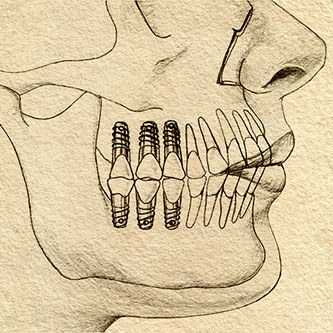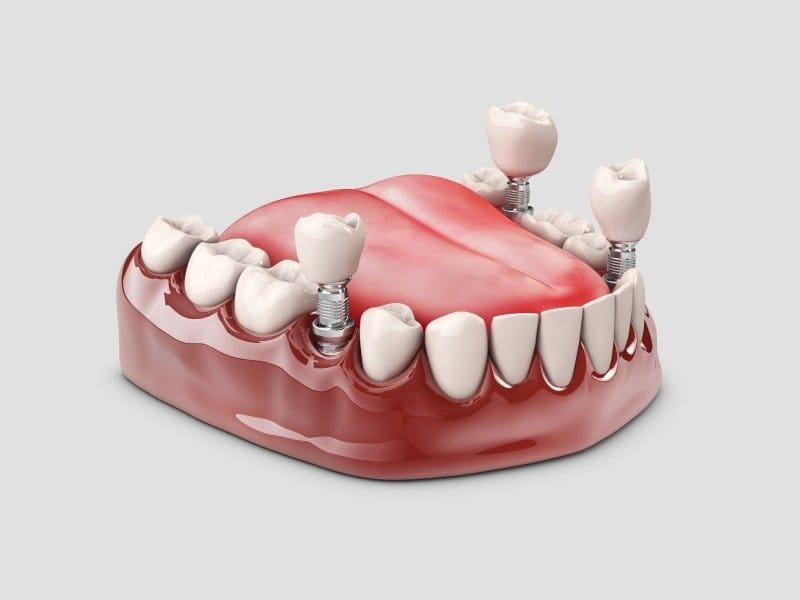
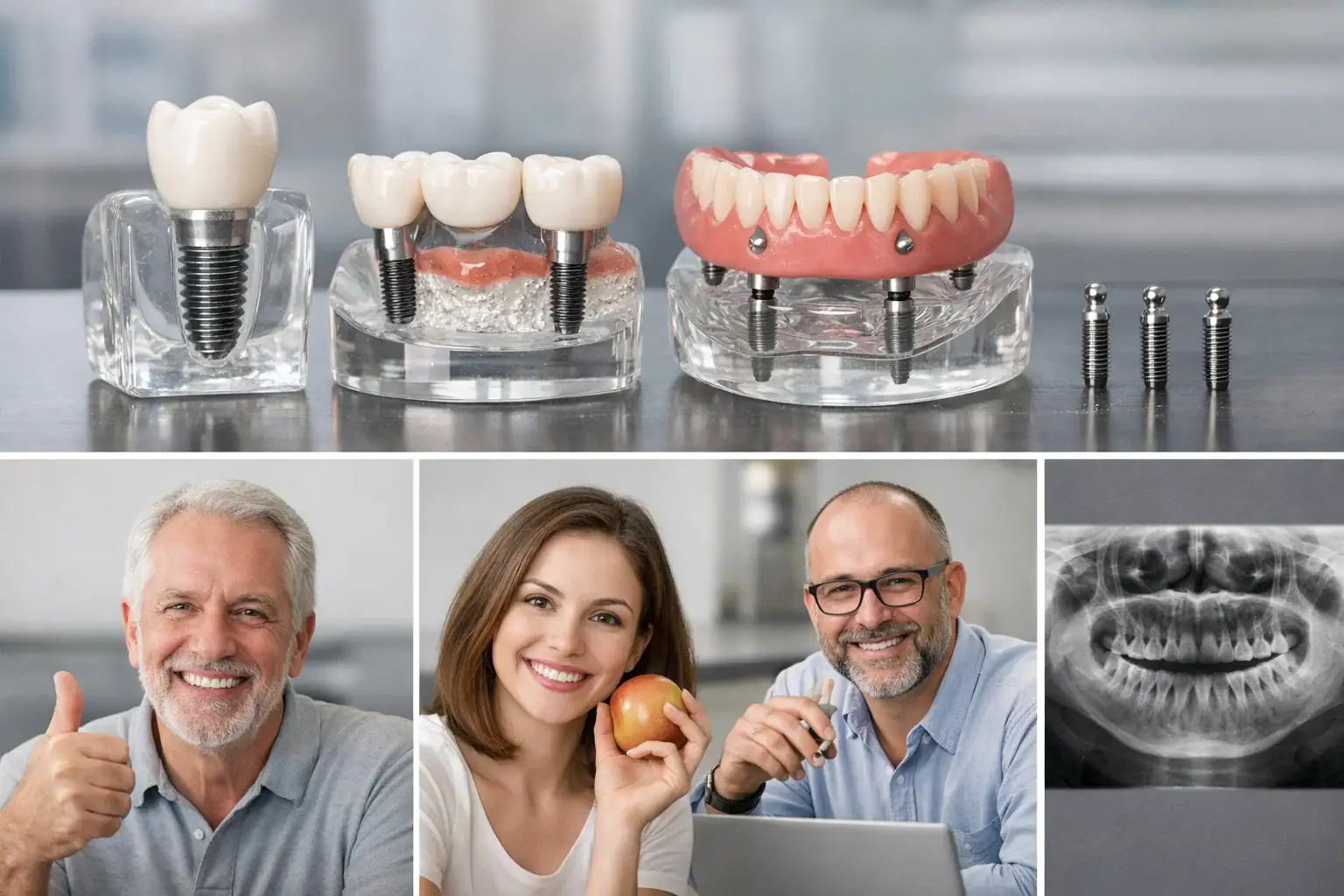
A dental implant is a titanium or ceramic post placed into the jawbone to replace a tooth root, and four designs cover almost every case: endosteal implants set inside the bone, subperiosteal implants resting on the bone beneath the gum where resorption is severe, zygomatic implants anchored in the cheekbone when the upper jaw is deficient, and narrow mini implants used mainly to stabilise dentures. Full-arch cases are usually restored on four to six implants per jaw. Pooled 10-year survival of contemporary implants is 96.4 percent, with a 95 percent confidence interval of 95.2 to 97.5, across 18 prospective studies (PubMed 30904559).
- 01Four designs cover the field and bone decides between them: endosteal for adequate volume, subperiosteal for severe resorption, zygomatic for a deficient upper jaw, mini implants for denture stabilisation.
- 02Material is a second axis. Titanium carries the long-term clinical record, zirconia is metal-free and chosen mainly for aesthetic reasons or metal sensitivity.
- 03Pooled 10-year survival is 96.4 percent, 95 percent confidence interval 95.2 to 97.5; the sensitivity analysis correcting for loss to follow-up gives 93.2 percent, and age 65 and over drops it to 91.5 percent (PubMed 30904559).
- 04Full-arch rehabilitation typically uses four to six implants per jaw, and a systematic review of 24 studies reported 99.8 percent implant survival beyond 24 months with the All-on-four concept (PubMed 28298995).
- 05Eligibility is about control rather than exclusion: patients with well-managed diabetes, osteoporosis and treated periodontal disease can proceed, while heavy smoking, active infection and uncontrolled systemic disease are addressed first.
/ Dental Implant Treatment Options and Basic Concepts
A Complete Guide to Implant Treatment Options
Dental implants are considered the gold standard for replacing missing teeth. Unlike removable dentures or traditional bridges, implant treatments offer a permanent, stable, and natural-looking solution that closely mimics real teeth in both function and appearance.
However, not all dental implants are the same and not every patient requires the same implant approach. The success of implant treatment depends on selecting the right implant type and determining whether the patient is clinically suitable for the procedure.
What Is a Dental Implant?
A dental implant is a biocompatible titanium or ceramic post surgically placed into the jawbone to replace the root of a missing tooth. Once integrated with the bone (a process known as osseointegration), the implant serves as a stable foundation for:
- Crowns
- Bridges
- Full-arch prostheses
Dental implants restore:
- Chewing efficiency
- Speech
- Facial structure
- Long-term oral health
Why Dental Implant Types Matter
Every patient presents a unique clinical scenario:
- Bone density varies
- Tooth loss patterns differ
- Systemic health conditions may exist
- Esthetic expectations change from patient to patient
Choosing the correct implant type directly affects:
- Treatment success rate
- Healing time
- Long-term stability
- Aesthetic outcome
/ Main Types of Dental Implants
1. Endosteal Implants (Most Common Type)
Endosteal implants are the most widely used dental implants worldwide.
Key features:
- Surgically placed into the jawbone
- Typically screw-shaped
- Made of titanium or zirconia
- Suitable for single or multiple tooth replacement
Who is suitable?
- Patients with adequate bone volume
- Healthy gum tissue
- Good overall oral hygiene
Endosteal implants are manufactured by systems such as Straumann and Nobel Biocare, both of which have published long-term survival data.
2. Subperiosteal Implants (For Severe Bone Loss)
Subperiosteal implants are placed on top of the jawbone but beneath the gum tissue, rather than inside the bone.
Ideal for:
- Patients with severe jawbone resorption
- Individuals who cannot undergo bone grafting
- Advanced full-arch rehabilitation cases
Modern subperiosteal implants are custom-designed using 3D imaging, making them far more predictable than older versions.
3. Zygomatic Implants (For Extreme Bone Deficiency)
Zygomatic implants are longer implants anchored in the zygomatic (cheek) bone instead of the upper jaw.
When are they used?
- Severe upper jaw bone loss
- Failed bone graft cases
- Patients seeking immediate full-arch restoration
This advanced technique often eliminates the need for sinus lifts or extensive grafting.
4. Mini Dental Implants
Mini dental implants (MDIs) have a smaller diameter than standard implants.
Advantages:
- Less invasive
- Faster healing
- Often used to stabilize dentures
Limitations:
- Lower load-bearing capacity
- Not suitable for all cases
- Shorter lifespan in high-stress areas
/ Dental Implant Planning and Aftercare
Dental implant planning connects material choice, treatment approach, patient suitability, procedure timing, and aftercare.
Implant Materials: Titanium vs Zirconia
Titanium Implants
- Most widely used
- Excellent osseointegration
- Long-term clinical data
Zirconia Implants
- Metal-free
- Highly aesthetic
- Suitable for patients with metal sensitivities
Implant Treatment Options Based on Tooth Loss
Single Tooth Implant
- Replaces one missing tooth
- Preserves adjacent teeth
- Natural look and function
Implant-Supported Bridge
- Replaces multiple missing teeth
- Fewer implants required
- More stable than traditional bridges
Full Mouth Dental Implants
- Fixed full-arch restoration
- Often uses 4–6 implants per jaw
- Also known as “ All-on-4 ” or “ All-on-6 ” concepts
Who Is a Good Candidate for Dental Implants?
Ideal Conditions:
- Good general health
- Adequate bone density
- Healthy gums
- Non-smoker or willing to quit
- Good oral hygiene habits
Conditions That May Require Special Planning
Dental implants can still be successful in patients with:
- Diabetes (well controlled)
- Osteoporosis
- Previous periodontal disease
- Sinus proximity issues
Advanced imaging such as CBCT scans and digital planning are essential in these cases.
Who May Not Be Suitable (or Needs Alternative Solutions)?
- Uncontrolled systemic diseases
- Heavy smoking
- Active gum infections
- Insufficient bone without grafting options
- Poor oral hygiene compliance
In such cases, alternative treatments or preparatory procedures may be recommended.
Bone Grafting & Sinus Lift: When Are They Needed?
If bone volume is insufficient, implant treatment may require:
- Bone grafting
- Sinus lift procedures
- Ridge augmentation
These procedures increase implant success and long-term stability.
Immediate vs Delayed Implant Placement
Immediate Implants
- Placed right after tooth extraction
- Shorter treatment time
- Requires good bone quality
Delayed Implants
- Placed after healing
- Higher predictability in compromised cases
Success Rate of Dental Implants
Pooled 10-year survival of contemporary implants is 96.4 percent across 18 prospective studies (PubMed 30904559). That figure assumes:
- Proper planning is done
- High-quality implant systems are used
- Patients follow aftercare instructions
Dental Implant Aftercare & Maintenance
Long-term success depends on:
- Daily oral hygiene
- Regular professional cleanings
- Avoiding excessive biting forces
- Night guards for bruxism patients
/ Frequently Asked Questions
Are dental implants permanent?
They are durable rather than guaranteed: pooled 10-year survival is 96.4 percent across 18 prospective studies (PubMed 30904559).
Is implant surgery painful?
The procedure is performed under local anesthesia; discomfort is usually mild and temporary.
How long does implant treatment take?
From 3 months to 9 months depending on the case.
Final Thoughts: Choosing the Right Implant Type
Dental implant treatment is not one-size-fits-all. The best results come from:
- Accurate diagnosis
- Personalized implant selection
- Advanced technology
- Experienced clinicians
When implant type and patient suitability are properly matched, dental implants offer life-changing results. Both functionally and aesthetically.
Let’s plan the right treatment together.
Free Assessment→- 1.Howe MS, Keys W, Richards D. Long-term (10-year) dental implant survival: a systematic review and sensitivity meta-analysis. J Dent. 2019;84:9-21. PMID 30904559
- 2.Soto-Penaloza D, Zaragozi-Alonso R, Penarrocha-Diago M, Penarrocha-Diago M. The all-on-four treatment concept: systematic review. J Clin Exp Dent. 2017;9(3):e474-e488. PMID 28298995