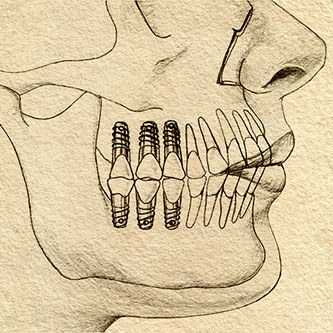
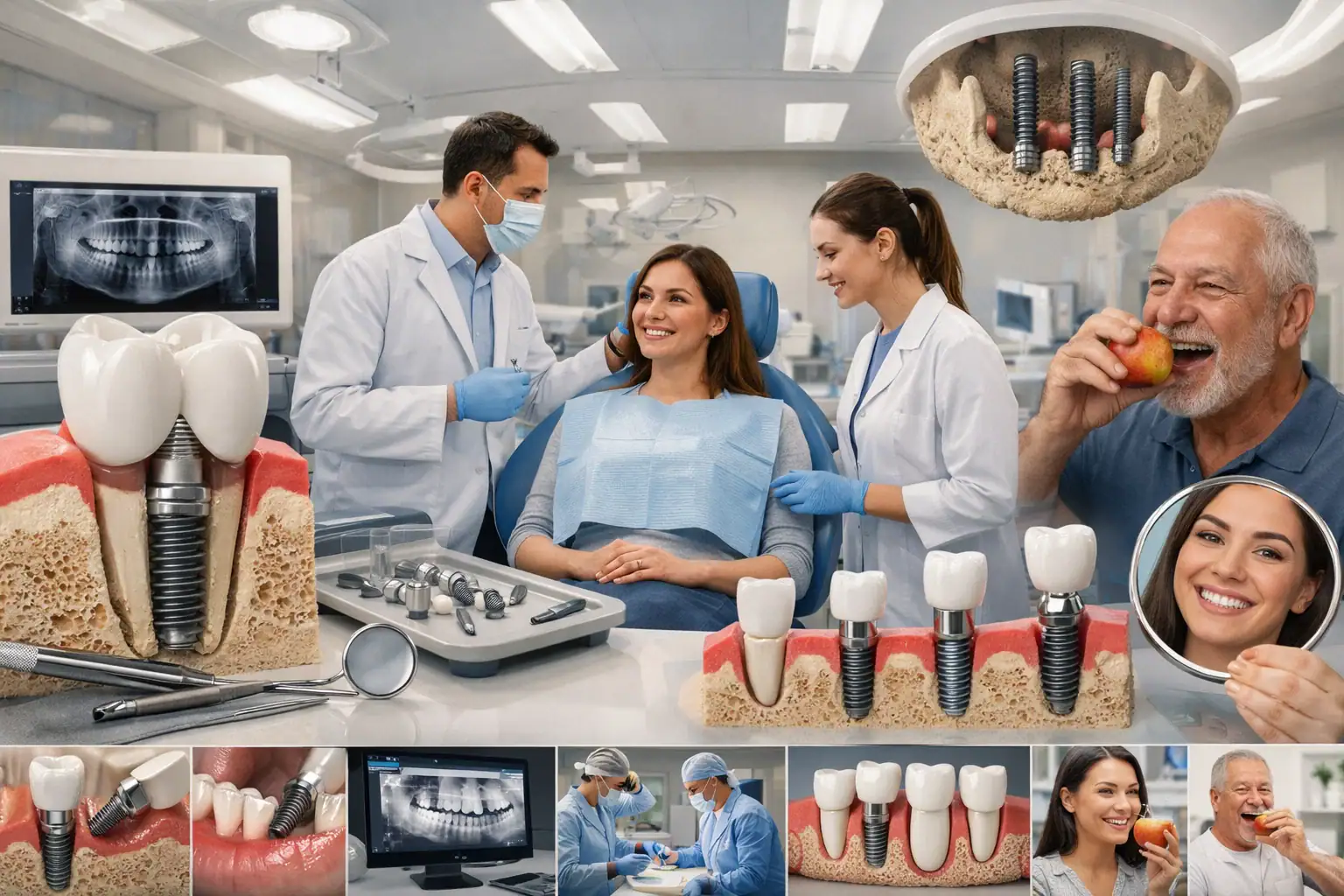
A dental implant is a screw-shaped titanium or zirconia post placed into the jawbone to replace a missing tooth root, which then carries a crown, bridge or full-arch prosthesis once bone has grown onto its surface. Mosdent puts the usual span from examination to final crown at 3 to 9 months, longer when bone grafting or a sinus lift is added. Across nine long-term studies covering 421 patients and 527 single implants followed at least ten years, implant survival was 95.0% at implant level and 93.8% at patient level, with 89.5% of the original crowns still in place (PubMed 27314122).
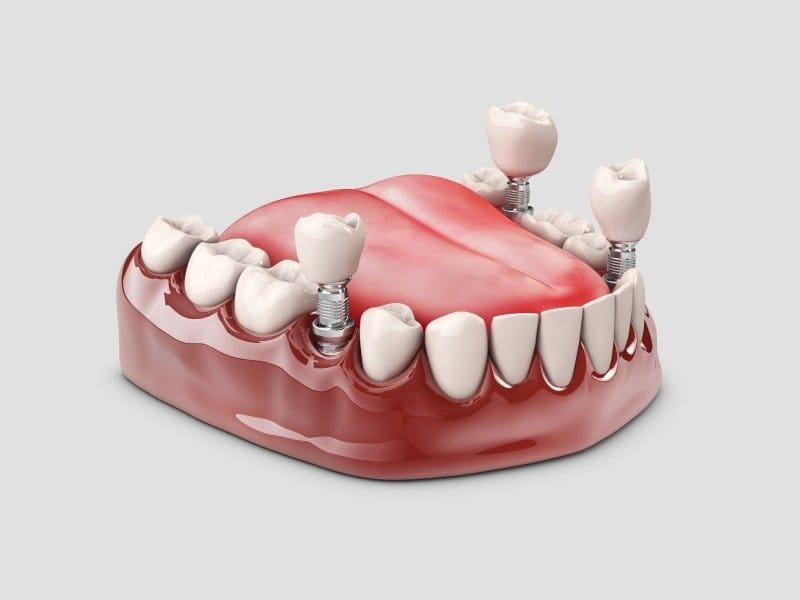
- 01An implant system has three parts: the fixture placed into bone, the abutment that connects to it, and the crown, bridge or prosthesis on top. Only the fixture replaces the tooth root.
- 02Ten-year evidence on single implants covers 421 patients and 527 implants across nine studies: 95.0% implant survival at implant level, 93.8% at patient level, and 89.5% survival for the original crowns (PubMed 27314122).
- 03Biological complications around implants are common rather than rare: pooled patient-level prevalence across 102 studies is 46% (95% CI 41-51) for peri-implant mucositis and 21% (95% CI 17-24) for peri-implantitis (PubMed 40489307).
- 04The same review identified periodontitis, diabetes mellitus, smoking and alcohol consumption as risk indicators for peri-implantitis, which is why active gum disease is stabilised before an implant is placed.
- 05Timeline is driven by healing, not scheduling: gum tissue closes in 1-2 weeks while osseointegration continues over months, and Mosdent gives 3 to 9 months as the usual total for examination through final crown.
Missing teeth are not only a cosmetic issue. Over time, tooth loss can change how you chew, speak, and smile, and it can also affect the health of your jawbone and surrounding teeth. When a tooth is missing, the jawbone in that area no longer receives normal chewing forces. That lack of stimulation can contribute to bone resorption, where bone volume gradually decreases.
A dental implant is widely considered the most modern, stable, and long-lasting tooth replacement method because it replaces the “root” portion of the tooth as well, not just the visible crown. Dental implants can support a single crown, a bridge for multiple missing teeth, or even a full-arch restoration such as All-on-4 or All-on-6.
/ Dental Implant Definition and Why Dental Implants Matter
Quick Definition: What Is a Dental Implant?
A dental implant is a small medical grade post most commonly made of titanium, and in some cases zirconia that is placed into the jawbone to serve as an artificial tooth root. After it heals and integrates with the bone, it can support a crown, bridge, or full arch prosthesis.
In simple terms:
A dental implant replaces the root of a missing tooth, allowing a new tooth to be attached securely often with a look and function close to natural teeth.
Why Dental Implants Matter More Than a Cosmetic Fix
Tooth loss can trigger a chain reaction in the mouth:
- Bone loss (resorption): Without stimulation from a tooth root, the jawbone can shrink over time.
- Tooth shifting: Neighboring teeth may drift into the gap; the opposing tooth can over-erupt.
- Bite imbalance: Shifting teeth can change the bite, increasing uneven wear or jaw discomfort.
- Gum and hygiene challenges: Gaps may trap food and plaque more easily.
- Speech and confidence impact: Missing teeth especially front teeth can affect pronunciation and self-esteem.
Dental implants aim to address these problems by restoring a stable chewing foundation and supporting long-term oral function.
/ Osseointegration and Dental Implant System Parts
How Dental Implants Work: Osseointegration Explained
The key biological reason implants can be so stable is osseointegration the process where bone cells grow and bond closely to the implant surface. When osseointegration is successful, the implant behaves like a strong “anchor” within the jawbone. A diagnosis of osteoporosis does not rule implants out: a 2023 meta-analysis of 12 studies and 3,505 implants found no difference in implant survival between patients with and without osteoporosis, although bone loss around the implants was greater in the osteoporosis group. A diagnosis of osteoporosis does not rule implants out: a 2023 meta-analysis of 12 studies and 3,505 implants found no difference in implant survival between patients with and without osteoporosis, although bone loss around the implants was greater in the osteoporosis group.
Several factors influence osseointegration success:
- Bone quality and quantity
- Implant design and surface technology
- Surgical technique and heat control during drilling
- Smoking habits
- Uncontrolled systemic conditions (e.g., poorly controlled diabetes)
- Oral hygiene and inflammation control
Implant treatment timelines typically include examination, implant placement, abutment, and crown, and the overall duration commonly ranges 3 to 9 months, with longer timelines if grafting or sinus lifting is required.
The Main Parts of a Dental Implant System
Most implant restorations include these components:
1) Implant fixture (the “root”)
This is the part placed into the bone ( titanium or zirconia ).
2) Abutment (the connector)
A connector piece that attaches to the implant and supports the final crown or bridge.
3) Crown / Bridge / Prosthesis (the visible tooth/teeth)
The final restoration restores chewing function and aesthetics.
In full-arch and overdenture cases, different connection systems may be used, but the concept remains: implants create stable anchorage for a restoration.
/ Dental Implant Candidate Profile and Treatment Timeline
Who Is a Good Candidate for Dental Implants?
Most adults with missing teeth can potentially be candidates, but proper diagnosis matters. Mosdent highlights that implant treatment can be applied to individuals over 18 with completed jaw development, and suitability is determined after patient-specific evaluation.
Common candidate requirements
- Healthy enough for a dental surgical procedure
- Sufficient bone volume or willingness to do bone augmentation if needed
- Controlled systemic health conditions (case-by-case)
- Commitment to oral hygiene and follow-up care
Conditions that may require extra planning
- Uncontrolled diabetes (control is important before implant treatment )
- Heavy smoking (higher risk of healing complications)
- Active gum disease (must be stabilized first)
- Significant bone loss (may require grafting, GBR, short implants, or advanced solutions)
- History of radiation therapy to head/neck (often not suitable or requires specialist risk assessment)
- Certain medication histories (your clinician evaluates risks)
Key takeaway: Most cases are solvable with the right planning, bone loss does not automatically disqualify someone from implants, as treatment options exist (bone grafting, sinus lift, GBR, short implants, and in advanced cases zygomatic implants).
Dental Implant Treatment Timeline: How Long Does It Take?
How long implant treatment takes has no single answer; the timeline depends on healing time and on whether additional procedures are needed.
Mosdent states that typical implant treatment completion ranges 3–9 months, and additional procedures like bone grafting or sinus lifting may extend the duration.
Typical treatment phases
- Consultation and diagnostics
- Implant placement surgery
- Healing period (osseointegration)
- Abutment placement (in some workflows)
- Final restoration (crown/bridge/full-arch prosthesis)
Immediate vs delayed implant placement
Some patients ask if implants can be placed immediately after extraction. Mosdent’s implant types/eligibility guidance discusses immediate vs delayed implant placement, noting that immediate implants can shorten overall time but require good bone quality and appropriate conditions.
/ Step-by-Step: How Dental Implants Are Done
Step 1: Consultation and digital planning
A high-quality implant plan usually includes:
- Clinical exam (gums, bite, spacing, hygiene)
- X-rays and often a 3D scan (CBCT) for bone evaluation and anatomical safety
- Discussion of goals (single tooth vs multiple vs full arch)
- Risk assessment (gum health, smoking, systemic conditions)
Why this matters for results: the final smile depends on both surgical placement and prosthetic planning. Great implant treatment is a “team result” between surgical and restorative planning.
Step 2: Tooth extraction (if needed) + site management
If a damaged tooth must be removed first, the clinician evaluates:
- infection control
- bone preservation techniques
- immediate implant feasibility (in selected cases)
Step 3: Implant placement surgery
Implant surgery is commonly performed under local anesthesia. In some clinical contexts, sedation can be considered based on patient comfort and case complexity.
During placement, the clinician:
- prepares the implant site with carefully controlled drilling
- places the implant at planned depth and angulation
- manages soft tissues for healing
Step 4: Healing and osseointegration
Healing time varies by bone quality, jaw location, and whether augmentation was done. During this phase:
- the gum heals in 1–2 weeks
- osseointegration continues over weeks to months
Step 5: Abutment and impression
After integration:
- an abutment is connected
- digital scan or impression is taken
- bite and aesthetics are recorded
Step 6: Final crown or restoration delivery
The crown ( or bridge/full-arch restoration ) is attached and bite is adjusted. Good implant restorations are engineered for:
- stable bite forces
- proper contact points
- cleanable contours
- natural aesthetics
/ Bone Grafting and Sinus Lift Planning
When Is Bone Grafting Needed for Dental Implants?
A common misconception is “If I have bone loss, implants aren’t possible.” In reality, many solutions exist.
Mosdent explains that if bone volume is insufficient, implant treatment may require:
- bone grafting
- sinus lift procedures
- ridge augmentation
Mosdent’s “Dental Implants & Suitable Treatment Conditions” page also lists solutions for bone loss:
- bone grafting
- sinus lift procedures
- guided bone regeneration (GBR)
- short implants
- zygomatic implants in advanced cases
What is bone grafting?
Bone grafting is the process of adding bone material (graft) to build up jawbone volume to support an implant. Over time, the graft can integrate and create a stronger foundation for implant placement.
Why might bone be insufficient?
- Long-standing tooth loss (bone gradually resorbs)
- Periodontal disease history
- Trauma
- Thin ridge anatomy
- Infection-related bone damage
Does bone grafting always mean a long delay?
Not always. The type and extent of grafting determines healing time. Some grafts require months of maturation, while minor augmentation can sometimes be combined with implant placement in selected cases.
What Is a Sinus Lift and Who Needs It?
In the upper jaw (posterior maxilla), the sinus cavity can limit bone height for implants. Mosdent defines sinus lift as lifting the sinus floor and adding bone when there isn’t enough bone height for implants in the upper back jaw area.
Why sinus lifting is performed
A sinus lift creates the bone volume required for stable implant placement in the upper posterior region. The bone graft is placed below the sinus cavity and can integrate over time.
How sinus lift relates to implant planning
Sinus lift decisions are made based on:
- CBCT measurements
- residual bone height
- sinus anatomy
- overall treatment design (single implant vs full-arch plan)
/ Dental Implant Solution Types and Recognized Brands
Types of Dental Implant Solutions (Single Tooth to Full Mouth)
1) Single tooth implant
Ideal for replacing one missing tooth without reducing neighboring teeth.
2) Multiple implants + bridge
Replaces several missing teeth, often using fewer implants than missing teeth, depending on load distribution and design.
3) Full-arch solutions: All-on-4 and All-on-6
Mosdent offers detailed pages on All-on-4 and All-on-6 implant systems in Istanbul.
All-on-4 is often presented as a less invasive approach that may reduce the need for advanced procedures like sinus elevation or bone augmentation compared to some traditional approaches.
All-on-6 is described as a modern implant treatment method, especially effective for complete edentulism.
4) Implant-supported prosthesis (fixed or removable)
Mosdent defines an implant supported prosthesis as a restoration using titanium or zirconia implants to support a fixed or removable prosthesis creating stable support for crowns, bridges, or full arch restorations.
Most Recognized Dental Implant Brands Worldwide
Below are implant brands commonly used internationally. Many clinics select from these systems based on clinical requirements and availability.
Premium / High-End Implant Brands
These are often chosen for their extensive research, component versatility, and long-term performance data.
- Straumann (Switzerland)
- Nobel Biocare (Switzerland/USA)
- Zimmer Biomet (USA)
- Dentsply Sirona: Astra Tech (Sweden/USA)
Why patients ask for them: long-term studies, strong global presence, and advanced surface technologies.
/ Dental Implants, Bridges, and Implant Materials
Dental Implants vs Dental Bridges : What’s the Real Difference?
A dental implant replaces the root of the missing tooth, while a dental bridge is supported by the neighboring teeth, which often have to be shaped.
The main differences:
| Factor | Dental Implant | Dental Bridge |
|---|---|---|
| Adjacent teeth | Usually preserved (no need to cut down) | Often requires shaping neighboring teeth |
| Bone preservation | Helps maintain bone stimulation | Does not replace root stimulation |
| Longevity | Often long-term with proper care | Can last years; depends heavily on support teeth |
| Hygiene | Requires implant-focused cleaning routines | Bridge cleaning can be more complex underneath |
| Treatment time | Often longer due to healing | Often quicker to deliver |
| Best for | Single/multiple teeth, full-arch solutions | Some cases with healthy adjacent teeth |
Bottom line: implants are more “root-replacing,” while bridges are “tooth-supported.” The best choice depends on bone condition, neighboring teeth health, and the patient’s timeline and preferences.
What Materials Are Used: Titanium vs Zirconia Implants?
Implant-supported prostheses can use titanium or zirconia implants.
Titanium implants
- Most commonly used worldwide
- Strong clinical history and component variety
- Excellent osseointegration performance
Zirconia implants
- Aesthetic benefits in select cases
- Can be considered for patients wanting metal-free solutions
- Case selection and system choice matters
/ Dental Implant Healing and Aftercare
Pain, Swelling, and Healing: What to Expect After Implant Surgery
Implant surgery itself is usually not painful, because most implant placement is done under local anesthesia; soreness and swelling come in the following days.
During the procedure
Most implant placement is performed under local anesthesia, so pain is generally controlled during surgery.
First 72 hours
- Mild to moderate soreness is common
- Swelling may peak around day 2–3
- Gentle care, prescribed medications, and rest help comfort
First 1–2 weeks
- Soft tissue healing progresses
- Stitches may be removed or dissolve depending on suture type
Next 2–4+ months
- Bone integration continues
- Final restoration timing depends on stability and case plan
If sinus lift or grafting was performed, healing timelines can be longer and overall treatment time can extend.
Risks and Complications: What Can Go Wrong?
Like any surgical treatment, dental implant placement carries risks, and most of them can be reduced with careful planning.
Potential risks
- Infection
- Implant integration failure (rare, but possible)
- Sinus-related complications (upper jaw cases)
- Nerve irritation risk (lower jaw planning is crucial)
- Soft tissue recession (aesthetic zone challenges)
- Mechanical issues (screw loosening, crown chipping, bite overload)
How to reduce risk
- Comprehensive diagnostics (CBCT where indicated)
- Treat gum disease first
- Smoking reduction /cessation
- Careful bite planning and night guard for bruxism cases
- Follow-up care and professional maintenance
Dental Implant Aftercare: How to Make Implants Last
Even the best implant surgery needs long-term maintenance.
Daily home care
- Brush at least twice daily
- Clean between teeth/implants with recommended tools (interdental brushes, floss designed for bridges/implants, or water irrigators if appropriate)
- Use clinician-recommended mouth rinses when needed
Professional maintenance
- Regular checkups for gum health around implants
- Professional cleaning with implant-safe instruments
- Bite evaluation (especially if you clench/grind)
Implants can last many years when surrounding tissues remain healthy and bite forces are managed.
/ Dental Implant Costs and Care Standards
Dental Implant Costs: What Determines the Price?
Dental implant cost is not a single number: the price varies with the clinical needs of each case.
Cost is influenced by:
- Single implant vs full-arch solution
- Implant system and component quality
- Need for bone grafting or sinus lift
- Complexity of case planning (3D planning, guided surgery workflows)
- Type of final restoration (zirconia, porcelain, hybrid prosthesis)
Additional procedures such as grafting or a sinus lift can lengthen treatment and increase its complexity.
Implant Dentistry in Istanbul: Why Planning and Standards Matter
Good implant care means the same things in any country:
- Transparent diagnostic workflow
- Clear timeline and alternatives
- Discussed risks and informed consent
- Hygiene and sterilization standards
- Documented follow-up plan
- Realistic expectations for function and aesthetics
Mosdent’s implant treatment page positions implant treatment as covering the full journey from exam to implant, abutment, and crown, and provides a typical timeline range (3–9 months).
Dental Implants in Brief
Dental implant definition: A dental implant is a titanium or zirconia post placed into the jawbone to replace a missing tooth root and support a crown, bridge, or full-arch prosthesis.
How long does it take? Most implant treatments take roughly 3–9 months, depending on healing and whether bone grafting or sinus lifting is needed.
Who can get implants? Typically adults with completed jaw development, adequate bone volume (or augmentation options), and stable oral and general health.
/ Frequently Asked Questions (FAQ)
What is a dental implant in simple words?
A dental implant is an artificial tooth root placed in the jawbone to hold a replacement tooth securely.
How long do dental implants last?
With good hygiene, regular maintenance, and a stable bite, implants can last many years. The crown may need replacement over time depending on wear.
Does getting dental implants hurt?
Implant placement is usually performed under local anesthesia. After surgery, mild to moderate soreness and swelling for a few days is common.
How long does it take to get a dental implant and crown?
Many cases take months because the implant needs time to integrate with the bone. Typical completion time ranges from 3 to 9 months, longer if grafting or sinus lifting is needed.
When is a sinus lift needed?
A sinus lift may be needed for upper back teeth when there isn’t enough bone height for implant placement; it involves lifting the sinus floor and adding bone graft.
Are All-on-4 and All-on-6 dental implant treatments the same?
Both are full-arch concepts, but they differ in the number of implants used to support the restoration. Mosdent provides separate guidance pages for each approach.
Can I get implants if I have bone loss?
Often yes. Treatment may involve bone grafting, sinus lift, GBR, short implants, or in advanced cases zygomatic implants.
What’s the difference between dental implants and bridges?
Implants replace the tooth root with a post in the bone, while bridges commonly rely on neighboring teeth for support. Mosdent also publishes implant vs bridge guidance.
Further Reading at Mosdent
- Full implants in Turkey: what a package includes
- Dental implant types and patient eligibility
- Dental implants and suitable treatment conditions
- What is a sinus lift and who is it suitable for?
- All-on-4 implant treatment
- All-on-4 or All-on-6: bone decides
- Implant-supported prosthesis
- Dental implant treatment at Mosdent
Let’s plan the right treatment together.
Free Assessment→- 1.Hjalmarsson L, Gheisarifar M, Jemt T. A systematic review of survival of single implants as presented in longitudinal studies with a follow-up of at least 10 years. Eur J Oral Implantol 2016;9 Suppl 1:S155-62. PubMed 27314122
- 2.Galarraga-Vinueza ME, Pagni S, Finkelman M, Schoenbaum T, Chambrone L. Prevalence, incidence, systemic, behavioral, and patient-related risk factors and indicators for peri-implant diseases: An AO/AAP systematic review and meta-analysis. J Periodontol 2025;96:587-633. PubMed 40489307
- 3.Lemos CAA, de Oliveira AS, Faé DS, Oliveira HFFE, Del Rei Daltro Rosa CD, Bento VAA, et al. Do dental implants placed in patients with osteoporosis have higher risks of failure and marginal bone loss compared to those in healthy patients? A systematic review with meta-analysis. Clin Oral Investig. 2023;27(6):2483-2493.
- 4.Cucchi A, Maiani F, Franceschi D, Sassano M, Fiorino A, Urban IA, et al. The influence of vertical ridge augmentation techniques on peri-implant bone loss: A systematic review and meta-analysis. Clin Implant Dent Relat Res 2024;26:15-65. PubMed 38114425