Most dental implants last 20 years or more, and how long yours lasts depends on maintenance, smoking, gum health and general health. A meta-analysis of 18 prospective studies found 10-year implant survival of 96.4% (PubMed 30904559). A meta-analysis of 1,028 implants followed for at least 20 years found 20-year survival of 93.0% (PubMed 42173763). The crown on top is replaced more often: at 10 years, 95.2% of implants and 89.4% of their crowns were still in place (PubMed 23062124). Maintenance visits at least every 5 to 6 months are recommended (PubMed 26701350).
- 01A meta-analysis of 18 prospective studies put 10-year survival of contemporary implants at 96.4%, falling to 93.2% once patients lost to follow-up were accounted for (PubMed 30904559).
- 02Across 1,028 implants followed for at least 20 years, 20-year survival was 93.0%, and failures split almost evenly between biological and mechanical causes (PubMed 42173763).
- 03On single-tooth implants, 10-year survival was 95.2% for the implant and 89.4% for the crown, so the crown is the part most likely to need replacing (PubMed 23062124).
- 04Using the 2017 World Workshop criteria, a meta-analysis of 20 studies found peri-implantitis in 25.0% of patients and 18.0% of implants (PubMed 40523497).
- 05Implants in smokers carried a 140.2% higher risk of failure than in non-smokers (PubMed 35056347), and a history of gum disease gave a risk ratio of 1.78 (PubMed 25283479).
How long do dental implants last on average
Most modern dental implants are still in place after 10 years, and the published figures agree with each other. A meta-analysis of 18 prospective studies on contemporary rough-surface screw implants found 10-year survival at implant level of 96.4% (PubMed 30904559). When the authors also accounted for patients lost to follow-up, the estimate fell to 93.2%, which they consider closer to real-world practice (PubMed 30904559).
Survival and success are different measures. Survival only tells you the implant is still in the mouth; success means it is working without bone loss, inflammation or pain. A systematic review of 23 studies with at least 10 years of follow-up, covering 7,711 implants, reported a mean follow-up of 13.4 years, mean survival of 94.6% and mean marginal bone loss of 1.3 mm (PubMed 25467739). Only 14 of those studies reported success rates, each with its own criteria (PubMed 25467739). So "what percentage of implants succeed" has no single answer, while "what percentage are still there" has a consistent one. The stages of treatment are set out on our dental implant treatment page.
Can a dental implant last a lifetime
No one can promise that an implant will last a lifetime, but most implants followed for more than 20 years are still in place, and losses build up slowly over the years. A meta-analysis of prospective studies with at least 20 years of follow-up pooled 10 studies and 1,857 implants; 1,028 were followed for 20 years or longer, 115 failed, and 20-year survival was 93.0% (PubMed 42173763). Where the cause of failure was recorded, in 44 implants, it split almost evenly between biological and mechanical causes (PubMed 42173763).
An earlier 20-year meta-analysis drew a more cautious picture. It found 92% survival in 3 prospective studies and 88% in 5 retrospective studies, and the prospective estimate fell to 78% once missing data were imputed (PubMed 39305362). Its authors concluded that follow-up should not end after placement, or even after 10 years (PubMed 39305362).
On this evidence, 20 years is a realistic horizon for an implant. Whether it lasts for life depends on home care, regular check-ups, smoking and general health. The "lifetime warranty" printed on many treatment quotes is not a clinical forecast; it is usually a manufacturer's commitment to replace components under stated conditions. Our article on implant warranties across borders explains how those documents differ.
Does the crown last as long as the implant
The implant and the crown fitted on it are separate parts with separate lifespans. The crown is replaced more often. A meta-analysis of 46 studies on single-tooth implants with a mean follow-up of at least 5 years found implant survival of 97.2% at 5 years and 95.2% at 10 years; for the crowns on those implants the figures were 96.3% at 5 years and 89.4% at 10 years (PubMed 23062124).
Technical problems were common in the same review: within 5 years, screw loosening occurred in 8.8%, loss of retention in 4.1% and fracture of the veneering ceramic in 3.5% (PubMed 23062124). Most of these do not cost you the implant itself; a loose screw is retightened, a crown that has come off is recemented, or the crown is remade. When patients ask how long an implant lasts, they often mean the tooth they can see. Keeping the implant healthy in the bone and renewing the visible crown are two different jobs, and knowing that from the start sets the right expectations.
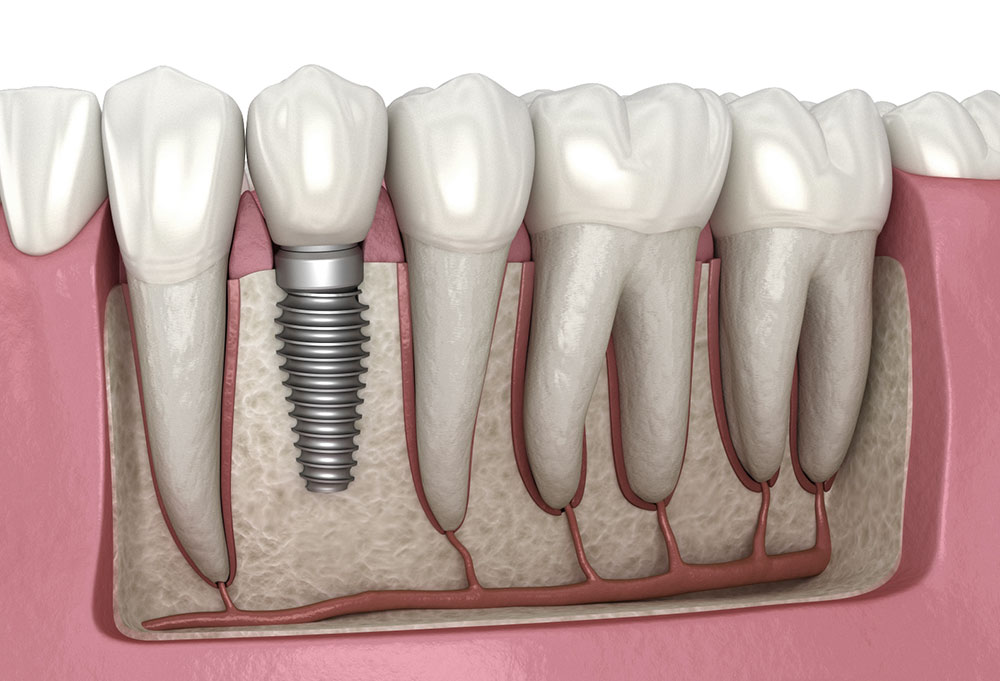
Replacing a crown does not mean removing the implant. Because the abutment and screw connect into the implant, the implant normally stays in the bone when the crown is changed, and the timing is judged at a routine check-up.
Why do dental implants fail years later
The main long-term threat to an implant is peri-implantitis, an inflammation of the gum and bone around it. A meta-analysis of 20 studies using the 2017 World Workshop criteria found peri-implantitis in 25.0% of patients and 18.0% of implants (PubMed 40523497). An earlier epidemiology review showed that its prevalence rises the longer an implant has been in function (PubMed 25495683). Early signs and treatment options are covered in our peri-implantitis guide.
A history of gum disease raises the risk. A meta-analysis pooling 22 studies found that implants placed in patients treated for periodontitis failed in 5.37% of cases, against 3.84% in periodontally healthy patients, a risk ratio of 1.78 (PubMed 25283479). None of those studies was randomised, so the authors ask for the result to be read with caution (PubMed 25283479).
Smoking is the risk factor patients can change themselves. A meta-analysis of 292 publications found that implants in smokers had a 140.2% higher risk of failure than implants in non-smokers (PubMed 35056347). The lack of firm, attached gum around the implant, known as keratinised mucosa, also matters: across 16 cross-sectional studies it was associated with more peri-implantitis, with an odds ratio of 2.78 (PubMed 36882495).
How to make a dental implant last longer
The approach with evidence behind it combines daily plaque removal at home with regular professional maintenance. A consensus report on preventing peri-implantitis named plaque as the cause of peri-implant inflammation and mechanical brushing as an effective preventive measure, and found that patients with mucositis who missed regular supportive care were at higher risk of developing peri-implantitis (PubMed 25626479). The same report treats bleeding on probing as the key clinical sign separating a healthy implant from a diseased one (PubMed 25626479).
On recall intervals, a meta-analysis of 13 clinical trials suggested a maintenance visit at least every 5 to 6 months, tailored to each patient's risk, and noted that biological complications can still occur under maintenance (PubMed 26701350). The home routine with interdental brushes, floss and water flossers is set out in our implant cleaning guide.
If your implants are placed abroad, decide before you fly home which dentist will see you for those visits. Bleeding, swelling or a bad taste around the implant, a loose crown or any movement of the implant is a reason to book an examination without waiting for the next recall. Mucositis, the early stage of this process, can be managed before it reaches the bone.
Do age, diabetes or implant brand affect how long implants last
Older age and well-controlled general conditions do not by themselves make implants short-lived, but some situations clearly raise the risk. A systematic review of 60 studies on older patients and medical conditions found pooled implant survival of 97.3% at 1 year and 96.1% at 5 years, and survival was also reported to be high in people with type II diabetes or Parkinson's disease (PubMed 30328186). In the same review, radiotherapy reduced implant survival in cancer patients, and people on high-dose antiresorptive drugs for bone metastases carried a high risk of complications after implant surgery (PubMed 30328186).
Age also shows in long-term data. A meta-analysis of 18 prospective studies following rough-surface implants for 10 years found survival of 91.5% in patients aged 65 and over once patients lost to follow-up were accounted for (PubMed 30904559). That is still high, but it is a reason to keep check-ups closer together in this age group.
Brand is part of the picture too. Survival data are published system by system, and the right system is chosen for the bone volume, the site and the planned restoration. There is no reliable comparison that gives one lifespan figure for Swiss, Swedish or Korean implants as a group. How systems are chosen is explained in why implant brand matters.
Let's plan the right treatment together.
Free Assessment→- 1.Howe MS, Keys W, Richards D. Long-term (10-year) dental implant survival: A systematic review and sensitivity meta-analysis. J Dent 2019;84:9-21. PubMed 30904559
- 2.Moraschini V, Poubel LA, Ferreira VF, Barboza Edos S. Evaluation of survival and success rates of dental implants reported in longitudinal studies with a follow-up period of at least 10 years: a systematic review. Int J Oral Maxillofac Surg 2015;44:377-88. PubMed 25467739
- 3.Lupi SM, Agolli J, Isola G, Scribante A. Dental implant survival and marginal bone loss after a minimum of 20 years: systematic review and meta-analysis of prospective studies. Int J Oral Maxillofac Surg 2026;55:1360-1369. PubMed 42173763
- 4.Kupka JR, König J, Al-Nawas B, Sagheb K, Schiegnitz E. How far can we go? A 20-year meta-analysis of dental implant survival rates. Clin Oral Investig 2024;28:541. PubMed 39305362
- 5.Jung RE, Zembic A, Pjetursson BE, Zwahlen M, Thoma DS. Systematic review of the survival rate and the incidence of biological, technical, and aesthetic complications of single crowns on implants reported in longitudinal studies with a mean follow-up of 5 years. Clin Oral Implants Res 2012;23 Suppl 6:2-21. PubMed 23062124
- 6.Reis INRD, Huamán-Mendoza AA, Ramadan D, Honório HM, Naenni N, Romito GA et al. The prevalence of peri-implant mucositis and peri-implantitis based on the world workshop criteria: A systematic review and meta-analysis. J Dent 2025;160:105914. PubMed 40523497
- 7.Derks J, Tomasi C. Peri-implant health and disease. A systematic review of current epidemiology. J Clin Periodontol 2015;42 Suppl 16:S158-71. PubMed 25495683
- 8.Chrcanovic BR, Albrektsson T, Wennerberg A. Periodontally compromised vs. periodontally healthy patients and dental implants: a systematic review and meta-analysis. J Dent 2014;42:1509-27. PubMed 25283479
- 9.Mustapha AD, Salame Z, Chrcanovic BR. Smoking and Dental Implants: A Systematic Review and Meta-Analysis. Medicina (Kaunas) 2021;58:39. PubMed 35056347
- 10.Mahardawi B, Jiaranuchart S, Damrongsirirat N, Arunjaroensuk S, Mattheos N, Somboonsavatdee A et al. The lack of keratinized mucosa as a risk factor for peri-implantitis: a systematic review and meta-analysis. Sci Rep 2023;13:3778. PubMed 36882495
- 11.Jepsen S, Berglundh T, Genco R, Aass AM, Demirel K, Derks J et al. Primary prevention of peri-implantitis: managing peri-implant mucositis. J Clin Periodontol 2015;42 Suppl 16:S152-7. PubMed 25626479
- 12.Monje A, Aranda L, Diaz KT, Alarcón MA, Bagramian RA, Wang HL et al. Impact of Maintenance Therapy for the Prevention of Peri-implant Diseases: A Systematic Review and Meta-analysis. J Dent Res 2016;95:372-9. PubMed 26701350
- 13.Schimmel M, Srinivasan M, McKenna G, Müller F. Effect of advanced age and/or systemic medical conditions on dental implant survival: A systematic review and meta-analysis. Clin Oral Implants Res 2018;29 Suppl 16:311-330. PubMed 30328186