A dental implant is a titanium or zirconia post placed in the jawbone that fuses to it through osseointegration, and every implant restoration has three parts: the post that replaces the root, the abutment that connects, and the final crown, bridge or denture above it. From surgery to the definitive prosthesis the process usually runs three to six months and rarely beyond six to eight, with immediate loading placing a temporary tooth on the day of surgery in selected cases. Pooled 10-year survival of contemporary implants across 18 prospective studies is 96.4 percent (PubMed 30904559).
- 01Every implant restoration has three components, post, abutment and prosthesis, and only the post replaces the root and transmits load into bone.
- 02The timeline is the part patients underestimate: three to six months from placement to the definitive prosthesis, rarely beyond six to eight months.
- 03Placement is either immediate, right after extraction, or delayed after healing; delayed placement is the more predictable route where bone quality is compromised.
- 04Pooled 10-year survival of contemporary implants is 96.4 percent, 95 percent confidence interval 95.2 to 97.5, with 93.2 percent in the sensitivity model that accounts for dropouts (PubMed 30904559).
- 05For full-arch cases, a systematic review of 24 studies reported 99.8 percent implant survival beyond 24 months with the All-on-four concept, peri-implant disease being the main biological complication (PubMed 28298995).
What a Dental Implant Replaces
A dental implant replaces the root of a missing tooth, and the visible tooth is then built on top of it. Istanbul is one of the cities patients travel to for implant treatment, often because the surgical and prosthetic stages can be planned around one or two visits. Before comparing clinics or systems, it helps to know what is actually being placed in the jaw and why the process takes months.
The implant itself is a screw-shaped post, usually titanium and sometimes zirconia, placed into the jawbone. Over the following weeks the bone grows onto the surface of the post and holds it firmly. This fusion is called osseointegration, and it is the step that turns a metal post into a stable base that can carry chewing load. Until it has happened, the final teeth are not fixed on top.
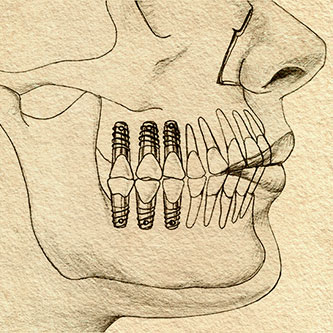
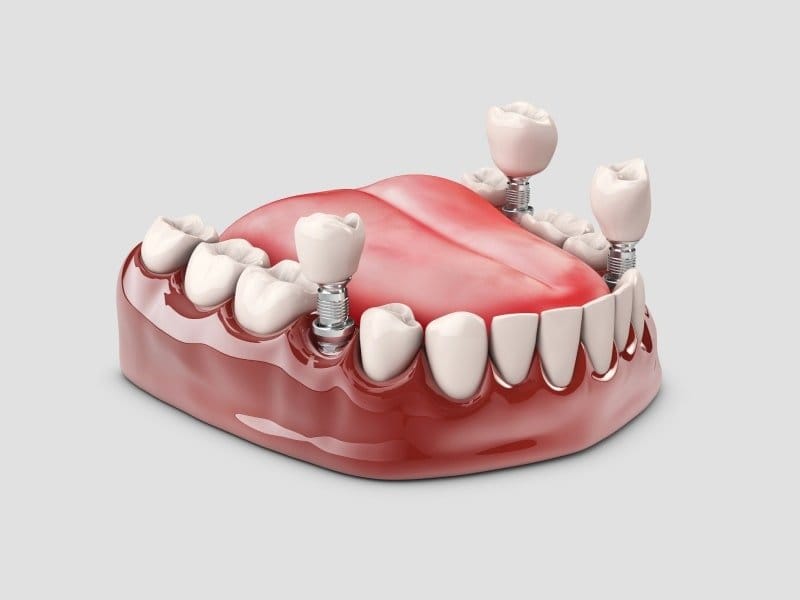
Every implant restoration has three parts. The post sits in the bone and does the work of the lost root. The abutment is the connector that joins the post to what sits above it. The prosthesis is the part you see: a single crown, a bridge over several implants, or a full-arch denture fixed on a small number of posts. Only the post replaces the root and carries load into the bone; the abutment and prosthesis can be adjusted, repaired or replaced over the years without touching it.
That split explains much of what follows in this article. The surgical decisions concern the post and the bone around it, while the aesthetic decisions and most later maintenance concern the abutment and the prosthesis. A treatment plan that names all three parts, with the system and material chosen for each, gives you something concrete to compare between clinics.
Implant Types and the Timing of Placement
Most patients receive endosteal implants, the standard posts placed directly into the jawbone. They are used for a single missing tooth, several missing teeth or a full arch, and they are the type that the published survival figures in this article describe. Where the jaw has lost so much bone that an endosteal post has nothing to anchor in, two other designs exist.
A subperiosteal implant does not enter the bone. It is a framework laid on the bone surface beneath the gum, with posts that pass through the gum to carry the prosthesis. It is considered when bone height and width are too limited for a standard post. A zygomatic implant is a longer post anchored in the cheekbone, used in the upper jaw when bone loss there is severe. Both belong to complex cases and are planned from three-dimensional imaging.
The second decision is timing. An implant can be placed immediately, in the same appointment as the extraction, or after the extraction site has healed, which is called delayed placement. Immediate placement shortens the overall treatment and is sometimes chosen for aesthetic reasons in the front of the mouth, where leaving a gap for months would be difficult. Delayed placement gives the socket time to fill with bone before the post goes in, and it is the more predictable route where bone quality is compromised or infection was present around the extracted tooth.
Loading is a separate question from placement. In selected cases a temporary tooth is fixed on the day of surgery, which is called immediate loading. The definitive crown or bridge still waits until osseointegration is complete. Which combination suits a given jaw is decided from the scan, the condition of the extraction site and the stability the surgeon achieves when the post is placed.
All-on-4 and All-on-6 for a Full Arch
All-on-4 and All-on-6 are ways of fixing a complete arch of teeth on a small number of implants, used when most or all teeth in a jaw are missing or cannot be kept. The fixed bridge is screwed onto the implants and stays in the mouth, so the patient does not remove it at night as with a conventional denture.
In All-on-4, four implants carry the arch. The two front posts are placed upright, and the two back posts are placed at an angle so that they reach available bone further forward and avoid the sinus in the upper jaw or the nerve canal in the lower jaw. This angled placement is the reason the concept often works for patients with moderate bone loss without grafting first. A systematic review that selected 24 studies from 728 screened articles reported implant survival of 99.8 percent beyond 24 months with the all-on-four concept, and noted biological complications such as peri-implantitis in few patients after a mean follow-up of two years (PubMed 28298995). The same review cautioned that methodological quality, follow-up length and sample attrition limit the evidence.
All-on-6 uses six implants for the same arch. The two extra posts spread chewing load over more points in the bone, which is why it is considered where bite force is high or where bone volume allows more posts to be placed. It also means two more surgical sites and two more implants in the plan.
The choice between the two follows the scan. Bone height and width at each candidate site, the position of the sinus and nerve, the opposing teeth and the patient's bite are measured first. Where bone loss is severe even for angled posts, grafting, guided bone regeneration or a sinus lift may be added before or during implant placement, and that changes both the timeline and the number of visits.
From the First Scan to the Final Teeth
The process starts with an assessment that sets everything else. A clinical examination is combined with a three-dimensional CBCT scan, which shows bone height and width at each planned site and the position of the sinus and nerve canals. Medical history is reviewed, and blood tests are requested where the history or the planned surgery calls for them. From these, the surgeon chooses the number, length and angle of the implants and whether grafting is needed.
Surgery is usually done under local anaesthesia, with sedation or general anaesthesia used for longer full-arch procedures when appropriate. With the area numb, most patients feel pressure during drilling and placement, while the anaesthetic blocks pain. The site is prepared with a sequence of drills, the posts are placed, and additional procedures such as a sinus lift or bone graft are carried out in the same session when the plan requires them. In full-arch cases a temporary fixed bridge is often attached the same day, so the patient leaves with teeth.
Healing is the long stage. From placement to the definitive prosthesis the process usually runs three to six months, and rarely beyond six to eight months. The variable part is osseointegration, which depends on bone quality and individual healing. Grafted sites generally need longer before they are loaded. During this period the temporary tooth or bridge is used carefully, and soft food is advised in the first weeks.
Once the implants are integrated, the final impressions or digital scans are taken and the definitive crown, bridge or full-arch prosthesis is made and fitted. The bite is checked and adjusted at this appointment. From then on the prosthesis is cleaned daily like natural teeth, with extra attention around the posts where the gum meets the restoration.
Ten-Year Survival and What Tends to Need Repair
Contemporary implants have strong long-term data, and it helps to read the numbers carefully. A systematic review of 18 prospective studies on modern implant systems found pooled 10-year survival of 96.4 percent, with a 95 percent confidence interval of 95.2 to 97.5 percent (PubMed 30904559). The same review ran a more conservative sensitivity analysis that accounted for patients lost to follow-up, and in that model 10-year survival was 93.2 percent (PubMed 30904559).
Age made a measurable difference in that analysis. In the sensitivity model, survival in patients aged 65 and over was 91.5 percent, and the authors described a possible doubling of the risk of implant loss in older age groups (PubMed 30904559). Being older does not rule out implants, but it is a reason to plan carefully and to keep review appointments.
Survival figures describe whether the post stays in the bone. They do not mean that nothing above the post needs attention over the years. A systematic review of tooth-supported and implant-supported restorations found that 38.7 percent of patients with implant-supported bridges had some complication after five years, and that the most frequent technical problems were fractures of the veneering ceramic, abutment or screw loosening and loss of retention (PubMed 17594374). In the same review, 10-year survival of implant-supported single crowns was 89.4 percent (PubMed 17594374).
Most of these technical problems are repairable. A loose screw is retightened, a chipped ceramic surface is polished or rebuilt, and a prosthesis can be remade on the same implants. This is why a treatment plan should say which implant system is used and whether its components are available for later repair. Biological problems around the implant, such as inflammation of the gum and bone, are prevented mainly by daily cleaning, avoiding tobacco and professional review.
What Happens When Missing Teeth Are Left
A gap left open changes the mouth over time, even when it does not hurt. The bone that once held the root is no longer loaded by chewing, and it gradually resorbs. As the ridge narrows, later implant placement may need grafting that would not have been necessary earlier.
The neighbouring teeth also react. Teeth next to the gap can tilt into it, and the opposing tooth can drift towards the empty space. These movements alter the bite, create contacts that trap food, and make the affected teeth harder to clean. Plaque that collects in these areas raises the risk of decay and of gum disease, and teeth that lose bone support can become mobile. Some patients also notice changes in the jaw joint when the bite shifts over years.
The effects reach beyond the mouth. Losing several teeth makes chewing harder, and people often change what they eat, avoiding raw vegetables, meat or other foods that need firm chewing. Speech can change when front teeth are missing, particularly with certain sounds. Many patients describe discomfort about smiling or eating in company, and for some this affects confidence and social life.
None of this means that every gap must be filled immediately. A single missing back tooth in a stable bite can sometimes be left and monitored. The decision depends on which tooth is missing, the state of the neighbouring teeth, the bite and the bone. An examination with imaging shows how the area is changing and whether an implant, a bridge or another option fits the situation, and it gives a baseline to compare against if you choose to wait.
Checking a Clinic and Reading the Fee
The quality of implant treatment varies from clinic to clinic, whichever country you are in, so the checking is done at clinic level. A few questions separate a documented plan from a general promise.
Ask which implant system will be placed and whether its lot number goes into your file. Established systems publish survival data and keep components available for later repair, which matters if a screw loosens or a crown needs remaking in years to come. Ask who will carry out the surgery and how often that clinician places implants in the region you need. Ask whether a three-dimensional scan is taken before the plan is finalised, and how the clinic handles adjustment and review once you are home. A clinic that quotes a final figure before examining and scanning your jaw has skipped the step that determines the outcome.
An implant case is priced from its parts. The implant system, the number of implants, whether grafting or a sinus lift is needed, and the type of prosthesis on top each change the total. At Mosdent an implant with its abutment starts from EUR 190 for Evoss or NucleOSS, from EUR 320 for Osstem and from EUR 800 for Straumann, and the figure that applies to you is written down after a CBCT scan. Starting prices are listed on our price list. The crown, bridge or full-arch prosthesis is priced separately according to its material and number of units.
Compare written plans line by line. Two quotes that look far apart often describe different systems, different numbers of implants or different prostheses. Once the parts are listed, the comparison becomes a question of what is being placed and who will look after it.
Planning Travel and Recovery Around Surgery
Implant treatment from abroad is usually split into two trips. The first covers examination, scanning and surgery, with a temporary tooth or bridge where the plan allows it. The second, after osseointegration, is for the definitive prosthesis. Knowing the stages in advance lets you book time off and flights around them.
After surgery, rest for at least 48 to 72 hours before heavy travel. Light travel is usually acceptable after that, but flying immediately after complex surgery adds pressure changes, dehydration and fatigue at the point where swelling and bleeding risk are highest. Where a sinus lift or extensive grafting has been done, the waiting period is longer and is set by the surgeon who performed it. Mild pain and swelling in the first days are expected, and the surgeon gives written instructions on medication, cold compresses, diet and cleaning.
Between the two visits, the temporary restoration is used with care and soft food is chosen in the early weeks. Any loosening of a temporary tooth, persistent pain, rising swelling or fever should be reported to the clinic promptly, even from home, so that it can be assessed by photograph, video call or local examination.
When you return for the final teeth, the fit, bite and appearance are checked before fixing, and cleaning around the implants is shown in the mouth. After that, review appointments at the interval your dentist sets, with professional cleaning and a check of the screws and prosthesis, are the practical way to keep the survival figures on your side. Ask before you leave which parts of that follow-up can be done by a dentist near home and what records you should take with you.
Let's plan the right treatment together.
Free Assessment→- 1.Howe MS, Keys W, Richards D. Long-term (10-year) dental implant survival: a systematic review and sensitivity meta-analysis. J Dent. 2019;84:9-21. PMID 30904559
- 2.Soto-Penaloza D, Zaragozi-Alonso R, Penarrocha-Diago M, Penarrocha-Diago M. The all-on-four treatment concept: systematic review. J Clin Exp Dent. 2017;9(3):e474-e488. PMID 28298995
- 3.Pjetursson BE, Brägger U, Lang NP, Zwahlen M. Comparison of survival and complication rates of tooth-supported fixed dental prostheses (FDPs) and implant-supported FDPs and single crowns (SCs). Clin Oral Implants Res 2007;18 Suppl 3:97-113. PubMed 17594374