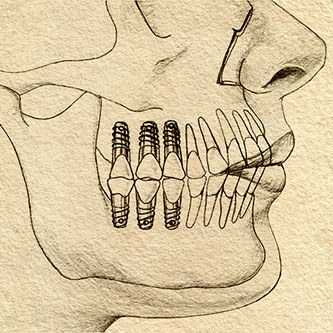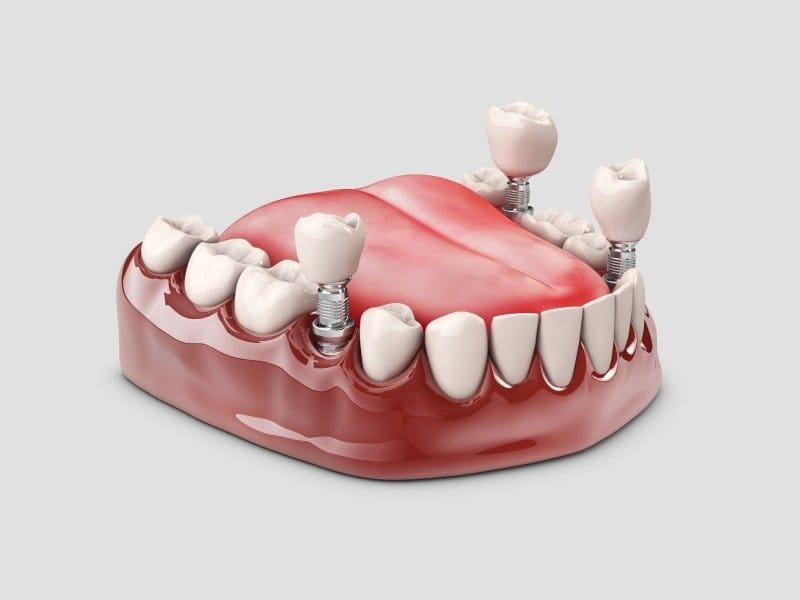
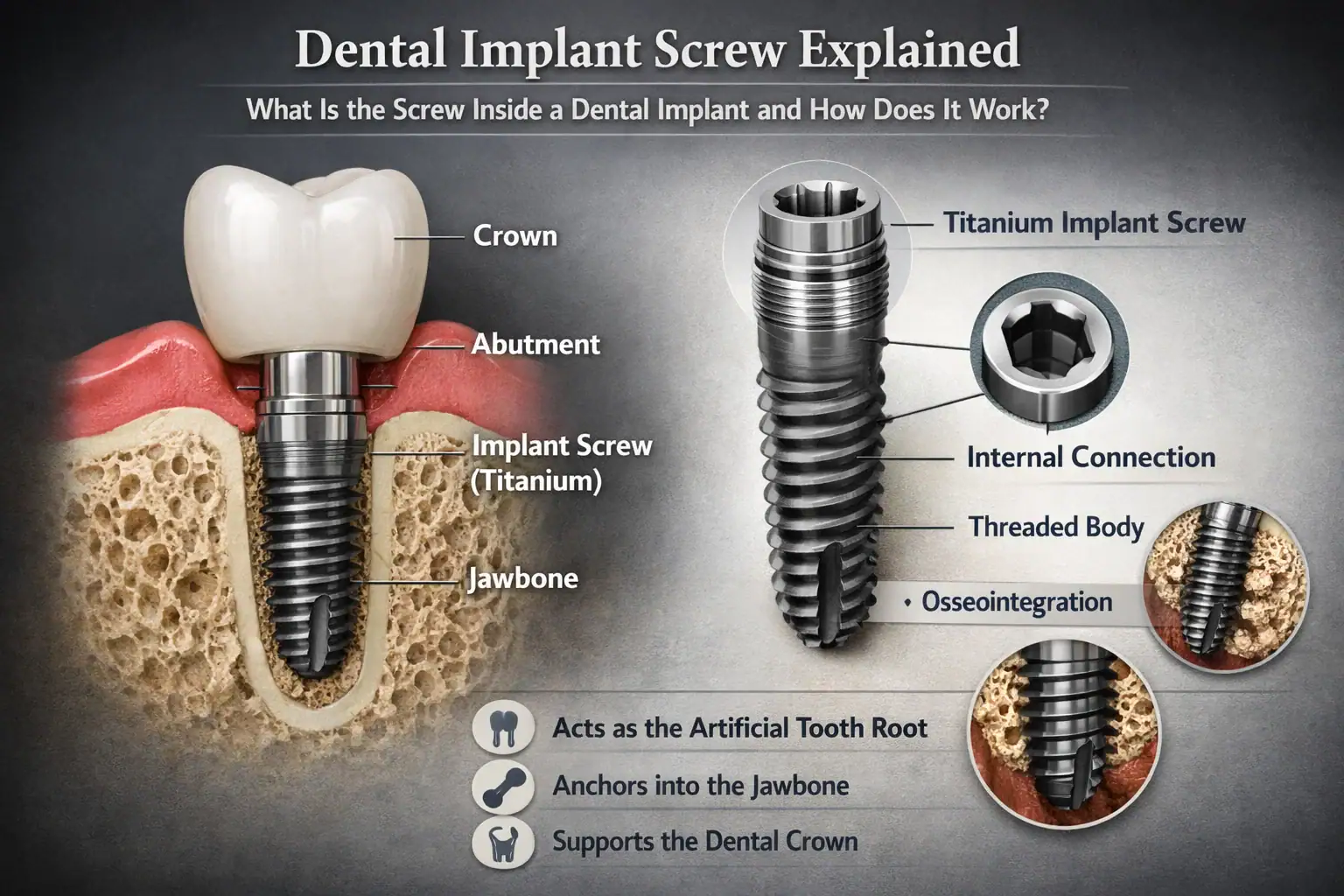
The screw inside a dental implant, properly called the abutment screw, is the small titanium fastener that passes through the abutment and threads into the implant fixture, clamping crown, abutment and fixture into one rigid unit. It is not the implant itself: the fixture is the threaded body that integrates with bone, and the screw only holds the parts together against daily bite load. Screw loosening is the most common technical complication of implant single crowns, with a cumulative 5-year incidence of 8.8% (95% CI 5.1 to 15.0) in a meta-analysis of 46 studies (PubMed 23062124).
- 01An implant restoration has three separate parts plus a fastener: the fixture in bone, the abutment above it, the crown on top, and the abutment screw that clamps all three together.
- 02Screw loosening reached a cumulative 5-year incidence of 8.8%, ahead of loss of retention at 4.1% and veneering ceramic fracture at 3.5% on implant single crowns (PubMed 23062124).
- 03Screw loosening stayed the most prevalent prosthesis complication across implant diameters in a review of 18 clinical studies, reported at 1.73% for narrow, 4.08% for standard and 12.45% for wide-diameter implants (PubMed 39889227).
- 04The screw is tightened with a calibrated torque wrench to the manufacturer's value rather than by hand, because both under-tightening and over-tightening change how the joint behaves under load.
- 05The screw normally outlives the restoration: implants supporting single crowns showed 97.2% survival at 5 years and 95.2% at 10 years in the same meta-analysis (PubMed 23062124).
Dental implants are one of the most advanced and reliable solutions for replacing missing teeth. When patients learn about implant treatment , they often imagine the visible crown the tooth that looks natural and aesthetic. However, the real hero behind the success of implant treatment is hidden beneath the gum line: the dental implant screw.
/ Dental Implant Screw and Implant Components
What Is a Dental Implant Screw?
A dental implant screw is a small but extremely important component that connects the implant fixture (the artificial tooth root) to the abutment and crown .
In simple terms:
- Implant fixture → placed inside jawbone
- Abutment → connector piece
- Crown → visible tooth
- Implant screw → holds everything together
Without the implant screw, the dental implant system would not function as a stable and durable tooth replacement.
Understanding Dental Implant Components
To fully understand the implant screw, we must first understand the dental implant structure.
A dental implant restoration has three main parts, plus the screw that joins them:
1. Implant Fixture (Titanium Root)
The part surgically placed inside the jawbone.
2. Abutment
The connector that links the implant to the crown.
3. Crown (Artificial Tooth)
The visible part that looks like a natural tooth.
4. Implant Screw (Abutment Screw)
The dental implant screw connects the abutment to the implant fixture securely.
This tiny component is responsible for long-term stability and function.
Why Is the Dental Implant Screw So Important?
The dental implant screw plays a critical role in the success of implant treatment.
Key functions:
- Provides mechanical stability
- Prevents crown movement
- Maintains bite strength
- Ensures long-term durability
Without a properly designed implant screw, the implant crown could loosen or fail over time.
What Is an Abutment Screw?
The implant screw is also called an abutment screw.
The abutment screw:
- Sits inside the implant fixture
- Connects the abutment to the implant
- Locks the prosthetic tooth in place
This tiny screw must withstand enormous chewing forces every day.
/ Dental Implant Screw Material and Function
What Material Is the Implant Screw Made Of?
Most dental implant screws are made of medical-grade titanium.
Why titanium?
✔ Biocompatible
✔ Extremely strong
✔ Corrosion resistant
✔ Bonds with bone safely
Titanium has been used in dental implants for decades because it is biocompatible and resists corrosion in the mouth.
How Does the Dental Implant Screw Work?
The dental implant screw works using precision engineering and torque mechanics.
During implant restoration:
- The abutment is placed on the implant.
- The implant screw is inserted.
- The screw is tightened using controlled torque.
- The crown is attached.
This creates a secure and stable tooth replacement.
Is the Dental Implant Screw Permanent?
Yes in most cases, the implant screw is designed to be permanent and long-lasting.
With proper care:
- Most screws stay in place for years
- One that loosens or wears can be retightened or replaced
Regular check-ups ensure long-term success.
Can an Implant Screw Become Loose?
Although rare, an implant screw can loosen due to:
- Excessive bite force
- Teeth grinding ( bruxism )
- Poor oral hygiene
- Trauma
At Mosdent, digital planning and precision torque techniques minimize this risk.
/ Dental Implant Screw Stability and Care
Implant screw stability and care cover looseness signs and routine protection.
Signs of a Loose Implant Screw
Patients may notice:
- Crown movement
- Clicking sensation
- Bite discomfort
- Gum irritation
If you experience these symptoms, a dentist should check the implant immediately.
How Is an Implant Screw Tightened?
Dentists use a torque wrench to tighten implant screws with precise force.
Correct torque ensures:
- Stability
- Longevity
- Reduced loosening risk
Dental Implant Screw vs Implant Fixture
Many patients confuse these parts.
| Implant Fixture | Implant Screw |
|---|---|
| Replaces tooth root | Holds abutment in place |
| Inside bone | Inside implant |
| Permanent | Permanent |
Both are essential for implant success.
Do All Dental Implants Use Screws?
Yes. Every modern dental implant system includes an implant screw.
Types of implant restorations:
- Single implant crown
- Implant bridge
- Full mouth implants
All rely on the implant screw for stability.
How Long Does an Implant Screw Last?
With proper care:
- The screw has no fixed lifespan; it is checked at routine visits
- In a review of single implant crowns, 95.2% of implants survived 10 years (PubMed 23062124)
Regular maintenance is essential.
How to Protect Your Implant Screw
Follow these tips:
✔ Brush twice daily
✔ Use floss or water flosser
✔ Avoid teeth grinding
✔ Visit dentist regularly
Why Choose Mosdent for Dental Implants?
Mosdent offers:
- Digital implant planning
- Advanced technology
- Experienced implant surgeons
- International patient services
/ Frequently Asked Questions (FAQ)
What is the screw inside a dental implant?
It connects the abutment to the implant fixture and holds the crown securely.
Is the implant screw visible?
No. It is hidden inside the implant and crown.
Can an implant screw break?
Rare, but possible under extreme force.
How often should implant screws be checked?
At least once per year during dental check-ups.
Do implant screws need replacement?
Usually no. Only if damaged or loose.
Final Thoughts
The dental implant screw may be small, but it plays a huge role in implant success. With proper care and regular check-ups at Mosdent, dental implants can serve for many years, though how long varies from person to person.
Let’s plan the right treatment together.
Free Assessment→- 1.Jung RE, Zembic A, Pjetursson BE, Zwahlen M, Thoma DS. Systematic review of the survival rate and the incidence of biological, technical, and aesthetic complications of single crowns on implants reported in longitudinal studies with a mean follow-up of 5 years. Clin Oral Implants Res 2012;23 Suppl 6:2-21. PubMed 23062124
- 2.Yeh YT, Chiou LL, Chen HH, Lin GH, Kao RT, Curtis DA. Influence of Dental Implant Diameters on Prosthesis Complications: A Systematic Review and Meta-analysis. Int J Oral Maxillofac Implants 2025;40:529-546. PubMed 39889227
- 3.Kim S, Jung UW, Cho KS, Lee JS. Retrospective radiographic observational study of 1692 Straumann tissue-level dental implants over 10 years: I. Implant survival and loss pattern. Clin Implant Dent Relat Res 2018;20:860-866. PubMed 30110515
- 4.Lim J, Han HS, Kim S, Kim H, Cho YD. Retrospective Analysis of Survival Rate and Risk Factor of Osstem TS III SA Dental Implants. J Oral Implantol 2025;51:454-462. PubMed 41241387