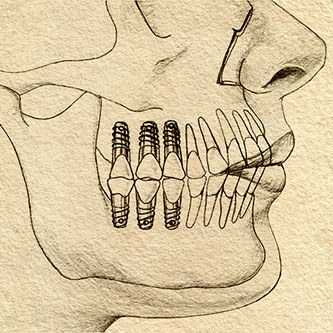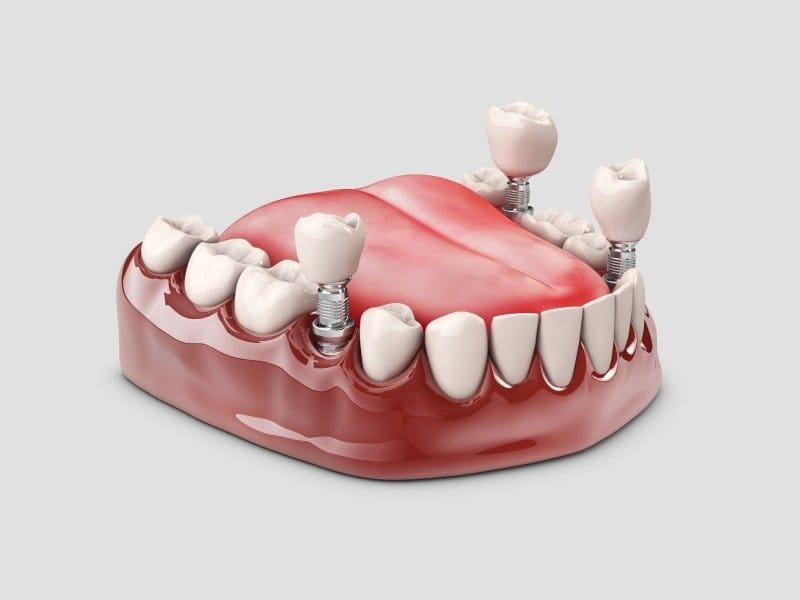

A dental implant is a titanium or zirconia screw placed into the jawbone to replace the root of a missing tooth; once it fuses with the bone in a process called osseointegration it carries a crown, a bridge or a denture. The screw is durable rather than guaranteed for life: pooled 10-year survival with contemporary roughened-surface implants was 96.4% (95% CI 95.2-97.5) across 18 prospective studies, and 93.2% in a sensitivity analysis that modelled patients lost to follow-up (PubMed 30904559). Bone fusion typically takes 2 to 6 months before the final prosthesis is fitted.
- 01Ten-year implant survival was 96.4% across 18 prospective studies, falling to 93.2% once loss to follow-up was modelled, and to 91.5% in patients aged 65 and over (PubMed 30904559).
- 02Osseointegration, the fusion of the screw with the jawbone, takes 2 to 6 months and is why implant treatment runs over several months rather than a single appointment.
- 03Smoking more than doubles the odds of failure: pooled across 292 publications with 35,511 implants placed in smokers and 114,597 in non-smokers, the odds ratio was 2.40 and marginal bone loss was 0.580 mm greater in smokers (PubMed 35056347).
- 04The types are not interchangeable: endosteal screws go into the jawbone, subperiosteal frames rest on top of it where bone is weak, and zygomatic implants anchor in the cheekbone when the upper jaw has lost too much bone.
Missing teeth are a significant health problem that negatively affects chewing and speech functions as well as aesthetic concerns. Dental implant treatment, one of the most common and effective solutions today, is a permanent dental restoration method using titanium screws instead of missing teeth. In this article, we will provide comprehensive information about what implant treatment is, how it is applied, its advantages, disadvantages and process.
/ Implant Treatment Overview
What is an Implant?
Implants are titanium screws that replace the root of a tooth. They are placed in the jawbone and provide a strong foundation for a dental prosthesis or crown. Implant treatment can be applied to both a single tooth missing and complete tooth loss.
Advantages of Implant Treatment
Implant treatment has many advantages over other dental treatment methods:
Provides a Permanent and Strong Solution
Implants offer the closest alternative to the natural tooth root and are long-lasting.
Provides a Natural Appearance
Since they are specially designed, they provide the closest aesthetic result to natural teeth.
Protects the Jawbone
Protects the jaw structure by preventing the bone loss that occurs in the jawbone after tooth loss.
Provides Comfortable Use
It is more comfortable and does not move compared to dentures.
Facilitates Chewing and Speaking
Missing teeth can negatively affect chewing and speaking functions. These functions are improved thanks to implants.
Types of Implants
There are different types used in implant treatment:
Endosteal (Inside the Jawbone) Implants
The most common type of implant placed directly into the jawbone.
Subperiosteal (Under the Gum) Implants
They are placed on top of the jawbone and are suitable for patients with weak bone structure.
Zygomatic (Cheekbone) Implants
They are long implants placed into the cheekbone for patients with jawbone loss.
Materials and Technologies Used in Implant Treatment
Titanium and Zirconium Implants
Titanium implants: The most commonly used implant type, a durable and biocompatible material.
Zirconium implants : Offers a more natural appearance in terms of aesthetics and is suitable for those with metal allergies.
Digital Planning and 3D Imaging
Before implant treatment , the patient's jaw structure is analyzed in detail and the most appropriate planning is made using 3D imaging techniques.
Laser-Assisted Implant Applications
Laser technology makes surgical procedures less invasive and accelerates the healing process.
/ Implant Treatment Preparation, Process and Post-Implant Care
Things to Consider Before Implant Treatment
The following factors should be evaluated before starting implant treatment:
- Bone Density: The jawbone must have sufficient density.
- General Health Status: Diseases such as diabetes and heart disease may affect the treatment process.
- Smoking: Smoking can negatively affect the implant's fusion with the bone.
- Oral Hygiene: A healthy gum structure is important for successful implant treatment.
Implant Treatment Process
Implant treatment consists of certain stages:
Examination and Planning
The patient's jawbone and tooth structure are evaluated, and the treatment process is planned.
Implant Placement
A titanium screw is surgically placed into the jawbone.
Bone Fusion Process (Osseointegration)
It usually takes 2-6 months for the implant to fuse with the bone.
Attachment of the Prosthesis or Coating
The treatment is completed by placing a permanent dental prosthesis or coating on the implant.
Post-Implant Nutritional Recommendations
The following nutritional recommendations should be followed in the post-implant period:
- Soft foods should be consumed for the first few days.
- Hard, very hot or very cold foods should be avoided.
- Alcohol and cigarette consumption should be avoided.
Post-Implant Complications and Solutions
Some complications may occur after implant treatment:
- Risk of infection: Regular hygiene should be provided.
- Implant rejection: In rare cases, the body may not accept the implant.
- Jawbone loss: Can be prevented with regular checkups.
/ Frequently Asked Questions
- How Long Does Implant Treatment Take?
The treatment period can last 3-6 months depending on the patient.
- Is Implant Application Painful?
Since it is performed under local anesthesia, no pain is felt during the procedure.
- How Long Does an Implant Last?
Ten-year survival was 96.4% across 18 prospective studies (PubMed 30904559); how long a given implant lasts depends on care and check-ups.
- What is the Price of Implant Treatment?
The price varies depending on the material used and the needs of the patient.
- What Should Be Considered After Implant Treatment?
Regular dental cleaning, healthy nutrition and avoiding smoking are important.
Implant treatment is one of the most successful methods to permanently solve tooth loss. With proper planning, regular care and treatment by a specialist dentist, it is possible to have long-lasting and comfortable dental health. Implant treatment is an ideal solution for individuals who have missing teeth problems.
Let’s plan the right treatment together.
Free Assessment→- 1.Howe MS, Keys W, Richards D. Long-term (10-year) dental implant survival: A systematic review and sensitivity meta-analysis. J Dent 2019;84:9-21. PubMed 30904559
- 2.Mustapha AD, Salame Z, Chrcanovic BR. Smoking and Dental Implants: A Systematic Review and Meta-Analysis. Medicina (Kaunas) 2021;58. PubMed 35056347