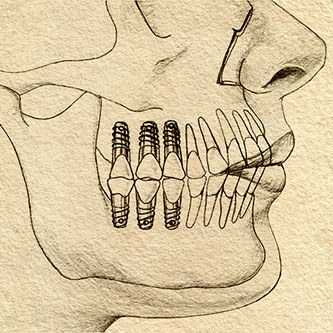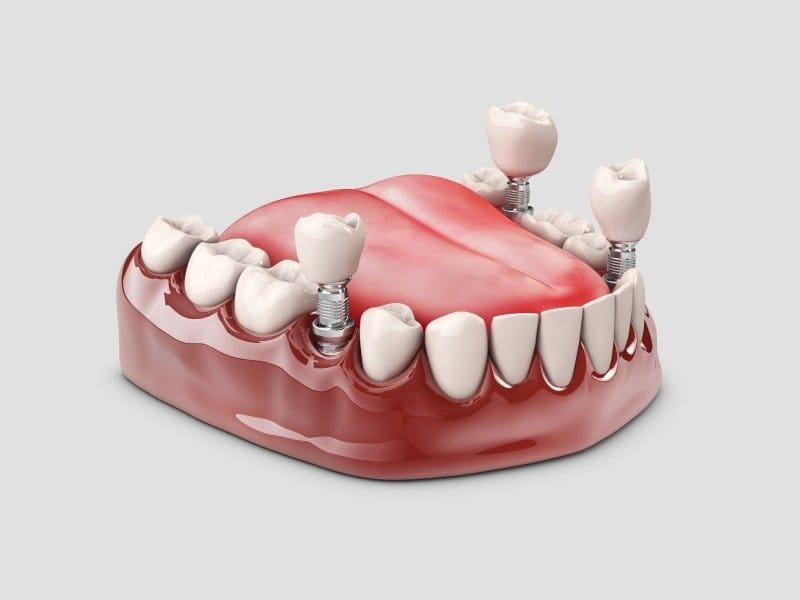
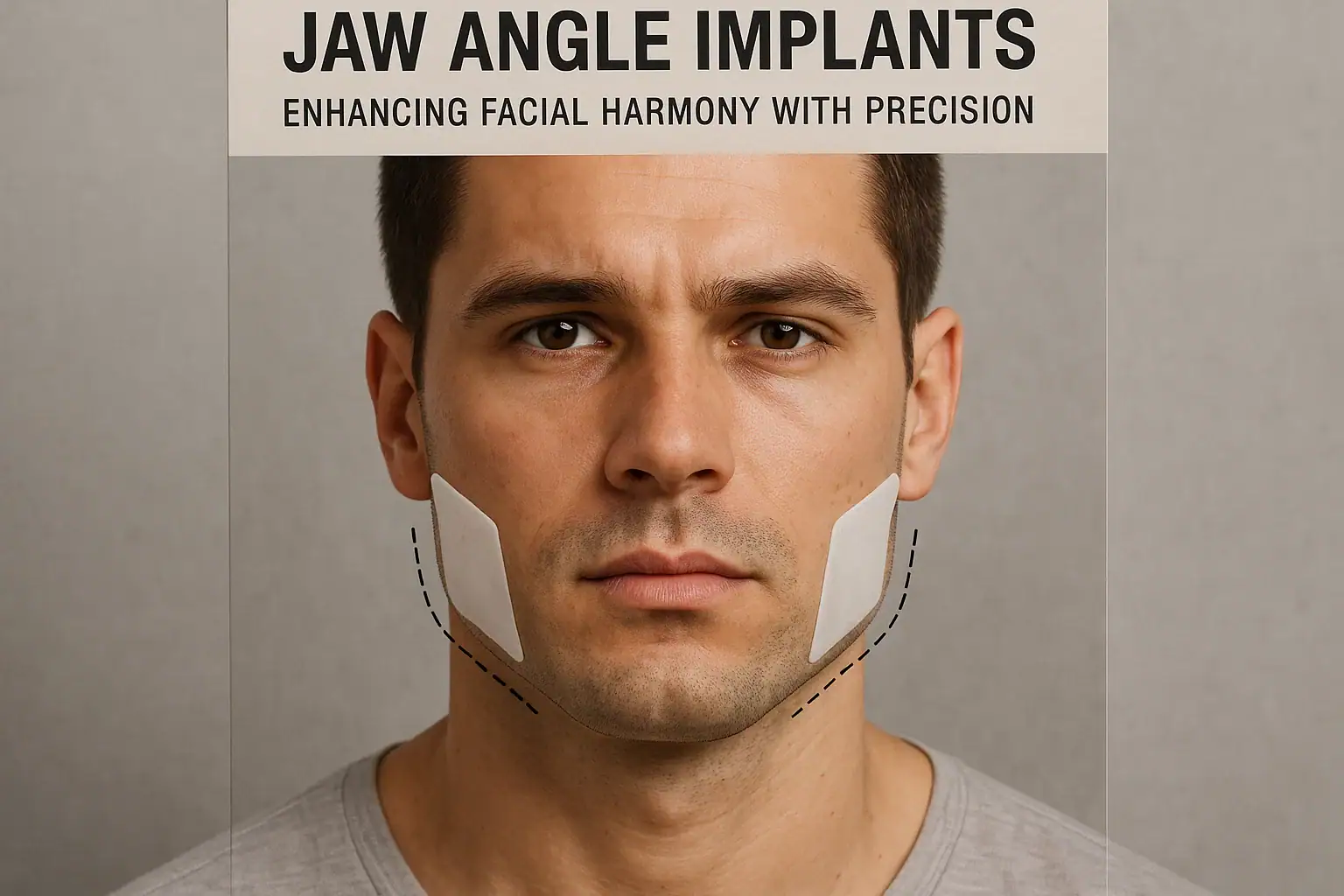
Jaw angle implants are solid alloplastic prostheses, usually silicone or porous polyethylene, placed through incisions inside the mouth onto the gonial angle of the lower jaw to widen and define the posterior mandible. In a series of 58 patients receiving 116 silicone angle implants, infection occurred in 4.3% and displacement in 13.8%, while 6% of the complication-free patients were dissatisfied with the final appearance (PubMed 30648361). Swelling settles over several weeks and the implant itself remains retrievable.
- 01The implant is alloplastic, not biological: solid silicone or high-density porous polyethylene shaped to sit on the gonial angle beneath the soft tissue envelope.
- 02In 116 silicone angle implants placed in 58 patients, infection occurred in 4.3% and displacement in 13.8% within a minimum 6-month follow-up (PubMed 30648361).
- 03Dissatisfaction is not rare even without complications: 6% of complication-free patients in that series were unhappy with the final facial appearance (PubMed 30648361).
- 04In a 100-patient retrospective series of porous polyethylene chin and gonial angle implants, jaw angle surgery accounted for 17% of cases and complications were 3 wound infections, 1 dehiscence and 4 transient paresthesias, all resolving within 30 days (PubMed 39407004).
- 05Material choice changes the nerve risk profile: across 39 studies and more than 3,104 alloplastic chin augmentation patients, paresthesia was reported in 0.4% with silicone, 3.2% with ePTFE and 20.1% with porous polyethylene (PubMed 36880789).
/ What a jaw angle implant actually is
A jaw angle implant is a solid, ready-shaped piece of silicone or porous polyethylene that a surgeon slides onto the gonial angle, the corner where your lower jaw turns upward towards the ear. It is placed through an incision inside the mouth, so nothing is cut on the face. It does not grow, dissolve or remodel with you. It sits under the soft tissue and changes the outline of the lower face by adding width and projection where the bone alone does not provide it.
That single sentence settles what the procedure is. The rest of this article is about the part that decides whether you are happy two years later: which material goes in, what the published complication figures actually are, and what you should insist on seeing in writing before you agree.
One thing to set straight at the start, because the internet repeats the opposite. This is not a permanent decision in the sense of being irreversible. A silicone implant can be taken out through the same intraoral route. Nor is it permanent in the sense of guaranteed to stay put, and the numbers below say so plainly.
/ The number that should decide your material
Two materials dominate: solid silicone and high-density porous polyethylene, usually sold as Medpor. Most articles describe the difference in comfortable terms, silicone is easy to remove, porous polyethylene lets tissue grow into it. Both statements are true and both miss the figure that matters.
A systematic review covering 39 studies and more than 3,104 patients who had alloplastic chin augmentation measured how often patients were left with altered sensation in the lip and chin. Paresthesia was reported in 0.4% of silicone cases, 3.2% with ePTFE, and 20.1% with porous polyethylene (PubMed 36880789). That is not a small gap between materials. It is the difference between a rare event and one patient in five.
Read it carefully before you use it, because it is easy to misread in both directions. This review is about chin augmentation, not the jaw angle, and the nerve at risk in that region is the mental nerve. The number tells you that material choice carries a real, measured neurological cost, not that your angle implant carries exactly that risk. What it earns you is a question, and it is the single most useful one you can ask: which material is my surgeon proposing, why that one for my anatomy, and what does it change about nerve risk and about taking the implant out later.
A surgeon who answers that question with anatomy rather than with a brand name is telling you something about how the rest of your care will go.
/ What the complication figures look like when someone counts them
Fifty-eight patients received 116 solid silicone angle implants and were followed for at least six months. Infection occurred in 4.3% and displacement in 13.8% (PubMed 30648361). Displacement means the implant moved from where it was placed, which shows up as asymmetry, a palpable edge, or a shape that is not the one that was planned.
A separate 100-patient series of porous polyethylene implants for the chin and gonial angle, in which angle surgery made up 17% of cases, reported 3 wound infections, 1 wound opening and 4 cases of temporary altered sensation, all of which settled within 30 days (PubMed 39407004).
Put the two together and the honest summary is this. Serious infection is uncommon. The complication you are most likely to meet is mechanical, the implant not staying exactly where it was put, and it is common enough that it belongs in your planning rather than in a footnote.
So the question to put to the clinic is not whether complications happen. It is what happens next when they do. Who pays for a revision, within what period, and is that written into the quote or left to goodwill on the day.
/ The finding that says the most about expectations
In the same 58-patient series, 6% of patients who had no complication at all were still dissatisfied with the way their face looked afterwards (PubMed 30648361). No infection, no displacement, a technically clean result, and still not the face they had pictured.
This is the most useful line in the whole literature for someone deciding, and it is the one marketing pages never print. It means a jaw angle implant can succeed as surgery and fail as a decision. Bone width is not the only thing that shapes the lower face. Soft tissue thickness, fat distribution, muscle bulk and how you carry your neck all contribute, and an implant changes only one of those.
The practical consequence is that a preview matters. Ask to see a simulation of your own scan rather than another patient's before and after photographs, and ask what part of the change on screen comes from the implant and what part is the rendering being generous. A clinic that will show you the limits of the plan is a clinic that expects you to still be satisfied a year later.
/ What the weeks after surgery are like
The operation is done under general anaesthesia and usually takes one to two hours. Because the incisions are inside the mouth, there is no external scar.
Swelling is the dominant experience and it does not disappear overnight. Expect the first few days to be the most uncomfortable, a soft diet through the first week, most of the visible swelling to settle over the following two to three weeks, and the final contour to become clear over several more. Mouth hygiene is done with antiseptic rinses while the intraoral incisions heal, and smoking and hard chewing are off the table during that period.
The practical takeaway is a calendar one. If you have a wedding, a shoot or a job interview, count backwards generously. The result you are paying for is the one visible at six weeks, not the face in the mirror at day ten.
/ Implants or fillers
These two are often presented as competing options and they are not really the same decision.
| Jaw angle implant | Jawline filler | |
|---|---|---|
| How long it lasts | Stays until removed | Months, then repeated |
| What it is | Solid silicone or porous polyethylene | Injectable gel |
| How it is done | Surgery under general anaesthesia | Injection in a clinic visit |
| Recovery | Weeks of swelling | Little to none |
| If you change your mind | Second operation to remove | Wears off, or can be dissolved |
Filler is the reversible, low-commitment way to see whether more width at the angle suits your face at all. An implant is the structural answer for someone who already knows it does. Using filler first as a trial is a legitimate strategy, and any clinic that treats that suggestion as a lost sale has told you what it optimises for.
/ Who this is not for
A jaw angle implant addresses the width and projection of the angle. It does not correct a bite that does not meet, it does not fix a jaw that is set too far back as a skeletal problem, and it does not resolve facial asymmetry that originates in the position of the jaw rather than its outline. Those belong to orthognathic surgery, a different operation with a different recovery.
Active gum or dental infection has to be treated before any intraoral surgery, and general health has to be suitable for general anaesthesia. If the examination shows the underlying issue is skeletal rather than contour, the honest answer is that an implant will disappoint you, and that is an answer worth hearing before rather than after.
/ What the fee depends on
We do not publish a figure for this operation, and a figure you find on any website before an examination is a guess about your anatomy. What moves the number is the material, whether the implant is stock or patient-specific, the anaesthesia and facility component, and whether the plan includes preoperative planning from a facial scan.
What you should insist on is not a low number but a complete one. A quote that lists the implant, the anaesthesia, the hospital component, the follow-up visits and the revision terms separately can be compared with another clinic's quote. A single total cannot.
/ Six questions to take to your consultation
First, which material are you proposing for me and why that one for my anatomy. Second, is the implant stock or made for my scan, and how is its position fixed so it cannot move. Third, if the implant displaces or I am unhappy with the shape, what is the revision policy and what is included in today's price. Fourth, can I see the plan on my own scan before the operation, and what part of that image is the implant. Fifth, what is the specific nerve risk in my case and how long can altered sensation last. Sixth, how many of these have you done and can I see a result of a face built like mine.
A clinic that answers all six in writing is a clinic worth comparing. The ones that answer with photographs alone have not answered.
At Mosdent the procedure is planned by our maxillofacial team from a facial scan, and the operation and follow-up are managed in the same hospital. If the examination shows a different procedure is the right answer for your face, we say so.
Let’s plan the right treatment together.
Free Assessment→- 1.Al-Jandan B, Marei HF. Mandibular angle augmentation using solid silicone implants. Dent Med Probl 2018;55:367-370. PubMed 30648361
- 2.da Rocha JHF, Ribeiro FCP, Da Silva GD, de Alcantara Giraud RF, Lima RS, Platania F, et al. Short-Term Outcomes of High-Density Porous Polyethylene Orthoses for Chin and Gonial Angle Augmentation. Aesthetic Plast Surg 2024;48:4805-4813. PubMed 39407004
- 3.Liao CD, Rodriguez E, Zhao K, Kunda N, George F. Complications Following Alloplastic Chin Augmentation: A Systematic Review of Implant Materials and Surgical Techniques. Ann Plast Surg 2023;90:S515-S520. PubMed 36880789