
"All-inclusive" is a marketing label, not a defined term. In dental tourism it usually covers some combination of the clinical work, hotel and airport transfers; it almost never automatically covers additional procedures discovered at examination, such as extractions, root canal treatment or bone grafting, and it rarely covers the second trip that many implant treatments require. The only reliable way to compare two quotes is to compare itemised lists: restoration type, material and brand per unit, every excluded item named in writing, and the number of trips assumed. Our own current per-unit prices are published openly, at this writing 300 EUR per implant and 200 EUR per crown, and the questions in this article apply to our quotes exactly as they apply to anyone else's.
- 01"All-inclusive" has no fixed definition. Two packages carrying the same label can differ in the clinical items covered, the trip count assumed and the aftercare included, so the label itself carries no comparable information.
- 02The items most often excluded from package prices are the ones that cannot be seen on a photograph: extractions, root canal treatment, post and core build-ups, bone grafting and sinus lifting. These are established at clinical examination and imaging, not before.
- 03An implant is not one purchase but three: the implant, the abutment and the crown are separate components, frequently priced separately. A quote that names only "implant" should be asked which of the three it covers.
- 04Trip count is part of the price. Conventional implant loading typically means two visits with a healing period between them; flights and accommodation for the second visit belong in any complete total.
- 05Türkiye requires an International Health Tourism Authorization Certificate for facilities treating international patients, and the Ministry of Health publishes a checkable list of certified providers. Checking it costs nothing and filters the market before you compare a single price.
/ What "all-inclusive" is and what it is not
All-inclusive is a label borrowed from package holidays, and in dental tourism it works the same way: it tells you a bundle exists, not what is in the bundle. In practice the term is used for at least three different offers. Some packages bundle only travel logistics, meaning hotel and airport transfers around a separately priced treatment. Some bundle a fixed clinical scope, for example a set number of crowns, with logistics added. A few genuinely attempt to bundle everything the plan will need. Nothing in the label tells you which of the three you are looking at.
This matters because the label does the exact opposite of what a buyer needs. A useful price is one whose contents are enumerable; "all-inclusive" is a price whose contents are implied. The short version of this article could be one sentence long: ask for the list. Everything below is a guide to what should be on that list, what tends to be missing from it, and how to compare two lists once you have them. The same discipline applies to us. We publish per-unit prices on our treatment pages, currently 300 EUR per implant and 200 EUR per crown, and those figures are subject to the same questions this article teaches you to ask: what a unit includes, what is billed separately, and what the trip plan looks like.
One more framing point before the detail. A package being incomplete is not evidence of bad faith. No clinic can price extractions or grafts it has not yet diagnosed. The problem is not that exclusions exist; it is when they are discovered by the patient in the chair rather than named in the quote.
/ An implant is three purchases, not one
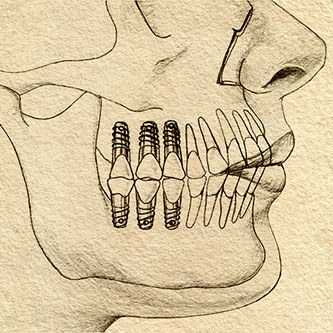
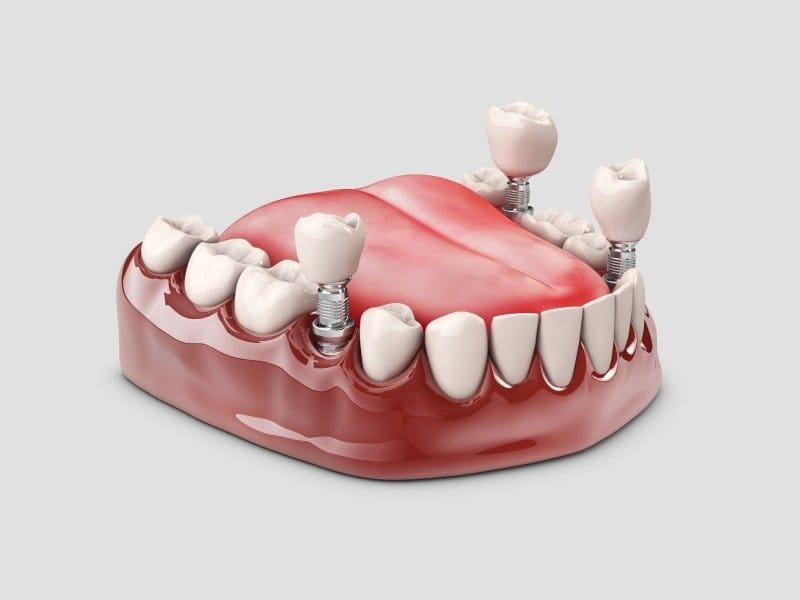
The single largest source of confusion in implant pricing is that "an implant" is casually used for a finished tooth, while clinically it names only the component in the bone. A restored implant tooth has three parts: the implant itself, a titanium or titanium-alloy fixture placed surgically in the jaw; the abutment, a connector that passes through the gum; and the crown, the visible tooth fixed on top. These are distinct components, often from different price lists, sometimes from different manufacturers. The three-part anatomy and the vocabulary around it are unpacked in our terminology decoder.
When a quote says "implant: 300 EUR", the first clarifying question is which of the three parts that figure covers. In our case the implant fee and the crown fee are separate published lines, which is exactly why we can state them plainly; a bundled "implant package" figure with no component breakdown cannot be compared with anything, including with itself a year later.
The second clarifying question is brand and line, because component pricing is where brand substitution hides. If the consultation discussed a premium brand and the final plan says only "implant", the paperwork has room for a quieter product to arrive in theatre. The fix is administrative, not confrontational: ask for the brand and system to be written into the plan, and for the implant card with brand and lot number after surgery. Under EU medical-device rules, implant patients must be given an implant card identifying the device; crowns and fillings are explicitly exempt from that requirement, so for the crown part of the plan the written treatment plan itself is your record. How manufacturer tiers work inside a single corporate group, and why "Straumann Group" on a quote is not yet a brand name, is a subject we cover separately in our article on Straumann Group's brand tiers.
/ The exclusions that surface at examination
The most expensive lines in a treatment plan are frequently the ones no package price can promise in advance, because they depend on findings, not wishes. Four recur constantly.
Extractions and root canal treatment come first. A tooth planned for a crown may turn out to need root canal treatment before it can carry one, or to be beyond saving. Neither can be diagnosed from a smile photo; both are separate procedures with separate fees almost everywhere.
Bone grafting and sinus lifting come second. Implants need bone volume, and where volume is missing a graft or membrane procedure is added, sometimes as a separate surgical stage with its own healing time. Whether you need one is established with three-dimensional imaging at examination. Any package that guarantees you will not need grafting has either examined your CBCT or is guessing.
The provisional phase comes third. Between preparation and final crowns most plans involve temporary crowns, try-in appointments and laboratory rounds. Whether the temporaries, the number of try-ins and any remakes are inside the package is a fair written question.
Sedation and ancillary items come fourth: sedation or general anaesthesia where wanted or needed, imaging, medications, night guards for patients who grind. None of these is exotic; all of them are commonly billed as separate lines. A quote that names its exclusions is not a worse quote than one that hides them. It is the only kind you can actually compare.
/ Trip count is part of the price
A dental journey is priced in flights and hotel nights as well as in clinical fees, and the number of trips is a clinical variable, not a booking preference. Crown and veneer work is commonly completed in a single visit of several working days, with the laboratory turning the case around between appointments. Implant work is different. In conventional loading, the implant is placed and then left to integrate with the bone for a period typically measured in months, after which a second visit completes the abutment and crown. Immediate-loading protocols exist for suitable cases and compress this, but suitability is a clinical finding, not a menu option; bone quality, implant stability at placement and bite forces all weigh in. Where grafting is staged separately, the calendar extends again.
The full arithmetic therefore has a travel column. If your case is a conventional two-stage implant, the true total includes the second return flight and the second hotel stay, and a package that quotes one trip has quoted part of the treatment. This is also where "cheaper" claims quietly break: a per-unit price can be genuinely low while the whole-journey total lands elsewhere. What immediate-loading full-arch protocols involve, and why their trip logic differs, is covered in our All-on-4 article; the surgical stages themselves are described on the implant treatment page.
Aftercare belongs in the same column. The plan should say who reviews you after you fly home, on what schedule, what the warranty covers in writing, and what happens if remedial work is needed: who pays, and whether you must return to Türkiye for the warranty to apply. The UK regulator's patient guidance on treatment abroad recommends asking precisely these questions before committing, and we think that recommendation is simply correct.
/ How to compare two quotes like an auditor
Two quotes can only be compared when they describe the same treatment, and most do not. A workable method has five steps.
First, normalise the scope. Same number of units, same restoration types. A ten-crown quote is not comparable with a quote for eight crowns and two veneers; the difference between a crown and a veneer is not stylistic but structural, as we explain in the Turkey teeth guide.
Second, normalise the specification. Material, construction and brand per unit: which ceramic, monolithic or layered, which implant system. "Zirconia crown" without a grade and construction is a family name, not a specification; our zirconia crowns article shows how wide that family runs.
Third, list the exclusions side by side. Extractions, endodontics, grafting, temporaries, sedation, imaging, medications, remakes. Where one quote is silent, write "unknown" rather than assuming parity, then ask.
Fourth, add the travel column: trips assumed, nights per trip, and who pays if a clinical finding adds a stage.
Fifth, compare aftercare and warranty in writing: duration, what is covered, where remediation happens. Only after these five steps do the two bottom-line figures mean anything. It is more work than comparing headline numbers. It is also the entire difference between buying a treatment and buying a sentence.
/ The regulatory floor: check before you compare
Price comparison assumes the options being compared are legitimate providers, and that assumption can be checked rather than hoped. Türkiye regulates international patient care through an authorization system: facilities and intermediaries serving international health tourists are required to hold an International Health Tourism Authorization Certificate, and the Ministry of Health operates a public English-language directory of certified providers at healthturkiye.gov.tr. A clinic's absence from marketing lists proves nothing either way; its presence in the official registry is a fact you can verify in one search before any money moves.
On the patient's home side, the UK's General Dental Council publishes guidance for people considering treatment abroad. Its core advice is procedural rather than alarmist: speak to your own dentist first, research how dentistry is regulated in the destination country, ask detailed questions about qualifications, success and complication handling, and do not feel obliged to commit on the day. We would add one item to that list from our side of the table: ask the clinic questions it should find easy. A serious provider can name its materials, its clinicians, its exclusions and its aftercare route without hesitation, because those answers exist in writing before you ask. If you want to test that claim on us, our current plans and prices live on the treatment pages and a specific case can be raised through the contact page; questions about what a figure excludes are welcome there, not resented.
Let’s plan the right treatment together.
Free Assessment→- 1.General Dental Council (UK). Going abroad for dental treatment. https://www.gdc-uk.org/standards-guidance/information-for-patients-public/going-abroad-for-dental-treatment
- 2.Republic of Türkiye Ministry of Health, HealthTürkiye portal. Certified Healthcare Providers & Certified Facilitators. https://healthturkiye.gov.tr/certificated-health-service-providers
- 3.European Commission. Factsheet for manufacturers of implantable medical devices (implant card, Regulation (EU) 2017/745 Article 18; exemption list including tooth crowns and dental fillings). https://health.ec.europa.eu/document/download/aefcab91-11e1-4532-abb7-3d88e221b998_en
- 4.Doughty J, Moore D, Ellis M, et al. Contemporary dental tourism: a review of reporting in the UK news media. Br Dent J. 2025;238(4):230-237. doi:10.1038/s41415-025-8330-2