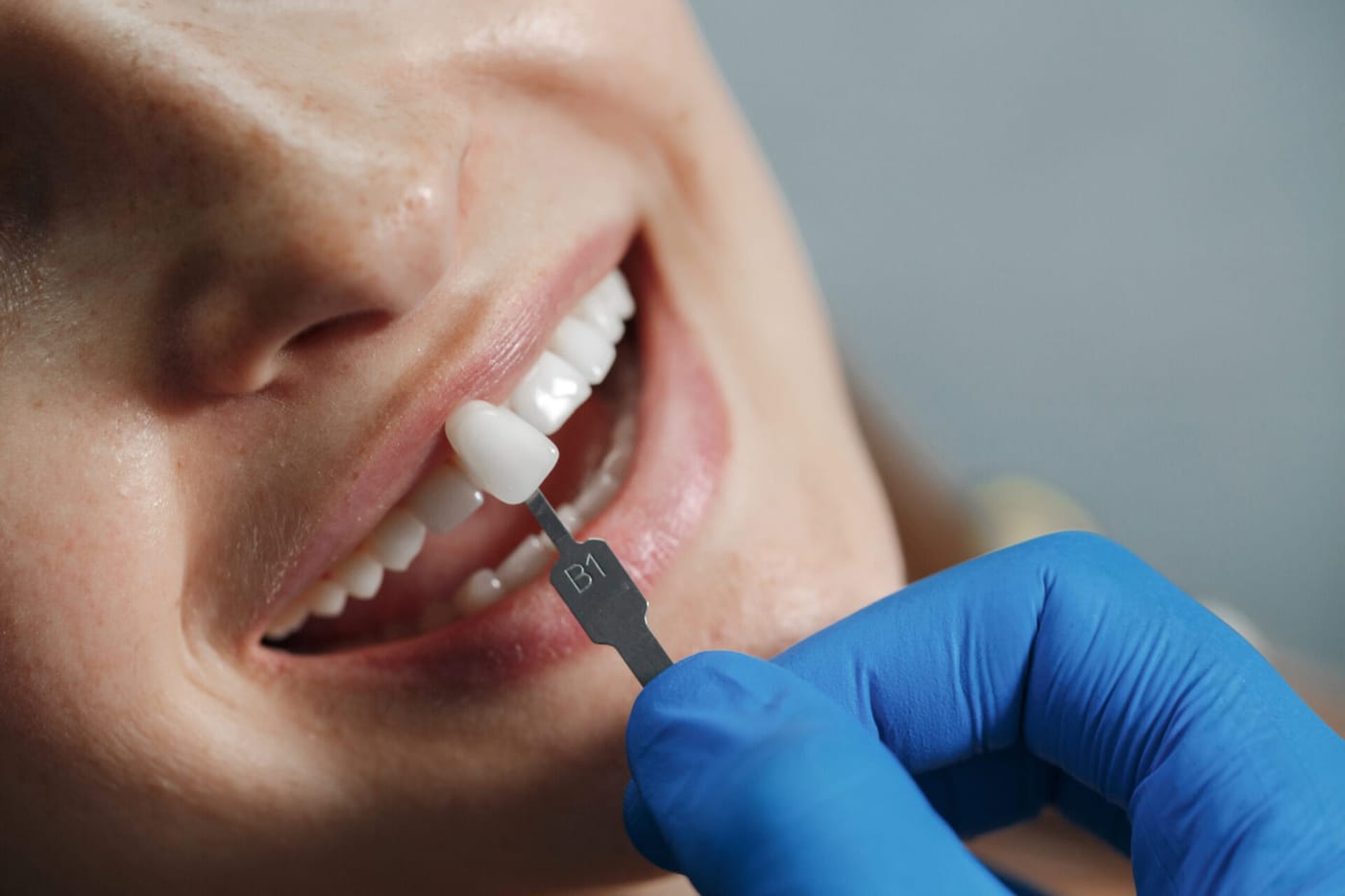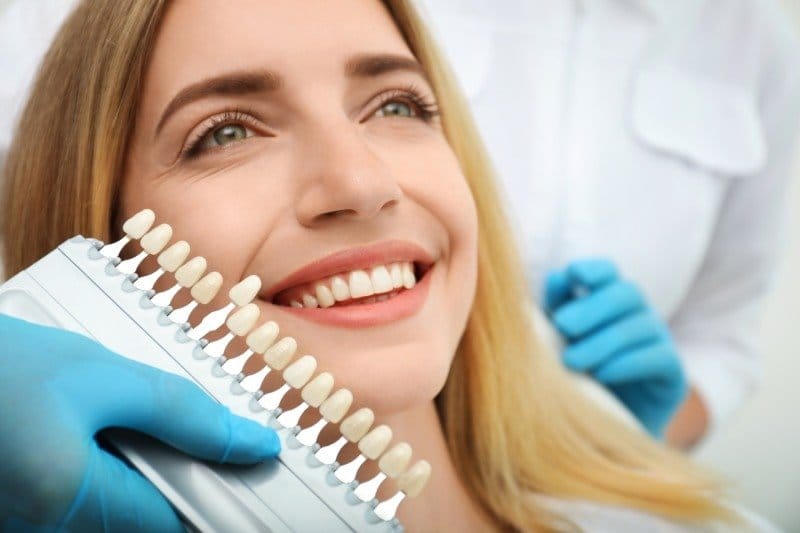
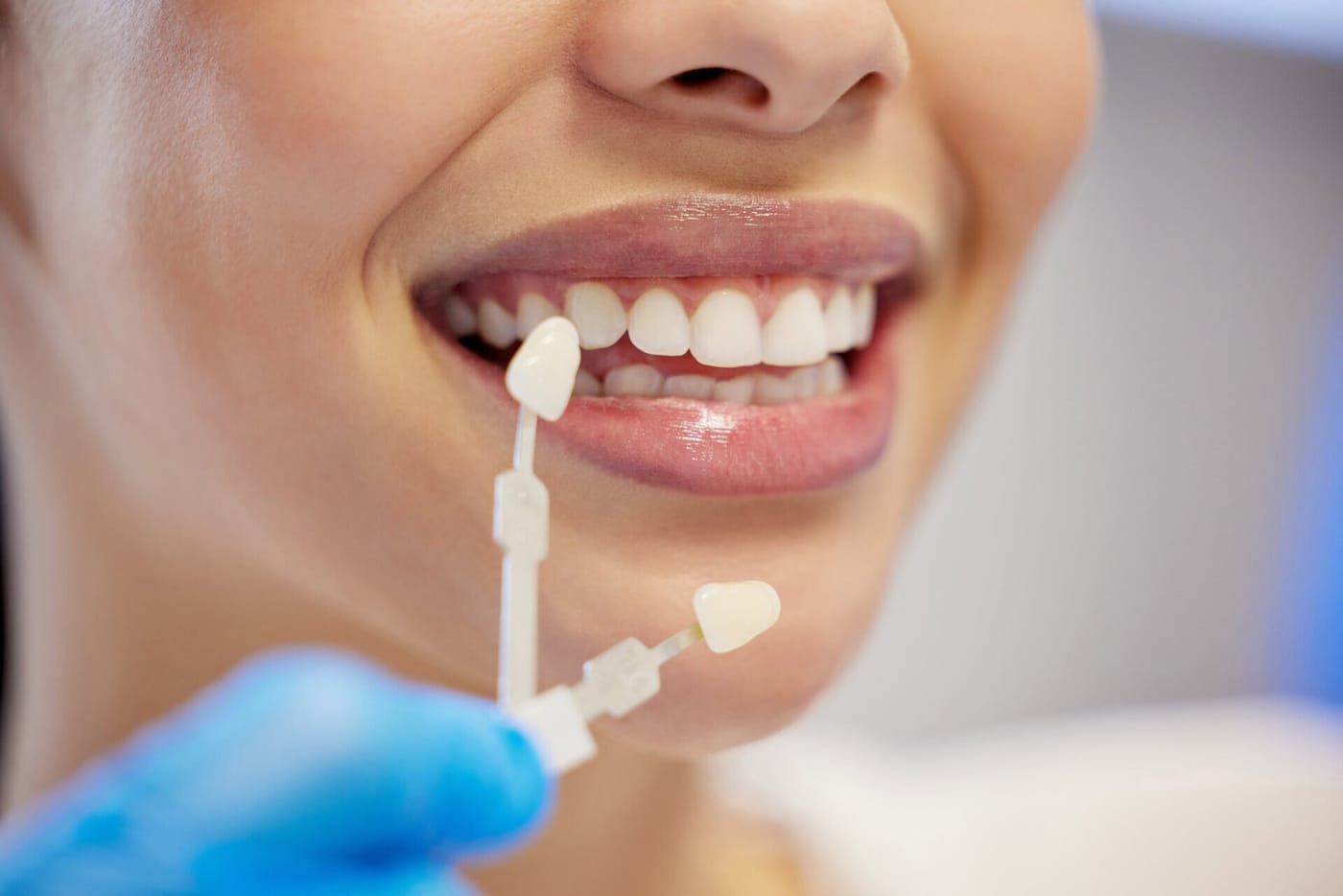
A zirconia crown is a full-coverage dental restoration milled from zirconium dioxide (ZrO₂), a high-strength ceramic. It contains no metal substructure, and because it wraps the whole tooth it requires irreversible preparation of the natural tooth beneath it. In a systematic review and meta-analysis of 64 clinical studies covering 3,509 metal-ceramic and 8,051 all-ceramic single crowns, monolithic zirconia showed a five-year survival of 96.8%, against 97.1% for metal-ceramic and 98.5% for monolithic lithium disilicate (PubMed 41489982). Zirconia therefore sits inside a narrow band of well-performing materials rather than above it. The material is spelled zirconia, not zirconium; zirconium is the pure metal element, while zirconia is the ceramic oxide actually used in the mouth. Which material suits your tooth depends on how much sound structure is left, where the tooth sits in the arch and what it bites against.
- 01Monolithic zirconia single crowns show 96.8% five-year survival, compared with 97.1% for metal-ceramic and 98.5% for monolithic lithium disilicate (PubMed 41489982, 64 studies).
- 02Zirconia is not one material. A systematic review of 78 laboratory studies reports mean flexural strength of 803 ± 233 MPa for 4Y-PSZ against 570 ± 116 MPa for 5Y-PSZ (p = 0.005); translucency is bought with strength (PubMed 40738693).
- 03Against opposing natural enamel over 24 months, monolithic zirconia produced 40.1 µm more vertical loss than a natural-tooth antagonist, metal-ceramic 82.5 µm, and lithium disilicate 5.0 µm (PubMed 38211687).
- 04A crown is not a veneer. Veneers whose preparation stayed within enamel survived at 99% over up to 12 years; those bonded into dentine were roughly ten times more likely to fail (PubMed 23342345). Crowns remove far more tooth than either.
- 05In bridges the ranking changes: five-year survival falls to 87.9% for monolithic zirconia and 92.9% for layered zirconia, against 91.3% for metal-ceramic, with those differences not statistically significant (PubMed 41650383).
/ What a zirconia crown actually is
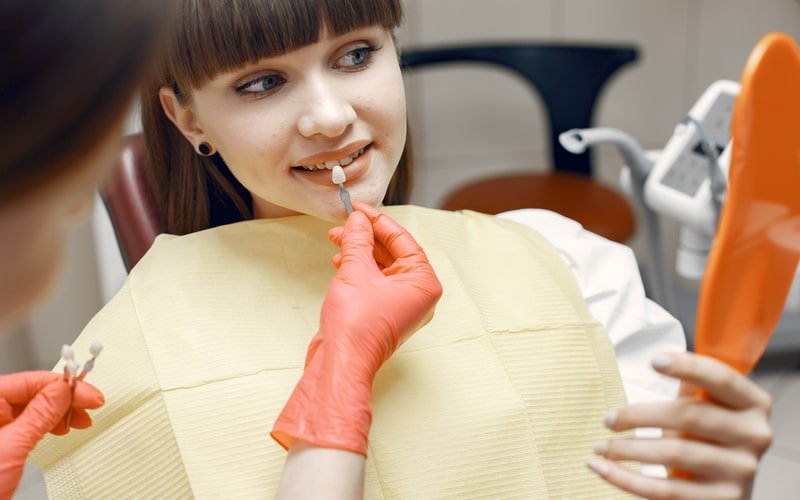
A zirconia crown is a full-coverage restoration milled from zirconium dioxide, a dense polycrystalline ceramic. The chemical formula is ZrO₂ and the correct material name is zirconia. Zirconium, without the "a", is the pure metal element sitting at atomic number 40 in the periodic table, and it is not what goes in your mouth. Quotes and clinic listings usually write "zirconium crown"; the material being described is zirconia.
The practical consequence of being a ceramic rather than a metal is structural. In a porcelain-fused-to-metal crown, a chromium-cobalt or nickel-bearing alloy coping carries the load and porcelain is layered over it. A monolithic zirconia crown has no coping; the entire restoration is milled from a single sintered ceramic blank and then stained and polished. The dark line that appears at the gum margin of older crowns after years of service comes from the metal substructure, so that particular failure mode does not exist in zirconia.
A third material shares the name. Cubic zirconia is the jewellery stone used as a diamond simulant, and its name is often confused with dental zirconia. Dental zirconia is a different product: different purity, different stabiliser content, and densely sintered at high temperature for mechanical performance rather than optical sparkle. No property of the jewellery stone transfers to a dental restoration.
/ Zirconia crowns versus porcelain crowns: what "porcelain" hides
Zirconia against porcelain is the hardest comparison to answer because "porcelain crown" is not a single thing. On a quote it can mean at least four different restorations. It can mean a porcelain-fused-to-metal crown, which has a metal coping. It can mean a feldspathic or leucite-reinforced all-ceramic crown. It can mean a lithium disilicate glass-ceramic crown. It can even mean a zirconia crown that the clinic has simply described as porcelain because the word is familiar to patients. Those four options have measurably different clinical records.
The 64-study meta-analysis reports each of them separately. At five years, monolithic lithium disilicate reached 98.5%, layered zirconia 97.3%, metal-ceramic 97.1%, monolithic zirconia 96.8%, layered leucite or lithium disilicate 95.7%, and feldspathic or silica-based ceramic 90.4% (PubMed 41489982). The gap between the top of that list and the bottom is more than eight percentage points, and every one of those restorations could legitimately be called "porcelain" in casual conversation.
So "zirconia or porcelain" needs one more step before it can be answered. Ask which ceramic, and ask whether there is a metal coping. A quote that names the material, the grade and the laboratory is a quote you can compare. A quote that says "porcelain crown" and gives a price tells you nothing about what you are buying. Our porcelain crown article covers the metal-ceramic side of that family in more detail, PFM crowns get their own material profile, and the prosthodontics treatment section lists what we actually offer.
/ Zirconia grades, and the strength you trade for translucency
Dental zirconia is a family of materials separated by yttria (Y₂O₃) content, written as a mol percentage. The grades you will see quoted are 3Y-TZP, 4Y-PSZ and 5Y-PSZ. As yttria content rises, the proportion of cubic phase rises with it, the material scatters less light and looks more like a natural tooth. The same change works against mechanical performance.
That trade-off has been measured. A systematic review of 78 laboratory studies reports mean biaxial flexural strength of 803 ± 233 MPa for 4Y-PSZ and 570 ± 116 MPa for 5Y-PSZ, a statistically significant difference at p = 0.005. On the basis of ISO 6872 classification, the same review supports 4Y-PSZ for three-unit fixed dental prostheses and 5Y-PSZ for three-unit fixed prostheses in the anterior region (PubMed 40738693). Grade selection is therefore a structural decision tied to span length and position, not a cosmetic preference.
A second systematic review, covering 53 laboratory studies, points the same way and adds detail worth knowing before treatment. Raising yttria content improved aesthetics at the cost of some mechanical performance, and even the most translucent zirconia remains less translucent than glass-ceramics. Low-temperature degradation, the ageing phenomenon that worried early zirconia users, was found not to be a concern for high-yttria compositions. Smooth polishing significantly increased strength while coarse grinding and mechanical fatigue reduced it, and the authors warn specifically about thin sections in high stress-bearing areas (PubMed 33581910). That last finding explains why identical material from two laboratories can behave differently: the finish is part of the strength.
/ Monolithic versus layered zirconia
Zirconia crowns are built in two ways, and the distinction predicts the most common complaint patients report. A monolithic crown is milled entirely from zirconia and finished with surface stain and polish. A layered crown uses zirconia only as a coping, with feldspathic porcelain hand-built over it for optical depth. The second option can achieve subtler colour transitions. It also introduces an interface that can fail.
The 64-study meta-analysis found that monolithic designs showed significantly fewer ceramic fractures and less chipping than veneered designs (PubMed 41489982). Chipping is not the same as losing the restoration; a chip can often be polished or repaired intraorally, which is why the survival numbers in the same analysis look almost identical: 97.3% at five years for layered zirconia and 96.8% for monolithic. The two designs are close on whether the crown stays in the mouth and separate on how much technical maintenance it needs along the way.
The practical reading is that monolithic construction lowers fracture and chipping risk, while layered construction can offer finer optical gradation in the anterior. Choosing monolithic for a patient with bruxism or for a heavily loaded posterior tooth is a load-distribution argument, not a claim that one is a better material. Ask which construction your quote covers and ask for it in writing, because the same word "zirconia" is used for both. For multi-unit work, our zirconia bridge guide covers how the same material behaves across a span, replacing a single missing tooth with a bridge works through a narrower case, and zirconia on implants is a separate planning question again.
/ What the survival data reports
The auditable longevity figures for zirconia crowns come from a systematic review and meta-analysis of clinical studies published between 2014 and 2024 with a minimum three-year follow-up, pooling 3,509 metal-ceramic and 8,051 all-ceramic tooth-supported single crowns across 64 studies (PubMed 41489982).
| Tooth-supported single crown | 5-year survival |
|---|---|
| Monolithic lithium disilicate | 98.5% |
| Veneered densely sintered zirconia | 97.3% |
| Metal-ceramic | 97.1% |
| Monolithic densely sintered zirconia | 96.8% |
| Veneered leucite / lithium disilicate | 95.7% |
| Densely sintered alumina | 94.5% |
| Glass-infiltrated alumina | 94.3% |
| Feldspathic / silica-based ceramic | 90.4% |
The authors conclude that lithium disilicate and zirconia-based all-ceramic single crowns achieve five-year survival comparable to metal-ceramic crowns, and that monolithic designs reduce fracture and chipping risk. Lithium disilicate is the material sold under the e.max name, and we profile it separately in our e.max veneers guide.
Bridges are a different question and the same research group answered it separately. Pooling 600 metal-ceramic and 1,532 all-ceramic multiple-unit fixed dental prostheses across 41 studies, five-year survival came out at 92.9% for veneered zirconia, 91.3% for metal-ceramic, 88.4% for glass-infiltrated alumina, 87.9% for monolithic zirconia and 82.5% for lithium disilicate. Lithium disilicate was significantly lower than metal-ceramic; differences among the other materials did not reach statistical significance (PubMed 41650383). Notice that the material ranked first among single crowns ranks last among bridges. Any answer to "how long do zirconia crowns last" that does not first ask how many units you are having is incomplete.
/ Wear on the teeth that bite against it
Crown selection usually focuses on the tooth being restored. The tooth it meets gets less attention, and it should get more, because a hard ceramic surface wears opposing natural enamel over time and the amount depends on the material. A network meta-analysis pooled seven clinical studies measuring mean vertical loss on antagonist teeth for up to 24 months after permanent crown placement, covering 261 crowns in 177 subjects (PubMed 38211687).
| Extra vertical enamel loss on the opposing tooth, up to 24 months | Versus a natural-tooth antagonist |
|---|---|
| Metal-ceramic | +82.5 µm (95% CI 54.4-110.6) |
| Monolithic zirconia | +40.1 µm (95% CI 22.2-58.0) |
| Lithium disilicate | +5.0 µm (95% CI -48.2-58.1) |
All three ceramic materials produced more antagonist wear than a natural tooth opposing another natural tooth. Monolithic zirconia produced roughly half the additional loss that metal-ceramic did, and lithium disilicate produced the least, though its confidence interval crosses zero and the estimate is therefore uncertain. These figures are a planning input for the clinician, not a league table.
A separate systematic review of in vivo studies reaches a compatible conclusion and states the limits plainly: antagonist enamel wear against zirconia was similar to or greater than that against natural teeth, but less than against metal-ceramics, and heterogeneity in study design, surface treatment and measurement method made meta-analysis impossible, so longer trials with larger samples are still needed (PubMed 30509545). Surface polish is believed to matter here, but the clinical evidence linking polish quality to measured wear remains thin.
/ Crown or veneer: how much tooth you actually lose
The difference between a crown and a veneer is the substance of the criticism aimed at dental tourism in the UK press. A crown is a full-coverage restoration. It requires circumferential reduction of the natural tooth, and that reduction is permanent. A laminate veneer is a technique, not a material, and in a suitable case it covers the labial surface with a preparation that can largely stay inside enamel. Patients are sometimes quoted "veneers" and receive crowns. The words are not interchangeable and the difference is measured in tooth structure you do not get back.
The evidence on enamel preservation is unusually direct. A study following 580 porcelain laminate veneers in 66 patients for up to 12 years found 99% survival where the preparation remained entirely within enamel and 94% where enamel remained only at the margins, with an overall cumulative survival of 86%. Veneers bonded to dentine, with preparation margins in dentine, were approximately ten times more likely to fail (PubMed 23342345). Adhesion to enamel is what makes the restoration hold, and once the enamel is gone that advantage cannot be recovered.
Veneer performance overall has been pooled as well: a systematic review and meta-analysis of 13 clinical studies reports 89% cumulative survival (95% CI 84-94) at a median nine-year follow-up, with debonding at 2%, fracture or chipping at 4% and secondary caries at 1% (PubMed 26757327). None of this makes veneers better than zirconia crowns. It makes them a different intervention for a different starting condition. A tooth that is broken down, heavily filled or root-treated usually needs full coverage; an intact tooth with sound enamel usually does not. If a treatment plan proposes full-coverage crowns on a large number of healthy, unrestored teeth, ask why in writing before you book anything. Our Turkey teeth guide covers that conversation at length, what the trend actually involves covers the reputational side, how long veneers last sets expectations on the alternative, and the laminate veneer treatment page sets out what minimal preparation means in practice.
/ The disadvantages of zirconia
Zirconia has several limits. Its opacity relative to glass-ceramics is the first. Even the most translucent grades remain less translucent than lithium disilicate, which is why a single anterior zirconia crown next to natural teeth can read as slightly flat in certain lighting, and why 5Y-PSZ was developed in the first place at the cost of mean flexural strength, 570 MPa against 803 MPa for 4Y-PSZ (PubMed 40738693).
The second limit is hardness working against you. Monolithic zirconia produced 40.1 µm more antagonist enamel loss than a natural-tooth antagonist over 24 months (PubMed 38211687). In a patient with existing wear facets or untreated bruxism, that is a real consideration rather than a footnote, and it is one reason a night guard is often part of the plan rather than an upsell.
The third is bonding behaviour. Zirconia does not etch with hydrofluoric acid the way glass-ceramics do, so its cementation protocol differs and relies on mechanical retention from the preparation plus surface conditioning and phosphate-monomer primers. In a short or heavily tapered preparation, retention becomes a genuine clinical problem. The fourth is repairability: a chipped layered zirconia crown can sometimes be polished, but a fractured monolithic unit is generally replaced rather than repaired.
The fifth concerns indication rather than material: zirconia cannot compensate for the wrong indication. Crowning a healthy tooth for colour alone removes sound structure that a whitening course, composite bonding or composite veneers could have addressed without cutting anything. Those options sit in our aesthetic dentistry section. The material is not the risk; over-treatment is.
/ What drives the cost of a zirconia crown
Prices quoted for zirconia crowns vary by a wide margin between clinics and between countries, and the spread is usually not explained. Most of it is not currency or margin. It is that different products are being priced under the same name. Our own current figures are published on the zirconia crown treatment page and kept up to date there.
The variables that actually move the number are these. Zirconia grade comes first, since 3Y, 4Y and 5Y blanks are different products at different costs. Construction is second, because a monolithic unit and a hand-layered unit represent different laboratory hours. Unit count is third, since pricing is per crown and a bridge charges for pontics as well as abutments. Additional procedures are fourth: root canal treatment, post and core build-up, extraction, gingival recontouring and bone or soft-tissue work are separate line items and are not included in a crown fee. Fifth is the provisional phase, the number of try-in appointments and whether the temporary crown is chairside or milled. Sixth is the warranty and what remote follow-up is actually provided after you fly home.
For anyone comparing an international quote, two questions separate a comparable price from an incomparable one. Ask which zirconia grade and which construction the quote covers, and ask what is excluded. A quote that lists 20 crowns at an attractive per-unit price and omits the endodontics that those preparations will require is not cheaper, it is incomplete. Our veneer cost guide walks through the same arithmetic for the veneer side, and you can raise a specific plan through our contact page.
/ Aftercare, MRI, and what happens once you have flown home
The most commonly reported failure in dental tourism is not a material failure. It is the absence of anyone to call afterwards. Before treatment, establish in writing what the warranty covers and what it does not: replacement of a fractured crown, recementation of a loose one, or treatment of a problem that develops in the tooth underneath are three different commitments and clinics treat them differently. Establish who reviews your case remotely, on what schedule, and what happens if a local dentist needs your records. Our clinical team is published with names and qualifications for exactly this reason.
Day-to-day care needs no special product. Abrasive whitening pastes can dull the polish over time, and whitening agents will not change the shade of a zirconia crown, so shade decisions are made before the crown is made rather than after. The crown itself cannot decay. What decays is the natural tooth underneath, typically starting at the margin where the crown meets the gum, which makes interdental cleaning and regular review more important after crown work rather than less. If a crown loosens or comes off while you are away from the clinic that placed it, our guide on what to do after tooth reduction covers the interim period, and lip discomfort after crown work covers a common and usually temporary complaint.
MRI comes up constantly. Zirconia is a ceramic oxide and contains no ferromagnetic metal, which distinguishes it from restorations built on chromium-cobalt or nickel-bearing alloys. Even so, tell the radiology team about every restoration in your mouth before a scan; older metal-containing fillings, crowns or orthodontic attachments may still be present from previous treatment, and the decision belongs to the team operating the scanner.
Let’s plan the right treatment together.
Free Assessment→- 1.Pjetursson BE, Pitta J, Balet A, Bjarnadottir GR, Sailer I, Romandini P. A Systematic Review and Meta-analysis Evaluating the Survival, Failure, and Complication Rates of Metal-Ceramic, Veneered, and Monolithic All-Ceramic Tooth-Supported Single Crowns, Part 1. Int J Prosthodont. 2026. doi:10.11607/ijp.9633
- 2.Romandini P, Pjetursson BE, Pitta J, Balet A, Ikumi R, Sailer I. A Systematic Review and Meta-analysis Evaluating the Survival, Failure, and Complication Rates of Metal-Ceramic, Veneered, and Monolithic All-Ceramic Tooth-Supported Multiple-Unit Fixed Dental Prostheses (FDPs), Part 2. Int J Prosthodont. 2026. doi:10.11607/ijp.9666
- 3.Bernauer SA, Lirgg NM, Ioannidis A, Zitzmann NU, Rohr N. Flexural strength of translucent zirconia for single crowns and fixed dental prostheses, A systematic review. J Prosthodont Res. 2026. doi:10.2186/jpr.JPR_D_24_00277
- 4.Fathy SM, Al-Zordk W, Grawish ME, Swain MV. Flexural strength and translucency characterization of aesthetic monolithic zirconia and relevance to clinical indications: A systematic review. Dent Mater. 2021;37(4):711-730. doi:10.1016/j.dental.2021.01.022
- 5.Mao Z, Beuer F, Hey J, Schmidt F, Sorensen JA, Prause E. Antagonist enamel tooth wear produced by different dental ceramic systems: A systematic review and network meta-analysis. J Dent. 2024;142:104832. doi:10.1016/j.jdent.2024.104832
- 6.Gou M, Chen H, Kang J, Wang H. Antagonist enamel wear of tooth-supported monolithic zirconia posterior crowns in vivo: A systematic review. J Prosthet Dent. 2019;121(4):598-603. doi:10.1016/j.prosdent.2018.06.005
- 7.Gurel G, Sesma N, Calamita MA, Coachman C, Morimoto S. Influence of enamel preservation on failure rates of porcelain laminate veneers. Int J Periodontics Restorative Dent. 2013;33(1):31-39. doi:10.11607/prd.1488
- 8.Morimoto S, Albanesi RB, Sesma N, Agra CM, Braga MM. Main Clinical Outcomes of Feldspathic Porcelain and Glass-Ceramic Laminate Veneers: A Systematic Review and Meta-Analysis of Survival and Complication Rates. Int J Prosthodont. 2016;29(1):38-49. doi:10.11607/ijp.4315
- 9.Tymofiyeva O, Vaegler S, Rottner K, Boldt J, Hopfgartner AJ, Proff PC, et al. Influence of dental materials on dental MRI. Dentomaxillofac Radiol 2013;42:20120271. PubMed 23610088
- 10.Bohner L, Meier N, Gremse F, Tortamano P, Kleinheinz J, Hanisch M. Magnetic resonance imaging artifacts produced by dental implants with different geometries. Dentomaxillofac Radiol 2020;49:20200121. PubMed 32589480