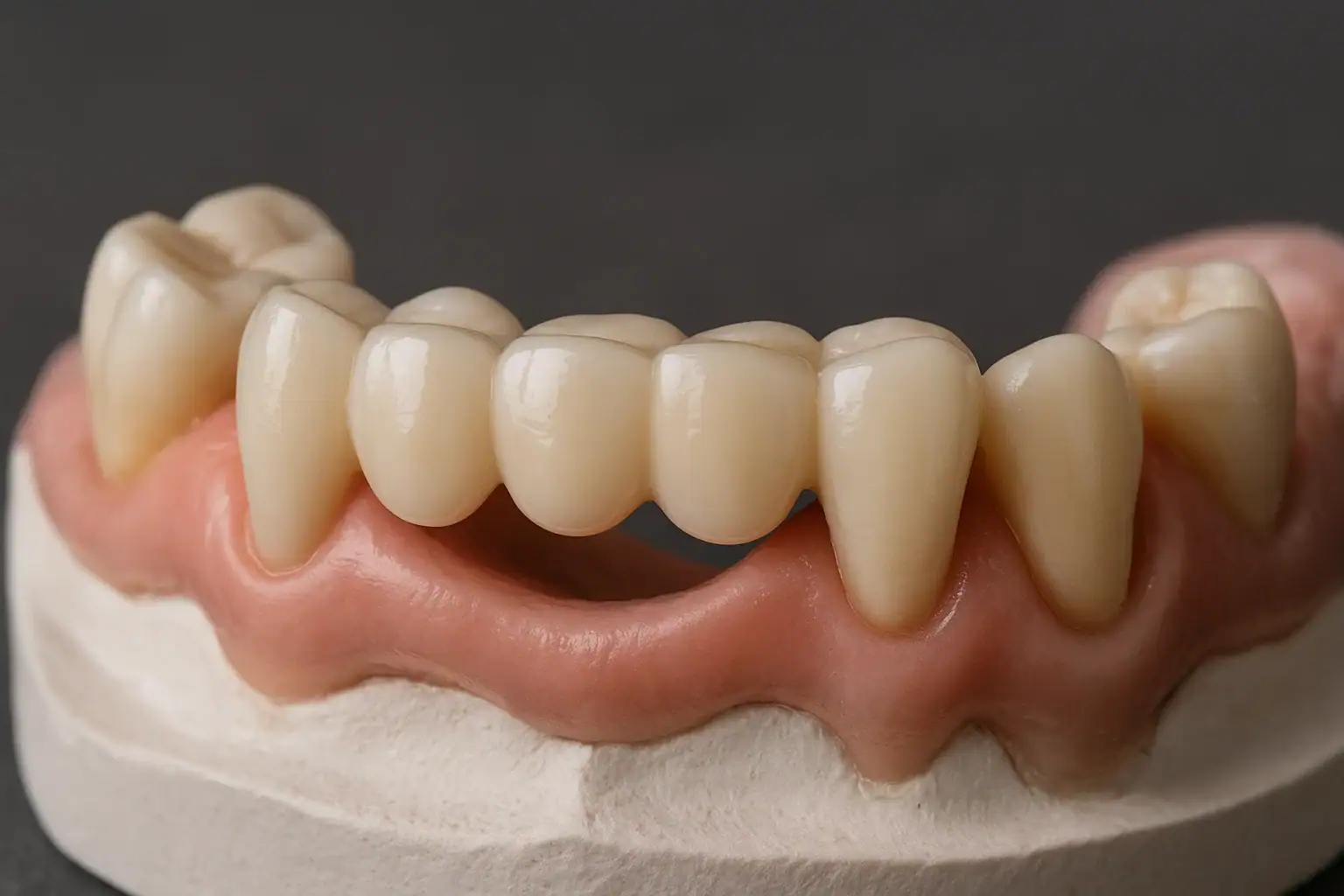
A 5-tooth bridge, also called a 5-unit bridge, is a single fixed restoration spanning five crown positions, most often three artificial teeth called pontics carried by two prepared abutment teeth, or the same span carried by 2 to 4 implants. It is cemented or screw-retained, so it is not removed at home. In a 2026 systematic review of 41 studies covering 600 metal-ceramic and 1,532 all-ceramic bridges, 5-year survival was 91.3 percent for metal-ceramic and 92.9 percent for veneered zirconia, and 71.0 percent of restorations stayed free of any complication over 5 years (PubMed 41650383).
- 01The standard design is 3 pontics plus 2 abutments; an implant-supported version uses 2 to 4 implants with a healing period of 8 to 16 weeks before the framework is fitted.
- 02Material choice moves the odds measurably. Across 41 studies covering 600 metal-ceramic and 1,532 all-ceramic bridges, 5-year survival was 92.9 percent for veneered zirconia, 91.3 percent for metal-ceramic, 88.4 percent for glass-infiltrated alumina, 87.9 percent for monolithic zirconia and 82.5 percent for lithium disilicate, the only material significantly below metal-ceramic (PubMed 41650383).
- 03Framework fracture exceeded 10 percent over 5 years for lithium disilicate and glass-infiltrated alumina bridges, which is why weaker ceramics are not used for long spans (PubMed 41650383).
- 04Retention loss and marginal caries are recurring complications: all-ceramic bridges showed higher rates of marginal caries and loss of retention than metal-ceramic ones (PubMed 41650383), and the earlier 40-study review reported the same pattern for zirconia (PubMed 25935732).
- 05Halitosis has a clinical definition, chronic bad breath beyond normal morning odour, and three categories: genuine halitosis, objectively detectable; pseudo-halitosis, believed but not detectable; and halitophobia, persistent fear of odour after treatment.
What a 5-Tooth Bridge Is
A 5-tooth bridge, also called a 5-unit bridge, is a single fixed restoration that spans five crown positions. In the standard design, three artificial teeth, called pontics, fill the gap and are carried by two prepared natural teeth at either end, called abutments. The bridge is cemented or screw-retained, so it stays in the mouth and is not taken out for cleaning at home. That is the main difference from a removable partial denture, which clips onto the remaining teeth and comes out every night.
The same span can also be carried by dental implants in place of natural teeth. An implant-supported 5-unit bridge usually rests on 2 to 4 implants placed in the jaw, and the framework is fitted after a healing period of about 8 to 16 weeks. Because the load goes into the bone through the implants, the teeth next to the gap do not have to be cut down.
A bridge of this length is considered when several neighbouring teeth are missing in a row and the patient wants a fixed replacement. It depends on one of two conditions. Either the teeth at each end are strong enough, in root length, bone support and gum health, to carry three missing teeth between them, or there is enough bone for implants. When five adjacent teeth are missing, a tooth-supported bridge would leave too few abutments for the load, and implants carry the span instead.
Longer spans put more stress on the supports than short ones. Every pontic adds chewing force that has to be passed to the abutments, and the connectors between the units have to resist bending over a greater distance. This is why the choice of design and material matters more for a five-unit bridge than for a three-unit one, and why the examination starts with the supports before it turns to the appearance of the new teeth.
Tooth-Supported, Implant-Supported and Adhesive Designs
The tooth-supported bridge is the traditional design. The abutment teeth are reshaped to take crowns, and the pontics are joined between them. It needs no surgery and can be completed in a few weeks. Its cost is paid in tooth structure, since the abutments are reduced permanently, and if they were healthy and unrestored that reduction is a real loss. In a systematic review comparing tooth-supported and implant-supported restorations, the estimated 10-year survival was 89.2% for conventional tooth-supported bridges and 86.7% for implant-supported bridges (PubMed 17594374). Each bridge type and who it suits is described on the dental bridge page.
The implant-supported design leaves the neighbouring teeth untouched and places the load on the bone. It requires surgery and a healing interval before the final bridge. The same review found that 38.7% of patients with implant-supported bridges had some complication after 5 years, compared with 15.7% for conventional bridges (PubMed 17594374). The complications differ in kind. Tooth-supported bridges most often run into biological problems such as caries and loss of pulp vitality in the abutments, while implant restorations more often have technical problems such as ceramic chipping, abutment or screw loosening and loss of retention (PubMed 17594374).
Cantilever bridges, in which the pontics are supported from one side only, performed less well. Their 10-year survival was 80.3%, and the review authors recommended them only as a second option, for anatomical reasons or patient preference (PubMed 17594374).
Adhesive bridges, also known as Maryland bridges, are bonded to the back of the neighbouring teeth with little or no reduction. They are suited to small gaps and are rarely used for a span as long as five units. At Mosdent in Istanbul, an adhesive (Maryland) bridge starts from €160. That is a starting price and not a quote; the figure that applies to a given case is written down after a free examination.
Materials and Their Measured Survival
The material of a multi-unit bridge changes its measured outcomes. A recent systematic review of 41 studies, covering 600 metal-ceramic and 1,532 all-ceramic bridges, reported 5-year survival of 92.9% for veneered densely sintered zirconia, 91.3% for metal-ceramic, 88.4% for glass-infiltrated alumina, 87.9% for monolithic densely sintered zirconia and 82.5% for lithium disilicate reinforced glass-ceramic (PubMed 41650383). Only lithium disilicate was significantly lower than metal-ceramic, and the differences among the other materials were not statistically significant. Overall, 71.0% of the restorations remained free of any complication after 5 years (PubMed 41650383).
Framework fracture separates the materials most clearly. It was more frequent in all-ceramic bridges, particularly lithium disilicate and glass-infiltrated alumina, where it exceeded 10% over 5 years (PubMed 41650383). The authors concluded that high fracture rates make weaker ceramics unsuitable for multi-unit restorations, and that monolithic zirconia offers improved resistance to chipping and framework fracture. Lithium disilicate remains a strong choice for single crowns and aesthetic work on front teeth, but a five-unit span is a different mechanical task.
An earlier review of 40 studies found the same direction. Five-year survival was 94.4% for metal-ceramic and 90.4% for densely sintered zirconia multiple-unit bridges, and zirconia bridges showed more caries in abutment teeth, more ceramic fractures and more loss of retention than metal-ceramic ones (PubMed 25935732). Metal-ceramic bridges remain a reliable option; their drawback is appearance, since the metal framework can show as a grey line at the gum margin if the gum recedes.
Most five-unit spans we make in Istanbul are milled from zirconia, for its strength across a long span. The material grades, the shade process and the fitting visits are set out on our zirconium dental crown page, and the wider fixed and removable range sits under prosthodontics.
Planning and the Steps of Treatment
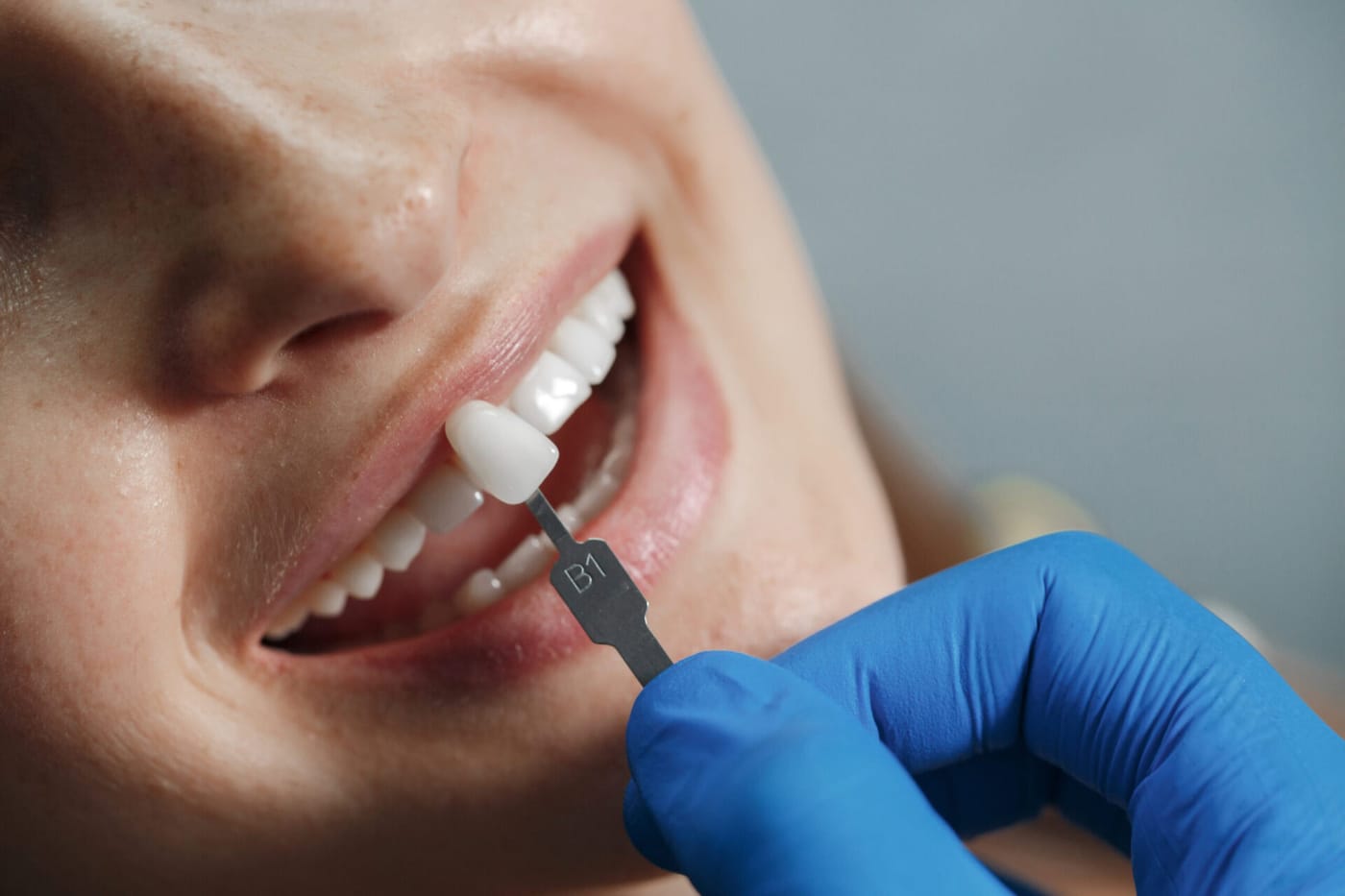
Planning starts with the supports. The examination includes radiographs, and a CBCT scan where implants are being considered, an assessment of the bite and a check of gum health around every tooth that might carry load. Any untreated gum disease, a tooth that needs extraction or a bone deficit that needs grafting is dealt with before the bridge is made, because a bridge placed on unstable foundations shares their problems. Where the bridge is in the visible part of the smile, a digital preview as part of smile design lets the patient see the proposed tooth shape and length before any tooth is prepared.
For a tooth-supported bridge the sequence is short. The abutment teeth are prepared under local anaesthetic, an impression or digital scan is taken, and a temporary bridge protects the prepared teeth while the laboratory works. The framework is tried in to check fit and bite, and the finished bridge is then cemented permanently. Most patients complete this in a few weeks, and some sensitivity to hot and cold in the abutments during the first days is common.
For an implant-supported bridge the timeline is longer. Two to four implants are placed, and the bone is given about 8 to 16 weeks to integrate with them. Abutments are then connected to the implants, impressions or scans are taken, the framework is tried in, and the final bridge is delivered, either cemented onto the abutments or fixed with screws that allow it to be removed by the dentist for maintenance.
In both cases the bite is checked carefully at delivery. A five-unit bridge that meets the opposing teeth too early on one side concentrates force on one abutment or one implant, and small adjustments at this stage prevent chipping and loosening later.
What Shapes the Cost and the Lifespan
There is no single figure for a 5-tooth bridge, and a quote is only useful when it is itemised in writing. Five factors drive it: the material, the number and condition of the abutment teeth or implants, the diagnostic imaging and temporary bridge, the dentist and laboratory involved, and the location. A tooth-supported bridge usually costs less at the start but may need further work on the abutments over the years. An implant-supported span costs more upfront but leaves the neighbouring teeth uncut. Insurance coverage, where it exists, generally depends on whether the treatment is judged medically necessary, and the policy terms are worth reading before treatment starts.
Lifespan is measured over defined follow-up periods. The strongest evidence for multi-unit bridges covers 5 years, with 92.9% survival for veneered zirconia and 91.3% for metal-ceramic (PubMed 41650383). For 10 years, conventional tooth-supported bridges reached 89.2% and implant-supported bridges 86.7% (PubMed 17594374). These are averages across many patients, and individual results depend heavily on what happens after the bridge is fitted.
Three factors shorten the life of a bridge most. Grinding and clenching load the connectors and the ceramic, and a night guard reduces that load for patients who grind. Gum disease around the abutments weakens their support. Plaque left under the pontics and at the crown margins leads to caries in the abutment teeth; for conventional bridges the most frequent complications were biological ones such as caries and loss of pulp vitality (PubMed 17594374). Diet plays a part too, since hard foods bitten on a pontic and frequent sugar intake both add risk. Many bridges are redone because a supporting tooth or the gum around it has failed while the bridge itself is still intact.
Cleaning Under the Bridge and Bad Breath
Odour around a bridge comes from trapped plaque and food debris. Halitosis is the clinical term for chronic bad breath that goes beyond normal morning odour. Its usual causes are a bacterial coating on the tongue, gum disease, food debris trapped under restorations and dry mouth, with sinus problems, reflux and diabetes as systemic contributors.
Around a bridge, three things create the low-oxygen conditions in which odour-producing bacteria thrive. Food and plaque collect under the pontics if that area is not cleaned. Margins that overhang or are poorly contoured trap plaque at the edge of the abutment crowns. Inflamed gums around the abutments add bleeding and bacterial by-products to the mix. Each of these has a practical remedy.
Daily cleaning targets the space under the pontics. Superfloss or floss threaders pass beneath the bridge and clean the underside of the pontics and the sides of the abutments; a water flosser helps flush out debris; interdental brushes reach the gaps where they fit. Brushing twice a day with fluoride toothpaste, cleaning the tongue and using an alcohol-free rinse if the dentist recommends one complete the routine. A professional cleaning every 6 months removes what home care misses and allows the margins to be checked.
If bad breath persists despite good cleaning, the dentist looks for a rough margin, a gap under the bridge or active gum disease, and corrects it. When the mouth is found clean, the cause may lie elsewhere, and a medical assessment for sinus, reflux or metabolic causes is the next step.
Halitosis is divided into three categories. Genuine halitosis is objectively detectable. Pseudo-halitosis is when the patient believes there is an odour that others cannot detect. Halitophobia is a persistent fear of bad breath that continues after treatment has resolved any real cause. Telling these apart matters, because the first responds to cleaning and repair while the others need reassurance and, in some cases, other support.
Signs a Bridge Needs Checking
A bridge that is working well is quiet: it does not trap food, bleed, move or smell. Changes in any of these are reasons to book an appointment without waiting for the next routine visit, because most bridge problems are easier to fix early.
The signs to watch for are persistent bad breath despite careful cleaning, bleeding or swollen gums around the abutment teeth, food that consistently packs under the pontics, any chip or crack in the porcelain, a loose or rocking feeling in the bridge, and pain or sensitivity in a supporting tooth or around an implant. A bridge that feels loose may have lost its cement seal on one abutment while remaining attached to the other, and in that situation decay can progress quickly under the loose crown without causing pain.
At a check-up the dentist looks at the margins of the abutment crowns for decay, measures the gum around the abutments or implants, checks the bite for high spots, and on implant bridges assesses the screws and the bone level on radiographs. Otherwise, a professional cleaning and inspection every 6 months is the routine interval.
Patients who grind their teeth are usually offered a night guard, which spreads the load across the arch at night and protects the ceramic from chipping. Patients with a history of gum disease may need more frequent maintenance visits than the standard interval.
Planned on sound supports, made from a material suited to a long span and cleaned daily underneath, a 5-tooth bridge restores chewing and appearance across a wide gap. The questions to settle at the first visit are whether the end teeth or the bone can carry the load, which design and material fit the span, and how the area under the pontics will be cleaned at home.
Let’s plan the right treatment together.
Free Assessment→- 1.Romandini P, Pjetursson BE, Pitta J, Balet A, Ikumi R, Sailer I. A Systematic Review and Meta-analysis Evaluating the Survival, Failure, and Complication Rates of Metal-Ceramic, Veneered, and Monolithic All-Ceramic Tooth-Supported Multiple-Unit Fixed Dental Prostheses (FDPs)-Part 2. Int J Prosthodont 2026;39:444-462. PubMed 41650383
- 2.Pjetursson BE, Sailer I, Makarov NA, Zwahlen M, Thoma DS. All-ceramic or metal-ceramic tooth-supported fixed dental prostheses (FDPs)? A systematic review of the survival and complication rates. Part II: Multiple-unit FDPs. Dent Mater 2015;31:624-39. PubMed 25935732
- 3.Pjetursson BE, Brägger U, Lang NP, Zwahlen M. Comparison of survival and complication rates of tooth-supported fixed dental prostheses (FDPs) and implant-supported FDPs and single crowns (SCs). Clin Oral Implants Res 2007;18 Suppl 3:97-113. PubMed 17594374