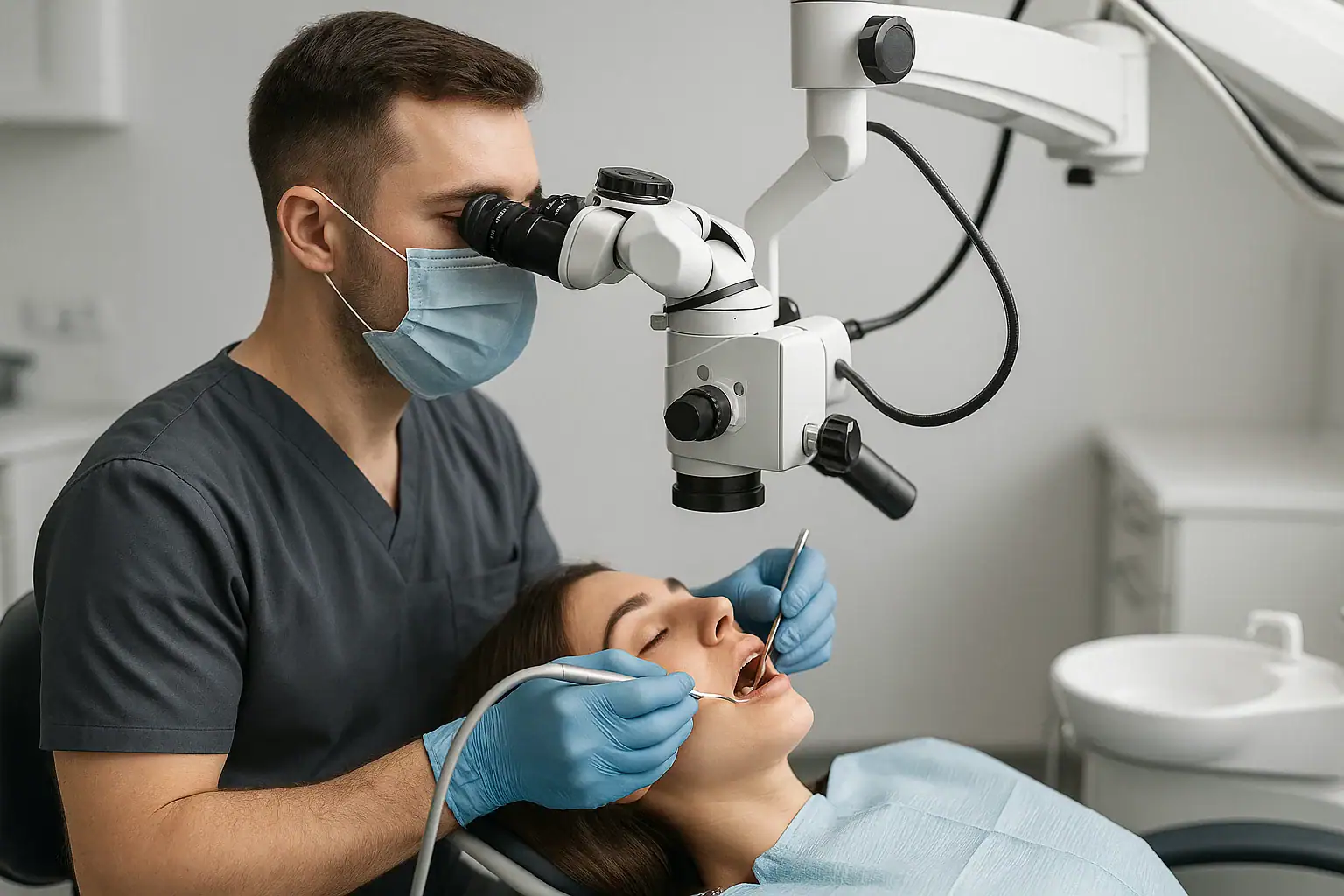
Micro endodontics is root canal treatment carried out under high magnification, using a dental operating microscope together with ultrasonic tips, cone beam computed tomography, digital radiography and electronic apex locators, so canal orifices and accessory canals that are invisible to the naked eye can be found, root fractures can be identified and the canal system can be cleaned. A session usually takes 60 to 90 minutes depending on the anatomy. In 122 maxillary molars, the second mesiobuccal canal was located in 64 percent of teeth by direct vision, 84 percent under the microscope and 90 percent after selective dentin removal under the microscope (PubMed 33107451).
- 01Micro endodontics is a change of vision rather than of biology: the same root canal treatment performed under a microscope, with CBCT, ultrasonic tips and an electronic apex locator.
- 02Magnification changes what is found: in 122 maxillary molars, second mesiobuccal canal detection rose from 64 percent by direct vision to 84 percent under the microscope and 90 percent after selective dentin removal (PubMed 33107451).
- 03CBCT is the fallback rather than the first move: in the same study it lifted overall detection of that canal to 93 percent in teeth where clinical detection had failed (PubMed 33107451).
- 04Four procedures dominate the field: primary root canal therapy, retreatment of failed cases, apicoectomy under microscopic vision, and diagnosis of vertical root fractures.
- 05A microscopic session runs 60 to 90 minutes depending on the anatomy, and the tooth stays out of heavy chewing until a permanent restoration is placed.
Modern dentistry has witnessed revolutionary advancements over the years, and one of the most significant developments is the emergence of micro endodontics . As a highly specialized field within endodontics, micro endodontics uses advanced technology and high-magnification tools to diagnose and treat dental pulp and root canal issues with high precision.
/ Micro Endodontics and Precision Technology
What Is Micro Endodontics?
Micro endodontics refers to the use of enhanced visual and diagnostic tools. Such as dental operating microscopes, ultrasonic instruments, and 3D imaging in root canal treatment . Unlike conventional endodontics, this technique enables dentists to visualize the tiniest details of the tooth structure and canal systems.
Key Technologies Used:
- Dental Operating Microscopes
- Ultrasonic Tips
- Cone Beam Computed Tomography (CBCT)
- Digital Radiography
- Apex Locators
How Micro Endodontics Differs from Traditional Endodontics
| Feature | Traditional Endodontics | Micro Endodontics |
|---|---|---|
| Magnification | Loupes or none | High-power microscope |
| Imaging | 2D X-rays | CBCT 3D imaging |
| Precision | Limited | Highly precise |
| Success Rate | Moderate | High due to enhanced visibility |
| Invasiveness | More invasive | Minimally invasive |
Benefits of Micro Endodontics
- Increased Accuracy: Better identification of root canal complexities, such as accessory canals or fractures.
- Minimally Invasive: Less removal of healthy tooth structure.
- Reduced Post-Operative Pain: More precise treatment reduces inflammation.
- Higher Success Rates: Improved outcomes and long-term tooth preservation.
- Patient Comfort: Faster recovery times and less discomfort.
Technology Behind Micro Endodontics
Micro endodontics is empowered by modern dental technologies that transform diagnostics and treatment:
- Microsurgical Instruments: Enable access and cleaning in complex root systems.
- CBCT Imaging: Offers 3D visualization for accurate diagnosis.
- Ultrasonic Devices: Enhance cleaning of root canals.
- Digital Apex Locators: Precisely identify the root canal length.
/ Micro Endodontics Treatment Process
Common Procedures Performed
1. Root Canal Therapy
Treating infected pulp with enhanced precision to remove all bacteria and save the tooth.
2. Retreatment of Failed Root Canals
Re-entering a previously treated tooth to correct past errors or incomplete procedures.
3. Apicoectomy (Root-End Surgery)
Surgically removing the root tip and surrounding infected tissue under microscopic visualization.
4. Diagnosis of Hidden Fractures
Micro endodontics is ideal for locating vertical root fractures that are often missed with traditional diagnostics.
When Is Micro Endodontics Especially Recommended?
Micro endodontics is particularly beneficial in cases such as:
- Calcified Canals: Where canals are narrow or obstructed, requiring magnified access.
- Complex Anatomy: Teeth with multiple canals or unusual curvature.
- Failed Previous Treatments: Offering a second chance for success.
- Patients with Medical Conditions: For those requiring precise, low-trauma dental work.
Post-Treatment Care and Recovery
After undergoing micro endodontic treatment:
- Avoid chewing on the treated tooth until a permanent restoration (crown) is placed.
- Over-the-counter pain medication may be recommended for mild discomfort.
- Follow-up visits ensure the success of the treatment and long-term health of the tooth.
The Future of Endodontics
The field of micro endodontics continues to evolve:
- AI-Enhanced Imaging: Assisting in diagnosis and planning.
- Smart Endodontic Files: Providing real-time feedback during treatment.
- Nanotechnology in Sealants: Improving the longevity and success of root fillings.
/ Micro Endodontics in Practice and Patient Considerations
Micro Endodontics in Practice
In clinics that work this way, treatment is carried out under the microscope and the plan is built case by case.
Patient Experience:
- Personalized treatment plans
- Thorough diagnostics
- Calming environments
Who Should Consider Micro Endodontics?
- Patients with persistent pain after previous root canal treatments
- Those with complex root canal anatomies
- Patients with dental trauma or fractures
- Anyone seeking a minimally invasive, high-precision alternative to traditional treatment
Traditional vs. Micro Endodontics: Is It Worth the Cost?
Although micro endodontics may come with a slightly higher cost due to the specialized equipment and training involved, the benefits often outweigh the expense. Patients report:
- Greater comfort
- Fewer complications
- Reduced likelihood of retreatment
Additionally, clinics that invest in micro endodontic technology often see improved patient satisfaction and clinical success rates.
FAQs
Q: What is micro endodontics?
A: It is a precision-based branch of endodontics that uses microscopes and digital imaging to enhance root canal treatment.
Q: Is it painful?
A: No, micro endodontics often reduces pain during and after treatment due to its accuracy.
Q: How long does the procedure take?
A: It typically takes 60–90 minutes, depending on the complexity of the tooth.
Q: Is it covered by insurance?
A: Many insurance plans cover it as part of endodontic services, but it’s best to check with your provider.
Micro endodontics represents the cutting edge of root canal therapy, offering patients a more comfortable, accurate, and effective alternative to traditional treatments. As its use grows, this technique is increasingly preferred in endodontic care.
If you are facing dental pain or have been recommended for a root canal, talk to a clinic that offers micro endodontic services about the options that suit your case.
Let’s plan the right treatment together.
Free Assessment→- 1.Manigandan K, Ravishankar P, Sridevi K, Keerthi V, Prashanth P, Pradeep Kumar AR. Impact of dental operating microscope, selective dentin removal and cone beam computed tomography on detection of second mesiobuccal canal in maxillary molars: A clinical study. Indian J Dent Res 2020;31:526-530. PubMed 33107451
- 2.Pinto D, Marques A, Pereira JF, Palma PJ, Santos JM. Long-Term Prognosis of Endodontic Microsurgery-A Systematic Review and Meta-Analysis. Medicina (Kaunas) 2020;56. PubMed 32899437