A tooth abscess is a pocket of pus caused by a bacterial infection, most often at the tip of the root of a tooth whose pulp has died (acute apical abscess) or in the gum beside a tooth (periodontal abscess). It arises from an inflamed or necrotic dental pulp or an infected root canal system, and guidelines treat it by removing the source: drainage, root canal treatment or extraction (PubMed 38712714). Antibiotics are reserved for spreading infection or fever and malaise; an American Dental Association panel recommended against them in most other situations (PubMed 31668170). Facial swelling with fever, or a swelling that keeps growing, needs same-day care.
- 01The 2024 Cochrane review found three trials with 134 participants and no trial of antibiotics given without dental treatment for apical abscess in adults (PubMed 38712714).
- 02Antibiotics are recommended when there is systemic involvement such as malaise or fever, or a high risk of it; otherwise immediate dental treatment comes first (PubMed 31668170).
- 03A meta-analysis of 114 studies found apical periodontitis, the often symptomless root-tip inflammation behind most abscesses, in 52% of individuals and 5% of teeth (PubMed 33378579).
- 04Between 86% and 93% of teeth survived 2 to 10 years after root canal treatment, and a crown placed afterwards improved survival (PubMed 20158529).
What a Tooth Abscess Is and Where It Forms
A tooth abscess is a pocket of pus that forms when bacteria infect the inside of a tooth or the gum around it. The most common type, the acute apical abscess, sits at the tip of the root. It develops when the dental pulp, the soft tissue inside the tooth, becomes inflamed and dies, or when bacteria colonise a root canal system that has lost its pulp (PubMed 38712714). Deep decay, a crack or an old injury usually opens the route for the bacteria, which is why a dead tooth can sit quietly for months before an abscess forms around it.
A periodontal abscess, often called a gum abscess, forms in the gum beside the root rather than at its tip. It is managed by draining it first and then treating the gum disease beneath it, and in the trials pooled by a 2026 systematic review it came back in 13.3% to 23% of cases within 15 months (PubMed 42014572).
Infection at the root tip does not always hurt. Apical periodontitis, the inflammation around the root tip that comes before and alongside an apical abscess, often runs as a silent chronic condition that only an X-ray shows. A meta-analysis of 114 studies found it in 52% of individuals and in 5% of teeth (PubMed 33378579). An abscess is the point at which that silent process flares into swelling and pain. A fluid-filled dental cyst at the root tip can look similar on an X-ray, and the two are told apart by symptoms, imaging and sometimes the tissue removed at surgery.
Signs of a Tooth Abscess and When It Becomes Urgent
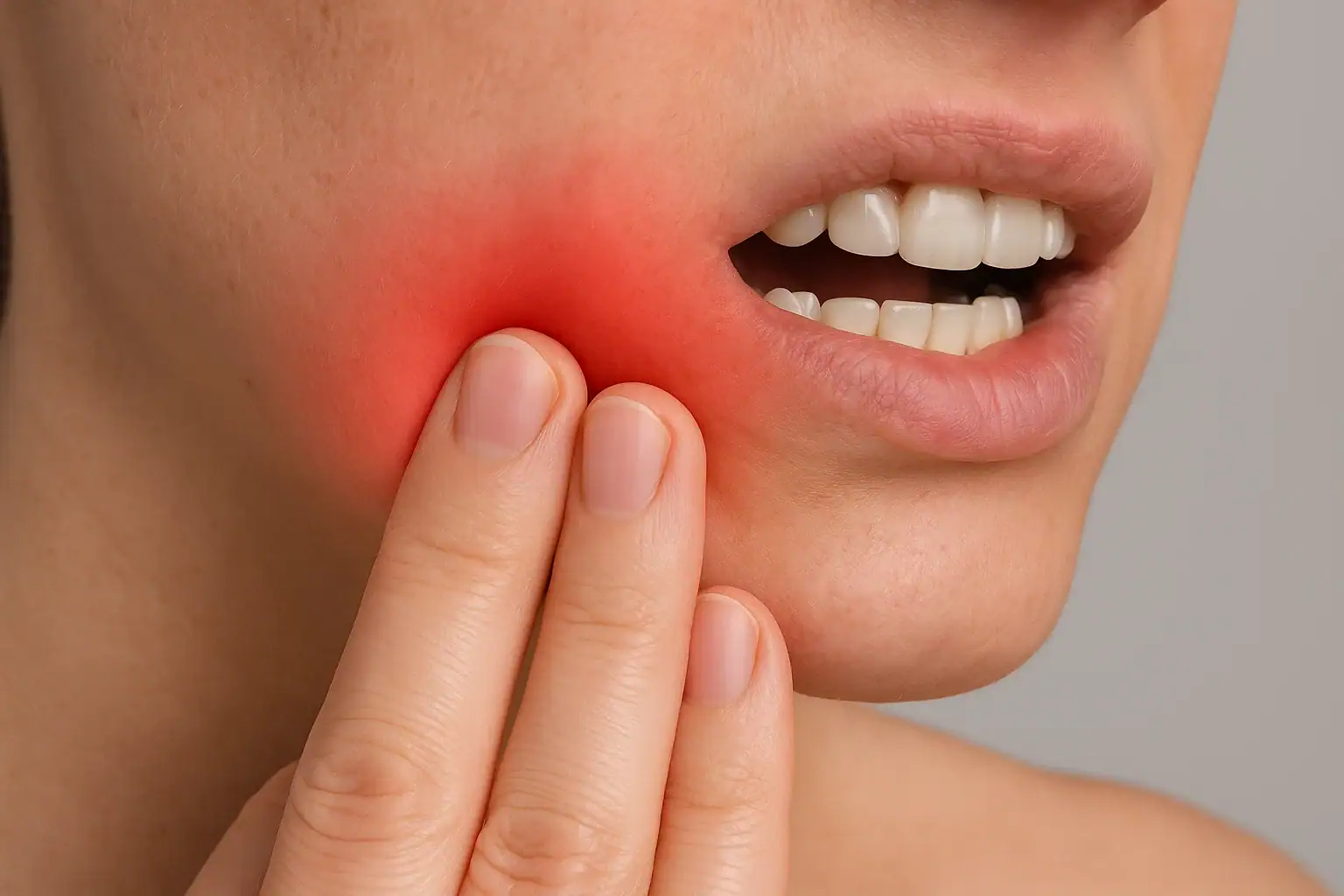
The usual signs of a tooth abscess are a throbbing toothache, pain when biting on the tooth or tapping it, swelling of the gum or the face, and sometimes a bad taste when pus drains into the mouth. A small swelling on the gum that comes and goes is a sign that the pus has found a way out. The pain may ease when it drains, but the infection inside the tooth is still there.
Clinical guidelines separate a localised abscess from one that is spreading. Spreading infection shows as cellulitis, lymph node involvement or diffuse swelling, and systemic involvement shows as fever or malaise; these are the situations in which antibiotics are recommended alongside dental treatment (PubMed 38712714). The same signs predict a slower recovery. In 688 patients with a dental abscess seen at an emergency dental unit in Trieste, fever, trismus (difficulty opening the mouth), involvement of several anatomical spaces and spontaneous drainage were all associated with a longer healing time (PubMed 23879656).
Anyone with facial swelling and a fever, or a swelling that is getting bigger, should be seen by a dentist the same day rather than waiting for a routine appointment. Swelling that spreads towards the eye or down the neck needs urgent medical care. If you are already in Istanbul, the emergency dentist page explains how to reach the clinic.
How a Dentist Treats a Tooth Abscess
Treatment of a tooth abscess removes the source of the infection. Clinical guidelines name the first-line options as local operative measures: incision and drainage of a swelling, root canal treatment of the infected tooth, or extraction (PubMed 38712714). An expert panel of the American Dental Association, which issued 5 clinical recommendations and 2 good practice statements on the subject, advised that immediate definitive dental treatment should be prioritised in all cases (PubMed 31668170).
Which of the three is used depends on whether the tooth can be saved. Root canal treatment cleans the infected canal system under local anaesthetic, gives the pus a way out through the tooth and then seals the canals. When the tooth is cracked below the gum, has lost too much structure to be restored or has advanced gum disease around it, extraction removes the tooth and the source together. A tooth that needs extraction but is left in place keeps the infection going.
When there is a soft, fluctuant swelling, the dentist may open it to let the pus drain on the same visit as the root canal work or the extraction. The relief that follows drainage comes from releasing pressure; the canal still has to be cleaned or the tooth removed, otherwise the abscess tends to return. A follow-up X-ray months later shows whether the bone around the root tip is healing.
Why Antibiotics Alone Do Not Cure a Tooth Abscess
Antibiotics do not drain pus or clean a dead pulp, so on their own they leave the source of a tooth abscess in place. The 2024 Cochrane review on this question included three trials with 134 participants and found no study that tested antibiotics without dental treatment for apical abscess in adults (PubMed 38712714).
When antibiotics were added to dental treatment, they made little or no difference. In one trial of 72 adults with symptomatic apical periodontitis whose canals were cleaned and filled under local anaesthetic, median pain on a 0 to 10 scale was 3.0 in both the antibiotic and placebo groups at 24 hours and 0 in both groups at 72 hours (PubMed 38712714). For a course of penicillin after canal cleaning in adults with a localised apical abscess, the evidence was very uncertain (PubMed 38712714).
The American Dental Association panel judged that for these conditions antibiotics may provide negligible benefits and probably contribute to large harms, and recommended them only when there is systemic involvement such as malaise or fever, or a high risk of it (PubMed 31668170). The harm is not only side effects for the patient; the Cochrane authors point to antibiotic resistance as the wider concern (PubMed 38712714).
That is why a dentist may drain and treat an abscess without prescribing anything, and why a course of tablets that eases the swelling for a few days does not replace the appointment. The same question for the gums is covered in our guide to antibiotics for gum infection.
Pain Relief While You Wait for Treatment
Painkillers can control the pain of a tooth abscess until the dentist treats it, but they do not treat the infection. An overview of five systematic reviews on acute dental pain found that non-steroidal anti-inflammatory drugs, with or without paracetamol (acetaminophen), offered the most favourable balance between benefits and harms (PubMed 29599019). In the same overview, combinations of ibuprofen and paracetamol had the highest proportion of adults reaching maximum pain relief, and combinations that included opioids were among those most often linked to acute adverse events (PubMed 29599019).
Which painkiller suits you, and how much of it, depends on your age, your health and the other medicines you take, so the choice is made with a pharmacist, a doctor or your dentist. Painkillers that bring the pain down can also hide the moment an abscess gets worse, so swelling, fever or difficulty opening the mouth still count as reasons to be seen quickly even when the pain is controlled.
Simple steps help while you wait: keep the area clean, avoid chewing on that side and do not try to burst a gum swelling yourself. Practical measures for the first hours of toothache are collected in our guide to fast toothache relief.
Keeping the Tooth After an Abscess
A tooth that has had an abscess can usually be kept if root canal treatment is possible and enough of the tooth remains to restore. A systematic review of 14 studies found that the pooled proportion of teeth surviving 2 to 10 years after root canal treatment ranged between 86% and 93% (PubMed 20158529). Four factors improved survival in that review: a crown placed after treatment, contact with teeth on both sides, the tooth not serving as an abutment for a bridge or a denture, and the tooth not being a molar (PubMed 20158529).
The state of the pulp before treatment matters less than many patients fear. A later systematic review and meta-analysis found no significant difference in tooth survival between teeth treated with a living pulp and teeth treated after the pulp had died; pulp status did make a significant difference to periapical healing when a lesion was already visible at the root tip on the X-ray (PubMed 36107038).
In practice this means the abscess itself is rarely the reason a tooth is lost. The deciding questions are whether the canal system can be cleaned and sealed, whether the tooth can take a crown afterwards and whether the gum and bone around it are healthy. When the answer to those is no, extraction followed by an implant or a bridge is the alternative, and that choice is made with an X-ray in front of you.
Let’s plan the right treatment together.
Free Assessment→- 1.Cope AL, Francis N, Wood F, Thompson W, Chestnutt IG. Systemic antibiotics for symptomatic apical periodontitis and acute apical abscess in adults. Cochrane Database Syst Rev 2024;5:CD010136. PubMed 38712714
- 2.Lockhart PB, Tampi MP, Abt E, Aminoshariae A, Durkin MJ, Fouad AF, et al. Evidence-based clinical practice guideline on antibiotic use for the urgent management of pulpal- and periapical-related dental pain and intraoral swelling: A report from the American Dental Association. J Am Dent Assoc 2019;150:906-921.e12. PubMed 31668170
- 3.Tibúrcio-Machado CS, Michelon C, Zanatta FB, Gomes MS, Marin JA, Bier CA. The global prevalence of apical periodontitis: a systematic review and meta-analysis. Int Endod J 2021;54:712-735. PubMed 33378579
- 4.Dommisch H, Hoedke D, Dourou M, Calciolari E, Herrera D, Toma S. Management of Periodontal Abscesses and Endodontic-Periodontal Lesions-A Systematic Review. J Clin Periodontol 2026. PubMed 42014572
- 5.Ottaviani G, Costantinides F, Perinetti G, Luzzati R, Contardo L, Visintini E, et al. Epidemiology and variables involved in dental abscess: survey of dental emergency unit in Trieste. Oral Dis 2014;20:499-504. PubMed 23879656
- 6.Moore PA, Ziegler KM, Lipman RD, Aminoshariae A, Carrasco-Labra A, Mariotti A. Benefits and harms associated with analgesic medications used in the management of acute dental pain: An overview of systematic reviews. J Am Dent Assoc 2018;149:256-265.e3. PubMed 29599019
- 7.Ng YL, Mann V, Gulabivala K. Tooth survival following non-surgical root canal treatment: a systematic review of the literature. Int Endod J 2010;43:171-89. PubMed 20158529
- 8.Rossi-Fedele G, Ng YL. Effectiveness of root canal treatment for vital pulps compared with necrotic pulps in the presence or absence of signs of periradicular pathosis: A systematic review and meta-analysis. Int Endod J 2023;56 Suppl 3:370-394. PubMed 36107038