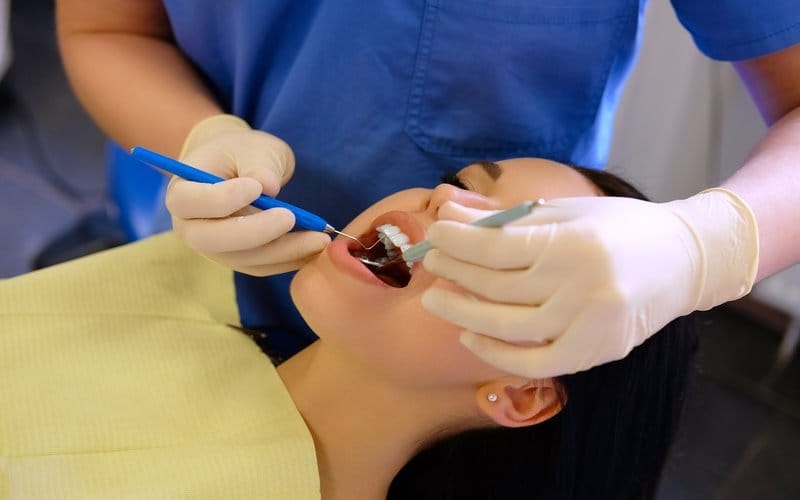
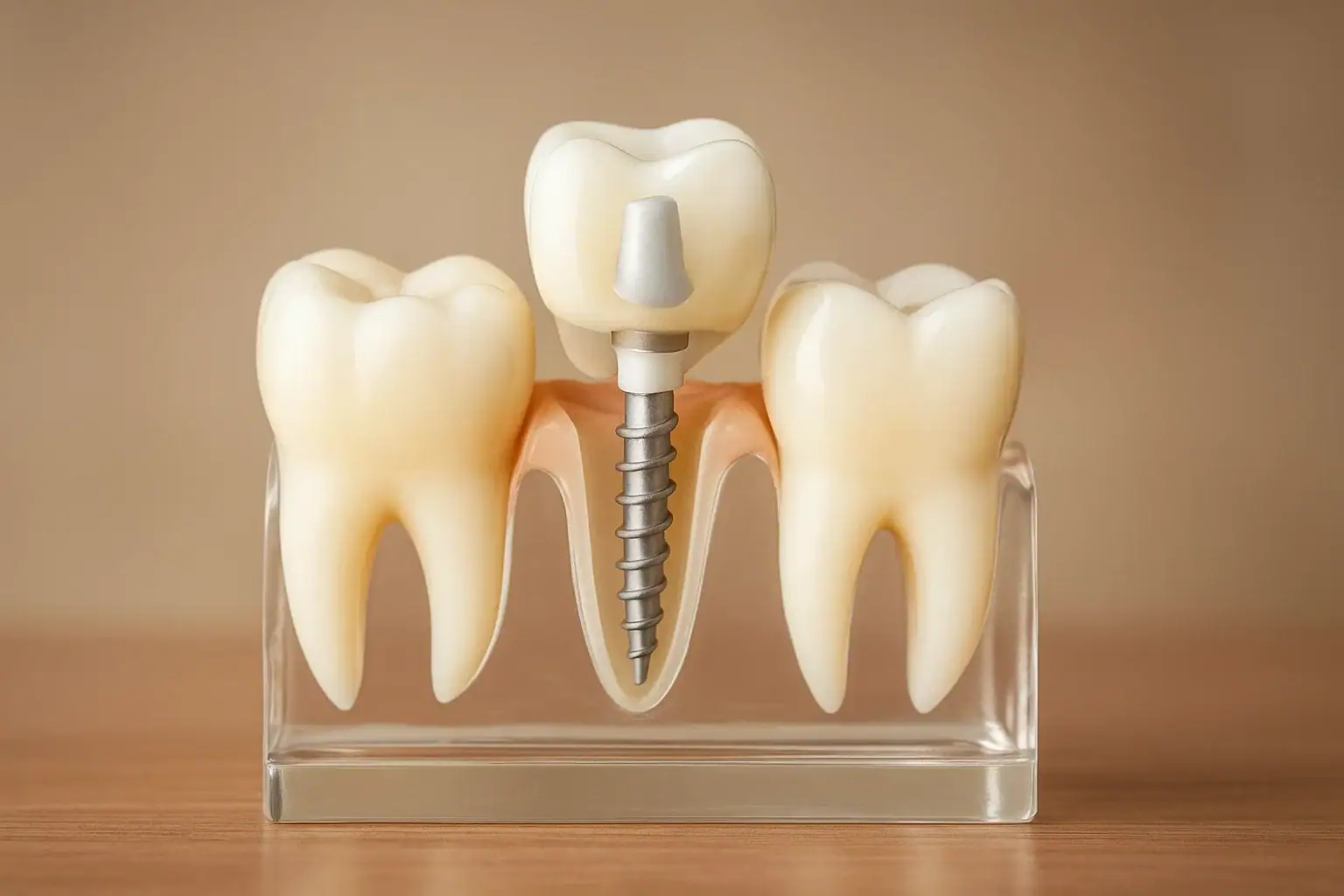
A dental post is a small rod cemented into the root canal of an endodontically treated tooth to retain a core build-up, which in turn supports a crown. It is indicated only when too little natural crown structure remains to hold the restoration on its own, not routinely after every root canal. Pooled data from seven randomised trials with at least two years of follow-up put survival of endodontically treated teeth at 92.8 percent with glass-fibre-reinforced posts and 78.1 percent with metal posts, a difference that did not reach statistical significance (PubMed 35430048).
- 01A post retains a core build-up; it adds retention rather than strength, so placing one where it is not needed only removes more dentine.
- 02Survival of endodontically treated teeth reached 92.8 percent with glass-fibre-reinforced posts and 78.1 percent with metal posts across seven randomised trials with at least two years of follow-up (PubMed 35430048).
- 03That difference was not statistically significant, so both post types remain defensible choices when a post is genuinely indicated.
- 04Fibre and ceramic posts avoid the grey shadow that a metal post casts through a translucent all-ceramic crown on a front tooth.
- 05A post is not placed when the root is too short, the fracture runs below the gum line, or there is significant bone loss and mobility.
Dental posts play a vital role in restorative dentistry, particularly when a tooth has undergone root canal treatment and requires additional structural support before placing a crown. In this comprehensive guide, we’ll explore what dental posts are, when they’re used, the different types available, and how they contribute to long-term oral health.
/ Dental Post Basics and Material Choices
What Is a Dental Post?
A dental post is a small, rod-like structure placed into the root canal of a tooth that has been treated endodontically (via root canal therapy). Its primary function is to anchor a core restoration, which then supports a dental crown.
When Are Dental Posts Used?
Dental posts are typically recommended when:
- There is insufficient natural tooth structure remaining to hold a crown.
- The tooth has been weakened by extensive decay or repeated procedures.
- A core buildup is required for added retention and stability.
Types of Dental Posts
There are two primary categories of dental posts:
Prefabricated Posts
- Made of metal or fiber-reinforced materials.
- Readily available in various sizes and shapes.
- Quick placement and cost-effective.
Custom-Cast Posts
- Designed to precisely fit the patient’s canal anatomy.
- Made from metal alloys and fabricated in a dental lab.
- Often chosen for teeth with unusual canal shapes or limited space.
Materials Used in Dental Posts
Dental posts come in a range of materials, each with specific advantages:
- Metal Posts : Often made from stainless steel, titanium, or gold; highly durable but less aesthetic.
- Fiber-Reinforced Composite Posts : Provide excellent aesthetics and are more flexible, reducing the risk of root fracture.
- Ceramic Posts : Biocompatible and tooth-colored, ideal for front teeth where appearance matters.
/ Dental Post Procedure and Clinical Considerations
Dental Post and Core Procedure
- Root canal treatment is completed.
- The canal is cleaned and shaped.
- A post is placed into the canal using dental cement.
- A core build-up material is applied around the post to mimic the original tooth structure.
- A crown is placed over the core to restore full function.
Immediate vs. Delayed Post Placement
- Immediate Post Placement : Done right after the root canal in the same session. Reduces overall treatment time.
- Delayed Post Placement : Done in a separate appointment to allow additional healing or when custom posts are needed.
The timing of post space preparation can affect the apical seal of the root canal filling. A 2021 systematic review comparing immediate and delayed post space preparation included 32 laboratory (in vitro) studies. In the three studies pooled in its meta-analysis, apical leakage was significantly greater after delayed preparation, with a mean difference of 0.41 mm between the groups (PubMed 33417064). The authors note that further studies are needed to establish how timing affects other outcomes.
The timing of post space preparation can affect the apical seal of the root canal filling. A 2021 systematic review comparing immediate and delayed post space preparation included 32 laboratory (in vitro) studies. In the three studies pooled in its meta-analysis, apical leakage was significantly greater after delayed preparation, with a mean difference of 0.41 mm between the groups (PubMed 33417064). The authors note that further studies are needed to establish how timing affects other outcomes.
Digital Technology in Post and Core Restorations
With the advent of digital dentistry:
- Intraoral scanning and CAD/CAM technology allow precise planning and manufacturing of custom posts and crowns.
- Improved fit reduces the likelihood of failure and enhances patient comfort.
Advantages and Disadvantages of Dental Posts
Advantages:
- Retains the core build-up in a tooth with little remaining structure.
- Provides a solid base for crowns.
- Preserves natural teeth instead of extracting them.
Disadvantages:
- May increase the risk of root fracture if not placed correctly.
- Post loosening over time in some cases.
- Metal posts may show through translucent crowns.
/ Dental Post Suitability and Ongoing Care
When Are Posts Not Recommended?
Dental posts may not be suitable if:
- The root is too short to securely hold a post.
- The tooth is fractured below the gumline.
- There is significant bone loss or mobility.
Is Dental Post Placement Painful?
Placing a dental post rarely causes pain, because it follows root canal therapy and the tooth nerve has already been removed. Mild discomfort or sensitivity may occur for a few days and can be managed with over-the-counter pain relievers.
Post vs. Implant: What’s the Difference?
- Dental Post : Used in a natural tooth that has undergone root canal therapy; maintains the natural root.
- Dental Implant : Used when the tooth and root are missing or unsalvageable; involves a titanium fixture placed into the jawbone.
Both serve as anchors for dental restorations, but their applications and procedures are entirely different.
Maintenance and Longevity
- Maintain excellent oral hygiene to reduce the risk of decay or reinfection.
- Avoid using the treated tooth for hard biting (like ice or nuts).
- Attend regular dental check-ups to monitor post and crown stability.
With proper care, dental posts can last many years, supporting crowns and improving function and aesthetics.
/ Patient Questions and Next Steps
FAQs
What is a dental post?
A support rod inserted into the root canal to hold a crown restoration.
Is a dental post always necessary after a root canal?
Not always. Posts are only used when there’s insufficient tooth structure to support a crown.
What are dental posts made of?
They can be metal, fiber-reinforced composite, or ceramic.
Can a dental post fail?
Yes, if not properly maintained or if placed in a structurally compromised tooth.
Are posts visible through the crown?
Metal posts might show through translucent crowns, but fiber or ceramic posts offer better aesthetics.
Dental posts play a critical role in preserving teeth that would otherwise be too damaged to support a restoration. By understanding their purpose, types, and care requirements, patients can make informed decisions alongside their dentist. If you’ve had root canal therapy and require a crown, consult your dental professional to see if a post and core restoration is right for you.
Ready to restore strength to your smile?
Explore your options with a trusted dental expert today!
Let’s plan the right treatment together.
Free Assessment→- 1.Tsintsadze N, Margvelashvili-Malament M, Natto ZS, Ferrari M. Comparing survival rates of endodontically treated teeth restored either with glass-fiber-reinforced or metal posts: A systematic review and meta-analyses. J Prosthet Dent 2024;131:567-578. PubMed 35430048
- 2.Dos Reis-Prado AH, Abreu LG, Tavares WLF, Peixoto IFDC, Viana ACD, de Oliveira EMC, et al. Comparison between immediate and delayed post space preparations: a systematic review and meta-analysis. Clin Oral Investig 2021;25:417-440. PubMed 33417064
- 3.Batista VES, Bitencourt SB, Bastos NA, Pellizzer EP, Goiato MC, Dos Santos DM. Influence of the ferrule effect on the failure of fiber-reinforced composite post-and-core restorations: A systematic review and meta-analysis. J Prosthet Dent 2020;123:239-245. PubMed 31227236