
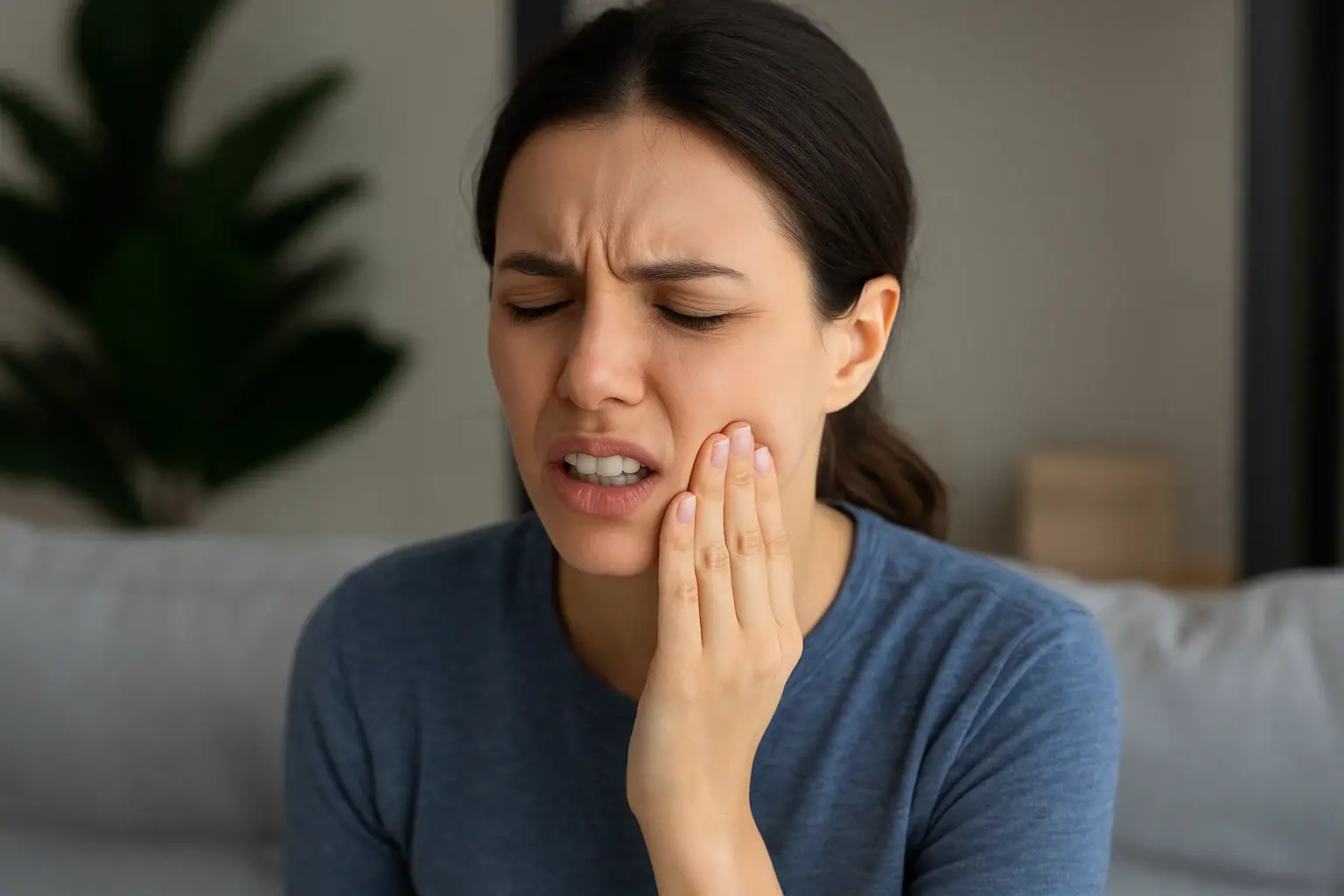
Toothache is a symptom rather than a diagnosis, and the pattern of the pain says where it comes from: enamel, dentin, pulp, gum and bone each produce a different signature, and the maxillary sinus can imitate all of them. A short zing to cold or sweets points to exposed dentin, whose pooled prevalence is 11.5% across 77 studies (PubMed 30639724); pain that lingers or starts on its own points to irreversible pulpitis. Desensitising toothpaste is a reasonable first step, though a Cochrane review found the effect of potassium nitrate toothpaste only at the 6 to 8 week follow-up and judged the evidence unclear (PubMed 16855970). Swelling, fever or difficulty swallowing bypass that trial entirely.
- 01The timing of the pain classifies it: pain that stops as soon as the cold is removed suggests reversible pulpitis, while lingering or spontaneous pain suggests irreversible pulpitis and needs root canal treatment or extraction.
- 02Dentin hypersensitivity, the classic short zing, has a pooled prevalence of 11.5% (95% CI 11.3-11.7) across 77 studies, with an average across all studies of 33.5% (PubMed 30639724).
- 03Sharp pain on releasing a bite rather than on closing is the signature of cracked tooth syndrome, and it frequently does not appear on a radiograph, which is why bite and transillumination tests are used.
- 04Bruxism explains much of generalised morning ache: global prevalence is 22.22%, sleep bruxism 21% and awake bruxism 23%, rising to 43% for sleep bruxism when measured by polysomnography (PubMed 39064299).
- 05Home triage has fixed limits: potassium nitrate toothpaste twice daily with any effect expected over weeks, no brushing for 30 minutes after acid exposure, and never aspirin placed on the tooth, which burns the soft tissue.
Where Tooth Pain Comes From
Tooth pain is a symptom, and the first step is to work out which structure is producing it. There are five usual sources: enamel worn thin, dentin exposed by recession or erosion, an inflamed pulp, the gums and bone around the tooth, and structures nearby such as the maxillary sinus and the jaw joint. Each produces a different kind of pain, which is why the pattern tells you more than the intensity.
Enamel, the hard outer shell, has no nerves of its own. When it thins, temperature and sugar reach the dentin beneath, which contains microscopic tubules filled with fluid. Cold, sweet or acidic stimuli move that fluid, and the movement triggers the nerve endings, producing a sharp, brief zing. The pulp at the centre holds the nerve and blood supply. When it becomes inflamed, a condition called pulpitis, the pain turns dull, throbbing and longer lasting. The periodontium, the gum and bone that hold the tooth in place, can also be the source; infection or inflammation there often feels like it is coming from the tooth itself.
Pain can also travel. Sinus pressure is felt in the upper back teeth even when those teeth are healthy, and tired jaw muscles can make several teeth ache at once, so a dental examination is the reliable way to narrow the cause down to one.
Reading the Pattern of the Pain
The timing of the pain is the most useful clue. Pain that appears with cold and stops as soon as the cold is removed suggests an irritated but healthy pulp, called reversible pulpitis. Pain that lingers after the stimulus is gone, or starts on its own without any trigger, suggests irreversible pulpitis, and that needs root canal treatment or extraction.
The trigger narrows things further. A short zing with cold drinks or sweets points toward exposed dentin, enamel wear, gum recession, an early cavity or sensitivity after whitening. Pain on chewing points toward a cracked tooth, a filling or crown sitting too high, a cavity, a gum abscess or sinus pressure on the upper molars. Pain in several teeth at once, arriving suddenly, usually has a cause outside the teeth, such as a sinus infection, night grinding, aggressive whitening or a recent brace adjustment. Pain that appears when you are ill tends to come from sinusitis, dehydration, mouth-breathing, stress clenching or reflux. Pain with sweets alone suggests early decay, a leaking filling or erosion.
Location adds the last piece. Pain you can point to with one finger usually comes from one tooth. Pain spread across one side of the upper jaw often involves the sinus, and ache across both jaws on waking often involves clenching.
Before the appointment, note which tooth hurts, what sets it off, how long each episode lasts and whether it wakes you at night. Dentists use these details to choose which tests to run.
Sensitivity to Cold and Sweets
A brief, sharp pain with cold air, cold water, sweets or touch is the classic signature of dentin hypersensitivity. It is common: a meta-analysis of 77 studies put its pooled prevalence at 11.5% (95% CI 11.3% to 11.7%), with an average across all studies of 33.5% (PubMed 30639724). Reported prevalence ranged from 1.3% to 92.1% depending on who was studied, and it was higher in younger adults and specialty practice patients (PubMed 30639724).
The causes all end in exposed dentin. Enamel erosion from acidic drinks, gum recession that uncovers the root, overbrushing with a hard brush, whitening and an acidic diet each remove some of the covering. Once dentin is exposed, the fluid in its tubules moves with each stimulus and the nerve responds.
Sweet sensitivity deserves separate attention. Sugar draws fluid through exposed tubules, but it also feeds the bacteria that produce acid, so pain with sweets is a classic early decay sign. The other explanations are dentin exposed by recession and gaps around old fillings that let sugar and acid seep in. If the pain is confined to one tooth, decay or a faulty restoration in that tooth is the likelier cause, and a desensitising toothpaste will not fix it.
Generalised sensitivity is usually managed with a desensitising toothpaste, a softer brush and a gentler technique, with high-fluoride varnish or a resin coating over exposed roots when that is not enough. Decay is treated with a filling, an onlay or a crown, or with root canal treatment when the pulp is involved.
Pain When Biting Down
Pain on chewing localises the problem, because pressure is applied to one tooth at a time. There are five common candidates.
Cracked tooth syndrome produces sharp pain that is often worse on releasing the bite than on closing, typically in molars with large fillings. Temperature sensitivity can accompany it. The crack frequently does not show on a radiograph, which is why dentists rely on bite tests and transillumination.
A high bite, where a recent filling or crown sits slightly too high, overloads the ligament around the root and makes the tooth tender. Adjusting the contact usually settles it.
Decay under a failing filling or crown hurts with pressure and with sweets, because the seal has opened and bacteria are working beneath the restoration.
A gum or periodontal abscess causes localised swelling, tenderness to biting and sometimes a bad taste. It needs drainage and cleaning of the pocket.
Sinus pressure can make the upper molars feel tall or bruised during a sinus infection, even though the teeth are healthy.
If the pain can be pinned to one tooth, avoid chewing on that side until it is examined, because continued pressure can extend a crack or worsen an infection. Treatment follows the cause. A cracked tooth is usually protected with a bonded onlay or a crown, root canal treatment is added if the crack has reached the pulp, and a crack running vertically down the root usually means extraction.
Sudden Pain in Several Teeth and Pain During Illness
When many teeth ache at once, the cause is usually outside the individual teeth. Sinus congestion or infection presses on the roots of the upper back teeth, and the ache is often worse when bending forward or lying down. Grinding and clenching overload the teeth and jaw muscles; teeth feel bruised, especially on waking. Bruxism is common: a systematic review put global prevalence at 22.22%, with sleep bruxism at 21% and awake bruxism at 23%, and sleep bruxism measured by polysomnography at 43% (PubMed 39064299).
Other widespread causes are peroxide whitening strips or gels and highly abrasive toothpastes, recent orthodontic aligner or brace changes, where tenderness for a few days is expected, and a sudden rise in acidic drinks such as sodas, energy drinks and citrus juices.
Illness changes the conditions in the mouth in several ways at once. Sinusitis, colds and flu refer pain to the upper teeth. Fever and mouth-breathing dry the mouth and remove the buffering that saliva provides. Antihistamines and decongestants dry it further. Illness-related stress intensifies clenching, and reflux or vomiting exposes enamel to stomach acid. Drinking enough water and rinsing with water after acidic exposure helps during the episode.
Widespread pain that lasts more than a couple of days or keeps getting worse should be examined, and with fever or facial swelling it needs same-day care.
Pulpitis, Gum Disease and Other Causes
Several causes of tooth pain are defined by the tissue they affect.
Pulpitis
Reversible pulpitis produces short pain with cold and is managed by removing the irritant, usually with a filling and desensitising measures. Irreversible pulpitis produces spontaneous or lingering pain and needs root canal treatment or extraction. Cold testing is the main way to tell the two apart.
Gum and bone disease
Gingivitis and periodontitis cause a dull ache, bleeding gums and bad breath, and sometimes an abscess. Treatment is professional cleaning below the gumline, better home care, and local antibiotics or drainage when an abscess forms.
Grinding and bite overload
Occlusal trauma and bruxism produce generalised ache, jaw fatigue, notching at the necks of the teeth and headaches. A night guard, adjustment of high contacts and evaluation of sleep and stress are the usual steps.
Acid erosion
Erosion from diet or reflux leaves smooth, cupped enamel and sensitivity, often on the front teeth. It is managed with diet changes, medical treatment of reflux, remineralisation and minimally invasive restorations.
Sensitivity after treatment
Fillings, whitening and cleanings can leave teeth sensitive for a period. This is usually transient and improves over days to weeks. Desensitisers and a bite check help, and sensitivity that persists is a reason to return.
What You Can Safely Try at Home
Home care has a real role for sensitivity and mild irritation, and fixed limits beyond that. The first step is a desensitising toothpaste used twice daily. The evidence supports this: a meta-analysis of 53 randomised trials with 4796 patients found that toothpastes containing potassium, stannous fluoride, arginine, calcium sodium phosphosilicate or nano-hydroxyapatite relieved the symptoms of dentin hypersensitivity (PubMed 29787782). An earlier Cochrane review of potassium toothpastes was more cautious, noting a significant effect in six studies at 6 to 8 weeks but judging the evidence limited because it rested on a small number of people (PubMed 16855970). A two to four week trial of a potassium nitrate and fluoride toothpaste is the usual starting point, and if the pain improves but returns when you stop, keep using it as your regular toothpaste.
Add a nightly fluoride rinse, avoid acidic drinks or use a straw, and do not brush for 30 minutes after acid exposure, because softened enamel wears more easily. If you clench, wear your night guard. A cold compress helps with swelling. If it is safe for you, a short course of ibuprofen can ease ligament inflammation, but check with your doctor or pharmacist if you have any condition that makes it unsuitable.
Two things should never be done. Do not place aspirin on the tooth or gum, because it burns the soft tissue. Do not start antibiotics without an examination, because they do not treat the cause of most tooth pain and can mask an infection that needs drainage.
How Dentists Find the Cause
Diagnosis combines several tests, because no single test sees everything. A visual examination and a probe detect decay, cracks and gum pockets. Percussion and bite tests press on individual teeth to localise ligament or crack pain. Thermal testing records how a tooth responds to cold; a short response that fades points toward reversible pulpitis, while a lingering one points toward irreversible pulpitis. Radiographs reveal decay between teeth, abscesses at the root tip, fractures and some sinus changes. Bite analysis with articulating paper finds high spots on fillings and crowns. When the symptoms point beyond the teeth, a medical or sinus evaluation is arranged.
Some problems only appear on specific tests. Cracked tooth syndrome often does not show on radiographs, but it reveals itself when the patient bites on a small instrument or when light is shone through the tooth. A tooth with a gum abscess may look normal on the surface while the probe finds a deep pocket.
The findings then lead to the treatments described in the sections above, from desensitising measures and bonding over exposed roots to scaling and root planing, replacement of failing restorations, root canal treatment, crowns and, for teeth that cannot be restored, extraction. Sinus pain is treated medically once the teeth are ruled out.
Signs That Need Same-Day Care
Tooth pain becomes urgent according to what accompanies it. Seek care immediately for facial swelling, spreading redness, fever or feeling generally unwell; for pain with difficulty swallowing or breathing; for trauma with loose or knocked-out teeth or bleeding that will not stop; and for severe, unrelenting pain that over-the-counter medication does not touch. These signs suggest a spreading infection or an injury that cannot wait for a routine appointment.
Other patterns need an appointment within days. These include pain that lingers after cold or starts on its own, pain on biting that you can pin to one tooth, sensitivity confined to one tooth, and widespread ache that has lasted more than a couple of days. Waiting allows a reversible problem, such as an irritated pulp or a small crack, to turn into one that needs root canal treatment or extraction.
Prevention reduces how often any of this happens: fluoride toothpaste twice a day, daily cleaning between the teeth, fewer acidic or sugary drinks, sugar-free gum after meals to stimulate saliva, a night guard if you grind and a sports mouthguard for contact activities. Check-ups every 6 months, or at the interval your dentist sets, find cracks, decay and gum problems before they become painful.
Let's plan the right treatment together.
Free Assessment→- 1.Favaro Zeola L, Soares PV, Cunha-Cruz J. Prevalence of dentin hypersensitivity: Systematic review and meta-analysis. J Dent 2019;81:1-6. PubMed 30639724
- 2.Zieliński G, Pająk A, Wójcicki M. Global Prevalence of Sleep Bruxism and Awake Bruxism in Pediatric and Adult Populations: A Systematic Review and Meta-Analysis. J Clin Med 2024;13. PubMed 39064299
- 3.Hu ML, Zheng G, Zhang YD, Yan X, Li XC, Lin H. Effect of desensitizing toothpastes on dentine hypersensitivity: A systematic review and meta-analysis. J Dent 2018;75:12-21. PubMed 29787782
- 4.Poulsen S, Errboe M, Lescay Mevil Y, Glenny AM. Potassium containing toothpastes for dentine hypersensitivity. Cochrane Database Syst Rev 2006;2006:CD001476. PubMed 16855970