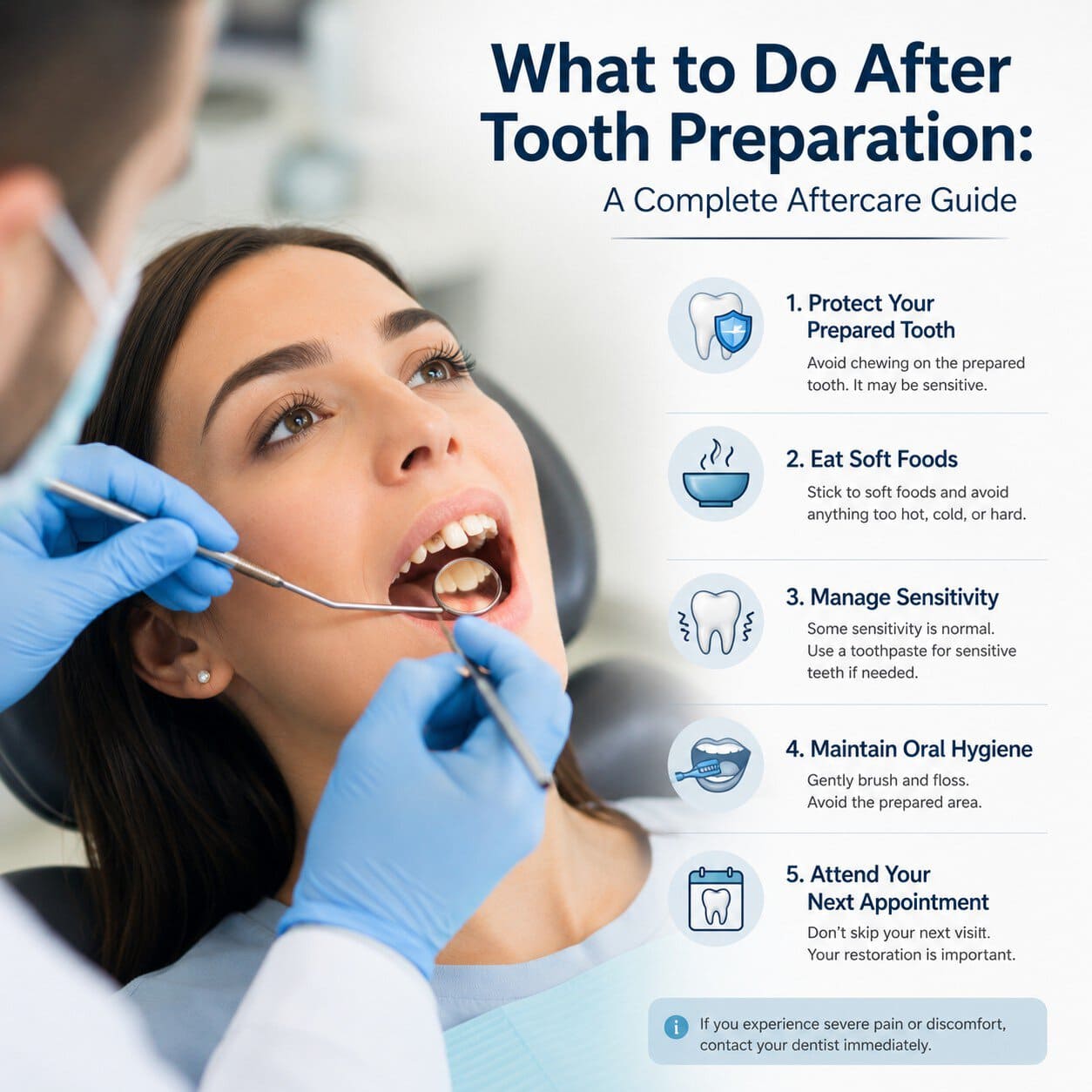
After tooth preparation, protect the trimmed tooth and its temporary crown or veneer for the one to two weeks until the permanent restoration is fitted: eat nothing for the first hour while the temporary cement sets, chew on the opposite side with soft food on day one, avoid hard and sticky foods, and draw floss out sideways rather than lifting it. Sensitivity to hot and cold usually peaks within 24 to 72 hours and settles over one to two weeks. Vital teeth prepared as crown or bridge abutments kept pulp vitality in 92% to 98% of cases over 5 to 20 years (PubMed 34516686). Sharp or worsening pain should be examined, not waited out.
- 01A temporary crown is not a formality: it keeps the prepared tooth from drifting and shields exposed dentine while the laboratory fabricates the permanent restoration, typically a one-to-two-week wait.
- 02Sensitivity peaks in the first 24 to 72 hours and normally improves over one to two weeks; sharp, throbbing or persistent pain is a reason to call the clinic rather than to wait it out.
- 03In a network meta-analysis of 32 trials with 4,638 participants, twice-daily dentifrices containing stannous, potassium (with or without stannous), or arginine reduced dentine hypersensitivity pain (PubMed 36753794).
- 04Vital teeth prepared as crown or bridge abutments kept pulp vitality in 92% to 98% of cases over follow-up periods of 5 to 20 years, pooled from 20 studies screened out of 10,075 records (PubMed 34516686).
- 05Around a temporary crown, floss is drawn out sideways rather than lifted, because lifting can pull the temporary off; on day one, nothing is eaten for at least the first hour while the temporary cement sets.
What Tooth Preparation Does to a Tooth
Tooth preparation, also called tooth trimming, shaving or reduction, is the step in which the dentist removes a thin layer of enamel so that a restoration can sit on the tooth without making it bulky. It comes before a crown, a porcelain veneer or a laminate veneer, and the amount removed depends on what will be fitted. A zirconium crown or a porcelain veneer needs more room than an ultra-thin laminate, and a prepless laminate needs almost none, because it is bonded onto the tooth as it is.
Whatever the restoration, the prepared tooth spends a waiting period between two appointments. The laboratory needs time to make the permanent crown or veneer, typically one to two weeks, and during that time the tooth wears a temporary. The temporary keeps the prepared tooth from drifting, covers the exposed dentine and lets you eat and speak normally.
The most common worry after this appointment is whether the tooth has been weakened for good. The long-term data on crowned teeth is reassuring. A systematic review of vital teeth prepared as crown or bridge abutments selected 20 studies out of 10,075 records and found clinical and radiographic success rates between 92% and 98% at follow-up periods from 5 to 20 years (PubMed 34516686). Put plainly, in most prepared teeth the nerve stays healthy for many years. The care you give the tooth in the first two weeks protects that outcome, because the temporary phase is when the tooth is most exposed to heat, cold and bacteria.
The First Hours After the Appointment
The first day decides much of how the waiting period goes, and most of the rules for it are about the temporary cement. That cement is designed to be removed later, so it holds less firmly than the permanent one and needs time to set. For at least the first hour after the appointment, eat nothing at all. Drinking water is fine; anything that needs chewing is not.
For the rest of that day, chew only on the opposite side of the mouth and keep to soft foods such as yoghurt, mashed potato, scrambled egg, soup and smoothies. Hard, crunchy or sticky foods can crack a temporary or lift it off its cement, and on the first day the cement is at its weakest. Very hot and very cold drinks should also wait while the anaesthetic is still wearing off, partly because the prepared tooth reacts to temperature and partly because a numb lip or cheek is easy to burn or bite without noticing.
Smoking is worth stopping for this day at least. It slows gum healing around the prepared margin and raises the chance of infection in tissue that has just been handled.
The gum around a prepared tooth may look slightly swollen or red and feel tender for 24 to 48 hours. This is a normal tissue response, especially if a retraction cord was placed to open the gum margin while the impression was taken. Warm salt water rinses ease it. Light bleeding in this window is expected; bleeding that is heavy or continues past two days should be reported to the clinic.
Sensitivity During the First Two Weeks
Some sensitivity after preparation is expected, and it follows a fairly predictable course. Once enamel is reduced, the dentine underneath sits closer to the pulp, so hot and cold reach the nerve more easily. Sensitivity usually peaks within 24 to 72 hours and then settles gradually over one to two weeks. Mild sensitivity that is fading day by day is part of normal healing.
A desensitising toothpaste helps during this period. A network meta-analysis of randomised trials, covering 32 studies and 4,638 participants, found that twice-daily dentifrices containing stannous, potassium with or without stannous, or arginine reduced dentine hypersensitivity pain (PubMed 36753794). These toothpastes work by blocking or calming the small tubules in dentine that carry temperature changes toward the nerve. They do their work over days of regular use, so it helps to start them on the day of preparation and keep using them until the permanent restoration is fitted.
Coffee and tea can stay in your routine with two adjustments. Let hot drinks cool to lukewarm before drinking, and avoid holding them against the prepared teeth for the first few days. Temporary materials also pick up colour more easily than the final ceramic, so heavy coffee, tea and red wine during the waiting period can stain the temporary. That stain does not carry over to the permanent restoration. Acidic drinks such as cola and citrus juice can irritate exposed dentine and are better kept to a minimum.
Sensitivity that grows over time, sharp or throbbing pain, or pain that wakes you at night is a different picture. It can point to irritation of the pulp or to a temporary that no longer seals the tooth, and it should be examined at the clinic without waiting for the next scheduled appointment.
Eating Around a Temporary Restoration
For the one to two weeks that the temporary is in place, food choice is the main thing that decides whether it stays on. Temporary crowns and veneers are made from softer materials than the permanent ones and held by a weaker cement, so they tolerate everyday chewing but not heavy or sticky loads.
The foods that cause trouble fall into a few groups. Hard foods such as nuts, ice, raw carrot and hard bread can crack a temporary or put enough pressure on it to break the cement seal. Sticky foods such as caramel, toffee and chewing gum grip the temporary and can pull it straight off when you open your mouth. Crunchy snacks such as crisps and crusty bread put sudden point loads on the temporary edge. Very hot or very cold food triggers sensitivity in the prepared tooth, and acidic drinks irritate exposed dentine. Alcohol can slow healing and may interact with pain medication, so keep it limited in the first days.
Plenty remains on the menu. Yoghurt, soft-cooked pasta, eggs, bananas, rice, fish and well-cooked vegetables are all easy on a temporary. Cutting food into small pieces and chewing on the side away from the prepared teeth reduces the load further, especially when several front teeth have been prepared.
If you grind or clench your teeth at night, tell your dentist before the temporaries are placed. Grinding can loosen or crack a temporary within a few nights, and a night guard may be suggested to protect the temporaries until the permanent restorations are fitted. Nail-biting, chewing pens and opening packages with your teeth put the same kind of load on a temporary and are worth avoiding in this period.
Cleaning Prepared Teeth and Gums
Cleaning continues through the temporary phase, with a gentler technique. Plaque left at the gum margin during the waiting period causes inflammation, and an inflamed margin can bleed and recede, which makes it harder to seat and seal the final restoration. The aim is to keep the gum around the prepared tooth healthy so that it is in the same condition on the fitting day as it was on the preparation day.
Brush twice a day with a soft-bristled brush and a non-abrasive toothpaste, and use slow, light strokes around the temporary. A desensitising toothpaste can do both jobs at once. An alcohol-free antibacterial mouthwash can be added as a gentle rinse, and warm salt water rinses soothe the gum in the first days.
Flossing between prepared teeth needs your dentist's approval, because the technique matters. Floss is slid in as usual but drawn out sideways, never lifted back up between the teeth. Lifting catches the edge of the temporary and is a common way for one to come loose at home. Whitening products are not used in this period. Temporary restorations do not respond to bleaching agents, and whitening gels can make prepared teeth more sensitive.
If you have had gum surgery or periodontal treatment alongside the preparation, your dentist will give separate instructions for the treated area, and those take priority over the general guidance here. The same applies to any area where stitches were placed.
Signs That Need a Call to the Clinic
Most of what happens after preparation settles on its own, but a few signs need a dentist and should not be managed at home. A temporary crown or veneer that falls off or feels loose is the most common one. Keep the temporary somewhere safe and contact the clinic as soon as it opens. Do not leave the prepared tooth uncovered for more than 24 hours, because an unprotected prepared tooth is exposed to bacteria and to temperature changes, and the neighbouring teeth can drift enough to change how the permanent crown seats. Do not glue it back yourself with household adhesive, which can damage the tooth and the temporary.
Pain is the second group. Severe pain, or pain that keeps worsening and does not respond to over-the-counter pain relief, needs examination. So does sensitivity that is still increasing after the first few days.
Swelling that spreads into the face or jaw, a persistent bad taste, pus at the gum line or a fever are signs of infection. Exposed dentine is vulnerable to bacteria, and an inflamed or infected pulp may need root canal treatment before the permanent restoration can be fitted. Caught early, this is manageable; left for weeks, it can complicate the whole plan.
A change in your bite is the last sign. If the teeth no longer meet the way they did, or one tooth hits first when you close, the temporary may have shifted or been made slightly high. You can reach the Mosdent team through the contact page or by phone. If the temporary comes loose or something feels wrong before the fitting appointment, it is simpler to call than to wait.
Care After the Permanent Restoration Is Fitted
Once the permanent crown or veneer is cemented, a second, shorter phase of aftercare begins. Your dentist will tell you how long to wait before eating while the permanent cement cures, and it is worth following that timing exactly. Some temperature sensitivity can persist for a short time after cementation, particularly in teeth that were prepared deeply, and it normally fades within a few weeks. If your bite feels different a few days after fitting, return to the clinic for an adjustment. A restoration that meets the opposite tooth too early takes more load than it was designed for and can chip or loosen over time.
From then on, the lifespan of a zirconium crown, an emax restoration or a laminate veneer depends largely on daily habits. Brush twice a day and clean between the teeth daily, paying attention to the margin where the restoration meets the gum, because that is where plaque collects and where decay or gum recession can start. Regular check-ups and professional cleaning let the dentist look at those margins before a small problem becomes a failed restoration.
The habits that break temporaries also shorten the life of permanent restorations. Nail-biting, opening packages with your teeth and chewing on pens place sudden loads on ceramic that it is not made for. If you grind your teeth, wearing your night guard every night protects both the restorations and the natural teeth against them. A chipped ceramic edge can sometimes be polished, but larger damage usually means remaking the restoration.
Preparing Several Teeth at Once
When several teeth are prepared in one session, as in a full smile makeover or a Hollywood smile, the same aftercare applies across a wider area, and some parts of it need more discipline. With a whole row of front teeth wearing temporaries, there is no untreated side to chew on, so the soft-food rule covers every meal until the permanent restorations are fitted. Cutting food small and avoiding biting into anything with the front teeth protects the temporaries at the front.
Speech may feel slightly different while temporaries are in place, especially on sounds made with the tongue against the upper front teeth. This is expected and resolves once the permanent restorations are fitted, which are shaped more precisely than temporaries. Some patients also notice that the temporaries feel bulkier than their own teeth, which is part of the same temporary phase.
Keep every follow-up appointment in this period. With multiple temporaries, the dentist checks that none has loosened, that the gum around each one is healthy and that the bite is even across all of them.
Patients who have travelled for treatment should make sure all aftercare instructions, including what to do if a temporary comes off, are clear before they leave the clinic. The waiting period is when a lost temporary or a sore tooth is most likely to happen, and knowing whom to contact and how quickly to act matters more when the clinic is in another country. Planning the return trip for the fitting appointment before the first visit ends avoids gaps in which prepared teeth are left without care.
Let’s plan the right treatment together.
Free Assessment→- 1.Kohli S, Bhatia S, Al-Haddad A, Pulikkotil SJ, Jamayet NB. Pulpal and Periapical Status of the Vital Teeth Used as Abutment for Fixed Prosthesis: A Systematic Review and Meta-Analysis. J Prosthodont. 2022;31(2):102-114. doi:10.1111/jopr.13433. PubMed 34516686
- 2.Pollard AJ, Khan I, Davies M, Claydon N, West NX. Comparative efficacy of self-administered dentifrices for the management of dentine hypersensitivity: A systematic review and network meta-analysis. J Dent. 2023;130:104433. doi:10.1016/j.jdent.2023.104433. PubMed 36753794