
Teeth Whitening
Teeth whitening in Istanbul: a single in-office session, or a custom tray protocol you continue at home. Both routes measure alike.
- Completed in a single in-office session
- At-home continuation with custom trays
- Under clinical supervision
- Existing fillings and crowns assessed first
First consultation free · same-day reply · no price pressure
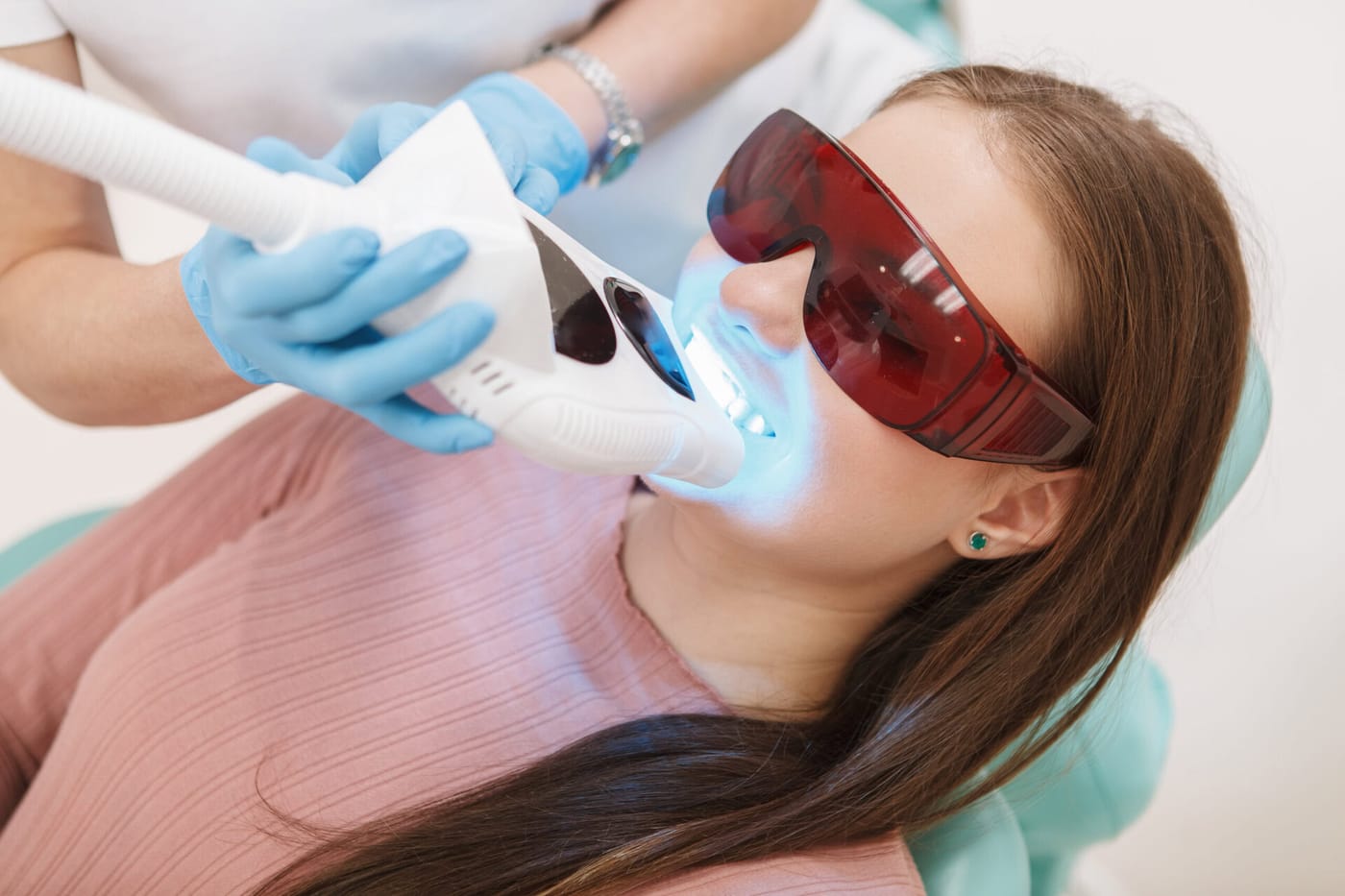
Teeth whitening lightens the natural shade of a tooth by chemically breaking down colour molecules with a hydrogen peroxide or carbamide peroxide gel, either in a single clinic appointment or at home in custom trays made from your impressions. An updated systematic review and meta-analysis comparing the two routes found no significant difference in shade guide colour change or in the risk of tooth sensitivity, with the certainty of evidence rated low (PubMed 40485133). Across 24 studies, most authors report the new shade holding for 1 to 2.5 years, with more relapse in severe discolouration (PubMed 37273018). Whitening acts only on natural tooth structure, which is why shade is settled before any veneer or crown work is quoted.
- 01In-office and at-home whitening produced no significant difference in shade guide units (SMD 0.04, 95% CI -0.17 to 0.25) or in the risk of tooth sensitivity (RR 0.82, 95% CI 0.61 to 1.10), while ΔE colour change favoured at-home treatment; the certainty of evidence was low (PubMed 40485133). For a patient travelling, that means a single clinic session plus trays to continue at home is a defensible plan rather than a compromise.
- 02Light and laser activation has no measured benefit. Pooling 21 randomised trials, activating the in-office gel with light changed neither colour outcome nor sensitivity, at high and low peroxide concentrations alike (PubMed 29289725). A quote that charges separately for laser activation is charging for something the evidence does not support.
- 03Lower gel concentration lowers sensitivity without costing shade. Low and medium concentration hydrogen peroxide carried on average 33% lower risk of bleaching sensitivity than high concentration gel (RR 0.67, 95% CI 0.51 to 0.86), with no clinically relevant difference in colour change (PubMed 33068711, 25 studies).
- 04The result is stable for roughly 1 to 2.5 years in most reports, and relapse is more frequent where the original discolouration was severe (PubMed 37273018, 24 studies). Plan a top-up with your take-home trays inside that window rather than a second flight.
- 05Resin composite restorations do change colour measurably after bleaching, but a meta-analysis of 23 in vitro studies judged the change to be not clinically significant (PubMed 35029690). Existing fillings, crowns and veneers therefore keep their shade in practice, so whitening comes first and the restorations are matched to the new shade afterwards.
/ Teeth whitening and tooth yellowing
Whitening is a process that chemically breaks down the colour molecules lodged in the hard tissue of a tooth. The gels are usually based on hydrogen peroxide, or on its slower-releasing form, carbamide peroxide. These agents pass into the microscopic pores of the enamel and lift the stains that build up over the years.
One distinction matters: whitening does not strip, grind or thin the tooth. Its structure is preserved; only the shade is lightened. That is why, when done with a dentist, it produces a visible result without harming enamel health.
Discolouration has two main sources. The first is surface staining: coffee, black tea, red wine, dark spices and tobacco gradually leave a coloured film on the enamel. These extrinsic stains respond best to whitening.
The second comes from within the tooth. As we age the enamel naturally thins and the yellowish dentin beneath shows through more. Certain antibiotics taken in childhood, excess fluoride or an old trauma can also colour a tooth from the inside. These cases call for a little patience and a tailored plan.
| At a glance | |
|---|---|
| Duration | 1-2 days |
| Sessions | 1 |
| Warranty | 12 months |
| Materials Used | Clinical whitening system |
/ How whitening is performed, continued at home and maintained
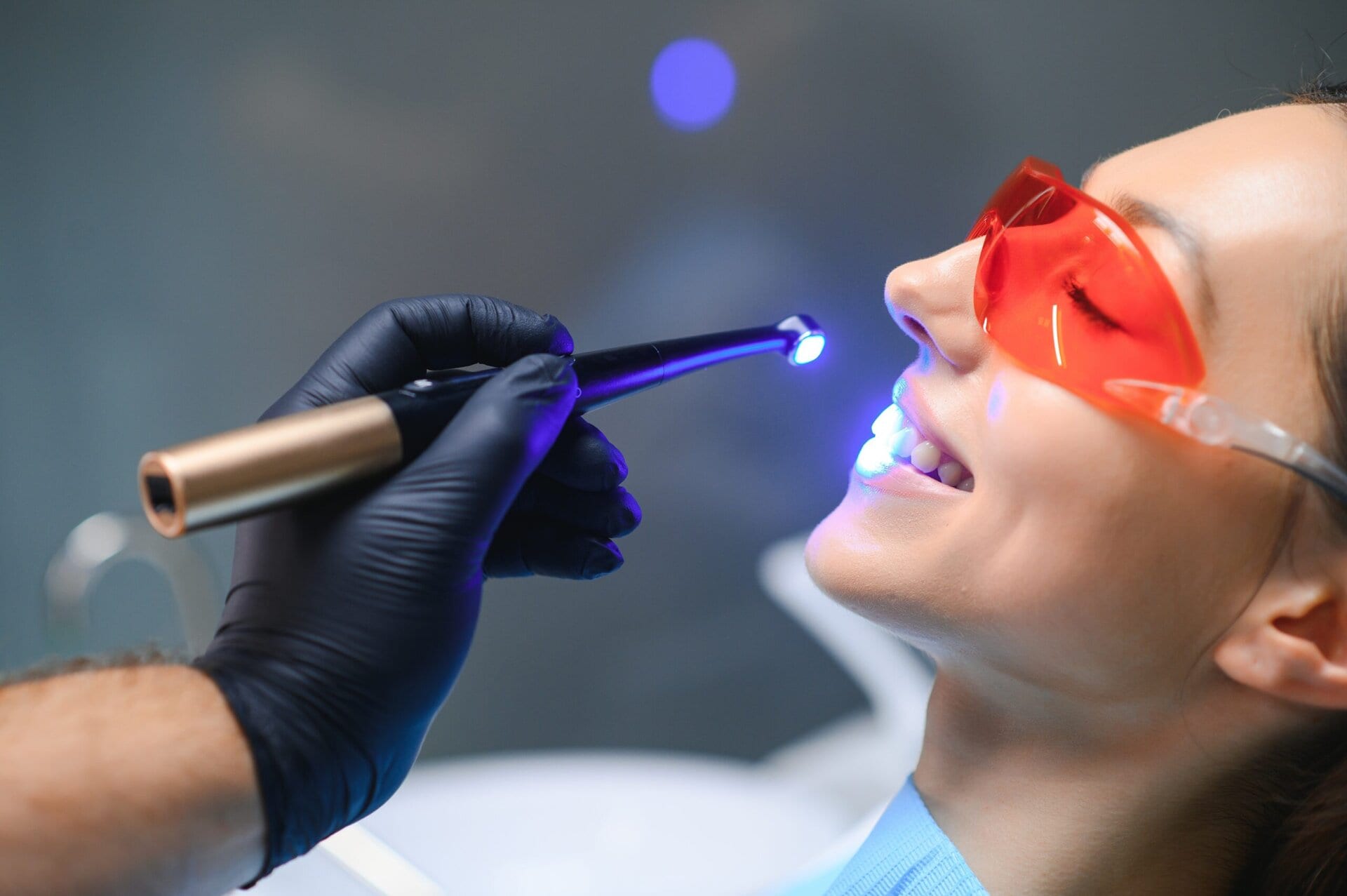
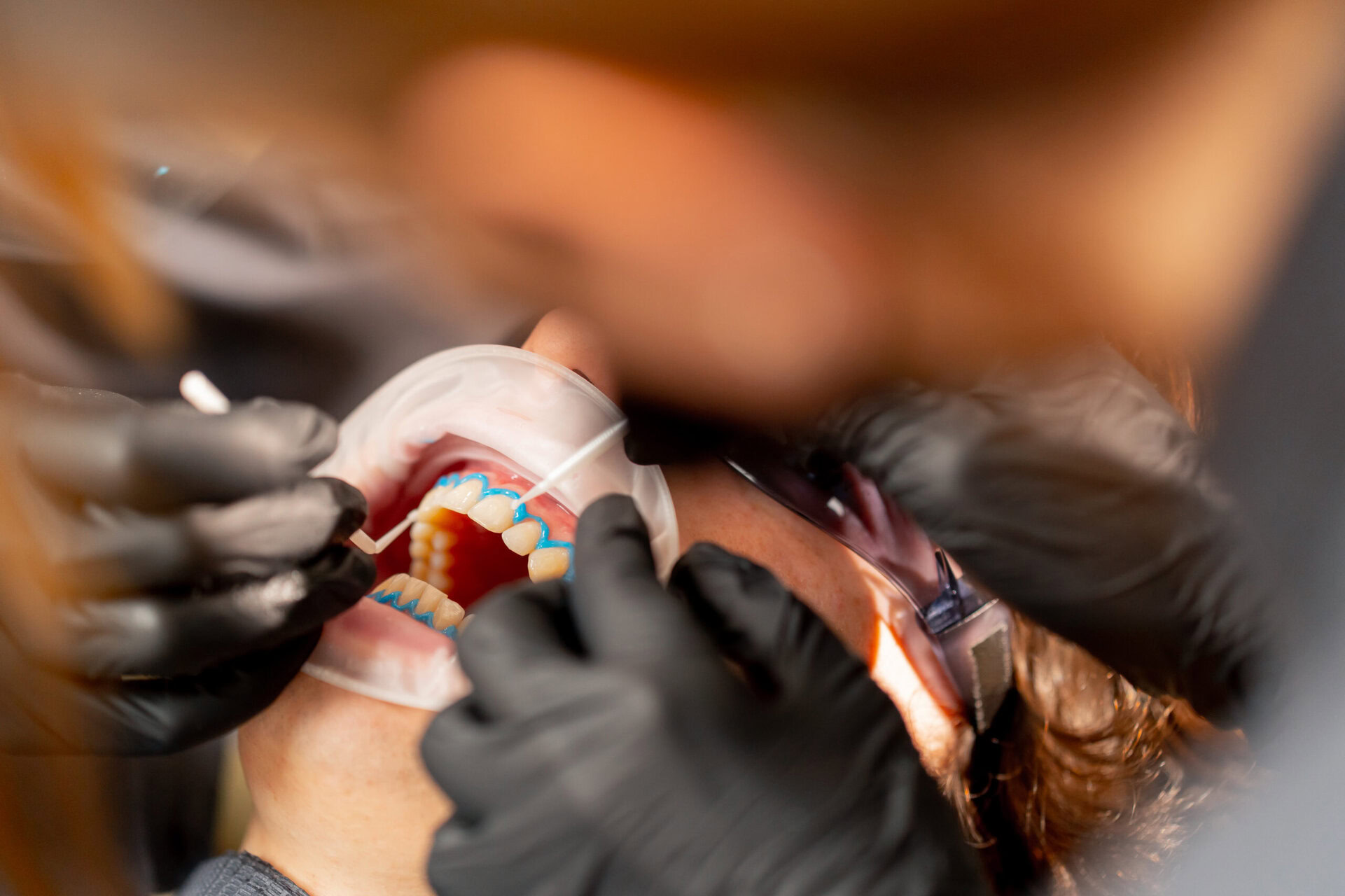
In-office whitening gives the fastest result because it is done under supervision with high-efficacy gels. First the gums are covered with a thin protective barrier so the gel only touches the tooth. The whitening gel is then applied, and in some systems a special light or laser speeds up its action.
A single session usually lasts thirty to sixty minutes. Most people see a clear lift after the very first visit. Depending on the degree of staining, your dentist may suggest one or several sessions.
For at-home whitening an impression of your teeth is taken and a thin, clear custom tray is made. You place a low-concentration gel in the tray and use it at home for a period your dentist sets. The result arrives more gradually than in-office whitening but looks very natural.
Why is a custom tray better than off-the-shelf strips? Because it fits your teeth exactly, keeps the gel off the gums and holds the dose under control. That means a more even brightness and less sensitivity.
The longevity of whitening cannot be fixed to a single number because it depends directly on your habits. In someone who loves coffee, tea and cigarettes the result fades faster, while it holds far longer in someone who avoids them. In general the effect ranges from a few months to a few years.
The good news is that whitening is not a one-time event but a maintainable one. When the shade drifts over time, a short top-up session or a few days of home use easily refreshes your smile.
Treatment Process
- 01Preparation: Gum protection and mineralisation.
- 02Application: Clinical whitening gel and activation.
- 03Aftercare: Post-treatment maintenance protocol.
/ Whitening safety, suitability and aftercare
After whitening some people feel a temporary sensitivity to cold. This comes from the gel leaving the enamel pores more permeable for a while, and it usually settles on its own within a few days. Gels containing potassium nitrate or fluoride noticeably reduce this sensitivity.
Whitening done under a dentist does not damage enamel. What is risky are internet products of unknown strength or uncontrolled application. Applied at the right dose, for the right time and with the gums protected, whitening is a safe procedure.
Whitening is not right for every mouth at every time. It is postponed during pregnancy and breastfeeding. In people under eighteen it is usually not advised because tooth development is not complete. If there is active decay or gum inflammation, those problems are treated first.
One point is especially important: fillings, crowns and porcelain do not whiten. If you have such restorations in the front, a colour mismatch with the natural teeth may appear after whitening. In that case your dentist will explain the right sequence and plan for you.
The first forty-eight hours after the procedure are the most critical, because the enamel pores stay open a little longer and are sensitive to coloured foods. Staying away from coffee, tea, red wine, dark drinks, staining sauces and tobacco during this window meaningfully extends the result.
In the long run the formula is simple. Brushing twice a day, cleaning between the teeth and a check-up every six months are the most reliable way to protect what whitening gave you.
- 1.de Geus JL, Martins A, Reis A, Rezende M. At-home vs In-office Bleaching: An Updated Systematic Review and Meta-analysis. Oper Dent 2025;50:E47-E69. PubMed 40485133
- 2.Maran BM, Burey A, de Paris Matos T, Loguercio AD, Reis A. In-office dental bleaching with light vs. without light: A systematic review and meta-analysis. J Dent 2018;70:1-13. PubMed 29289725
- 3.Maran BM, Matos TP, de Castro ADS, Vochikovski L, Amadori AL, Loguercio AD, et al. In-office bleaching with low/medium vs. high concentrate hydrogen peroxide: A systematic review and meta-analysis. J Dent 2020;103:103499. PubMed 33068711
- 4.Fioresta R, Melo M, Forner L, Sanz JL. Prognosis in home dental bleaching: a systematic review. Clin Oral Investig 2023;27:3347-3361. PubMed 37273018
- 5.Vidal ML, Pecho OE, Collares K, Brandeburski S, Bona AD. Color Change of Resin-based Composites After In Vitro Bleaching Protocols: A Systematic Review and Meta-analysis. Oper Dent 2022;47:149-162. PubMed 35029690
Who is this treatment for?
- Surface discolouration caused by coffee, tea and red wine
- Age-related darkening
- Staining that cannot be removed by scaling and polishing
- Tooth staining that persists despite regular brushing
- A naturally more yellowish tooth colour
- Discolouration in a single tooth after trauma or root canal treatment
- Severe discolouration problem
Doctors specialising in this treatment

Frequently asked
01How long do whitening results last?+
A systematic review of 24 studies reported that most authors found the shade stable for 1 to 2.5 years, with relapse more frequent in heavily discoloured teeth (PubMed 37273018). Limiting coffee, tea and red wine and having an annual review help keep the result at the upper end of that range.
02Is laser teeth whitening more effective than whitening without light?+
No measurable advantage has been demonstrated. A meta-analysis pooling 21 randomised trials found that in-office bleaching activated with light or laser changed neither the colour outcome nor the risk of sensitivity compared with the same gel used without light, and the finding held at both low and high peroxide concentrations (PubMed 29289725). What determines the result is the gel and its contact time, not the light source.
03Is in-office or at-home whitening better?+
They perform alike. In an updated 2025 systematic review and meta-analysis, shade-guide lightening showed no significant difference between the two (SMD 0.04, 95% CI -0.17 to 0.25) and neither did the risk of sensitivity (RR 0.82, 95% CI 0.61-1.10), with colour change measured by ΔE slightly favouring the at-home route and certainty rated low (PubMed 40485133). The choice is therefore about schedule, not about outcome.
04Does a higher-concentration gel whiten more?+
It raises sensitivity rather than the result. Across 25 studies, low and medium concentration hydrogen peroxide carried on average 33% lower risk of bleaching sensitivity than high concentration gel (RR 0.67, 95% CI 0.51-0.86), while no clinically meaningful difference in shade change was detected (PubMed 33068711).
05Can whitening be applied to crowns or veneers?+
No. Whitening acts only on natural tooth structure; porcelain, zirconium or composite restorations will not change colour. Discuss any existing restorations with your dentist before treatment.
Aesthetic Dentistry
Smile Design
Smile design is a planning process: facial proportions, lip line and gum contour are analysed digitally before treatment, and the approved design guides it.
Explore→02Hollywood Smile
Hollywood Smile is a treatment package in which ten to twenty teeth in the smile line are planned by digital smile design and refaced with veneers or crowns.
Explore→Speak with your doctor about this treatment.
Not sure which treatment fits? Tell us what’s wrong →