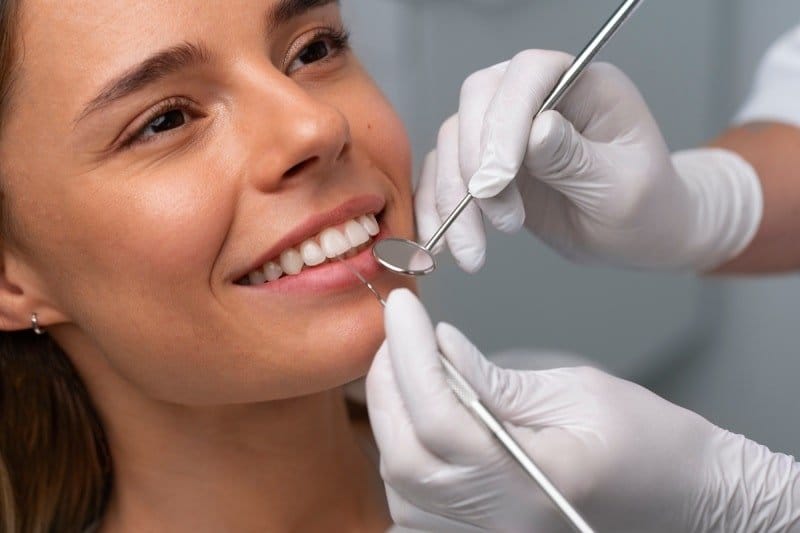

A tooth fracture is a crack or break in the enamel, dentine or deeper layers caused by trauma, pressure or structural weakness, and it ranges from a painless enamel craze line to a vertical root fracture that can split the tooth in two. Treatment follows the depth: composite filling for superficial enamel cracks, a porcelain or zirconia crown when a large piece is lost, root canal treatment when the fracture reaches the pulp, and extraction when the tooth is split. Traumatic dental injuries affect 15.2% of people in the permanent dentition worldwide (PubMed 29455471).
- 01Fracture types run from a painless enamel craze line, through a fractured cusp and a vertical crack, to a split tooth or vertical root fracture that usually ends in extraction.
- 02Traumatic dental injuries are common: pooled prevalence is 15.2% in the permanent dentition (102 studies, 268,755 individuals) and 22.7% in the primary dentition (PubMed 29455471).
- 03Diagnosis needs more than looking: clinical examination with light and magnification, radiographs for deep or root fractures, transillumination for internal cracks, and a percussion test for sensitivity.
- 04Mouthguards measurably reduce risk: dento-alveolar trauma occurred in 7.75% of mouthguard users versus 48.31% of non-users across eight studies of contact sport athletes (odds ratio 0.18) (PubMed 30222244).
- 05Healing times differ by treatment: sensitivity after a filling lasts a few days, pain after root canal treatment settles within 3 to 5 days, a crown takes a few weeks to feel settled, and surgery 1 to 2 weeks.
/ Tooth Fractures and Their Causes
Beware of the Cracks in Your Smile!
Tooth fractures can occur unexpectedly at different times in life. Sports accidents, biting hard objects, traumas, and even grinding teeth at night can cause cracks or fractures in the structure of the tooth. A tooth fracture may not always be visible, but if not detected and treated in time, it can cause serious consequences such as decay, inflammation, and tooth loss. Sport deserves a special mention: sports account for 10% to 42% of facial fractures, including fractures of the jaw, and a meta-analysis of 26 studies found the risk of orofacial injury 2.33 times higher in athletes who did not wear a mouthguard. Sport deserves a special mention: sports account for 10% to 42% of facial fractures, including fractures of the jaw, and a meta-analysis of 26 studies found the risk of orofacial injury 2.33 times higher in athletes who did not wear a mouthguard.
What is a Tooth Fracture?
A tooth fracture is the cracking or complete breakage of the enamel, dentin or deeper layers of the tooth as a result of trauma, pressure or structural weakness. It can occur in different forms, from slight cracks to serious root fractures. The size and depth of the fracture directly affects the treatment process.
What Causes Tooth Fractures?
Tooth fractures can develop due to many different reasons. The most common reasons are:
- Biting hard objects (ice, hard candy, etc.)
- Traffic accidents or physical trauma
- Sports accidents
- Teeth grinding (bruxism)
- Weakened tooth structure under previous large fillings
- Not having protective restorations after root canal treatment
- Weakening of enamel tissue with age
/ What are the Types of Tooth Fractures?
Enamel Crack (Craze Line)
Usually does not cause pain, only an aesthetic problem. These are superficial cracks that occur in the enamel layer.
Fractured Tooth (Fractured Cusp)
A part of the chewing surface of the tooth has broken. It is usually seen in teeth that have been filled.
Vertical Crack of the Tooth
The crack may have progressed to the root of the tooth. It usually causes pain during chewing.
Split Tooth
A serious condition in which the crack separates the tooth into two pieces. Tooth extraction is usually required.
Vertical Root Fracture
These are cracks that develop upwards from the inside of the tooth root. It can progress without giving any symptoms and cause infection.
What are the symptoms of a broken tooth?
Not every tooth fracture is noticed right away. However, if you have the following symptoms, you may have a crack or fracture in your tooth:
- Sensitivity to hot and cold
- Sudden, sharp pain when chewing
- Discomfort when pressure is applied to the tooth
- Swelling or inflammation in the gums
- Catching the tongue on sharp edges
- Sudden bleeding in the mouth (if the fracture was caused by trauma)
How is a Broken Tooth Diagnosed?
A tooth fracture can sometimes be seen with the naked eye, and sometimes it is diagnosed with x-rays or special tests:
- Clinical examination: The doctor examines whether there is a crack with a special light and magnifying glass.
- Dental film (radiography): Required for deep cracks or root fractures.
- Transillumination: Used to check whether the internal structure of the tooth is cracked with light.
- Percussion test: Sensitivity is assessed by gently tapping the tooth.
/ Broken Tooth Treatment Methods and Materials
How is Broken Tooth Treated?
The treatment plan varies according to the type, size and location of the fracture. Here are the common treatment methods:
Aesthetic Filling in Small Cracks
If there is only a superficial fracture in the enamel layer, repair can be done with a composite aesthetic filling. This process, which is carried out with color-matched materials, provides successful results both functionally and aesthetically.
Coating (Crown) in Large Piece Fractures
If a significant portion of the tooth has been lost, the tooth is protected by covering it with porcelain or zirconia coatings. In this way, both aesthetics and durability are ensured.
Fractures Requiring Root Canal Treatment
If the fracture has reached the nerve tissue (pulp) of the tooth, root canal treatment should be performed to prevent pain and inflammation. Then, a filling or crown is applied to the tooth.
Extraction in Cases Where the Tooth Splits in Two
If the tooth crack has progressed enough to split the tooth in two, unfortunately the tooth may not be saved. In this case, the tooth is extracted and prosthetic solutions such as implants or bridges are considered to prevent the space from remaining empty.
Apical Surgery for Root Fractures
Sometimes root tip cracks cannot be fixed with root canal treatment. In such cases, surgical intervention (apical resection) may be required for the root tip of the tooth.
Materials Used in Broken Tooth Treatment
Composite Fillings: Provides aesthetic and fast solutions.
Porcelain and Zirconia Coatings: Provides high durability.
Glass ionomer filling: Especially suitable for temporary solutions.
Fiber post: Used as sub-crown support after root canal treatment.
/ Broken Tooth Emergencies and Recovery Process
Is a Broken Tooth an Emergency?
Tooth fractures, especially if they are close to the nerve or due to trauma, may require emergency intervention. In cases such as bleeding in the tooth, severe pain, or a completely dislodged tooth, a dentist should be consulted without delay.
Things to consider during first aid:
If there is a piece that has fallen out as a result of a broken tooth, it should be stored in a clean container.
The mouth should be rinsed with warm water, and the tooth should not be directly treated.
If there is pain, painkillers can be taken, but aspirin should be avoided.
If there is bleeding, pressure should be applied with gauze.
What is the Recovery Process After Broken Tooth Treatment?
The healing process after treatment varies depending on the method used:
- Mild sensitivity after filling may last a few days.
- Pain after root canal treatment decreases within 3–5 days.
- It may take a few weeks for the tooth to fully settle after the crown procedure.
- If a surgical procedure is performed, healing may take 1–2 weeks.
During the healing process, it is important to eat soft foods, change the chewing side and have regular doctor check-ups.
Precautions to Prevent Broken Teeth
- Using a mouth guard when doing sports
- Not breaking foods such as ice, hard candy and nuts with your teeth
- Using a night guard if you have a teeth grinding problem
- Paying attention to oral hygiene, preventing cavities
- Having regular checks on teeth that have previously undergone root canal treatment
- Getting restorative support if there is excessive wear on the teeth
/ Frequently Asked Questions About Broken Teeth
Does a broken tooth heal on its own?
No. A tooth is a hard tissue and cannot repair itself when broken. A dentist's intervention is absolutely necessary.
If a broken tooth does not cause pain, should it be treated?
Yes. Even if it does not cause pain, the accumulation of bacteria in the broken area increases and serious decay or infection may develop over time.
How long does it take to treat a broken tooth?
It varies depending on the method applied. Composite filling can be completed in a single session, while crown and root canal treatment can be completed in 2-3 sessions.
Can an implant be placed on a broken tooth?
If the tooth has been extracted and there is a suitable bone structure, implant treatment can be preferred.
Broken Tooth Is a Problem That Should Not Be Postponed
Tooth fractures can negatively affect the quality of life both aesthetically and functionally. These problems can be easily solved with early diagnosis and correct treatment methods. Neglecting a tooth fracture can lead to more serious problems, even tooth loss. Therefore, if there is sudden discomfort, sensitivity or a noticeable fracture in the mouth, a dentist should definitely be consulted.
Let’s plan the right treatment together.
Free Assessment→- 1.Petti S, Glendor U, Andersson L. World traumatic dental injury prevalence and incidence, a meta-analysis: one billion living people have had traumatic dental injuries. Dent Traumatol. 2018;34(2):71-86. PMID 29455471
- 2.Fernandes LM, Neto JCL, Lima TFR, et al. The use of mouthguards and prevalence of dento-alveolar trauma among athletes: a systematic review and meta-analysis. Dent Traumatol. 2019;35(1):54-72. PMID 30222244
- 3.Viozzi CF. Maxillofacial and Mandibular Fractures in Sports. Clin Sports Med. 2017;36(2):355-368.
- 4.Knapik JJ, Hoedebecke BL, Rogers GG, Sharp MA, Marshall SW. Effectiveness of Mouthguards for the Prevention of Orofacial Injuries and Concussions in Sports: Systematic Review and Meta-Analysis. Sports Med. 2019;49(8):1217-1232.
- 5.Donnelly A, Foschi F, McCabe P, Duncan HF. Pulpotomy for treatment of complicated crown fractures in permanent teeth: A systematic review. Int Endod J 2022;55:290-311. PubMed 35076954