A decayed tooth can smell, and the smell goes once the source is removed: the decay is cleaned out and the tooth filled, the root canal treated if the nerve has died, or the tooth extracted if it cannot be saved. The odour is made by bacteria living in the cavity, in food packed into it and in dead pulp tissue, which release volatile sulphur compounds such as hydrogen sulphide and methyl mercaptan (PubMed 30927516). Roughly 80-90% of bad breath starts in the mouth, and deep cavities, exposed dead pulps, trapped food and imperfect fillings are all on the list of causes (PubMed 17555859). Mouthwash and toothpaste only play a supporting role.
- 01In roughly 80-90% of cases bad breath comes from the mouth itself, and the recognised causes include deep cavities, exposed dead pulps, trapped food and imperfect fillings (PubMed 17555859).
- 02The main odour gases are volatile sulphur compounds such as hydrogen sulphide and methyl mercaptan, produced mostly by gram-negative anaerobic bacteria breaking down sulphur-containing amino acids (PubMed 30927516).
- 03Among Iranian secondary school students aged 14 to 18, having 4 or more decayed, missing or filled teeth was the factor most strongly linked to bad breath on a smell test (odds ratio 2.253) (PubMed 31695509).
- 04A root canal only becomes infected once the pulp has died or been removed, and obligate anaerobes dominate the bacteria in teeth with a first infection (PubMed 34958494).
- 05Between 86% and 93% of teeth were still in place 2 to 10 years after root canal treatment, and a crown fitted afterwards headed the list of factors that improved survival (PubMed 20158529).
Why a Decayed Tooth Smells
A decayed tooth smells because bacteria multiply in the cavity and in the food that gets packed into it, and they give off foul-smelling gases as they feed. Bad breath in general comes from microbes breaking down organic material in the mouth, and a review of its causes lists deep cavities, exposed dead pulps, trapped food and imperfect fillings as separate sources (PubMed 17555859). The gases behind the odour are mainly hydrogen sulphide and methyl mercaptan. These volatile sulphur compounds are produced largely by gram-negative anaerobic bacteria, the kind that thrive without oxygen, when they break down sulphur-containing amino acids (PubMed 30927516).
As decay progresses it leaves a hole that a toothbrush struggles to clean, and food collects in it or wedges between the decayed tooth and its neighbour. Trapped food appears in halitosis reviews as a cause in its own right, and one review puts the share of bad breath that starts in the mouth at about 85% (PubMed 19838550). In a study of 1,377 university students in southern China, bad breath that people noticed themselves was linked with food impaction, and a clinician's smell test found bad breath in 33.9% of them (PubMed 41384447).
What sets decay odour apart from everyday bad breath is that it has a single source: one tooth, its cavity or its nerve. Bad breath also has other oral causes, including a coated tongue, gum disease and a dry mouth (PubMed 17555859). The wider picture, including what tongue cleaning can and cannot do, is in our guide to the causes of halitosis.
Can a Rotten Tooth Cause Bad Breath? What the Studies Show
A rotten tooth can cause bad breath, and studies find bad breath more often in people with more decay, but decay is not behind every case. Bad breath itself is common: a meta-analysis of 13 studies estimated that 31.8% of adolescents and adults have it (PubMed 28676903). Untreated decay in adult teeth is common too; in 2010 it was the most prevalent health condition in the world, affecting 2.4 billion people (PubMed 25740856).
The clearest links between the two come from children and teenagers. In 150 Brazilian children aged 6 to 12, a smell test found bad breath in 17.3%, and children with tooth decay had an odds ratio of 3.8 for bad breath (PubMed 30620931). Among secondary school students aged 14 to 18 in Kermanshah, Iran, 29.75% had bad breath on a smell test, and the factor most strongly linked to it was having 4 or more decayed, missing or filled teeth (odds ratio 2.253) (PubMed 31695509).
Not every study agrees. In 30 children aged 7-15 with high levels of decay in Kırıkkale, Turkey, the number of decayed surfaces was not related to sulphur compounds in mouth air; tongue coating and gum measures were, and odour readings improved as oral hygiene got better (PubMed 18602293). These studies are cross-sectional or small, so they cannot prove that decay causes the smell on its own. A dentist therefore treats decay as one possible source and checks the tongue and gums at the same visit.
Dead Tooth Smell: Infected Root Canals and Abscesses
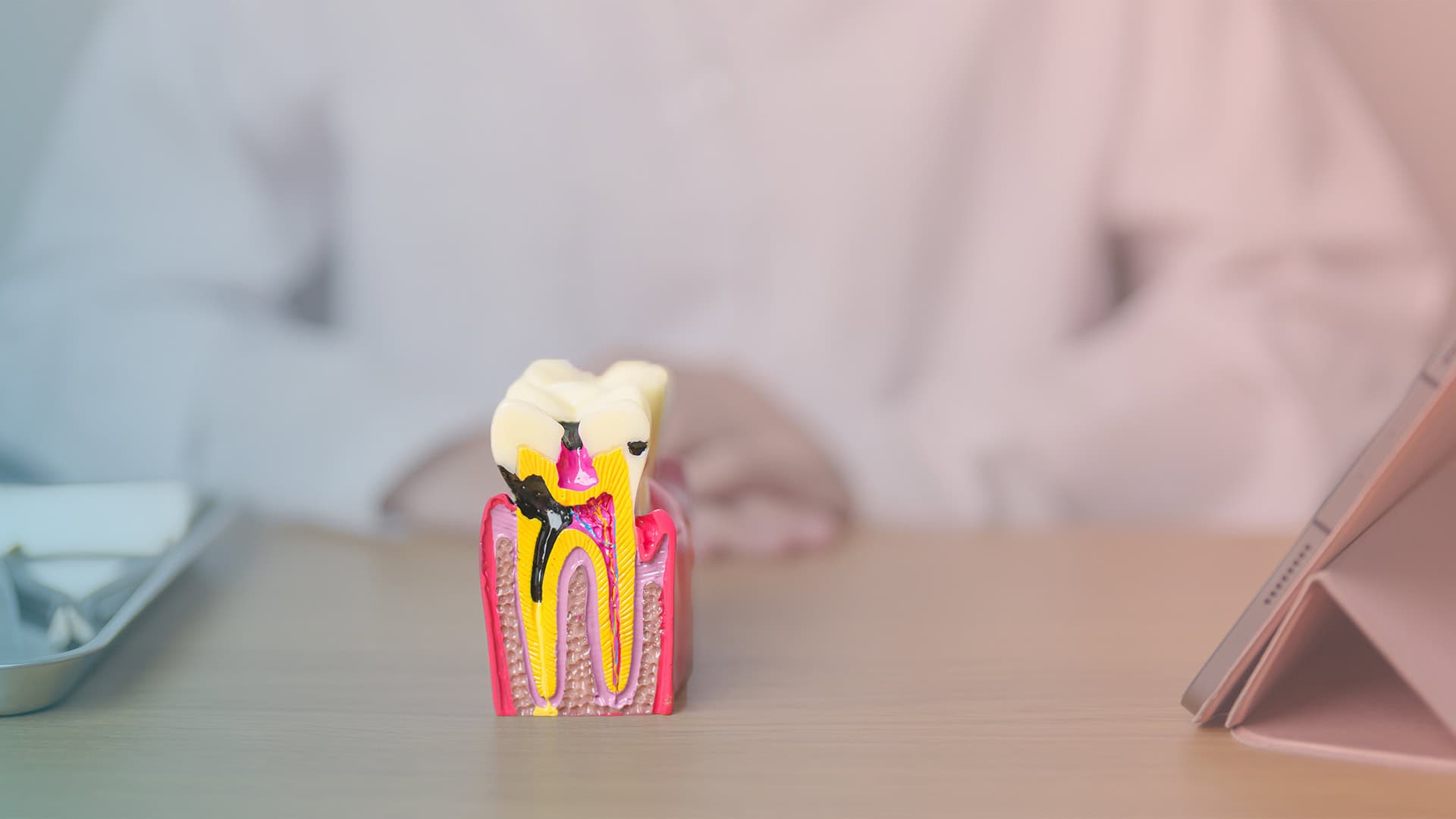
When decay reaches the nerve, or pulp, the pulp can become inflamed and die, and bacteria then multiply in the empty root canal, so the tooth can smell from the inside. A root canal only becomes infected once the pulp has died or been removed during earlier treatment. More than 500 bacterial species have been found in these infections, though a core group of 20 to 30 species turns up most often, and obligate anaerobes dominate in teeth infected for the first time (PubMed 34958494). Exposed necrotic pulp is also listed separately among the oral causes of bad breath (PubMed 17555859).
If the infection spreads past the root tip, an acute apical abscess can form. Abscesses hold a mixed community dominated by anaerobic bacteria, with Fusobacterium, Prevotella and Porphyromonas among the common genera (PubMed 23554416). The same genera appear among the bacteria most closely linked with bad breath (PubMed 32748883). That overlap helps explain why a dead or abscessed tooth can give off a noticeable smell, although we could not find a published study that measures the odour from a dead tooth directly. More on how a tooth dies and what follows is in our dead tooth guide.
Antibiotics alone will not fix a dead or abscessed tooth, because the source of the infection stays inside it. The 2024 Cochrane review found 3 trials with 134 participants, and guidelines advise removing the source first by drainage, root canal treatment or extraction, keeping antibiotics for spreading infection or symptoms such as fever (PubMed 38712714). Warning signs and when an abscess is urgent are covered in our tooth abscess guide.
How to Get Rid of Tooth Decay Smell: Filling, Root Canal or Extraction
Tooth decay smell goes when the decayed tissue and its bacteria are cleaned out of the tooth and the cavity is sealed, and which treatment you need depends on whether the decay has reached the nerve. A review of oral malodour notes that bad breath caused by disease is treated primarily by treating that disease, with toothpastes and mouthwashes playing a supplementary role to brushing (PubMed 30927516). As long as the cavity is there, the source of the smell stays too.
If the nerve is still alive, the decay is removed and the tooth is filled. Fillings wear too: a systematic review of back-tooth composite fillings found 1.55 lost restorations per 100 restoration years, meaning that for every 100 fillings followed for a year about 1.55 failed, and the most common biological reason for failure was secondary decay starting around the filling (PubMed 26003655). An old filling with an open edge can therefore become a source of odour as well, and imperfect fillings are listed among the causes of bad breath (PubMed 17555859). How a tooth-coloured filling is placed is explained on our composite filling page.
If the nerve has died or the canal is infected, the tooth needs root canal treatment, in which the canal is cleaned, shaped and sealed. A systematic review of 14 studies found that 86% to 93% of teeth were still in place 2 to 10 years after root canal treatment, and a crown placed afterwards headed the list of factors that improved survival (PubMed 20158529). The steps are set out on our root canal treatment page. When a tooth is too broken down to save, extraction also removes the source of infection (PubMed 38712714).
What You Can Do at Home and When to See a Dentist
Home care can make a smelly tooth less noticeable, but it will not stop the decay; only a dentist can clean out the cavity and seal it. Until your appointment, brushing carefully and flossing around the decayed tooth may help. In 896 adults attending a preventive dental clinic in Pretoria, South Africa, regular flossing was the self-care habit most strongly linked to a lower chance of bad breath (PubMed 23198466).
If the smell lingers after the decay has been treated, the source may lie elsewhere. A meta-analysis of five studies found that people with gum disease (periodontitis) had 3.16 times higher odds of bad breath (PubMed 28749582), so the gums and the back of the tongue are worth checking too.
See a dentist if the smell seems to come from one tooth, if you can see a dark hole, a chipped tooth or a filling with an open edge, if food keeps catching in the same spot, or if a bad taste will not go away. Pain in the tooth, or swelling or discharge from the gum, suggests the infection may have reached the root tip. Facial swelling, fever or feeling generally unwell can mean the infection is spreading and needs attention without delay. An American Dental Association guideline reserves antibiotics for this kind of whole-body involvement and puts immediate dental treatment first in every case (PubMed 31668170). If you are travelling to Turkey for dental work, mention the smell and any swelling at your first consultation so the tooth can be examined and, where needed, X-rayed before treatment is planned.
Let's plan the right treatment together.
Free Assessment→- 1.van den Broek AM, Feenstra L, de Baat C. A review of the current literature on aetiology and measurement methods of halitosis. J Dent 2007;35:627-35. PubMed 17555859
- 2.Cortelli JR, Barbosa MD, Westphal MA. Halitosis: a review of associated factors and therapeutic approach. Braz Oral Res 2008;22 Suppl 1:44-54. PubMed 19838550
- 3.Suzuki N, Yoneda M, Takeshita T, Hirofuji T, Hanioka T. Induction and inhibition of oral malodor. Mol Oral Microbiol 2019;34:85-96. PubMed 30927516
- 4.Silva MF, Leite FRM, Ferreira LB, Pola NM, Scannapieco FA, Demarco FF, et al. Estimated prevalence of halitosis: a systematic review and meta-regression analysis. Clin Oral Investig 2018;22:47-55. PubMed 28676903
- 5.Kassebaum NJ, Bernabé E, Dahiya M, Bhandari B, Murray CJ, Marcenes W. Global burden of untreated caries: a systematic review and metaregression. J Dent Res 2015;94:650-8. PubMed 25740856
- 6.Guedes CC, Bussadori SK, Weber R, Motta LJ, Costa da Mota AC, Amancio OMS. Halitosis: prevalence and association with oral etiological factors in children and adolescents. J Breath Res 2019;13:026002. PubMed 30620931
- 7.Ziaei N, Hosseinpour S, Nazari H, Rezaei M, Rezaei K. Halitosis And Its Associated Factors Among Kermanshah High School Students (2015). Clin Cosmet Investig Dent 2019;11:327-338. PubMed 31695509
- 8.Nalçaci R, Sönmez IS. Evaluation of oral malodor in children. Oral Surg Oral Med Oral Pathol Oral Radiol Endod 2008;106:384-8. PubMed 18602293
- 9.Zhang H, Zhang T, Fu X, Qin H, Chen X, Zeng X. Prevalence and Associated Factors of Halitosis Among University Students in Guangxi, Southern China: A Cross-Sectional Study. Oral Health Prev Dent 2025;23:863-874. PubMed 41384447
- 10.Siqueira JF Jr, Rôças IN. Present status and future directions: Microbiology of endodontic infections. Int Endod J 2022;55 Suppl 3:512-530. PubMed 34958494
- 11.Siqueira JF Jr, Rôças IN. Microbiology and treatment of acute apical abscesses. Clin Microbiol Rev 2013;26:255-73. PubMed 23554416
- 12.Hampelska K, Jaworska MM, Babalska ZŁ, Karpiński TM. The Role of Oral Microbiota in Intra-Oral Halitosis. J Clin Med 2020;9. PubMed 32748883
- 13.Cope AL, Francis N, Wood F, Thompson W, Chestnutt IG. Systemic antibiotics for symptomatic apical periodontitis and acute apical abscess in adults. Cochrane Database Syst Rev 2024;5:CD010136. PubMed 38712714
- 14.Ástvaldsdóttir Á, Dagerhamn J, van Dijken JW, Naimi-Akbar A, Sandborgh-Englund G, Tranæus S, et al. Longevity of posterior resin composite restorations in adults – A systematic review. J Dent 2015;43:934-54. PubMed 26003655
- 15.Ng YL, Mann V, Gulabivala K. Tooth survival following non-surgical root canal treatment: a systematic review of the literature. Int Endod J 2010;43:171-89. PubMed 20158529
- 16.Silva MF, Cademartori MG, Leite FRM, López R, Demarco FF, Nascimento GG. Is periodontitis associated with halitosis? A systematic review and meta-regression analysis. J Clin Periodontol 2017;44:1003-1009. PubMed 28749582
- 17.Ayo-Yusuf OA, Postma TC, van Wyk C. Clinical correlates of oral malodour in a population of patients attending a preventive clinic in Pretoria, South Africa. SADJ 2011;66:326, 328-31. PubMed 23198466
- 18.Lockhart PB, Tampi MP, Abt E, Aminoshariae A, Durkin MJ, Fouad AF, et al. Evidence-based clinical practice guideline on antibiotic use for the urgent management of pulpal- and periapical-related dental pain and intraoral swelling: A report from the American Dental Association. J Am Dent Assoc 2019;150:906-921.e12. PubMed 31668170