
Aesthetic Filling
An aesthetic filling restores tooth lost to decay or fracture with tooth-coloured composite resin, layered and light-cured, usually in a single session.
- Natural colour match
- Single-session completion
- Minimal tooth structure removed
First consultation free · same-day reply · no price pressure
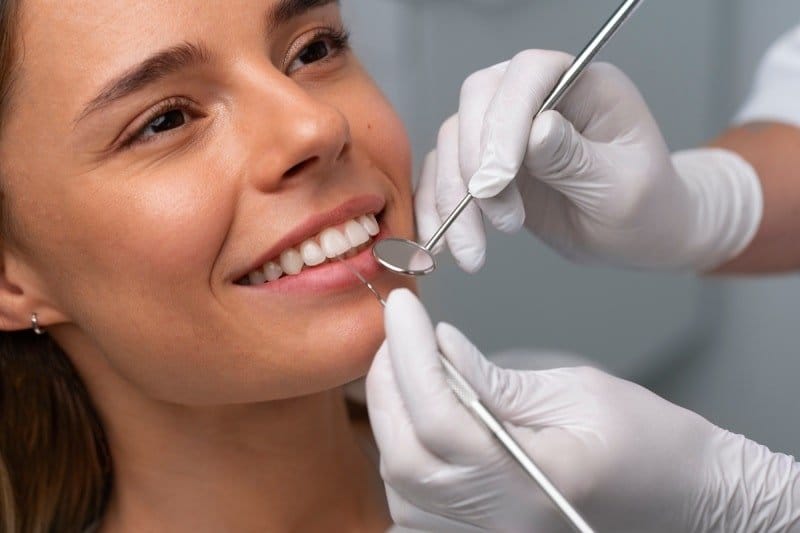
An aesthetic filling is the name given to a resin composite restoration placed where it is visible; the material is composite resin and the technique is incremental placement into the cavity with light curing, so the term describes an indication rather than a separate class of material. Across 21 clinical trials, estimated median success at 10 years was 95% for Class III cavities between front teeth and 90% for Class IV cavities that include the incisal edge (PubMed 25773188). A systematic review of 17 studies covering 1,821 anterior restorations recorded a total failure rate of 24.1% and annual failure rates from 0% to 4.1% depending on the study (PubMed 26303655).
- 01Cavity class drives the outcome. Bulk fracture was the main reason Class IV restorations were replaced, and those fractures were significantly more frequent with microfilled composites than with hybrid or macrofilled ones, while caries next to the restoration accounted for only about 2.5% of all restorations replaced over 10 years, irrespective of cavity class (PubMed 25773188).
- 02Technique shows up in the data. In the same meta-analysis, etching enamel without applying a bonding agent produced significantly more marginal staining and detectable margins than enamel bonding or the total-etch technique, and bevelling the enamel significantly reduced deterioration of anatomical form without reducing marginal staining (PubMed 25773188). These are the details worth confirming in writing before treatment abroad.
- 03Why the filling was placed predicts how it will fail. Anterior restorations placed for caries or fracture failed mostly by fracture, while those placed for esthetic reasons failed more often on colour, anatomical form and surface staining (PubMed 26303655).
- 04Past a certain amount of lost tissue the decision moves away from a direct filling. Pooling randomised trials only, posterior partial coverage restorations survived at 93.7% over three years in lithium disilicate (95% CI 83.7-97.7) and 89.3% in resin matrix ceramic (95% CI 76.4-95.3), with long-term performance described as uncertain (PubMed 39558793).
- 05On the common worry that mouthwash discolours fillings, a systematic review of 15 laboratory studies found the colour change stayed within the clinically acceptable threshold (ΔE ≤ 2.7) in 10 of them. This is immersion data from in vitro work, not measurement in the mouth (PubMed 32891404).
/ How Aesthetic Filling is Done
Aesthetic filling is a long-term functional filling that harmonizes with the patient's natural tooth color. As a result of the developments in today's dentistry, the use of metal has decreased and has been replaced by porcelain and plastic alloys. These materials, which exactly match the tooth color, have perfectly replaced traditional amalgam fillings.
Aesthetic filling procedure is an excellent aesthetic and functional solution as it does not involve the loss of healthy teeth. Aesthetic filling, which can be placed completely inside a living tooth, can prevent the formation of new tooth decay in the area.
Ceramic or composite materials can be used in aesthetic filling treatment. Aesthetic filling, which is a minimally invasive procedure applied for various problems such as discolored, broken, cracked, sensitive or painful teeth due to various reasons; It is often preferred for a fast, durable and aesthetic solution.
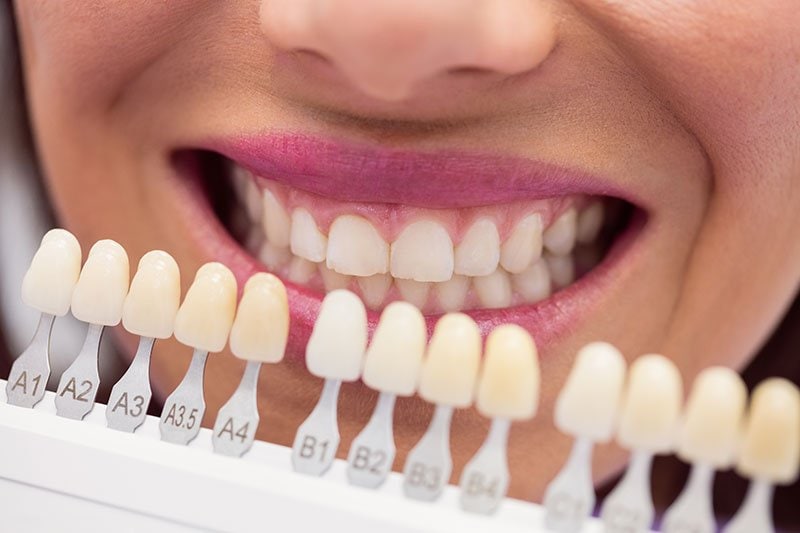
Aesthetic filling treatment is applied under local anesthesia. Therefore, the patient does not feel any pain or soreness during the procedure. First, the integrity of the tooth to be treated is checked. Anesthesia is applied and expected to take effect. If there is decay in the tooth, the decayed parts are first removed with the help of special tools. After the area is completely cleaned, a color that is compatible with the patient's natural tooth color is selected. A special substance is applied to give the tooth enamel the desired shape.
The most important step of the procedure is to enlarge the area needed to place the filling and to fix the filling to healthy tooth tissues by joining the shaped surfaces. In the next step, the filler is hardened with the help of a curing light. This process is repeated at each step as the filling is placed layer by layer. The anatomical shape of the tooth and the grooves are created. Then, the bite test is performed and the filling height is evaluated.
| At a glance | |
|---|---|
| Duration | 1 session |
| Sessions | 1 |
| Warranty | 3 years |
| Materials Used | 3M Filtek · Ivoclar Tetric |

Treatment Process
- 01Consultation: Initial examination and needs assessment; imaging where required.
- 02Treatment: Decay removal, composite layering, polishing.
- 03Follow-up: Outcome review and aftercare guidance.
/ Candidates for Aesthetic Filling
People with abrasion, fracture and decay in their teeth due to trauma, inadequate filling or different reasons are considered candidates for aesthetic filling treatment. In addition, the aesthetic filling procedure can be used to fill the gaps between the teeth and to change the color and shape of the teeth.
Aesthetic filling procedure may come to the agenda at the point of eliminating decays, abrasions and fractures that occur in the teeth over time due to insufficient oral hygiene or various reasons. Thanks to aesthetic filling treatment, it may be possible to restore the old form to decayed or broken teeth.
At the same time, aesthetic filling treatment can be used to remove permanent discolorations that do not respond to professional teeth whitening applications, to repair teeth that have decayed or broken for any reason, to close the gaps between the teeth and to lengthen the length of the teeth. Since the aesthetic filling can be adjusted according to the color of the patient's own teeth, it provides a natural appearance that is compatible with natural tooth enamel. Another advantage of aesthetic filling is that it is an effective and reliable dental procedure that does not cause any damage to the teeth or gums.
/ Types of Aesthetic Fillings
Composite filling or ceramic filling can be used in aesthetic filling treatment.
Composite filling is one of the most commonly used filling types. It can be customized to match the tooth color. A composite filling is a mixture of acrylic resin reinforced with powdered glass filler. The composite filling, which can be applied to repair or restore teeth, is extremely durable and resistant to breakage. In addition to providing highly aesthetically successful results, the composite filling is micro-mechanically bonded to the tooth structure and provides more support. It is a functional solution for patients with metal allergies as it does not contain metal.
For the metal to be placed, more tooth structure has to be removed. Since this is not the case with composite fillings, it may be possible to preserve the natural tooth structure. Composite resin can wear and change colour over time. In a meta-analysis of anterior composite restorations, marginal staining was significantly more frequent when enamel was etched without a bonding agent, and bevelling the enamel significantly reduced deterioration of anatomical form (PubMed 25773188). Composite fillings can act as filling material for tooth gaps. They can also be used to fill gaps between teeth, restore worn tooth enamel, fix chipped or cracked teeth and create a natural tooth structure.
Ceramic filling material, which is usually made of porcelain, is more resistant to staining than composite resin filling material. When it adheres to the teeth, it provides a good seal and restores the strength lost by the tooth. Due to their similarity to natural tooth enamel, they cannot be easily distinguished from natural teeth.
Since ceramic filling has high durability, it lasts longer than metal amalgam. Due to its non-toxicity, ceramic fillings do not expand, shrink and leak.
/ Aesthetic Filling Treatment Overview
Aesthetic Filling Treatment Duration
Aesthetic filling treatment is usually completed in one session. Depending on the number of teeth to be treated and the size of the problem, the duration of the procedure may vary depending on the patient. However, aesthetic filling usually takes between 30 minutes and 1 hour.
Situations Where Aesthetic Filling is Preferred
Some situations where aesthetic filling treatment is preferred are listed below:
- To eliminate tooth decay and permanent discoloration due to various reasons
- Removing gaps between teeth (Diastema)
- Lengthening tooth length
Properties of Aesthetic Tooth Filling
- It has a long service life thanks to its durability.
- Thanks to its compatibility with natural tooth color, it cannot be distinguished from natural teeth when viewed from the outside.
- Its compatibility with tooth color and texture allows it to be applied quickly and comfortably.
- It can be applied to patients of all age groups to achieve an aesthetic and natural appearance.
- Since it has a structure compatible with all tissues in the mouth, it does not cause allergic reactions.
- There is no sensitivity to heat or cold after application.
/ Advantages of Aesthetic Dental Filling
- Aesthetic filling gives very successful results in terms of aesthetics as it is applied in accordance with the natural color and shape of the teeth. The filling material is selected in a color similar to the color of the tooth, so that the filling area retains its natural appearance.
- Aesthetic filling is usually completed in a single session. It is a time-saving method for patients, as the dentist gets immediate results after applying the composite filling material to the tooth.
- Aesthetic filling preserves the natural structure of the tooth and requires a minimum amount of tooth material removal. Therefore, it does not harm the health of the teeth.
- Composite filling materials are strong and durable. They do not affect the chewing function of the teeth and can last for a long time.
- Aesthetic filling treatment can be used to change tooth color or restore worn, stained teeth. Thus, it may be possible to make patients' smiles whiter and more attractive.
- Aesthetic filling is more economical than other aesthetic dental treatments.
/ Aesthetic Filling Lifespan and Prices
With complete routine oral care and regular dental examinations, problems such as deformation, leakage or gaps at the margins can be detected and treated early. During routine dentist examinations, the necessary care processes for aesthetic fillings are applied. In this way, aesthetic fillings can be made to last longer.
The lifespan of the aesthetic filling may vary depending on how much attention is paid to oral and dental care for each patient. At the same time, the quality of the material used in aesthetic filling treatment, the expertise and experience of the dentist who performs the application are among the factors affecting the life of the aesthetic filling.
In addition to these, the location of the aesthetic filling and how big it is are considered to be factors related to the lifespan of the filling. For this reason a single number of years is not accurate; studies measure lifespan as the share of restorations still in place without replacement after a given period. Across 21 clinical trials on front teeth, estimated median success at 10 years was 95% for Class III cavities between front teeth and 90% for Class IV cavities that include the incisal edge (PubMed 25773188). In back teeth, a meta-analysis pooling patient data from 12 studies with at least 5 years of follow-up found that 569 of 2,816 composite restorations failed during observation, mainly from caries and fracture, with higher risk in high-caries-risk patients and in restorations covering more surfaces (PubMed 25048250).
Aesthetic Filling Prices
Aesthetic filling prices may vary depending on the number of teeth to be treated, whether there is a need for different dentistry procedures other than filling, the quality of the material used, the location of the tooth to be treated, the current condition of the tooth, the price policy of the clinic where the treatment will be applied and similar factors.
- 1.Heintze SD, Rousson V, Hickel R. Clinical effectiveness of direct anterior restorations--a meta-analysis. Dent Mater 2015;31:481-95. PubMed 25773188
- 2.Demarco FF, Collares K, Coelho-de-Souza FH, Correa MB, Cenci MS, Moraes RR, et al. Anterior composite restorations: A systematic review on long-term survival and reasons for failure. Dent Mater 2015;31:1214-24. PubMed 26303655
- 3.Prott LS, Pieralli S, Klein P, Spitznagel FA, Ibrahim F, Metzendorf MI, et al. Survival and Complications of Partial Coverage Restorations on Posterior Teeth-A Systematic Review and Meta-Analysis. J Esthet Restor Dent 2025;37:620-641. PubMed 39558793
- 4.Morais Sampaio GA, Rangel Peixoto L, Vasconcelos Neves G, Nascimento Barbosa DD. Effect of mouthwashes on color stability of composite resins: A systematic review. J Prosthet Dent 2021;126:386-392. PubMed 32891404
- 5.Opdam NJ, van de Sande FH, Bronkhorst E, Cenci MS, Bottenberg P, Pallesen U, et al. Longevity of posterior composite restorations: a systematic review and meta-analysis. J Dent Res 2014;93:943-9. PubMed 25048250

Who is this treatment for?
- Wear, fracture or decay in teeth due to trauma
- Gaps or diastema between the teeth
- Permanent discoloration that does not respond to whitening
- Discolored, broken, cracked, sensitive or painful teeth
- The need to restore worn tooth enamel
- The need to lengthen the teeth
Doctors specialising in this treatment




Frequently asked
01How does an aesthetic filling differ from amalgam?+
Aesthetic fillings use composite resin matched to your natural tooth shade. Mercury-free and virtually invisible. They are more aesthetic and biocompatible than silver amalgam. Composite is not maintenance-free: a systematic review of 17 studies covering 1,821 anterior restorations recorded a 24.1% total failure rate over follow-up.
02How long will an aesthetic filling last?+
A single number of years cannot be given; across 21 clinical trials on front teeth, estimated median success at 10 years was 95% for Class III and 90% for Class IV cavities (PubMed 25773188). Mosdent provides a 3-year guarantee.
Restorative & General
Bonding
Bonding adds tooth-coloured resin composite to the tooth in layers and light-cures it, correcting small fractures, gaps and shape faults in one session.
Explore→02Composite Filling
A composite filling restores tooth lost to decay or fracture with tooth-coloured resin composite, layered and light-cured in one session, with no mercury.
Explore→03Dental Radiology
Dental radiology images the roots, bone and impacted teeth an examination cannot show; periapical, panoramic or CBCT imaging follows the clinical question.
Explore→Speak with your doctor about this treatment.
Not sure which treatment fits? Tell us what’s wrong →