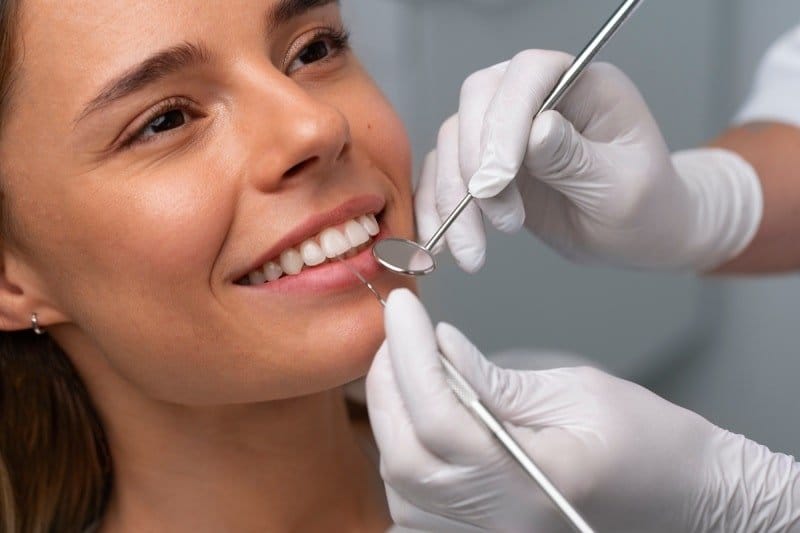

Composite veneers are thin layers of tooth-coloured resin bonded directly onto the front surface of a tooth, shaped by hand and light-cured chairside, which is why most cases finish in one appointment of roughly one to two hours per group of teeth. Because little or no enamel is removed, the approach is conservative. A meta-analysis of randomised trials put the pooled survival of resin composite laminate veneers at 88 percent, with 95 percent confidence limits of 81 to 94 percent and follow-up ranging from 24 to 97 months; surface roughness, colour mismatch and marginal discolouration were the most reported complications (PubMed 38035903).
- 01Composite veneers are a technique rather than a material: resin composite is layered onto enamel and cured in the mouth, so a full set of front teeth can be completed in a single visit of about one to two hours.
- 02Pooled survival in randomised trials is 88 percent, 95 percent confidence interval 81 to 94 percent, with follow-up between 24 and 97 months (PubMed 38035903).
- 03Ceramic veneers carry longer service data: pooled survival at 10.4 years was 96.13 percent for feldspathic, 93.70 percent for leucite-reinforced glass-ceramic and 96.81 percent for lithium disilicate across 29 studies (PubMed 39523553).
- 04The practical trade-off is repairability. A chipped composite veneer is polished or patched in one appointment, while a fractured porcelain veneer is replaced as a whole unit.
- 05Neither composite nor porcelain responds to bleaching, so the target shade is decided before bonding and then protected by controlling staining habits.
Nowadays, patients around the world are demanding more and more cosmetic dental treatments. With the multiple advances in dental materials and technology, these procedures are getting a lot of attention, making them foundations for modern cosmetic dentistry.
Composite veneers are among the treatments international patients come to Istanbul for.
/ Composite Veneers and Procedure
What Are Composite Veneers?
Composite veneers are a type of cosmetic dental treatment that consists of attaching thin shells made from dental composite resin placed over your teeth. This layer of composite is used by specialists to correct multiple cosmetic issues, such as:
- Tooth discoloration
- Minor anatomic defects
- Mild to moderate chips and fractures
- Minor misalignments
- Gaps between teeth
How They Work
Composite veneers are placed directly over the tooth surface with a specialized bonding agent under a strict dry environment, typically in a single appointment. While they require minimal wear and preparation when compared with other types of dental veneers, they need a skilled professional to make these restorations by hand.
The composite material used for this dental treatment is carefully selected and chosen to match your teeth's natural color and tone, making the results practically unnoticeable.
Step-by-Step Process
Just like any other cosmetic procedure, the process starts with an initial consultation that includes a comprehensive oral evaluation and an interview to establish your expectations and goals. This initial evaluation can include photographs, an oral assessment, X-ray exams, and other complementary tests to assess your current situation.
Once the treatment plan and layout are ready, the specialist starts preparing the teeth surface, using specialized agents that create microscopic retentions. Then, the dentist applies the resin, shapes it to its appropriate dimensions, and polishes the final restoration to achieve a smooth and natural look.
Treatment Time
Composite veneer’s procedure is typically done in one treatment session. Moreover, the specialist can even place multiple veneers in a single appointment with the appropriate planning.
Most times, the entire procedure takes about 1–2 hours per group of teeth, allowing you to resume your daily activities the same day with a new smile.
/ Composite Veneers Cost in Istanbul and Material Differences
The precise cost of cosmetic dental treatment varies depending on multiple factors. However, here you have an overview of the usual price:
Average Price Range
Composite veneers cost between $150–$300 USD per tooth. However, this price depends on:
- Number of teeth treated
- Quantity of composite required to make the veneers
- The clinic you choose
- The experience of the dentist
- The composite resin and other materials used
- The technology and complementary equipment used
- The amount of previous work, or additional procedures, necessary to bond the veneers to the tooth’s surface.
However, when compared to the prices in other countries, like the U.S. and UK (ranging from $250 to $800 per tooth), Istanbul prices represent a significant saving while keeping the quality of international standards.
Composite vs. Porcelain Veneers
While composite and porcelain veneers share similar purpose and steps, there are crucial differences that need to be considered:
Key Differences
The material used represents the main difference. Over ten years, indirect composite veneers had poorer colour match, more fractures and more wear than ceramic veneers in a split-mouth trial (PubMed 31181242), and over two years direct composite veneers showed more staining and roughness than pressed lithium disilicate (PubMed 39063806). Porcelain, however, requires more wear on your teeth's surface to allow space for the new material.
On the other hand, composite is a versatile material, easy to repair and modify, making it more affordable and manageable than porcelain. For instance, if a porcelain veneer chips or fractures, you’ll have to replace it entirely. But if it occurs with composite veneers, the dentist would only need to repair the affected area.
The time is another crucial aspect to consider. Composite veneers usually require a single visit to complete the treatment, while porcelain veneers can take several visits and a dental lab for completion.
/ Composite Veneers Longevity and Care
Longevity and Maintenance
Porcelain veneers have the longer track record. In a 10-year practice-based study of 1,459 veneers, direct composite veneers failed at an annual rate of 4.1 percent against 1.2 percent for ceramic veneers (PubMed 35379471), and randomised trials of composite veneers pooled 88 percent survival over 24 to 97 months (PubMed 38035903).
While composite may stain over time, it can be polished and repaired easily in one-time dental appointments.
The usual recommendations to keep your composite veneers in great shape include:
- Maintain excellent oral hygiene to prevent gum disease and cavities.
- Avoid or reduce stain-inducing foods and drinks, such as coffee, wine, and dark sodas.
- Avoid biting hard foods like bone or dry nuts.
- Address your harmful habits like smoking, teeth grinding (bruxism), or biting hard objects (pens, nails, etc.).
Advantages of Composite Veneers
Composite veneers are a great alternative to fix multiple dental problems. Here are some of their most crucial benefits:
- Non-invasiveness : Composite requires minimal to no enamel removal, which makes it one of the more conservative cosmetic treatments.
- Affordability : The price and upfront cost are considerably lower than other materials like porcelain or zirconia.
- Fast-results : Composite veneers can be done in a single visit, which suits travellers and people with busy schedules.
- Reversibility : Unlike porcelain veneers, composite veneers can often be removed later, because little or no enamel was taken away to place them.
Are You a Candidate for Composite Veneers?
The ideal candidates for composite veneers are patients with minor cosmetic issues, such as discolorations, gaps, chips, and minor esthetic defects. However, individuals with major bite issues, teeth grinding problems, or severe tooth damage may not be eligible for this treatment.
For complex and severe cases, the patients might benefit more by choosing other cosmetic treatments like dental crowns, orthodontics, and others.
/ FAQs About Composite Veneers in Istanbul
How long do composite veneers last?
Randomised trials pooled 88 percent survival over 24 to 97 months of follow-up (PubMed 38035903). Home hygiene and regular check-ups help spot problems early, and in a 10-year practice-based study many veneers that needed attention were repaired and stayed in place (PubMed 35379471).
Do composite veneers damage your natural teeth?
Composite veneers need minimal to no enamel removal, which makes them one of the more conservative cosmetic options, and in many cases the material can later be removed without cutting into the tooth. The bond still relies on healthy enamel, so decay or gum inflammation is treated first.
Is the procedure painful?
Because there is little or no tooth reduction, the procedure often needs no anesthesia. If decay has to be removed or a margin refined first, local anesthesia is used for that part.
Can composite veneers be whitened?
Sadly, no. Composite and other dental materials like porcelain cannot be whitened with any dental procedure. However, while dental composite can be stained over time, your dentist can polish it easily in a short dental visit.
What are the common complications?
In a meta-analysis of composite veneer studies, surface roughness, color mismatch and marginal discoloration were the most reported complications, and most were judged clinically acceptable with or without reintervention (PubMed 38035903). Chips and fractures also occur, and regular check-ups catch them early.
Choosing Istanbul and Final Takeaway
Composite veneers are built directly on the tooth in one appointment, which makes the clinician the main variable in the result: the shape, the layering and the final polish are all done by hand at the chair. That is the question worth asking before booking, rather than the fee. At Mosdent a composite laminate veneer starts from EUR 130 per tooth, and the quote that applies to you names the number of teeth after an examination.
Final Takeaway
Composite veneers correct mild aesthetic problems in a single appointment, and that single appointment is both their advantage and their limit. In a meta-analysis of resin composite laminate veneers, surface roughness, colour mismatch and marginal discoloration were the most frequently reported complications, most of them judged clinically acceptable with or without reintervention (PubMed 38035903). The practical reading is that a composite veneer is maintained rather than fitted and forgotten: polishing at recall appointments keeps the surface, and a chipped edge is repaired at the chair.
Whether composite or ceramic suits your case depends on how much enamel is left, how the teeth meet and how much change you want. That is decided at an examination, and the plan is written down with the material and the number of teeth named on it.
Let’s plan the right treatment together.
Free Assessment→- 1.Lim TW, Tan SK, Li KY, Burrow MF. Survival and complication rates of resin composite laminate veneers: a systematic review and meta-analysis. J Evid Based Dent Pract. 2023;23(4):101911. PMID 38035903
- 2.Klein P, Spitznagel FA, Zembic A, et al. Survival and complication rates of feldspathic, leucite-reinforced, lithium disilicate and zirconia ceramic laminate veneers: a systematic review and meta-analysis. J Esthet Restor Dent. 2025;37(3):601-619. PMID 39523553
- 3.Gresnigt MMM, Cune MS, Jansen K, van der Made SAM, Özcan M. Randomized clinical trial on indirect resin composite and ceramic laminate veneers: Up to 10-year findings. J Dent 2019;86:102-109. PubMed 31181242
- 4.Elkaffas AA, Alshehri A, Alqahtani AR, Abuelqomsan MA, Deeban YAM, Albaijan RS, et al. Randomized Clinical Trial on Direct Composite and Indirect Ceramic Laminate Veneers in Multiple Diastema Closure Cases: Two-Year Follow-Up. Materials (Basel) 2024;17. PubMed 39063806
- 5.Mazzetti T, Collares K, Rodolfo B, da Rosa Rodolpho PA, van de Sande FH, Cenci MS. 10-year practice-based evaluation of ceramic and direct composite veneers. Dent Mater 2022;38:898-906. PubMed 35379471