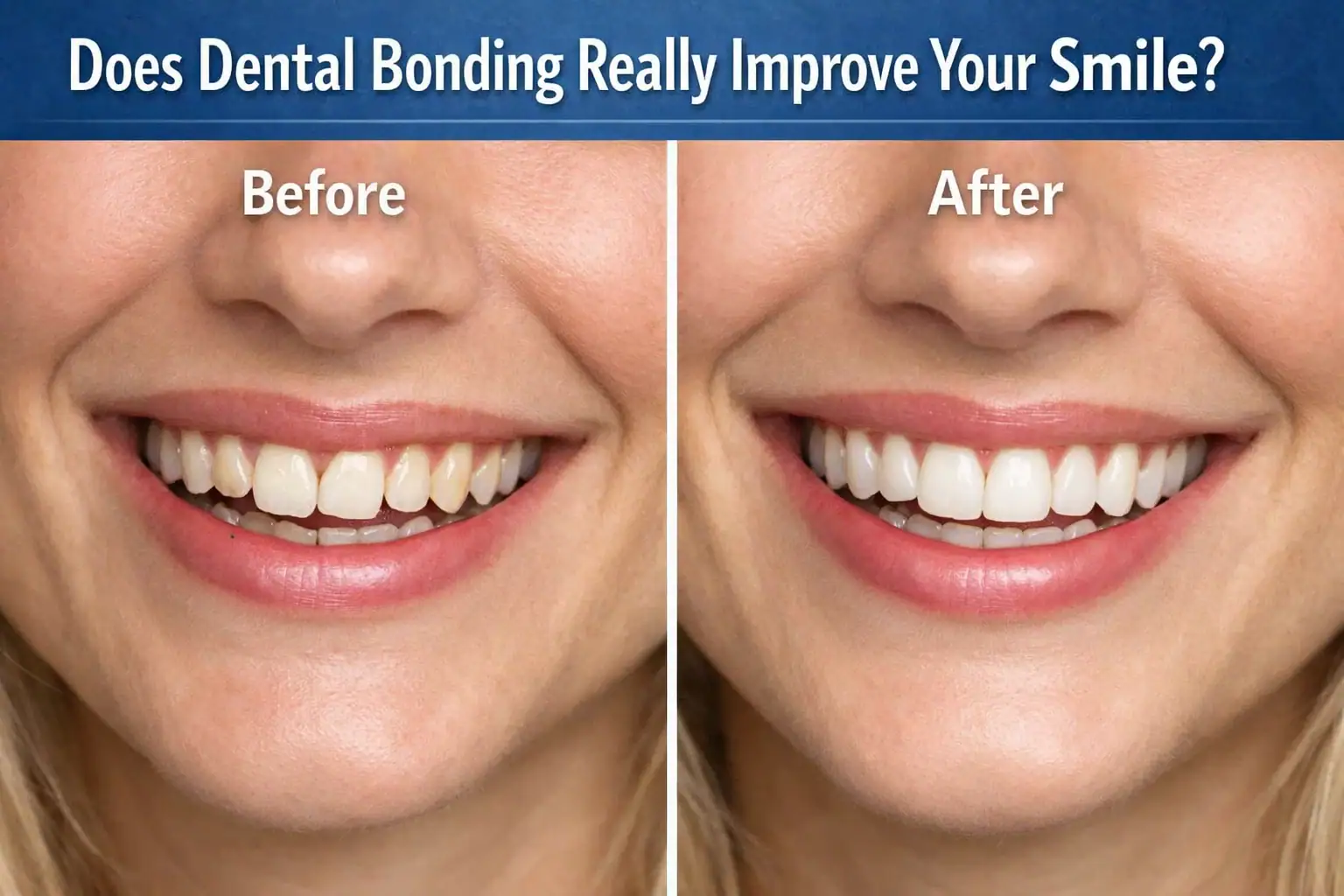
Dental bonding is a direct cosmetic restoration in which tooth-coloured composite resin is applied to the enamel surface, sculpted by hand and light-cured in the same visit, usually without drilling. It changes shape, edge length, colour and symmetry, so within those limits it does improve appearance. In a meta-analysis of randomised trials of resin composite laminate veneers, pooled survival was 88% (95% CI 81 to 94) over follow-up ranging from 24 to 97 months, with surface roughness, colour mismatch and marginal discoloration the most reported complications (PubMed 38035903).
- 01Bonding is a technique, not a material class: the material is resin composite, applied and cured chairside in a single visit.
- 02Pooled survival of resin composite laminate veneers in randomised trials was 88% (95% CI 81 to 94) across follow-up of 24 to 97 months (PubMed 38035903).
- 03A 7.2-year evaluation of 163 anterior composite build-ups placed for fracture and diastema reported a mean annual failure rate of 1.43% and 88.34% survival up to 10 years (PubMed 28256273).
- 04Failures are cosmetic rather than catastrophic: restoration fracture and colour mismatch, with beverage consumption significantly correlated with discoloration (p=0.005, PubMed 28256273).
- 05Porcelain sits in a different durability band: across 580 porcelain laminate veneers followed up to 12 years, survival was 99% when preparation stayed inside enamel and 94% with enamel only at the margins (PubMed 23342345).
/ The Ultimate In-Depth Guide to Cosmetic Tooth Bonding Results, Benefits & Longevity
Cosmetic dentistry has transformed how people enhance their smiles, and dental bonding remains one of the most accessible, conservative, and effective treatments available today. But many patients still ask:
Does dental bonding really improve your smile?
Is dental bonding worth it long term?
How natural does bonding look compared to veneers?
Can bonding correct crooked teeth and gaps?
What Is Dental Bonding? (A Clinical Overview)
Dental bonding is a cosmetic restorative procedure where a tooth colored composite resin is applied directly to the enamel surface and sculpted to enhance tooth shape, color, length, and alignment.
The resin is then hardened using high-intensity curing light, chemically bonding it to natural tooth structure.
Dental Bonding Is Commonly Used For:
- Closing gaps ( diastema )
- Repairing chipped teeth
- Masking stains
- Improving tooth symmetry
- Lengthening worn teeth
- Minor alignment corrections
It is considered one of the most conservative cosmetic dentistry procedures.
How Dental Bonding Improves Your Smile Aesthetically
Dental bonding improves multiple smile parameters simultaneously:
✔ Tooth Proportion
Creates balanced tooth height-to-width ratios.
✔ Smile Symmetry
Aligns uneven edges and shapes.
✔ Color Uniformity
Covers stains and discoloration.
✔ Smooth Surface Texture
Improves light reflection and brightness.
✔ Smile Line Enhancement
Corrects irregular edges that disrupt harmony.
/ How Dental Bonding Enhances Your Smile and Practical Guide
The Science Behind Why Dental Bonding Looks Natural
Modern composite materials replicate:
- Enamel translucency
- Light refraction
- Natural surface gloss
Advanced layering techniques allow dentists to mimic dentin and enamel structure.
This is why professionally applied dental bonding blends naturally.
Common Smile Problems Dental Bonding Corrects in Detail
Diastema (Tooth Gaps)
Bonding can close gaps instantly without braces.
Chipped & Fractured Teeth
Restores natural contours.
Uneven Teeth
Balances length and width.
Worn Enamel
Rebuilds tooth edges.
Mild Crookedness
Visually aligns teeth (optical straightening).
Who Is the Ideal Candidate for Dental Bonding?
Excellent Candidates:
✔ Minor cosmetic issues
✔ Healthy enamel
✔ Non-smokers (or light smokers)
✔ Good oral hygiene
✔ Realistic expectations
Less Ideal:
❌ Severe crowding
❌ Large structural damage
❌ Heavy bruxism (without night guard)
Major Benefits of Dental Bonding
Minimal Invasion
No drilling or enamel removal.
Same-Day Results
Immediate transformation.
Cost-Effective
Lower than veneers or crowns.
Little to no discomfort
Usually no anesthesia required.
Custom Shaping
Fully personalized smile design.
Limitations You Should Know
Bonding is not perfect for every case.
Durability
Composite is softer than porcelain.
Staining Potential
Can discolor over time.
Chipping Risk
Hard foods may damage it.
How Long Does Dental Bonding Last?
Typical lifespan:
It varies
Factors affecting longevity:
- Oral hygiene
- Diet
- Smoking
- Grinding habits
- Dentist skill
Practical Guide to Dental Bonding
Dental Bonding vs Porcelain Veneers: Deep Comparison
| Feature | Dental Bonding | Porcelain Veneers |
|---|---|---|
| Lifespan | Shorter; repaired more often | Longer |
| Cost | Lower | Higher |
| Enamel removal | None | Minimal |
| Aesthetic quality | Very good | Excellent |
| Repairability | Easy | Complex |
Is Dental Bonding Safe?
Yes composite resins are biocompatible and widely used in restorative dentistry.
No known systemic risks.
Can Dental Bonding Change Your Facial Appearance?
Yes, by improving:
- Smile width
- Tooth proportions
- Lip support
Many patients appear younger and more confident.
Post-Bonding Care for Maximum Longevity
✔ Brush twice daily
✔ Floss regularly
✔ Limit dark beverages
✔ Avoid biting hard objects
✔ Wear night guard if grinding
Psychological Impact of Smile Improvement
Studies show improved smiles lead to:
- Higher self-esteem
- Increased social confidence
- Better professional impressions
Can Dental Bonding Be Repaired?
Yes, unlike veneers, composite can be touched up or reshaped easily.
/ Frequently Asked Questions
Does bonding permanently fix teeth?
No, but it is a long-term cosmetic solution.
Can bonding fall off?
Rare if properly placed.
Does bonding damage enamel?
No.
Can I whiten bonded teeth?
Bonding doesn’t whiten but can be replaced lighter.
Advanced Techniques, Verdict and Key Takeaways
Advanced Dental Bonding Techniques Today
- Micro-layering
- Shade mapping
- Digital smile design integration
These elevate aesthetic results significantly.
Final Verdict: Does Dental Bonding Improve Your Smile?
Absolutely.
Dental bonding provides:
✔ Immediate aesthetic enhancement
✔ Natural appearance
✔ Conservative treatment
✔ Affordable transformation
For mild to moderate smile imperfections, dental bonding is one of the best cosmetic dental solutions available.
Key Takeaways
- Dental bonding enhances shape, color, and symmetry
- Safe and minimally invasive
- Fast and affordable
- Requires maintenance
- Ideal for cosmetic corrections
Let’s plan the right treatment together.
Free Assessment→- 1.Lim TW, Tan SK, Li KY, Burrow MF. SURVIVAL AND COMPLICATION RATES OF RESIN COMPOSITE LAMINATE VENEERS: A SYSTEMATIC REVIEW AND META-ANALYSIS. J Evid Based Dent Pract 2023;23:101911. PubMed 38035903
- 2.Lempel E, Lovász BV, Meszarics R, Jeges S, Tóth Á, Szalma J. Direct resin composite restorations for fractured maxillary teeth and diastema closure: A 7 years retrospective evaluation of survival and influencing factors. Dent Mater 2017;33:467-476. PubMed 28256273
- 3.Gurel G, Sesma N, Calamita MA, Coachman C, Morimoto S. Influence of enamel preservation on failure rates of porcelain laminate veneers. Int J Periodontics Restorative Dent 2013;33:31-9. PubMed 23342345