
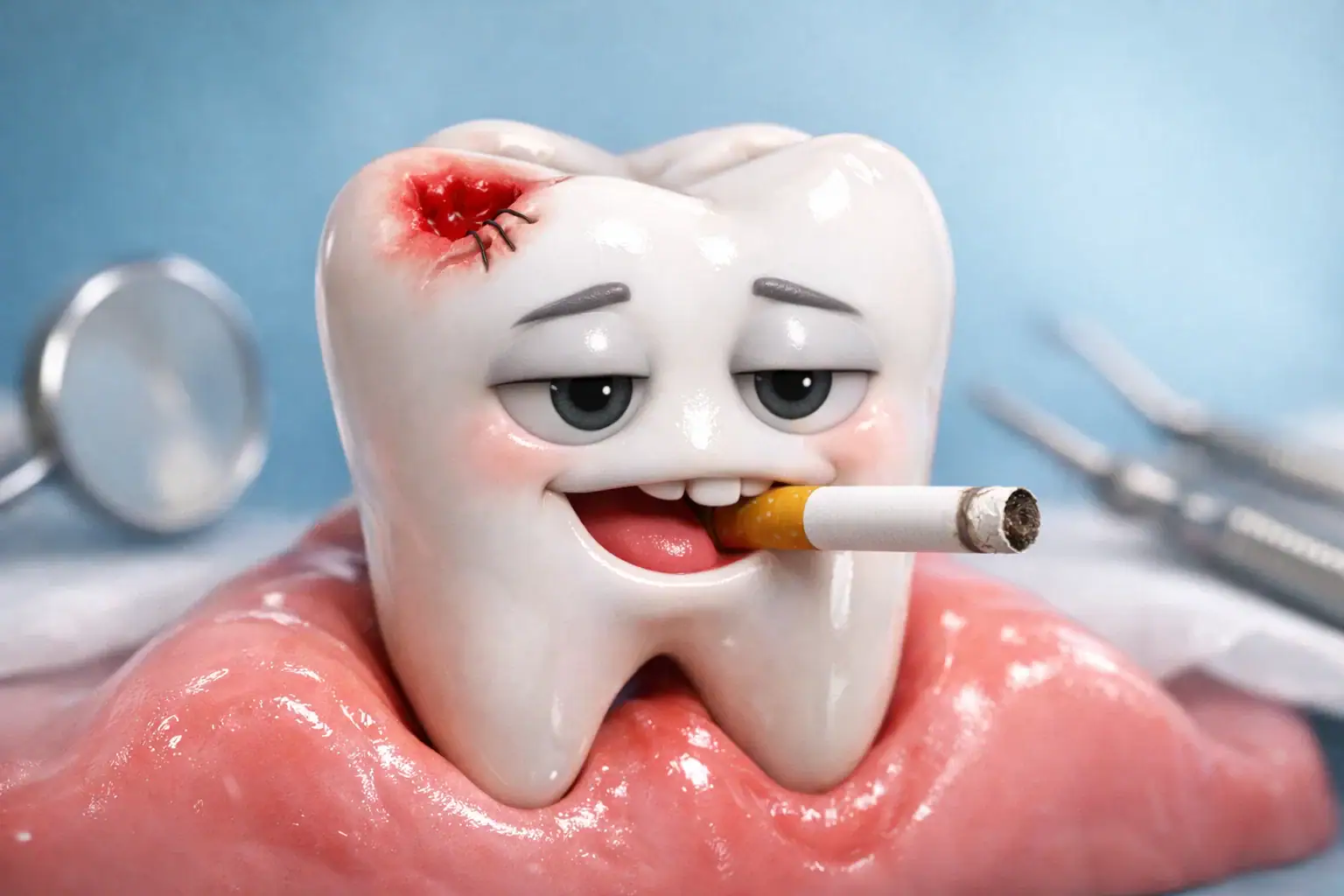
Smoking after a tooth extraction should be avoided for at least 72 hours after a simple extraction and 7 to 10 days after a surgical or wisdom tooth removal, because the suction of inhaling, nicotine-driven vasoconstriction and smoke chemicals all act on the blood clot that seals the socket. In a systematic review of 11 studies, dry socket occurred in about 13.2 percent of smokers versus 3.8 percent of non-smokers, more than a three-fold increase in the odds (PubMed 35877395). Risk is highest in the first 24 hours, when the clot is least stable, and falls as soft tissue closes over the socket.
- 01The waiting time follows the extraction type: a minimum of 72 hours after a simple extraction, 7 to 10 days after a surgical or wisdom tooth removal, and up to 14 days for lower third molars.
- 02Pooled data from 11 studies put dry socket at 13.2 percent in smokers and 3.8 percent in non-smokers, more than a three-fold increase in the odds (PubMed 35877395).
- 03In a prospective series of 238 third molar extractions, smoking carried an odds ratio of 6.41 for dry socket (95% CI 2.86 to 14.36), alongside poor oral hygiene at 9.53 and surgical technique at 3.27 (PubMed 38646199).
- 04Dry socket is partial or total loss of the post-extraction clot with exposed alveolar bone, and the pain typically starts one to five days after the extraction rather than immediately.
- 05Nicotine patches remove both problems that matter here, the suction and the smoke, which is why they are the harm reduction option discussed for the healing window.
/ Smoking Risks After Tooth Extraction
“When can I start smoking after tooth extraction?”
Whether it’s cigarettes, vapes, or marijuana, smoking after tooth extraction is a major risk factor for complications, especially dry socket, delayed healing, infection, and prolonged pain.
The general rule is not to smoke for at least 72 hours (3 days) after a simple extraction and 7 to 10 days after a surgical or wisdom tooth removal, because the blood clot that seals the socket is most fragile in the first days.
Why Is Smoking After Tooth Extraction Dangerous?
To understand the risks, you need to understand how healing works after a tooth is removed.
The Role of the Blood Clot
After extraction, your body forms a blood clot in the socket. This clot:
- protects the underlying bone and nerves,
- allows new tissue to grow,
- is essential for proper healing.
Smoking disrupts this process in three critical ways:
- Suction (inhaling pulls the clot out)
- Nicotine (reduces blood flow and oxygen)
- Heat & chemicals (damage healing tissues)
/ Dry socket risk and smoking timeline after tooth extraction
What Is Dry Socket and Why Does Smoking Cause It?
Dry Socket (Alveolar Osteitis)
Dry socket occurs when:
- the blood clot dissolves or is dislodged,
- bone and nerves become exposed,
- severe pain develops 2–5 days after extraction.
Smoking is the number one preventable cause of dry socket.
Why Smoking Triggers Dry Socket
- Suction from smoking pulls the clot out
- Nicotine constricts blood vessels
- Smoke toxins delay tissue regeneration
This is why dentists strongly warn against smoking after tooth extraction.
How Long Should You Avoid Smoking After Tooth Extraction?
General Rule (Most Dentists Agree):
Do not smoke for at least 72 hours (3 days) after tooth extraction.
However, this depends on the type of extraction.
Smoking After Tooth Extraction: Timeline Guide
Smoking After Tooth Extraction: First 24 Hours
Absolutely NO smoking
Why:
- The blood clot is extremely fragile
- Risk of dry socket is highest
- Even one cigarette can cause complications
Smoking in the first 24 hours after a tooth extraction is not safe and is strongly discouraged.
Smoking After Tooth Extraction: 48–72 Hours
⚠️ Still high risk
- Clot is forming but not stable
- Healing tissue is very sensitive
If you must smoke (not recommended):
- avoid suction,
- do not smoke back-to-back,
- follow all protective measures (explained later).
Smoking After Tooth Extraction: 4–7 Days
Moderate risk
- Soft tissue is closing
- Risk is lower but not gone
Most dentists prefer patients wait 7 full days.
Smoking After Tooth Extraction: 7–10 Days
Lower risk
- Socket is mostly healed
- Risk of dry socket significantly reduced
/ Smoking After Wisdom Tooth Extraction
Smoking After Wisdom Tooth Extraction: Special Warning
Smoking after wisdom tooth extraction is even more dangerous because:
- Wisdom teeth extractions are often surgical
- Larger wounds = slower healing
- Dry socket rates are higher
Recommendation
Avoid smoking for at least 7–10 days
Ideally 14 days for lower wisdom teeth
Lower wisdom teeth are removed surgically far more often than other teeth, which is why the waiting time is longer. What that operation involves, and how the socket is closed, is on our wisdom tooth extraction page; the rest of the surgical work sits under oral surgery.
Smoking Weed After Tooth Extraction: Is It Safer?
Many patients ask:
“Is smoking weed after tooth extraction safer than cigarettes?”
Short Answer: No
Smoking weed after tooth extraction carries the same risks:
- suction dislodges the clot,
- heat irritates the wound,
- smoke contains harmful compounds.
⚠️ Additional Risks with Marijuana
- Stronger inhalation (more suction)
- Dry mouth (slower healing)
- Masking pain (delays seeking help)
Edibles (after 48–72 hours, if approved by your dentist) may be safer than smoking.
Vaping After Tooth Extraction: Is It Okay?
Many believe vaping is safer. It’s not.
Why Vaping Is Still Risky
- Creates suction
- Nicotine reduces blood supply
- Heated vapor irritates tissues
Vaping can still cause dry socket.
Smoking After Tooth Extraction With Gauze: Does It Help?
Some patients try to smoke with gauze over the socket.
Reality Check:
- Gauze does not eliminate suction
- Smoke still reaches the wound
- Nicotine still restricts blood flow
Smoking after tooth extraction with gauze is still unsafe.
/ When Can You Start Smoking After Tooth Extraction?
Best Evidence-Based Answer
- Simple extraction: minimum 72 hours
- Surgical / wisdom tooth extraction: 7–10 days
- Ideal for optimal healing: 14 days
The longer you wait, the lower your risk.
What Happens If You Smoke Too Soon After Extraction?
Possible complications include:
- Dry socket
- Severe pain
- Infection
- Bad taste and odor
- Delayed healing
- Need for additional dental visits
- Increased treatment cost
Signs You May Have Dry Socket
Contact your dentist if you experience:
- Severe throbbing pain after day 2–4
- Pain radiating to ear or jaw
- Bad smell or taste
- Visible bone in socket
- Pain not relieved by medication
How to Reduce Risk If You Can’t Stop Smoking (Harm Reduction)
Not ideal, but better than nothing:
- Delay smoking as long as possible (minimum 72h)
- Avoid suction (no deep inhalation)
- Rinse gently with salt water AFTER 24h
- Do not smoke on the extraction side
- Keep mouth hydrated
- Reduce frequency drastically
Does Nicotine Patch or Gum Help?
Yes.
Nicotine Replacement Therapy (NRT)
- Patches
- Lozenges
These avoid suction and smoke exposure
Safer than smoking during healing
How Long Does Healing Take After Tooth Extraction?
- Initial clot: 24–48 hours
- Soft tissue healing: 7–10 days
- Bone healing: weeks to months
Smoking slows all stages.
/ Frequently Asked Questions (FAQ)
Why no smoking after tooth extraction?
Because smoking dislodges the blood clot, restricts blood flow, and dramatically increases dry socket risk.
How long no smoking after tooth extraction?
At least 72 hours, ideally 7–14 days.
Can one cigarette cause dry socket?
Yes. Even one cigarette can dislodge the clot.
Is dry socket guaranteed if I smoke?
No, but risk increases significantly.
Is vaping safer than smoking after extraction?
No. Vaping still causes suction and irritation.
Can I smoke weed after tooth extraction?
Smoking weed carries the same risks. Edibles may be safer after approval.
Can smoking delay healing?
Yes. Nicotine reduces oxygen and blood flow, slowing recovery.
Final Thoughts
Smoking after tooth extraction is one of the most common reasons for complications, especially dry socket. While quitting even temporarily may be difficult, delaying smoking for at least 72 hours, and ideally 7–14 days, can dramatically improve healing outcomes.
Your mouth heals fastest when:
- blood flow is optimal,
- the clot remains undisturbed,
- and tissues are protected.
When in doubt, wait longer. Healing is always cheaper and easier than treating complications. If the extraction becomes the moment you stop smoking altogether, mouth ulcers may appear for a while: in a study of 90 smokers in a cessation programme, the point prevalence of aphthous ulcers rose from 3.3% on the first day to 21.1% by the third week, then fell again as time passed. If the extraction becomes the moment you stop smoking altogether, mouth ulcers may appear for a while: in a study of 90 smokers in a cessation programme, the point prevalence of aphthous ulcers rose from 3.3% on the first day to 21.1% by the third week, then fell again as time passed.
Let’s plan the right treatment together.
Free Assessment→- 1.Kuśnierek W, Brzezińska K, Nijakowski K, Surdacka A. Smoking as a Risk Factor for Dry Socket: A Systematic Review. Dent J (Basel) 2022;10. PubMed 35877395
- 2.Tandon P, Kumar Sahoo S, Mohanty L, Jain N, Hittalamani V, Shinde Kamble S, et al. Dry Socket Prevalence and Risk Factors in Third Molar Extractions: A Prospective Observational Study. Cureus 2024;16:e56721. PubMed 38646199
- 3.Marakoğlu K, Sezer RE, Toker HC, Marakoğlu I. The recurrent aphthous stomatitis frequency in the smoking cessation people. Clin Oral Investig. 2007;11(2):149-53.