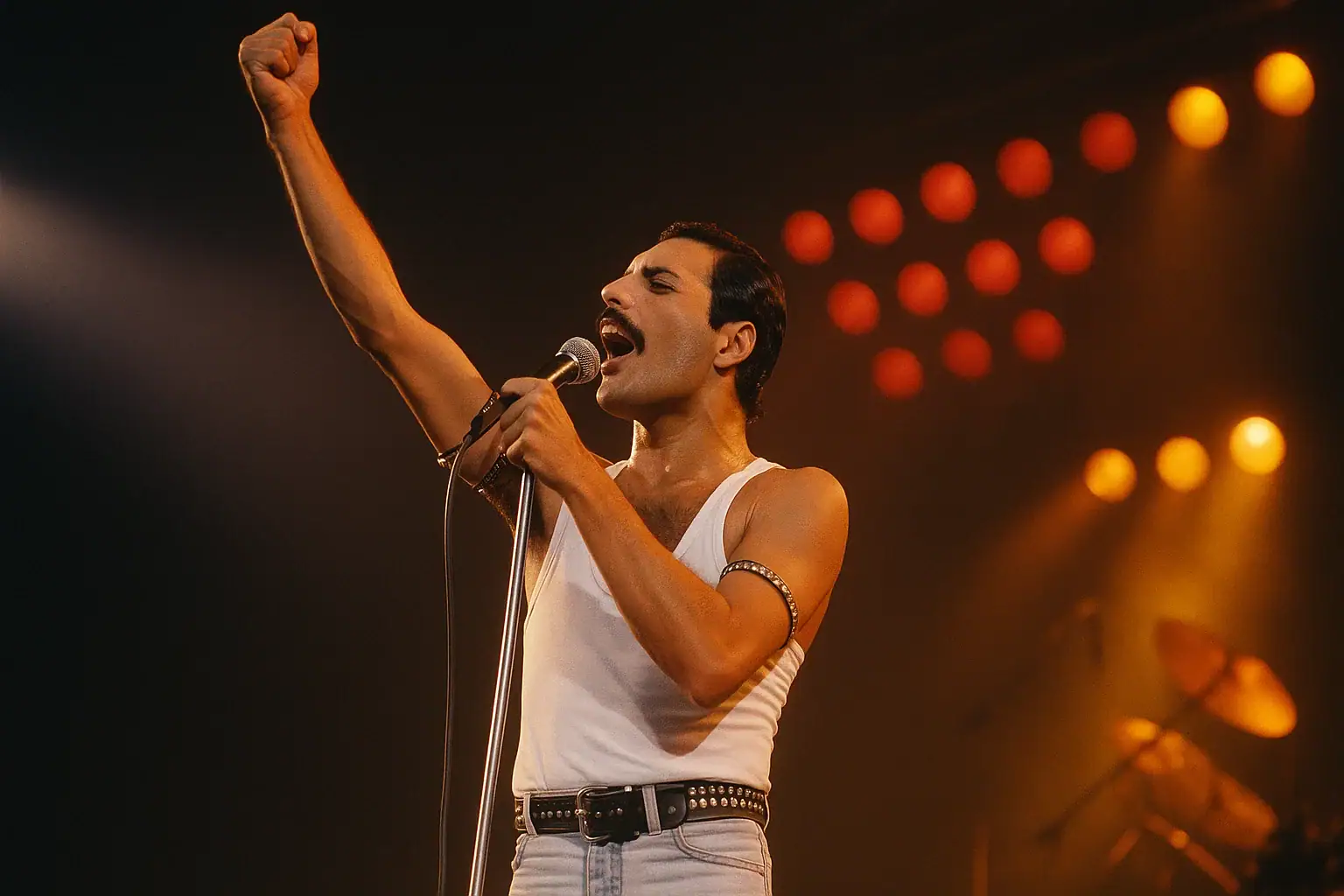
Freddie Mercury's pronounced overjet, often called an overbite, came from supernumerary teeth, extra teeth developing beyond the normal set, and he is reported to have had 36 teeth instead of the usual 32, with four extras behind the upper front teeth pushing them forward. He never had them corrected, because he feared that changing his mouth would change his voice, and no record of an orthodontic consultation exists. Extra teeth are uncommon: a meta-analysis of 14 prevalence studies found reported rates from 0 to 3 percent, averaging 1.6 percent in European white populations, with a relative risk of 1.37 for males over females (PubMed 22752325).
- 01Supernumerary teeth are extra teeth beyond the normal count, classified by position: mesiodens near the central incisors, paramolars beside the molars and distomolars behind the third molars. Mercury's case is described as mesiodens.
- 02Reported prevalence varies with how it is looked for. A meta-analysis of 14 studies found figures from 0 to 3 percent, a mean of 1.6 percent in European white populations and 2.7 percent in southern Chinese populations, with males at a relative risk of 1.37, 95 percent CI 1.13 to 1.50 (PubMed 22752325).
- 03Detection method changes the number: prevalence based on clinical examination alone was significantly lower than when radiographs were also used, so the condition is regarded as underestimated (PubMed 22752325).
- 04Four extra upper teeth are what produced the profile: 36 teeth against an adult average of 32, pushing the upper incisors forward into a pronounced overjet, often called an overbite, that he kept for life.
- 05The look outlived him as a prosthetic: Rami Malek wore custom prosthetic teeth for the 2018 film Bohemian Rhapsody and trained with speech coaches to speak around them.
/ Freddie Mercury's dental structure and extra teeth
A Smile as Powerful as the Voice
Freddie Mercury, the legendary frontman of Queen, is remembered not only for his unmatched vocal range and stage presence but also for his distinctive appearance, particularly his prominent overbite. Over the years, Freddie Mercury's teeth have sparked curiosity, admiration, and even myth. Fans and dental professionals alike have wondered: Did Freddie Mercury have extra teeth? If so, how many teeth did he have, and why didn't he get them fixed?
Freddie Mercury had four extra (supernumerary) teeth in his upper jaw, 36 teeth instead of the usual 32, which pushed his upper front teeth forward. He kept them because he feared that changing his mouth would change his voice.
What Was Unique About Freddie Mercury's Teeth?
One of the most distinctive aspects of Freddie Mercury's appearance was his protruding upper teeth. This was caused by a severe overbite, likely a result of supernumerary teeth, a condition that gave him four extra teeth in his upper jaw. These additional teeth pushed the front teeth forward, creating a dramatic and instantly recognizable dental profile.
Did Freddie Mercury Have Extra Teeth?
Yes. Freddie Mercury had a condition known as mesiodens, in which additional teeth (supernumerary) develop beyond the normal 32. He reportedly had 36 teeth, four more than average, all behind his upper front teeth.
These extra teeth were responsible for:
His pronounced overbite
A wider oral cavity
Distinctive jawline profile
While the condition is rare, it’s not medically dangerous and doesn’t necessarily require treatment unless it causes discomfort or aesthetic concern.
/ Freddie Mercury's supernumerary teeth
Scientific Perspective: What Are Supernumerary Teeth?
From a clinical standpoint, supernumerary teeth are extra teeth that appear in addition to the standard number. There are multiple forms:
Mesiodens, extra teeth near the central incisors (most common in Freddie's case)
Paramolars, found near the molars
Distomolars, behind the third molars (wisdom teeth)
Supernumerary teeth occur in roughly 0.15% to 1.9% of the population and are more frequent in males. Most cases are asymptomatic, but they can cause crowding, impaction, and in Freddie’s case, a lifelong overbite.
Did Freddie Mercury Ever Fix His Teeth?
No, Freddie Mercury never had his teeth fixed.
Crowding and an overbite of that kind are treated today without taking the character out of a smile. A crooked teeth treatment plan sets out what is involved and when extraction is genuinely needed.
Despite access to the best care and significant financial means, he refused orthodontic treatment . According to bandmates, he was deeply concerned that altering his mouth might affect his voice. In Mercury’s mind, changing anything that contributed to his vocal tone, including his dental architecture, was not worth the risk.
Did His Teeth Help His Voice?
Experts and fans have long debated whether his teeth contributed to his unique vocal resonance. Here’s what’s speculated:
Extra teeth and a wider oral cavity may have created more space for sound resonance
His overbite likely altered airflow and vibration mechanics
He exhibited greater vibrato variation and broader vocal frequency
Although there’s no definitive proof, many believe that Freddie Mercury’s teeth helped shape the very sound that made him a legend.
/ Freddie Mercury's dental insecurities
Psychological Effects: Living with Dental Insecurities
While Freddie Mercury’s charisma was undeniable, he wasn’t always comfortable with his appearance.
- He often covered his mouth when laughing or speaking during his early years
- He was reportedly teased in boarding school for his teeth
- However, he later learned to own his look, using confidence and flair to deflect attention
This transformation, from insecurity to icon, is part of what makes his story so universally inspiring.
Cultural Impact: Freddie Mercury’s Teeth in Pop Culture
Mercury’s overbite has become a beloved feature in fan art, caricatures, and merchandise.
- Halloween costumes often include fake overbite prosthetics
- Memes and drawings exaggerate his smile as a tribute
- In the 2018 film Bohemian Rhapsody, Rami Malek wore realistic prosthetic teeth to match Mercury’s look, an essential part of capturing his presence
These homages show how his smile became a cultural symbol of self-expression and individuality.
Did Freddie Ever Consider Surgery?
Though Mercury never went through with treatment, some sources suggest that managers and friends may have encouraged him to consult with orthodontists in the early days of Queen. However:
- No formal records exist of a scheduled consultation
- Mercury himself dismissed such discussions
/ Freddie Mercury's smile on screen
On-Screen Replication: How His Teeth Were Recreated for Film
When Rami Malek was cast in Bohemian Rhapsody, recreating Mercury’s dental structure was a top priority.
- Malek trained with speech coaches to adjust to the prosthetic overbite
- The fake teeth altered his pronunciation and movement, enhancing realism
- He kept the prosthetic teeth after filming as a memento
Did Freddie Mercury Regret Not Fixing His Teeth?
There is no evidence that he regretted his decision. On the contrary:
- He joked about his teeth in interviews
- He viewed them as part of his artistic identity
- He wore his smile with confidence, turning it into a badge of boldness
Freddie Mercury and the Hollywood Smile: A Different Kind of Beauty
In a world that often idolizes the “ Hollywood Smile ”, symmetrical, white, straight teeth, Freddie Mercury challenged the norm.
- He showed that artistry and charisma don’t depend on aesthetic conformity
- His success proved that confidence is more magnetic than perfection
- Today, many fans view his teeth as a powerful reminder: be yourself, unapologetically
What can we learn from the legacy of his teeth?
- Imperfections can become icons
- Confidence trumps cosmetic correction
- True artistry shines through authenticity
- Uniqueness is a strength, not a weakness
Freddie Mercury’s smile wasn’t perfect, but it was unforgettable. And perhaps that’s the point.
/ FAQ
Did Freddie Mercury have extra teeth?
Yes, he had four extra upper teeth, leading to a pronounced overbite.
How many teeth did Freddie Mercury have?
He reportedly had 36 teeth, four more than the average adult.
What was wrong with Freddie Mercury’s teeth?
Nothing medically, but they were crowded and protruded due to extra teeth.
Did Freddie Mercury fix his teeth?
No, he never altered them out of fear that it might affect his vocal range.
Did his teeth help his voice?
Experts believe they may have enhanced vocal resonance and tonal brightness.
A Smile That Rocked the World
Freddie Mercury’s teeth were more than a physical trait, they were a defining part of his legacy. What others may have seen as a flaw, he transformed into a feature of power, performance, and pride.
He didn’t chase perfection. He celebrated uniqueness, and in doing so, became one of the most unforgettable performers in history.
So whether you're here out of curiosity or seeking a deeper understanding of the man behind the smile, let Freddie’s story remind you: individuality never goes out of style.
Let’s plan the right treatment together.
Free Assessment→