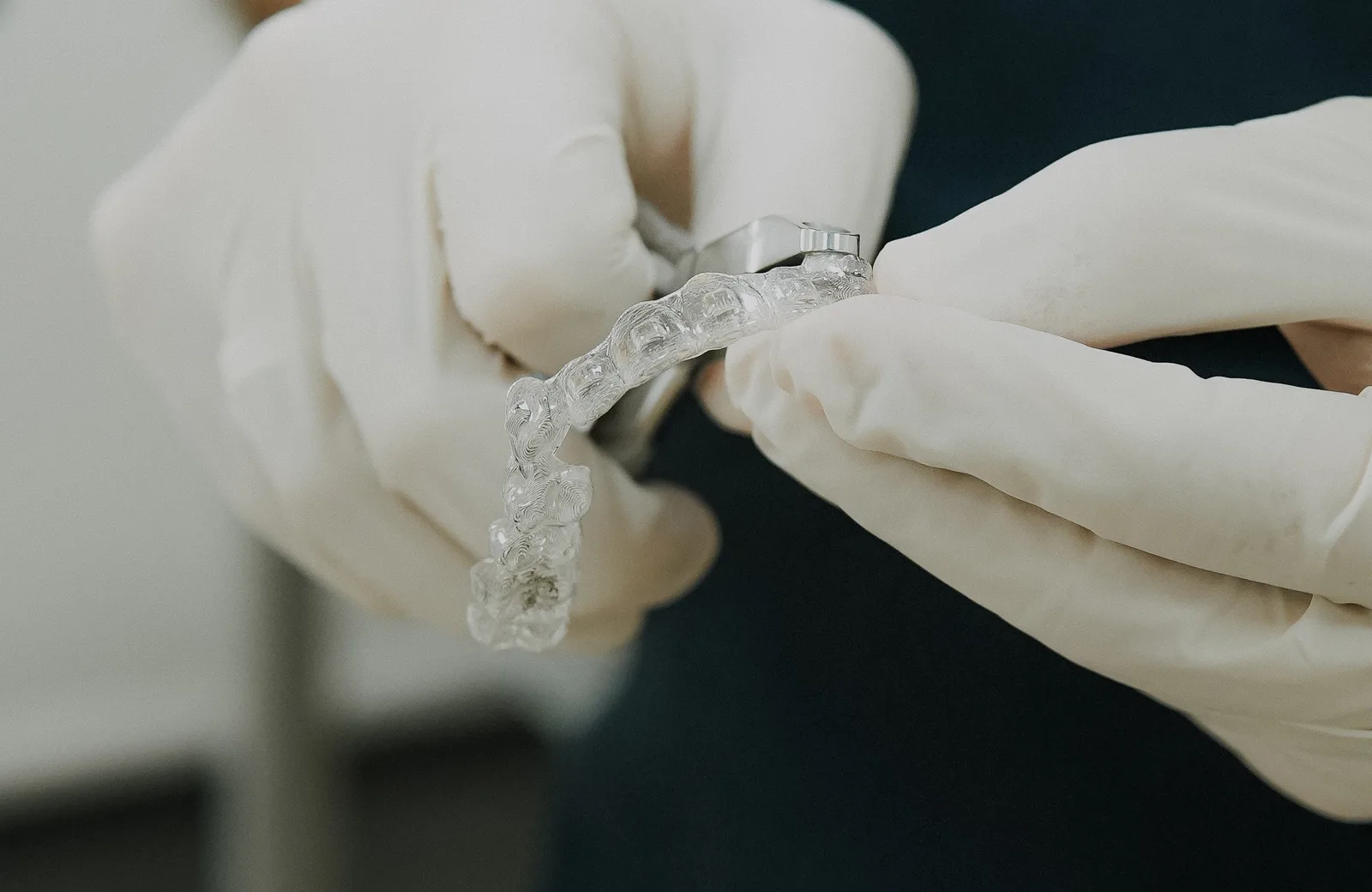
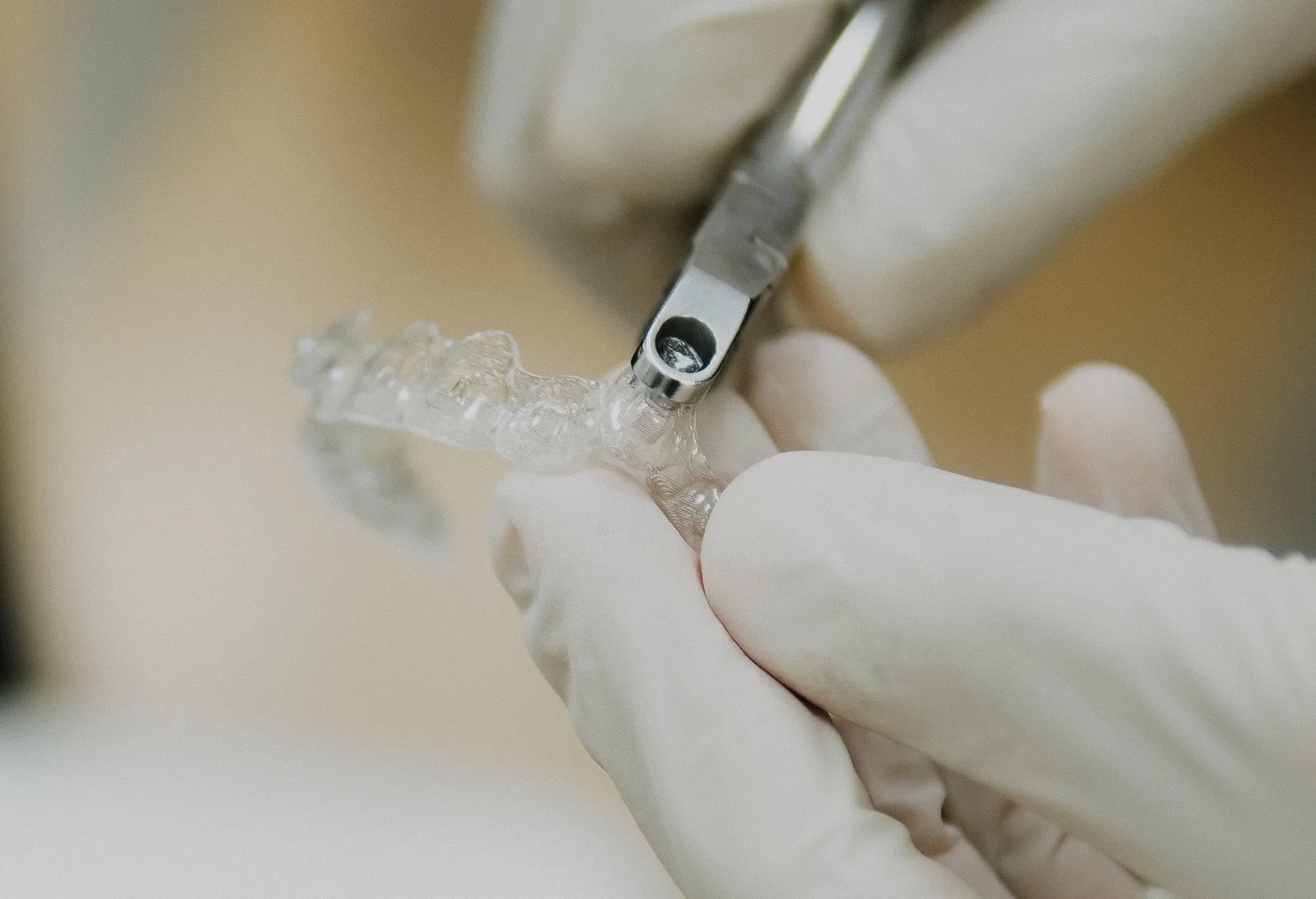
ClearCorrect and Invisalign are clear aligner systems from two different companies: ClearCorrect has been part of the Straumann Group since 2017, and Invisalign is made by Align Technology. No clinical study comparing patients treated with the two was found in PubMed, so the measured differences are laboratory ones. A systematic review of twelve studies found that straight, extended trimlines such as ClearCorrect's generally deliver higher forces and better retention than scalloped ones (PubMed 39707339), while staining studies point in both directions. For Invisalign itself, a prospective study of 38 patients measured a mean accuracy of 50% for all tooth movements (PubMed 32620479); the only comparable ClearCorrect study was written by company employees (PubMed 38766278).
- 01No randomised or comparative clinical study of ClearCorrect against Invisalign was found in PubMed; brand comparisons rest on laboratory work and on one comparison of virtual setups in 10 patients (PubMed 41128735).
- 02A systematic review of twelve studies found that straight, extended trimlines generally exert higher forces and moments and hold better than scalloped ones, with effects that vary by tooth movement (PubMed 39707339).
- 03An independent analysis confirmed ClearCorrect's three-layer structure (outer PETG/inner PU layers) and found its mechanical properties largely stable after two weeks of intraoral use, while transparency and surface changed (PubMed 39490325).
- 04Staining results conflict: a study of 704 samples found Invisalign coloured more than ClearCorrect in coffee and tea (PubMed 40596984), while a study of 40 specimens ranked ClearCorrect among the most susceptible (PubMed 41492584).
- 05In 38 Invisalign patients the mean accuracy for all tooth movements was 50% (PubMed 32620479); the only ClearCorrect predictability study is a pilot written by company employees (PubMed 38766278).
- 06An overview of 18 systematic reviews limits the evidence for aligners of any brand to mild to moderate malocclusions (PubMed 34993617).
/ The Two Companies Behind the Two Aligners
Who owns ClearCorrect is straightforward: ClearCorrect has been part of the Straumann Group since 2017, while Invisalign is made by Align Technology. Straumann described ClearCorrect aligners as being in use since 2006 and identified the group as a Basel-based implant manufacturer. Invisalign entered the US regulatory record earlier, with the FDA 510(k) database listing Align Technology's first ALIGN SYSTEM clearance, K981095, as substantially equivalent on 8 September 1998; the database also lists a further Invisalign System clearance, K252380, dated 29 August 2025. ClearCorrect's first FDA 510(k) clearance, K082556, is listed as substantially equivalent on 6 February 2009, and a later ClearCorrect System clearance, K220140, is dated 5 October 2022.
For a patient, the company history matters less than the treatment plan, yet it helps to separate ownership from performance claims. Both Invisalign and ClearCorrect appear in the FDA database under the same device classification name, Aligner, Sequential, with the same product code and regulation number, so the regulatory pathway itself does not rank one brand above the other. A Straumann media release also states that ClearCorrect and Align Technology settled a long-running patent dispute out of court on 28 March 2019; the same release says the litigation began before Straumann acquired ClearCorrect.
A disclosure is needed here. Mosdent provides Invisalign treatment, and Dr Ahmet Murat Artuç received Align Technology's award for the highest number of Invisalign treatments completed among corporate customers during 2025; that award measures case volume, not treatment outcomes. Straumann is also one of the implant systems Mosdent works with, which is relevant to the Straumann Group as a company and to Straumann implants, but it does not mean Mosdent provides ClearCorrect aligner treatment.
/ ClearQuartz and SmartTrack: What Each Plastic Is and How It Holds Force
How is ClearCorrect different from Invisalign begins with the plastic: ClearCorrect uses ClearQuartz, while Invisalign uses SmartTrack. The manufacturers describe both materials in favourable terms, but their pages do not provide a published side by side clinical comparison of the two plastics. ClearCorrect's manufacturer states that ClearQuartz is a tri-layer plastic that improves comfort and clarity while maintaining durability and applies one third less initial force; the same page's footnotes say those comparisons are data on file against ClearCorrect's older 0.030 single-layer material, not against Invisalign. Align Technology states that SmartTrack applies gentle, constant force, improves control of tooth movements and straightens teeth more predictably; the supporting footnote on that page includes a patient survey and an internal wear study in which Align reports no statistically significant difference between EX30 and SmartTrack.
Independent work gives a narrower answer. A laboratory analysis of ClearCorrect aligners retrieved after two weeks of intraoral use confirmed a three-layer structure with outer PETG and inner PU layers, and found only slight chemical alteration, no significant change in glass transition temperature and only a minimal change in storage modulus after use (PubMed 39490325). For SmartTrack, a survey of patients who changed material during ongoing Invisalign treatment found lower maximum pain ratings after the switch, while the authors added that clinical effectiveness still needed investigation (PubMed 27778051). A later retrospective study of adult Invisalign patients concluded that SmartTrack, with or without precision bite ramps, did not appear to open a deep bite more predictably than the earlier EX30 material (PubMed 35750579).
The broader material literature also cautions against reading plastic names as direct clinical promises. A systematic review found that only SmartTrack retrieval studies met its inclusion criteria; pooled retrieved aligners showed reduced indentation modulus and Martens hardness after use, read by the authors as reduced force delivery capacity, and they called for similar studies on other materials (PubMed 35090857). Reviews of aligner materials report deterioration with thermoforming and intraoral ageing across materials, and force decay early in wear is a recurring laboratory finding (PubMed 38017152; PubMed 42709287). A bench study of generic thermoforming sheets found lower forces from multi-layered materials than single-layered ones, but it did not include ClearQuartz or SmartTrack (PubMed 38637429). No published PubMed study was found that measures wall thickness, force delivery or stress relaxation of ClearCorrect and Invisalign aligners side by side.
/ ClearCorrect Reviews in Staining, Leachables and Cell Tests
ClearCorrect reviews that focus on staining and material response should be read as laboratory evidence, not as a simple brand verdict. The manufacturer states that ClearCorrect aligners are nearly invisible and more stain-resistant than other aligners on the market, without naming the compared aligners or citing a study on that page. Published staining studies do compare brands, yet they do not all point in the same direction. That is why a patient should treat colour claims as context for daily wear, food and drink habits, rather than as proof that one system will look unchanged in the mouth.
Two in vitro studies favoured ClearCorrect on staining against Invisalign. One study exposed specimens to instant coffee, red wine and black tea, and reported that coffee or red wine coloured Invisalign significantly more than ClearCorrect or Minor Tooth Movement aligners, while black tea stained all three brands after longer exposure (PubMed 32070379). Another in vitro study of four brands found greater colour differences for Invisalign than ClearCorrect after coffee and tea immersion, and identified Invisalign as polyurethane and ClearCorrect as polyester by infrared analysis (PubMed 40596984). A smaller in vitro study reached the opposite ranking, reporting that ClearCorrect and one other brand showed the greatest susceptibility to staining, while Invisalign showed moderate staining that did not depend on the beverage (PubMed 41492584). A systematic review of aligner ageing found coffee to produce the greatest pooled discolouration, with Invisalign consistently exceeding the clinically perceptible threshold (PubMed 42709287).
Material release and cell testing need the same restraint. The ClearCorrect retrieval analysis found that intraoral ageing mainly changed transparency and surface, with organic compounds and trace elements released at different levels from new and used aligners; the authors called for investigation of the health impact of long-term use (PubMed 39490325). An in vitro study that kept Invisalign, ClearCorrect and a thermoplastic retainer material in several drinks detected no measurable bisphenol A release (PubMed 40399894). A cell study of five aligner brands found the most pronounced cytotoxic effects for Invisalign and Spark across three cell lines, but this was a cultured-cell laboratory finding and the authors did not report clinical harm to patients (PubMed 40762314).
/ ClearCorrect vs Invisalign Trimline Design
ClearCorrect vs Invisalign is visibly different at the edge of the aligner: ClearCorrect is promoted with a high, flat trimline, while Invisalign is described by Align Technology as scalloped. ClearCorrect's manufacturer states that a high and flat trimline leads to more predictable results and that a smooth unscalloped line extending past the gingival margin is more retentive. The evidence cited for that claim is a single laboratory study on thermoformed aligners, not a clinical trial. Align Technology's provider page describes the Invisalign trimline as scalloped and offers doctors a choice between a standard scalloped trimline and a 1 mm extended scalloped trimline.
The independent literature supports the idea that edge shape changes mechanics, but it does not convert that into a brand outcome ranking. A systematic review of twelve studies found that straight and extended margins generally exerted higher forces and moments than scalloped or shorter designs and showed superior retention, while also stating that the effect varied with the tooth movement and that further research is needed before evidence-based guidelines can be written (PubMed 39707339). This is a useful finding for the orthodontist planning a movement, especially when retention of the aligner matters.
A finite element model gives a concrete example of the mechanical difference: flat trimline aligners generated a higher palatal root moment than scalloped designs for an upper central incisor, with values of 4.74 Ncm and 1.51 Ncm respectively (PubMed 41958447). That model also found that engagers did not consistently enhance root torque expression and often increased unwanted forces (PubMed 41958447). The gum-health question remains less settled. A scoping review of twenty-five studies on periodontal response during aligner treatment found that only three addressed edge design and only one directly compared edge configurations, so the periodontal relevance of trimline design is not established (PubMed 41892738).
/ Engagers and Attachments
Does ClearCorrect use attachments? Yes, ClearCorrect uses bonded tooth-coloured shapes, although the brand calls them engagers. The manufacturer states that its more retentive trim line can reduce the need for engagers, but that is a manufacturer claim tied to retention logic rather than a patient trial proving fewer appointments or better outcomes. Invisalign commonly uses attachments too, and the key point for a patient is that these shapes are planned for specific tooth movements. If one quote includes more attachments than another, it may reflect the software setup, the doctor's prescription and the chosen movement strategy rather than the brand name alone.
The evidence around attachments is more complicated than the marketing language suggests. A systematic review and meta-analysis of Invisalign studies found no significant difference in accuracy between optimised and conventional attachments for most movements; it reported pooled accuracy for canine derotation of 61.2 percent and 71.5 percent, and found that none of the attachments produced the movement predicted by the ClinCheck program (PubMed 40778386). This does not mean attachments have no role. It means the planned digital movement, the bonded shape and the biological tooth response do not match perfectly in every case.
The trimline literature also shows why attachments cannot be judged alone. In the finite element model of an upper central incisor, flat trimlines generated a higher palatal root moment than scalloped trimlines, while engagers did not consistently improve root torque expression and often increased unwanted forces (PubMed 41958447). For a patient, the practical question is not whether engagers or attachments appear on the teeth. The better question is whether the orthodontist can explain why each one is being placed, which movement it is meant to help, and how progress will be checked during treatment.
/ Clinical Evidence for Each System and the Missing Head-to-Head Trial
Is ClearCorrect as good as Invisalign cannot be answered with a patient trial directly comparing the two systems, because no randomised or comparative clinical study treating patients with ClearCorrect and Invisalign side by side was found in PubMed. Published brand comparisons are laboratory studies and one comparison of virtual setups. The absence of that trial means neither brand should be declared clinically superior on the basis of published evidence. A patient can still compare the planned movements, the number of aligners, refinements, attachments, wear instructions and the orthodontist's monitoring plan.
The virtual setup study is useful, with limits. When the records of ten patients were submitted with standardised prescriptions to Invisalign, ClearCorrect, 3M Clarity and Spark, the virtual setups differed significantly in the number of aligners and attachments; ClearCorrect prescribed the fewest of both, while the same study also reported deficiencies for ClearCorrect and Spark in planning a bilateral canine Class I relationship (PubMed 41128735). Fewer planned aligners or attachments in this kind of setup study should not be read as proof of shorter treatment, lower fee or better outcome.
System-specific clinical evidence exists, but it is uneven. The only ClearCorrect predictability study found in PubMed was a pilot study in Class I malocclusions, and all authors declared employment with ClearCorrect or the Straumann Group; it reported high success for several planned movements and low accuracy for upper-molar extrusion where little movement was planned (PubMed 38766278). A prospective Invisalign study of thirty-eight patients reported a mean movement accuracy of 50 percent, with higher accuracy for buccal-lingual crown tip and lower accuracy for rotation (PubMed 32620479). Across aligners as a treatment type, an overview of eighteen systematic reviews found clear aligners effective for mild to moderate malocclusions and associated with inferior outcomes in severe cases or for specific tooth movements (PubMed 34993617). A survey of adults in active aligner treatment, written by authors with Straumann Group employment or lecturing ties, reported pain patterns during aligner treatment, but the abstract did not name the aligner brand (PubMed 38679672).
/ ClearCorrect Aligners Cost and What Decides the Fee
Clear Correct aligners cost, written as ClearCorrect by the manufacturer, is decided more by the clinical plan than by the label on the plastic. The fee for aligner treatment follows the complexity of tooth movement, expected duration, number of aligners, attachments, refinement sets, scans, reviews, retention after active treatment and any preparatory dental work. No published cost comparison was found that proves ClearCorrect is cheaper or more expensive than Invisalign in a way a patient can apply to an individual treatment plan. If two quotes differ, ask for the same clinical details in both plans before comparing them.
Duration and refinements are major fee drivers because they change the amount of clinical work. In a study of Invisalign patients, treatment duration increased as the number of refinements increased, initial complexity was associated with duration, outcome and number of refinements, and no patient improved for the first time when refinements continued after three (PubMed 35868952). This is not a ClearCorrect price study, but it explains why a plan that looks similar at the start can become different once refinements are needed.
Wear instructions also affect whether the planned schedule is realistic. ClearCorrect tells patients to wear aligners twenty-two hours a day, while Align Technology tells Invisalign patients to wear each set for twenty to twenty-two hours a day and change to a new set every one to two weeks as directed by the doctor. The larger clinical boundary is the case type: clear aligners perform better in mild to moderate malocclusions than in severe cases or in certain difficult tooth movements (PubMed 34993617). Mosdent provides Invisalign treatment, so patients comparing that pathway can read more about Invisalign cost in Turkey, but the treatment decision should rest with the orthodontist who has examined the teeth, bite and periodontal condition.
Let’s plan the right treatment together.
Free Assessment→- 1.Bouchema T, Saunier J, Mauriello J, Tfayli A, Savard B, Yagoubi N. Chemical analysis and performance evaluation of ClearCorrect aligners as received and after intraoral use: Implications for durability, aesthetics, and patient safety. Dent Mater 2024;40(12):2135-2147.
- 2.Bräscher AK, Zuran D, Feldmann RE Jr, Benrath J. Patient survey on Invisalign treatment comparing the SmartTrack material to the previously used aligner material. J Orofac Orthop 2016;77(6):432-438.
- 3.Blundell HL, Weir T, Byrne G. Predictability of overbite control with the Invisalign appliance comparing SmartTrack with precision bite ramps to EX30. Am J Orthod Dentofacial Orthop 2022;162(2):e71-e81.
- 4.Bakdach WMM, Haiba M, Hadad R. Changes in surface morphology, chemical and mechanical properties of clear aligners during intraoral usage: A systematic review and meta-analysis. Int Orthod 2022;20(1):100610.
- 5.Srinivasan B, Padmanabhan S, Srinivasan S. Comparative evaluation of physical and mechanical properties of clear aligners - a systematic review. Evid Based Dent 2024;25(1):53.
- 6.Almotairy N, Aleisa F, Alshammari AK. Ageing effects on chemical, physical, mechanical, and morphological properties of clear aligners - a systematic review. Prog Orthod 2026;27(1):40.
- 7.Elshazly TM, Bourauel C, Ismail A, Ghoraba O, Aldesoki M, Salvatori D, et al. Effect of material composition and thickness of orthodontic aligners on the transmission and distribution of forces: an in vitro study. Clin Oral Investig 2024;28(5):258.
- 8.Bernard G, Rompré P, Tavares JR, Montpetit A. Colorimetric and spectrophotometric measurements of orthodontic thermoplastic aligners exposed to various staining sources and cleaning methods. Head Face Med 2020;16(1):2.
- 9.Kobkiatkawin C, Panyayong W, Suphangul S, Thiradilok S. Color stability of clear aligners exposed to various beverages: an in vitro study. BMC Oral Health 2025;25(1):971.
- 10.Narkhede S, Rao P, Sawant V, Kambli S, Garg N, Shah SP, et al. Comparative Assessment of Color Stability in Four Commercial Clear Aligner Materials Exposed to Common Beverages: An In Vitro Study. Cureus 2025;17(12):e98482.
- 11.Arslan Avan B, Bodur OC, Yildirim E, Osanmaz A, Tuncer C, Baloş Tuncer B. An in-vitro assessment of bisphenol a release from thermoplastic orthodontic appliances exposed to various beverages. BMC Oral Health 2025;25(1):750.
- 12.Nunes C, Mestre C, Fernandes IP, Serra M, Marto CM, Gonçalves AC, et al. Brand-Specific Differences in the Cytotoxicity of Clear Aligner Materials. Orthod Craniofac Res 2025; online ahead of print. doi: 10.1111/ocr.70009.
- 13.Nakornnoi T, Srirodjanakul W, Chintavalakorn R, Santiwong P, Sipiyaruk K. The biomechanical effects of clear aligner trimline designs and extensions on orthodontic tooth movement: a systematic review. BMC Oral Health 2024;24(1):1523.
- 14.Traversa F, Rossini G. Biomechanical Assessment of Root Torque in Clear Aligners: Impact of Trimline Design, Engagers, and Pressure Points With Palatal Compensation Movement. Orthod Craniofac Res 2026; online ahead of print. doi: 10.1111/ocr.70121.
- 15.Rusu EP, Lazăr AP, Erhan BL, Bud E, Păcurar M, Lazăr L. Clear Aligner Therapy and Marginal Edge Design: Clinical and Laboratory Evidence on Periodontal and Biological Outcomes-A Scoping Review. Dent J (Basel) 2026;14(3):130.
- 16.Muthuswamy Pandian S, Subramanian AK, Vaiid N. Comparison of efficacy and accuracy of tooth movements in optimized and conventional attachments of clear aligners - A systematic review and meta-analysis. J Oral Biol Craniofac Res 2025;15(5):1123-1133.
- 17.Telles V, Mattos CT, Copello F, Doughan MB. A pilot study comparing virtual treatment setups among clear aligner companies. Dental Press J Orthod 2025;30(3):e2524243.
- 18.Caldas W, Bonin FA, Piscinini JLM, Vianna CP, Shimizu RH, Trojan LC. Evaluation of the success of predicted dental changes with clear-aligner treatment: A pilot study. Saudi Dent J 2024;36(5):708-711.
- 19.Haouili N, Kravitz ND, Vaid NR, Ferguson DJ, Makki L. Has Invisalign improved? A prospective follow-up study on the efficacy of tooth movement with Invisalign. Am J Orthod Dentofacial Orthop 2020;158(3):420-425.
- 20.Yassir YA, Nabbat SA, McIntyre GT, Bearn DR. Clinical effectiveness of clear aligner treatment compared to fixed appliance treatment: an overview of systematic reviews. Clin Oral Investig 2022;26(3):2353-2370.
- 21.Caldas W, Bonin FA, Vianna CP, Shimizu RH, Trojan LC. Influence of pain duration and severity on oral health-related quality of life and patient satisfaction during adult treatment with clear aligners. Prog Orthod 2024;25(1):18.
- 22.Arqub SA, Banankhah S, Sharma R, Da Cunha Godoy L, Kuo CL, Ahmed M, et al. Association between initial complexity, frequency of refinements, treatment duration, and outcome in Invisalign orthodontic treatment. Am J Orthod Dentofacial Orthop 2022;162(3):e141-e155.
- 23.Straumann Group. Media release, 28 March 2019: ClearCorrect and Align Technology agree to settle long-standing patent dispute out of court (includes: ClearCorrect aligners since 2006, member of the Straumann Group since 2017).
- 24.ClearCorrect (Institut Straumann AG). About the aligners: ClearQuartz tri-layer material and trimline claims, with the manufacturer's own footnotes.
- 25.ClearCorrect (Institut Straumann AG). Easy to wear: stain resistance claim and 22 hours a day wear instruction.
- 26.ClearCorrect. ClearQuartz product brochure 480.530_en (trim line retention claim, engagers, comparison against the earlier single-layer .030 material).
- 27.Align Technology. Invisalign digital experience: SmartTrack material claims and the manufacturer's footnote on its internal wear study.
- 28.Align Technology. Align innovations, provider page: custom trimline option (standard or 1 mm extended scalloped trimline).
- 29.Align Technology. Invisalign frequently asked questions (daily wear time and aligner change interval).
- 30.US Food and Drug Administration. 510(k) Premarket Notification K981095, ALIGN SYSTEM, Align Technology, decision date 09/08/1998.
- 31.US Food and Drug Administration. 510(k) Premarket Notification K252380, Invisalign System, Align Technology, Inc., decision date 08/29/2025.
- 32.US Food and Drug Administration. 510(k) Premarket Notification K082556, CLEARCORRECT, Clearcorrect, Inc., decision date 02/06/2009.
- 33.US Food and Drug Administration. 510(k) Premarket Notification K220140, ClearCorrect System, Clearcorrect, LLC, decision date 10/05/2022.