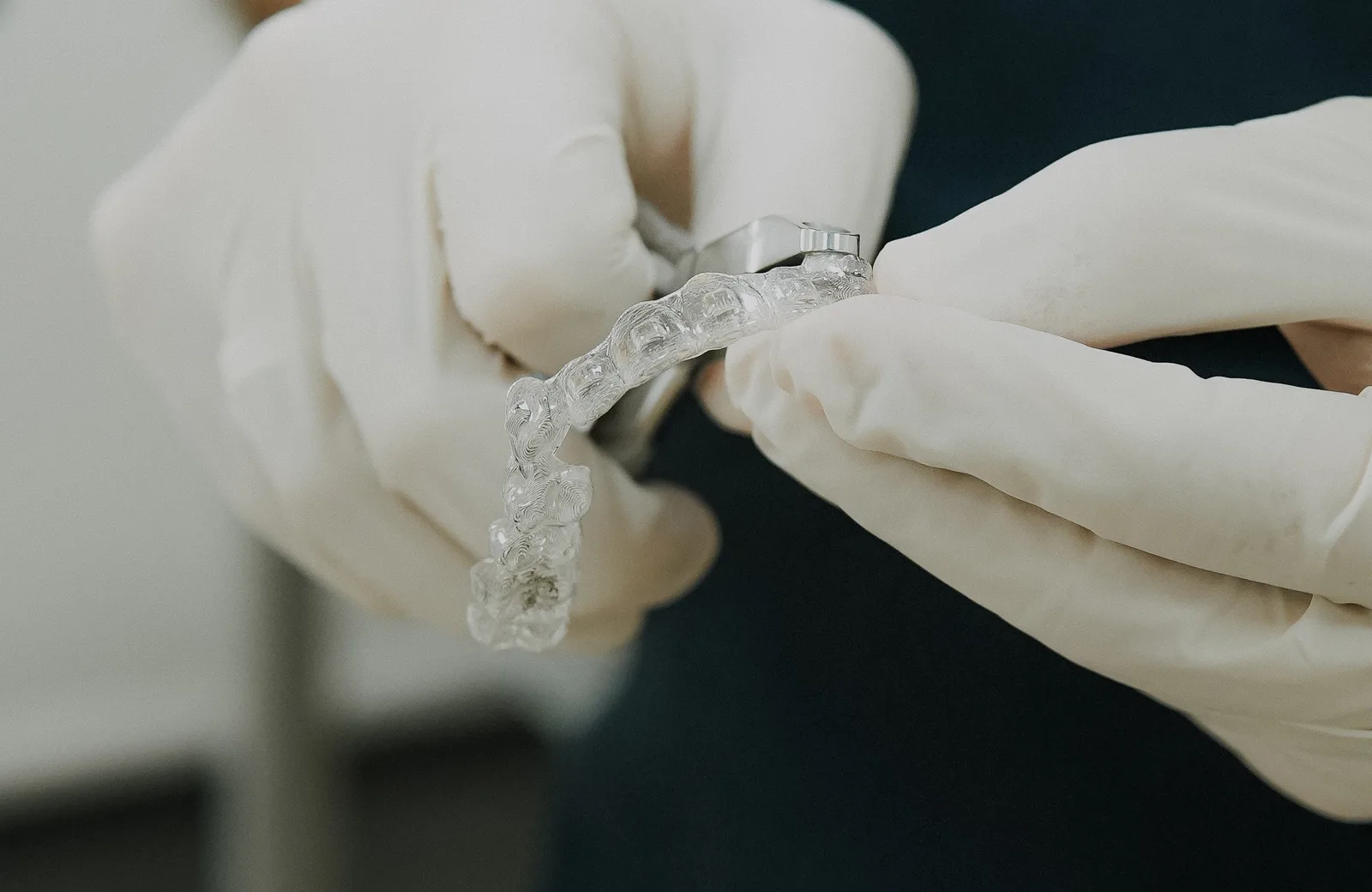
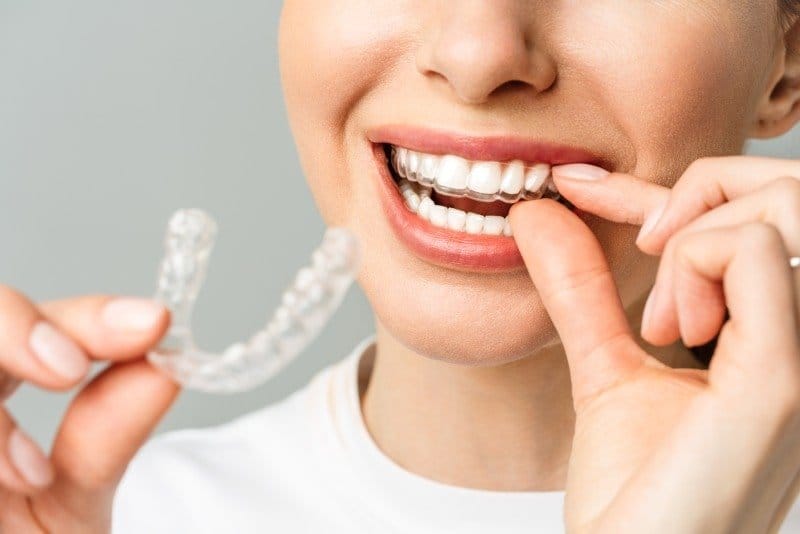
Nuvola is a clear aligner system made by G.E.O. S.r.l. (Gruppo Europeo di Ortodonzia) near Rome, registered in the European device database as a class I device and cleared by the United States regulator in 2022; Invisalign is made by Align Technology. No published clinical study compares the two brands directly. The studies that name Nuvola are small, for example a retrospective study of 39 adults in which the achieved torque of the front teeth did not differ significantly from the plan over a first phase of 12 aligners (PubMed 29607469). Most of the wider evidence on clear aligners comes from Invisalign: a scoping review of 119 accuracy studies warns that its estimates derive from Invisalign-focused research and should not be treated as universal benchmarks (PubMed 42516363).
- 01Nuvola is made by G.E.O. S.r.l. in San Cesareo, in the province of Rome; the manufacturer states that the laboratory was founded in 1995 and created the Nuvola system in 2000. It is listed in the European device database as a class I device and was cleared by the United States regulator under 510(k) K222418 in 2022.
- 02No published clinical study compares Nuvola with Invisalign. The only side by side study found is a laboratory micro-CT study of six brands fitted to one single resin cast, which found differences in thickness and fit between brands (PubMed 32390068).
- 03In a retrospective study of 39 adults treated with Nuvola, no statistically significant difference was found between predicted and achieved torque of the front teeth over a first phase of 12 aligners (PubMed 29607469).
- 04For the Nuvola OP System, a retrospective study of 100 patients reported the maximum upper arch expansion at the first molar level (2.35 ± 1.64 mm), and its authors asked for further studies to separate the effect of the aligners from that of the functional device (PubMed 35565146).
- 05Most evidence on clear aligners was generated on Invisalign: in a prospective study of 38 Invisalign patients the mean accuracy across all tooth movements was 50% (PubMed 32620479), and a scoping review of 119 studies warns against applying such figures as universal benchmarks (PubMed 42516363).
- 06With any brand, ask who plans and who supervises the treatment, how many refinement phases the plan includes and until what date, and what the retention plan is; the Cochrane review of 47 studies with 4377 participants notes that without retention teeth tend to return to their initial position (PubMed 37219527).
/ The companies behind Nuvola and Invisalign
Nuvola aligners are presented by their manufacturer as an Italian clear aligner system created by Centro GEO Ortodonzia, while Invisalign is made by Align Technology. The manufacturer states on its Italian company site that Centro GEO Ortodonzia was founded in 1995 in Rome as an orthodontic and prosthetic laboratory, and that in 2000 it created the Nuvola clear aligner system together with NuvolaWEB software for dentists. The company imprint names G.E.O. S.r.l., Gruppo Europeo di Ortodonzia, at Via del Progresso 14, 00030 San Cesareo, in the province of Rome, and the European Commission VAT validation service returns Gruppo Europeo di Ortodonzia S.r.l. at the same address for Italian VAT number 12441451007.
The international Nuvola site states that Nuvola is a Made in Italy product distributed by Nuvola World Srl with a contact address in Vicenza, Italy. The English language Nuvola site gives a United Kingdom address in Uckfield, East Sussex, and a United Kingdom telephone number for G.E.O. S.r.l. These details matter because they let a patient distinguish the manufacturer, the distributor and the local dental practice offering the treatment.
Align Technology states that it was founded in 1997 in Redwood City, California, introduced the Invisalign System in 1999, and that doctors in over 100 markets now use the system, with over 23 million patients treated. That scale makes Invisalign more visible, but visibility is not the same thing as a direct clinical comparison with Nuvola.
/ Nuvola aligners reviews are separate from device registrations
Nuvola aligners reviews should be separated from what device registers record, because registers answer whether a product and manufacturer are recorded, while reviews usually describe personal experience. The European database on medical devices lists Gruppo Europeo di Ortodonzia s.r.l. of San Cesareo as an active manufacturer with single registration number IT-MF-000031779. The same database lists Nuvola Aligner, trade name Nuvola, as a class I device under the Medical Device Regulation with the status on the market.
The United States Food and Drug Administration database records that the device Nuvola, submitted by Gruppo Europeo Ortodonzia Srl of Rome, was found substantially equivalent under 510(k) number K222418 on 7 October 2022 in the sequential aligner category, product code NXC. The same FDA category includes Align Technology's original aligner system, cleared under K981095 on 8 September 1998. This is a regulatory record, not a statement that two products perform the same in every clinical situation.
For a European patient, the practical check is more concrete. Under Regulation (EU) 2017/745, devices other than custom-made or investigational devices must bear the CE marking, and that marking must also appear in the instructions for use and on sales packaging (Regulation (EU) 2017/745, Article 20). Manufacturers of class I devices declare conformity themselves by issuing an EU declaration of conformity, so a patient in Europe can ask to see the CE marking on the aligner packaging and the manufacturer named on it (Regulation (EU) 2017/745, Article 52(7)).
/ Nuvola vs Invisalign in wear time, staging and planning
Nuvola vs Invisalign looks similar at the level of daily wear, but the manufacturers describe different staging and planning systems. The manufacturer states that Nuvola aligners are worn for at least 22 hours a day, removed for eating, brushing and flossing, and replaced every 10 to 14 days in the prescribed sequence. Align Technology states that each set of Invisalign aligners is worn for 20 to 22 hours a day and changed for a new set every 1 to 2 weeks as directed by the doctor.
Nuvola is described as a dentist-led system. The manufacturer states that the dentist uploads a digital scan of the arches to the NuvolaWeb platform, receives a free treatment plan proposal, reviews every phase in the NuvolaView 3D simulation, and the aligners are then manufactured and delivered to the dentist, who hands them to the patient. The manufacturer also states that Nuvola proceeds in treatment phases, each consisting of a series of 12 aligners for each dental arch, with reassessment at the end of each phase and a new set of 12 aligners if needed.
The manufacturer states that Nuvola treatments last on average between 9 and 18 months, depending on the severity of crowding, the movements requested by the dentist and above all patient cooperation. It lists indications including mild to severe crowding, diastemas, mild and moderate malocclusions, pre-prosthetic treatments and post-orthodontic relapses. The manufacturer describes Nuvola material under the names Evolution and Nuvola Essential, but its own pages do not publish test data for the listed material properties. Align Technology states that Invisalign aligners are made from a patented thermoplastic material called SmartTrack.
/ The Nuvola OP System and the Freedom device in manufacturer statements and studies
The Nuvola OP System is described by the manufacturer as an orthodontic protocol that combines aligner therapy with functional orthodontic therapy. The manufacturer states that it uses two tools, Nuvola Pro aligners and the Freedom myofunctional device. Nuvola Pro aligners are described as carrying lingual pins meant to direct the tongue towards the area behind the upper incisors and push areas designed for group movements.
The manufacturer states on its United Kingdom page that the Nuvola OP System reduces treatment time by 33% and chair time by 50%, and that it allows dentists to treat cases such as deep bite, open bite, crossbite and strong transverse discrepancies that would be difficult or unpredictable with aligners alone. No controlled study was found in PubMed that compares treatment time or outcomes with the Nuvola OP System against aligners used alone or against Invisalign, so that shorter-treatment statement has no published comparative test behind it.
Two retrospective studies report arch-width measurements with Nuvola OP. In one study, a morpho-functional corrector was used for 30 min/day alongside the aligners, and measurements from 100 patients showed a statistically significant increase in every upper arch width measured, with the maximum expansion at the first molar level, 2.35 ± 1.64 mm; 96% of patients who completed a questionnaire were satisfied, and the authors concluded that further studies are needed to separate the contribution of the aligners from that of the device (PubMed 35565146). In another retrospective study, 54 adult patients aged between 18 and 48 years treated with Nuvola OP aligners combined with an interceptive myofunctional device had an average treatment duration of 22.4 months, and the four arch width measurements increased by means of 2.1 mm, 2.37 mm, 1.0 mm and 3.67 mm; the abstract describes no comparison group treated with aligners alone or with another brand (PubMed 40150081).
/ Published studies that name Nuvola aligners
Nuvola aligners reviews in the scientific literature are limited to a small group of papers, not large side-by-side patient trials against Invisalign. A PubMed search for the brand name on 20 September 2026 returned seven records that name Nuvola in the title or abstract, made up of five clinical studies, all small and mostly retrospective, one laboratory study of aligner fit, and one commentary on a clinical study. That is useful documentation, but it is not the same as a broad comparative evidence base.
In a retrospective cohort study from the University of L'Aquila of 39 adult patients treated with Nuvola aligners, the study looked only at the first treatment phase of 12 aligners and found no statistically significant difference between the predicted and achieved torque movements of the front teeth (PubMed 29607469). In a University of Bari study of 35 patients treated with Nuvola aligners, transverse widening showed high adherence to the digital prescription when measured at the tips of the teeth, while measurements taken at the gum level showed a greater and statistically significant deviation from the plan (PubMed 37239039). A 2014 comparative study of two Italian aligner systems, Nuvola and Fantasmino, reported that the goal of treatment was achieved with both systems, that the size of the Nuvola aligner helped patient cooperation, and that difficulties were found with both systems in the correction of torque and rotations (PubMed 24934094).
The only published study found that examines Nuvola and Invisalign side by side is a laboratory study. Passive aligners of six brands, including Nuvola and Invisalign, were fitted to one single resin cast and scanned by micro-CT; the brands differed in thickness and in the gap between aligner and tooth, with the F22 aligner showing the lowest gap volume followed by Airnivol and Invisalign, and some authors declared that they contributed to the development of the F22 system (PubMed 32390068). No published clinical study was found in PubMed that compares treatment results of Nuvola and Invisalign in patients. No PubMed abstract was found that names Nuvola aligners in a study of colour stability, mechanical properties or periodontal indices; a separate in vitro staining study tested five other aligner types, Invisalign among them, and reported perceivable colour change after 14 days of immersion in red wine and coffee, with NBS values from 1.5 to 3, most marked for Invisalign, with NBS up to 35 (PubMed 35012036).
/ Comparing clear aligner providers by treatment duration and effectiveness
To compare clear aligner providers based on treatment duration and effectiveness, the published evidence supports cautious class-level conclusions rather than a winner between Nuvola and Invisalign. A 2026 scoping review of clear aligner movement accuracy included 119 studies, of which 70 were retrospective, 12 prospective and 4 randomised controlled trials, and its author cautioned that the accuracy estimates came from heterogeneous, Invisalign-focused research and should not be used as universal benchmarks (PubMed 42516363). That means figures generated mainly from Invisalign research should not be transferred automatically to Nuvola.
A systematic review of Invisalign clinical effectiveness included 3 randomised trials, 8 prospective and 11 retrospective studies. It found Invisalign to be a viable alternative to conventional treatment for mild to moderate malocclusions in non-growing patients treated without extractions, and found limited efficacy in arch expansion through bodily tooth movement, extraction space closure and larger vertical and front-to-back discrepancies (PubMed 30264270). This helps set expectations for clear aligners in selected cases, but it does not establish what Nuvola will do in a particular patient.
In a prospective clinical study of 38 patients treated with Invisalign, the mean accuracy across all tooth movements was 50%, with the highest accuracy for buccal-lingual crown tip, 56%, and the lowest for rotation, 46% (PubMed 32620479). The same 2026 scoping review reports, on the basis of limited studies, that refinements were required in over 50% of clear aligner cases and that 17.2% necessitated conversion to fixed appliances (PubMed 42516363). The practical message is to ask how your orthodontist will monitor tracking, refinements and possible change of appliance, whichever brand is proposed.
/ Checks before starting with clear aligner brands that are less familiar
When comparing clear aligner brands, a patient can lower uncertainty by checking the package, the manufacturer name, the treatment plan and the refinement policy before signing. In Europe, ask to see the CE marking on the aligner packaging and the manufacturer named on it, because the regulation requires the CE marking to appear on the device information and packaging (Regulation (EU) 2017/745, Article 20). Ask whether the treatment is being provided through a dentist-led workflow, because the Nuvola manufacturer states that the dentist uploads the scan, reviews the NuvolaView 3D simulation and receives the manufactured aligners to hand to the patient.
Ask how many aligners are planned and what happens if the teeth do not track as expected. The manufacturer states that Nuvola cases are ordered by the dentist in four levels by total number of aligners for dual arch treatment, with level A up to 14, level B up to 28, level C up to 48 and level PLUS over 48; it also states that 1, 2, 3 and 4 refinement phases respectively are included in the treatment cost charged to the dentist, and that each case has an expiry date after which aligners are no longer sent free of charge, at 1 year, 2 years, 2.5 years and 3 years from the first shipment date. In a study of 355 Invisalign patients, treatment duration increased with the number of refinements, most patients improved after the first refinement, and no patient improved further when refinements were continued after 3 (PubMed 35868952).
Ask about retention before the first aligner is delivered. The Nuvola manufacturer states that after orthodontic treatment it is advisable to wear removable retainers and that the dentist advises how and for how long. A Cochrane review of retention, including 47 studies with 4377 participants, states that without retention teeth tend to return to their initial position, although its evidence comparing retainer types was low to very low certainty and came from braces patients, because aligner studies were excluded (PubMed 37219527). The company's own pages do not publish a list of countries or clinics where Nuvola is provided; they show Italian, United Kingdom and international distributor pages, training events in Italy and the United States, and a contact form for finding a dentist, and no page naming a provider in Turkey was found. For a wider map of brands, see our guide to clear aligner brands, and for another comparison see Invisalign, Orthero and ClearCorrect compared. Disclosure: Mosdent, founded in 1992 and located in Bahcelievler, Istanbul, provides Invisalign treatment; its orthodontist Dr Ahmet Murat Artuç received the Align Technology award for the highest number of Invisalign treatments among corporate customers during 2025, an award that measures case volume and is not a ranking of treatment outcomes, and Nuvola does not appear among the treatments listed on the Mosdent site.
/ Clear aligners vs Invisalign price depends on case scope and refinements
Clear aligners vs Invisalign price depends mainly on case complexity, the number of aligners, treatment duration, refinements and the treating dentist's fee policy. The Nuvola manufacturer states that treatment cost can vary according to duration and the complexity of the tooth movements required, and that the fee a patient pays is set by the treating dentist, not published by the manufacturer. For that reason, a brand name alone is not enough to estimate the final fee.
Nuvola's own ordering structure shows why two clear aligner cases can be priced differently. The manufacturer states that Nuvola cases are ordered by total number of aligners for dual arch treatment, with level A up to 14, level B up to 28, level C up to 48 and level PLUS over 48, and that included refinement phases and expiry dates differ by level. A short case that tracks as planned is structurally different from a longer case that needs repeated reassessment and new aligners.
Duration is also tied to cooperation and movement difficulty. The manufacturer states that Nuvola treatments last on average between 9 and 18 months and that duration depends on the severity of crowding, the movements requested by the dentist and above all the cooperation of the patient. Evidence from Invisalign also shows why refinements matter economically and clinically, because in a study of 355 Invisalign patients, treatment duration increased with the number of refinements (PubMed 35868952). This article does not give price figures; if you need figures for one market, use the separate guide to Invisalign cost in Turkey.
Let’s plan the right treatment together.
Free Assessment→- 1.Ercoli F, Tepedino M, Parziale V, Luzi C. A comparative study of two different clear aligner systems. Prog Orthod 2014;15(1):31.
- 2.Tepedino M, Paoloni V, Cozza P, Chimenti C. Movement of anterior teeth using clear aligners: a three-dimensional, retrospective evaluation. Prog Orthod 2018;19(1):9.
- 3.Lombardo L, Palone M, Longo M, Arveda N, Nacucchi M, De Pascalis F, Spedicato GA, Siciliani G. MicroCT X-ray comparison of aligner gap and thickness of six brands of aligners: an in-vitro study. Prog Orthod 2020;21(1):12.
- 4.Perrotti G, Carrafiello A, Rossi O, Karanxha L, Baccaglione G, Del Fabbro M. Clinical Use of Aligners Associated with Nuvola OP System for Transverse Maxillary Deficiency: A Retrospective Study on 100 Patients. Int J Environ Res Public Health 2022;19(9):5751.
- 5.Inchingolo AM, Ceci S, Coloccia G, Azzollini D, Malcangi G, Mancini A, Inchingolo F, Trerotoli P, Dipalma G, Patano A. Predictability and Effectiveness of Nuvola Aligners in Dentoalveolar Transverse Changes: A Retrospective Study. Biomedicines 2023;11(5):1366.
- 6.Bucur SM, Moga RA, Olteanu CD, Bud ES, Vlasa A. A Retrospective Study Regarding the Efficacy of Nuvola OP Clear Aligners in Maxillary Arch Expansion in Adult Patients. Diagnostics (Basel) 2025;15(6):738.
- 7.Daniele V, Macera L, Taglieri G, Spera L, Marzo G, Quinzi V. Color Stability, Chemico-Physical and Optical Features of the Most Common PETG and PU Based Orthodontic Aligners for Clear Aligner Therapy. Polymers (Basel) 2021;14(1):14.
- 8.Borzabadi-Farahani A. Clear aligner therapy: a scoping review of treatment prediction, clinical effectiveness, and limitations. Front Dent Med 2026;7:1864529.
- 9.Papadimitriou A, Mousoulea S, Gkantidis N, Kloukos D. Clinical effectiveness of Invisalign orthodontic treatment: a systematic review. Prog Orthod 2018;19(1):37.
- 10.Haouili N, Kravitz ND, Vaid NR, Ferguson DJ, Makki L. Has Invisalign improved? A prospective follow-up study on the efficacy of tooth movement with Invisalign. Am J Orthod Dentofacial Orthop 2020;158(3):420-425.
- 11.Arqub SA, Banankhah S, Sharma R, Da Cunha Godoy L, Kuo CL, Ahmed M, Alfardan M, Uribe F. Association between initial complexity, frequency of refinements, treatment duration, and outcome in Invisalign orthodontic treatment. Am J Orthod Dentofacial Orthop 2022;162(3):e141-e155.
- 12.Martin C, Littlewood SJ, Millett DT, Doubleday B, Bearn D, Worthington HV, Limones A. Retention procedures for stabilising tooth position after treatment with orthodontic braces. Cochrane Database Syst Rev 2023;5(5):CD002283.