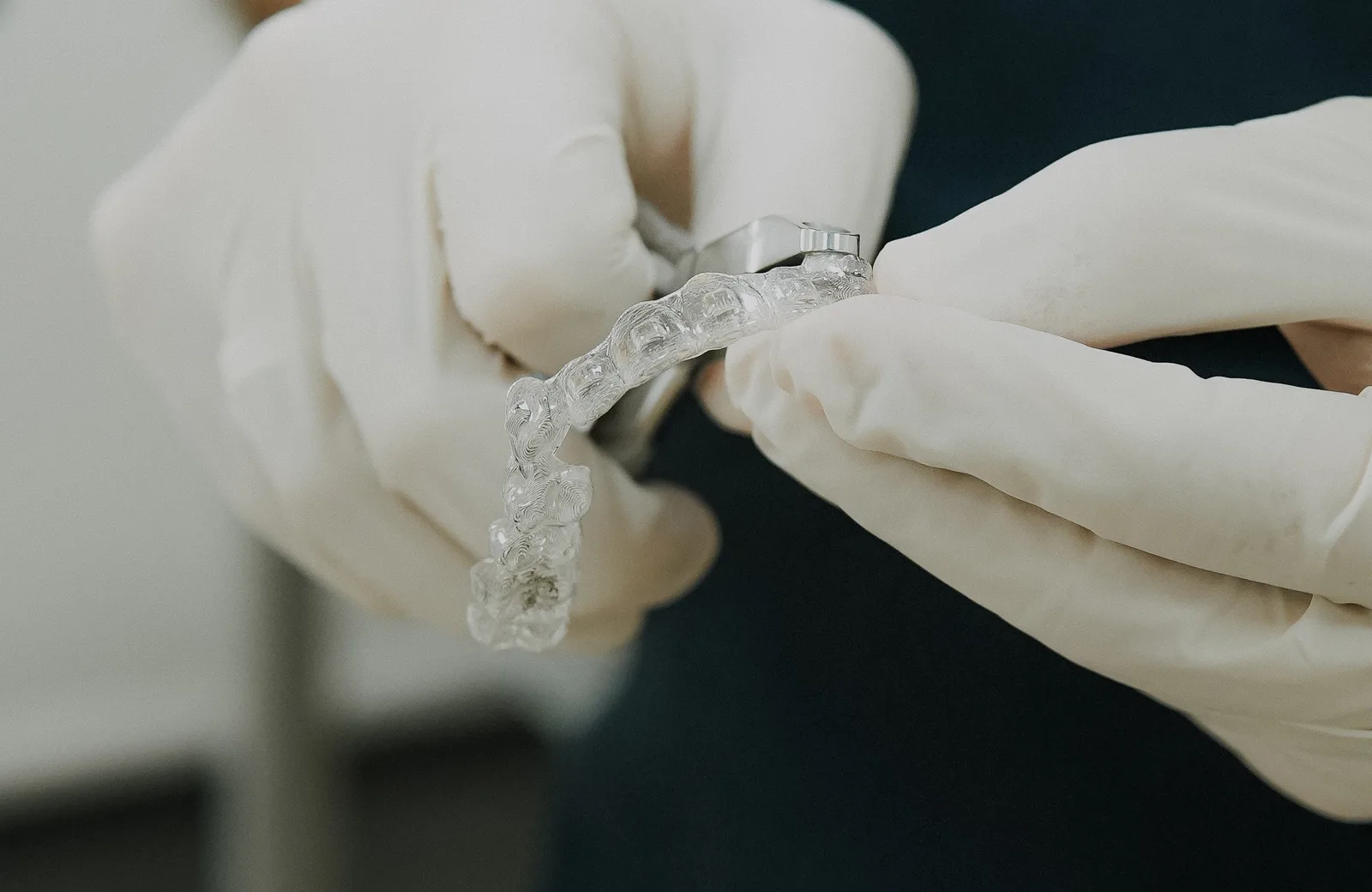
K Line Europe GmbH is a Düsseldorf manufacturer whose K Clear aligners hold a United States 510(k) record (K220726) and which now mainly produces aligners sold under other brand names. A few indexed studies name the system, but none measures how accurately it moves teeth or compares its results with Invisalign, so the two cannot be ranked on evidence. What is known applies to aligners as a class and was mostly measured on Invisalign: in a prospective study of 38 patients the mean accuracy for all tooth movements was 50% (PubMed 32620479). For a less documented brand, the things a patient can check are who made the aligners, who plans and supervises the case, and what happens when a refinement is needed.
- 01K Line Europe GmbH is registered in Düsseldorf (Amtsgericht Düsseldorf, HRB 73989) and states that it supplies only dental professionals and business clients, not patients (klinealigner.com, legal notice).
- 02The manufacturer now describes itself as a private-label producer, so aligners made by K Line can reach a patient under a different brand name (klinealigner.com, frequently asked questions).
- 03K Clear was found substantially equivalent by the United States Food and Drug Administration under 510(k) K220726 on March 16, 2022; a 510(k) does not compare clinical results with Invisalign (accessdata.fda.gov).
- 04Indexed studies that name K Line cover staining in the laboratory (PubMed 37560499; PubMed 39814781), gum health against braces in 40 healthy adults (PubMed 41141208) and bone height in 50 periodontally healthy adults (PubMed 40995244); none measures tooth-movement accuracy.
- 05Class-level evidence, generated on Invisalign: the mean accuracy for all tooth movements was 50%, with rotation lowest at 46% (PubMed 32620479).
- 06Refinements are the norm in aligner treatment: in a questionnaire answered by 188 orthodontists, at least one refinement was requested in 70.31% of cases (PubMed 40435056).
/ K Line Europe, K Clear and the private-label model
K Line aligners can refer to aligners made by K Line Europe, to the company's own K Clear brand, or to another brand that uses K Line as the manufacturer behind the scenes. According to its own legal notice, K Line Europe GmbH is a German limited liability company registered in Düsseldorf, with Dr Sherif Kandil named as managing director. The clinic publishing this article works with Invisalign in Istanbul and does not provide, plan or sell K Line or K Clear aligners.
The manufacturer's own timeline says K Line was established in Dortmund in 2014, opened its first production facility in Düsseldorf in 2015 and entered the clear aligner market in 2016. The same company timeline dates the launch of its private-label business model to 2020, and the chief executive writes that the company began with its own aligner brand before shifting focus to manufacturing aligners that doctors, entrepreneurs and dental groups sell under their own names.
That private-label point matters for patients. On its frequently asked questions page, the manufacturer describes itself as 100% B2B and as the engine behind a brand, not the name on the box. In practical terms, a patient may be offered aligners under a local clinic or brand name while K Line is the manufacturer.
K Clear is the company's own aligner brand. The company timeline reports that more than 2,000 doctors were prescribing K Clear aligners in 2018, and K Clear is also the trade name used in the company's United States regulatory clearance. The legal notice states that K Line Europe supplies products exclusively to dental professionals and business clients and does not sell directly to patients. For an adult comparing offers, that means the contract, follow-up and clinical responsibility sit with the treating dental professional, not with a direct-to-consumer purchase from the manufacturer.
/ Regulatory records that can be checked for K Line aligners Germany
K Line aligners Germany checks should focus on the legal manufacturer, the custom-made device statement, the ISO certificate, EUDAMED and the United States 510(k) record for K Clear. The manufacturer's legal notice states that it makes transparent dental aligners as Class IIa custom-made devices under Article 2 No. 3 of Regulation (EU) 2017/745, the Medical Device Regulation, and names the Bezirksregierung Düsseldorf as its supervisory authority. That route has a specific paperwork logic, so a missing CE mark on a custom-made aligner should not be read as a defect by itself.
Article 20 of Regulation (EU) 2017/745 requires the CE marking on devices other than custom-made or investigational devices, so a custom-made aligner does not carry a CE mark and no notified body number appears on it (Regulation (EU) 2017/745, Article 20). Under Article 21 and Annex XIII, a custom-made device must be accompanied by a statement made available to the patient; that statement names the manufacturer and all manufacturing sites, identifies the prescribing professional and declares conformity with the general requirements in Annex I (Regulation (EU) 2017/745, Article 21 and Annex XIII).
The manufacturer's legal notice lists an ISO 13485 certificate issued by QAS International, certificate number QAMD20220739, valid until 10.07.2028. The European Commission's EUDAMED database lists K Line Europe GmbH, Düsseldorf, as an active manufacturer with the single registration number DE-MF-000012846, registered on 7 September 2021; the public device module showed no device entries under that number on 20 September 2026, which is consistent with custom-made devices not being registered there individually.
For the United States, the Food and Drug Administration found K Clear substantially equivalent under 510(k) number K220726 on March 16, 2022, as a Class II prescription device indicated for the alignment of teeth in patients with permanent dentition. This is a clearance record, not a clinical trial against Invisalign. The manufacturer's current website describes production sites and private-label services, but it does not carry a public list of national distributors, so distribution in the Philippines or elsewhere in Asia could not be confirmed from a company-owned page.
/ Material and planning workflow as the two manufacturers describe them
K Clear aligners are described in regulatory and manufacturer material as removable clear aligners made from thermoplastic material and planned through a doctor-facing workflow. The 510(k) summary for K Clear describes the aligner material as a thermoplastic polyurethane-polyester composite resin and states that each aligner is worn for 20 to 22 hours a day, then replaced by the next aligner in the sequence as directed by the dental professional. The K Line USA website states that K Clear aligners use Zendura Flex multi-layered material and are available with a straight or scalloped trim line.
The manufacturer states that orthodontists lead its treatment planning, that software speeds the work up while human experts make the final call, and that the treating doctor can approve each plan, adjust it or hand the full case to the K Line team. For a patient, the point to check is who approves the plan in the case being offered locally and who monitors tracking, attachments, interproximal reduction and refinements.
Align Technology states that Invisalign aligners are made from its patented SmartTrack material and trimmed to follow each patient's gum line. Align Technology also states that each set of Invisalign aligners is worn for 20 to 22 hours a day and changed for a new set every 1 to 2 weeks, as directed by the doctor.
These manufacturer descriptions help compare workflow and wear instructions, but they do not prove that one brand moves teeth better in a given case. Material, trim line, software and planning support matter because they shape how treatment is delivered. The clinical result still depends on diagnosis, the planned movements, patient wear time and how the provider responds when teeth do not track as planned.
/ The published K Line aligners review literature and its limits
A K Line aligners review should separate studies that name the system from studies that measure tooth movement accuracy. The published studies located here that name K Line or K Clear cover staining, oral hygiene or bone height; they do not measure how accurately K Line or K Clear delivers planned movements against Invisalign. That makes the literature limited, but it is a statement about what has been measured, not a judgement that the product is inferior.
One in vitro study from India exposed aligners from 5 different companies, K Line among them, to tea, green tea, coffee, turmeric, saffron and Kashmiri red chili powder for 12 hours and 24 hours; it found statistically meaningful colour change with turmeric, saffron, Kashmiri red chili powder and coffee in decreasing order (PubMed 37560499). Another in vitro study immersed 48 aligners from four companies, Invisalign, EON, Clear Cap and K clear, in beverages for seven days and found that all stained, that cleaning agents reduced staining, and that there were minimal differences in discolouration across brands (PubMed 39814781).
A prospective clinical study of 40 healthy adults aged 18-30 years, whose full text names K Line Europe as the maker of the aligners used, compared fixed appliances with clear aligners and found a mean increase in plaque index after three months of 0.54±0.26 with fixed appliances versus 0.20±0.16 with aligners; it compared appliance types, not aligner brands (PubMed 41141208). A retrospective study of the panoramic radiographs of 50 periodontally healthy adults, whose full text names K Line Europe as the maker of the aligners used, found minimal but statistically significant changes in alveolar bone height after aligner treatment, the greatest being 0.31 mm in the mandibular anterior region; it had no comparison group (PubMed 40995244).
No PubMed-indexed study was found that measures how accurately K Line or K Clear aligners deliver planned tooth movements, how often they need refinement, or how their results compare with Invisalign or another brand. A systematic review of pain with aligners and fixed appliances included seven articles, reported its findings for Invisalign and stated that no evidence was identified for other brands of clear aligners (PubMed 31956934).
/ Class-level evidence for K Line vs Invisalign
K Line vs Invisalign cannot be answered by saying that Invisalign numbers automatically apply to K Line, because most measured predictability data come from Invisalign or from aligners as a class. The better reading is that clear aligners have documented strengths and limitations, and each brand needs its own clinical data for direct claims. A less widely known brand is not automatically less accurate, but the evidence has to be checked movement by movement.
In a prospective clinical study of 38 patients treated with Invisalign, the mean accuracy for all tooth movements was 50%, highest for buccal-lingual crown tip at 56% and lowest for rotation at 46% (PubMed 32620479). A systematic review of eleven studies found that extrusion was the most difficult movement to control with clear aligners, with 30% accuracy, followed by rotation, while upper molar distalisation showed the highest predictability at 88% when a bodily movement of at least 1.5 mm was prescribed (PubMed 25412265).
Intrusion data are also class-level, not K Line-specific. A systematic review of eight clinical studies of lower incisor intrusion with clear aligners reported predictability between 35% and 65%, with seven of the eight studies rated as having a serious risk of bias (PubMed 40944102).
The existence of brand differences is also documented. A retrospective comparison of Invisalign and Eon Aligner in 80 patient cases found that both systems achieved planned arch width changes, that Eon Aligner outperformed Invisalign in rotational accuracy, and that both showed poor predictability for vertical movements (PubMed 42041693). This is useful when reading any brand comparison, including clear aligner brands compared, because it shows why a familiar name and a lesser-known name still need movement-specific evidence.
/ Refinements and wear time in K Line aligners vs Invisalign
K Line aligners vs Invisalign decisions should include a plan for refinements and wear time, because every aligner system depends on whether teeth follow the digital plan. Refinement means that additional aligners may be planned after the first series, but studies and companies do not always define refinement in the same way. The patient-facing question is who pays for, approves and supervises extra aligners if tracking changes.
The K Line USA website states a refinement rate of 15.8%. The page gives no definition of refinement, no sample size and no time frame for the figure, and no published PubMed study reporting that figure was found. For that reason, the number should not be compared directly with questionnaire or clinical-study numbers from other aligner systems.
Class-level evidence gives context. In a questionnaire answered by 188 orthodontists, at least one refinement was requested in 70.31% of aligner cases and a second refinement in 21.95%, and refinements were requested more often by the more experienced clinicians (PubMed 40435056). In a study of 355 Invisalign patients, treatment duration increased with the number of refinements, most patients achieved improvement after the first refinement, and none improved further when refinements were continued after 3 (PubMed 35868952). A systematic review of twenty studies concluded that refinement after the first aligner series is multifactorial and linked to case complexity, extraction treatment and movements such as rotation and intrusion; it also found that studies define refinement in different ways (PubMed 42442043).
Wear time is another boundary. In a randomised clinical trial of 50 adult patients with very mild crowding treated with Invisalign, 12 hours a day aligned the upper teeth adequately, but correction of lower front tooth irregularity was significantly less efficient than with the 22 hour protocol (PubMed 41372110). A systematic review of 24 studies on removable orthodontic appliances concluded that compliance is suboptimal and that patients routinely overestimate wear time, although those studies covered removable appliances in general rather than aligners alone (PubMed 28651764).
/ A checklist for clear aligner brands with less public literature
Clear aligner brands with less public literature can still be assessed by documents, workflow and follow-up terms before treatment starts. Ask the provider to name the legal manufacturer, not just the clinic-facing brand. If the aligner is made by K Line under a private-label arrangement, the manufacturer itself says it can be the engine behind a brand without appearing as the name on the box.
For an EU custom-made aligner, ask for the custom-made device statement rather than looking for a CE mark on the aligner. Article 20 of Regulation (EU) 2017/745 sets out why custom-made devices do not carry the CE mark route, while Article 21 and Annex XIII describe the statement that must be made available to the patient (Regulation (EU) 2017/745, Article 20; Regulation (EU) 2017/745, Article 21 and Annex XIII). That statement should identify the manufacturer, manufacturing sites and prescribing professional.
Ask who designs the treatment plan and who signs it off. K Line states that orthodontists lead its treatment planning, that software speeds the work up and that the treating doctor can approve, adjust or hand the full case to the K Line team. The practical issue is whether your local dentist will review attachments, interproximal reduction, tracking and refinements in person or by another documented process.
Ask how refinements are defined in the offer, how many are included and what happens if treatment needs retention afterward. A systematic review of twenty studies found that refinement is affected by case complexity, extractions and movements such as rotation and intrusion, and that different studies define refinement differently (PubMed 42442043). Retention also needs a written plan, because a Cochrane review of retention covering 47 studies with 4377 participants states that without a retention phase teeth tend to return to their initial position, while the evidence comparing retainer types was low or very low certainty (PubMed 37219527). For a separate Orthero vs Invisalign article, see Invisalign, Orthero and ClearCorrect compared.
/ Factors that decide K Line aligners cost
K Line aligners cost should be judged by what is included in the clinical package rather than by the brand name alone. K Line Europe states that it supplies products exclusively to dental professionals and business clients and does not sell directly to patients, so the patient fee is set through the treating provider's diagnosis, plan and follow-up model. No price figures, currency amounts or country-specific fee claims are used here because the documented material available for this comparison does not support a patient-level price table.
The first cost factor is case complexity. More difficult movements, extractions, rotations, intrusion and longer tracking problems can add appointments, refinements and clinical time. A systematic review of twenty studies found that refinement after the first aligner series is linked to case complexity, extraction treatment and movements such as rotation and intrusion, and that refinement definitions differ across studies (PubMed 42442043).
The second factor is how much doctor time and chair time the case needs. In a study that matched 150 aligner patients to 150 patients with conventional braces treated by one orthodontist, aligner treatment needed fewer visits and less chair time but showed significantly greater total material costs and required significantly more total doctor time (PubMed 24749702). That study is about aligners as a treatment category, not K Line specifically, but it explains why two aligner quotes can differ even when both use clear trays.
The third factor is what happens after the last active aligner. Retention should be part of the offer, because teeth tend to return toward their initial position without a retention phase, although evidence comparing retainer types is low or very low certainty and comes from braces studies rather than aligner studies (PubMed 37219527). International patients comparing Istanbul with a local quote can use Invisalign cost in Turkey for a separate Invisalign-focused cost discussion, while asking any K Line provider for an itemised plan rather than a brand-only price.
Let’s plan the right treatment together.
Free Assessment→- 1.Venkatasubramanian P, Jerome MS, Ragunanthanan L, Maheshwari U, Vijayalakshmi D. Color stability of aligner materials on exposure to indigenous food products: An in-vitro study. J Dent Res Dent Clin Dent Prospects 2022;16(4):221-228.
- 2.Ajwa N, Radhi F, Aloraini R, AlSaydalani G. Comparative color stability assessment of orthodontic clear aligners: an in vitro study. Sci Rep 2025;15(1):2041.
- 3.Sen S, Wani MA, Kour J, Siddiqui S, Chatterjee S, Devi A, et al. Comparative Evaluation of Periodontal Pathogen Load and Health in Patients Treated With Fixed Orthodontic Appliances Versus Clear Aligners: A Prospective Clinical Study. Cureus 2025;17(9):e93016.
- 4.Pharande S, Parvesh P, Sharma R, Sawhney C, Bisht A, Gorchhia K, et al. Evaluation of Alveolar Bone Height Changes Following Clear Aligner Therapy: A Retrospective Analysis Using Orthopantomograms. Cureus 2025;17(8):e90858.
- 5.Cardoso PC, Espinosa DG, Mecenas P, Flores-Mir C, Normando D. Pain level between clear aligners and fixed appliances: a systematic review. Prog Orthod 2020;21(1):3.
- 6.Haouili N, Kravitz ND, Vaid NR, Ferguson DJ, Makki L. Has Invisalign improved? A prospective follow-up study on the efficacy of tooth movement with Invisalign. Am J Orthod Dentofacial Orthop 2020;158(3):420-425.
- 7.Rossini G, Parrini S, Castroflorio T, Deregibus A, Debernardi CL. Efficacy of clear aligners in controlling orthodontic tooth movement: a systematic review. Angle Orthod 2015;85(5):881-9.
- 8.Fracchia DE, Bignotti D, Lai S, Battista E, Verdecchia A, Spinas E. Predictability of Lower Incisor Intrusion with Clear Aligners: A Systematic Review of Efficacy and Influencing Factors. J Clin Med 2025;14(17):6339.
- 9.Algarni RA, Asiri SN, Al-Ani A. Treatment Predictability of Two Clear Aligner Systems: A Retrospective Assessment of Invisalign Versus Eon Aligner. Dent J (Basel) 2026;14(4):240.
- 10.Ladewig VM, Machado KON, Fernandes TMF, Almeida-Pedrin RR, Oltramari PVP, Almeida MR, et al. Does the need for refinement sets of orthodontic clear aligners correlate with professional experience? Dental Press J Orthod 2025;30(2):e2524248.
- 11.Arqub SA, Banankhah S, Sharma R, Da Cunha Godoy L, Kuo CL, Ahmed M, et al. Association between initial complexity, frequency of refinements, treatment duration, and outcome in Invisalign orthodontic treatment. Am J Orthod Dentofacial Orthop 2022;162(3):e141-e155.
- 12.Nogueira Matos K, Belline da Silva T, Matos de Faria Almeida L, de Faria Almeida M, Dos Santos Dantas Guimarães HH. Clinical, biomechanical, and digital factors associated with refinement after the first series of clear aligners: A systematic review. Int Orthod 2026;24(4):101211.
- 13.Fialho T, Angheben CZ, Ohira ETB, Cotrin P, Garib D, Prado E, et al. Evaluation of the effectiveness of orthodontic treatment with Invisalign in different wear time protocols: Randomized Clinical Trial. Eur J Orthod 2025;47(6):cjaf089.
- 14.Al-Moghrabi D, Salazar FC, Pandis N, Fleming PS. Compliance with removable orthodontic appliances and adjuncts: A systematic review and meta-analysis. Am J Orthod Dentofacial Orthop 2017;152(1):17-32.
- 15.Martin C, Littlewood SJ, Millett DT, Doubleday B, Bearn D, Worthington HV, et al. Retention procedures for stabilising tooth position after treatment with orthodontic braces. Cochrane Database Syst Rev 2023;5(5):CD002283.
- 16.Buschang PH, Shaw SG, Ross M, Crosby D, Campbell PM. Comparative time efficiency of aligner therapy and conventional edgewise braces. Angle Orthod 2014;84(3):391-6.
- 17.K Line Europe GmbH. Legal notice (registered office, commercial register number, MDR manufacturer statement, ISO 13485 certificate, business-to-business supply).
- 18.K Line Europe GmbH. About us: company timeline and chief executive's statement on the private-label model.
- 19.K Line Europe GmbH. Frequently asked questions (private-label, business-to-business model).
- 20.K Line Europe GmbH. Treatment plans (planning workflow as described by the manufacturer).
- 21.K Line USA. K Clear Aligners (material, trim line and refinement rate as stated on the site).
- 22.U.S. Food and Drug Administration. 510(k) K220726, K Clear, K Line Europe GmbH: decision letter, indications for use and 510(k) summary, March 16, 2022.
- 23.Regulation (EU) 2017/745 of the European Parliament and of the Council on medical devices: Article 2(3), Article 20, Article 21 and Annex XIII.
- 24.European Commission. EUDAMED actor registration, K Line Europe GmbH, single registration number DE-MF-000012846.
- 25.Align Technology. Invisalign frequently asked questions (company, SmartTrack material, daily wear time and aligner change interval).